


Description
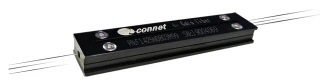
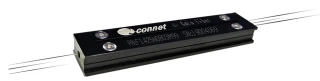
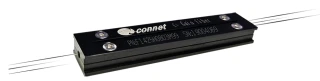
The Chirped Fiber Bragg Grating (FBG) is a specialized optical component designed to address the challenges of dispersion in long-distance fiber optic communication systems. Unlike standard FBGs, the chirped variant features a grating period that varies along its length, enabling it to reflect different wavelengths of light at distinct positions within the grating. This unique structure introduces controlled optical path differences for various wavelengths, making it highly effective for dispersion compensation and signal management in advanced photonic networks.
Chirped FBGs are widely utilized in applications such as Erbium-Doped Fiber Amplifier (EDFA) gain flattening, dispersion compensation modules, and amplified spontaneous emission (ASE) filtering for noise suppression. Their ability to act as wideband rejection filters in Wavelength Division Multiplexing (WDM) systems, particularly in the 1300 nm and 1550 nm bands, makes them indispensable in modern telecommunications infrastructure. The broad bandwidth and high reflectivity of these gratings ensure efficient performance across a range of wavelengths, while their low insertion loss preserves signal integrity.
Constructed using robust fiber types like SMF-28 or compatible alternatives, Chirped FBGs are engineered for durability and reliability in demanding environments. They can be customized with various recoating materials such as acrylate or polyimide to enhance environmental resistance, and are available with different optical connectors or as bare fiber to suit diverse installation requirements. With precise wavelength control, high tensile strength, and flexible pigtail lengths, Chirped FBGs offer a versatile solution for both laboratory research and large-scale network deployments.
Chirped Fiber Bragg Grating FBG for Dispersion Compensation and Filtering
Specifications
| Center Wavelength Range: | 1550 – 1650 nm |
|---|---|
| FBG Length: | Not Specified |
| Reflectivity: | 30 - 99% |
| Center Wavelength: | 1064, 1530, 1550, 1575, 1590, 1625, 1650 nm |
| Wavelength Tolerance: | +/-0.25 nm |
| Reflectivity: | 10~99 % |
| Bandwidth (FWHM): | 10 (1-15) nm |
| SLSR: | >10 dB |
| Insertion Loss: | <0.5 dB |
| FBG Recoating: | None, Acrylate, Polyimide, or Custom |
| Tensile Strength: | >100 kpsi |
| Fiber Type: | SMF-28 or Compatible |
| Pigtail Length: | 1 m (Typical), or Custom |
| Optical Connector: | Bare Fiber, FC/APC, SC/APC, or Custom |
Got questions about specs? Use the inquiry form to ask.
 Download Data Sheet

Features
- Wide Bandwidth: Supports broad spectral ranges, ideal for advanced optical applications.
- Low Insertion Loss: Ensures minimal signal attenuation for high-performance fiber optic systems.
- High Reflectivity: Customizable reflectivity from 10% to 99% for precise application requirements.
- Chirped Grating Design: Varying grating period enables effective dispersion compensation in long-distance fiber communications.
- Multiple Center Wavelengths: Available at 1064, 1530, 1550, 1575, 1590, 1625, and 1650 nm for versatile system integration.
- Excellent Wavelength Tolerance: Tight wavelength tolerance of ±0.25 nm for reliable performance.
- Superior Side Lobe Suppression Ratio (SLSR): Greater than 10 dB, reducing noise and crosstalk.
- High Tensile Strength: Withstands >100 kpsi, ensuring durability and reliability in demanding environments.
- Flexible Recoating Options: Choose from None, Acrylate, Polyimide, or custom recoating to suit your application.
- Customizable Pigtail Lengths: Standard 1 meter or tailored to your specifications.
- Connector Versatility: Available as bare fiber, FC/APC, SC/APC, or custom connectors for seamless integration.
- Compatible Fiber Types: Built on SMF-28 or compatible fibers for industry-standard connectivity.
- Quality Assurance: Manufactured to rigorous standards for consistent, high-quality performance.
Applications
- EDFA Gain Flattening Filter: Chirped Fiber Bragg Gratings (FBGs) are widely used in Erbium-Doped Fiber Amplifiers (EDFA) to equalize the gain spectrum, ensuring uniform amplification across multiple channels in dense wavelength division multiplexing (DWDM) systems.
- Dispersion Compensation: Chirped FBGs are essential for compensating chromatic dispersion in long-haul optical fiber communication systems, improving signal integrity and transmission distance.
- ASE Filtering and Noise Suppression: Used as filters to suppress amplified spontaneous emission (ASE) noise in optical amplifiers, enhancing the signal-to-noise ratio and overall system performance.
- WDM Band Rejection Filtering: Ideal for wavelength division multiplexing (WDM) systems, Chirped FBGs act as band rejection filters at 1300 nm and 1550 nm, selectively blocking unwanted wavelength bands.
- Optical Pulse Shaping: Employed in ultrafast optics and laser systems to shape and compress optical pulses by introducing controlled dispersion.
- Fiber Laser Linewidth Narrowing: Used in fiber lasers to stabilize and narrow the emission linewidth, improving coherence and spectral purity.
- Sensor Interrogation Systems: Chirped FBGs are used in distributed sensing applications, such as strain, temperature, and pressure monitoring in civil engineering, aerospace, and energy sectors.
- Optical Coherence Tomography (OCT): Utilized in medical imaging systems to manage dispersion and improve axial resolution in OCT setups.
- Chromatic Dispersion Monitoring: Integrated into optical networks for real-time monitoring and management of chromatic dispersion, ensuring optimal network performance.
- Laser Cavity Dispersion Management: Applied in laser cavities to control dispersion, enabling stable mode-locking and pulse generation.
Frequently Asked Questions
What is a Chirped Fiber Bragg Grating (Chirped FBG)?
What are the main applications of Chirped FBGs?
How does a Chirped FBG provide dispersion compensation?
What are the available center wavelengths for ATGrating Chirped FBGs?
What are the key features of ATGrating Chirped FBGs?
What fiber types and connector options are supported?
Can the pigtail length and recoating be customized?
Got more questions? Use the inquiry form to ask the supplier directly.
Similar Products


Your inquiry has been received.
Create an account by adding a password
Why create an account?
- Auto-complete inquiry forms
- View and manage all your past messages
- Save products to your favorites
- Close your account anytime — no hassle