
Description
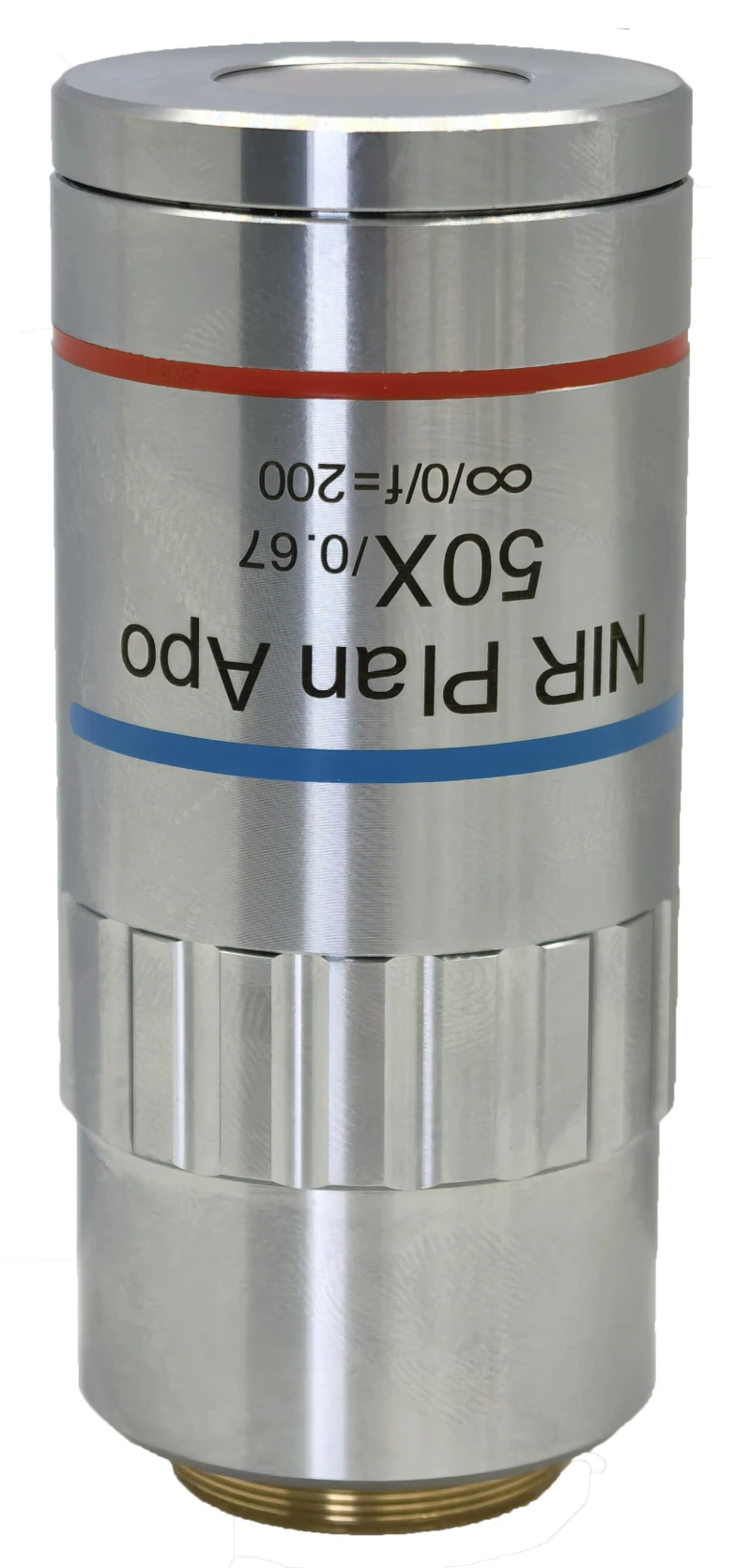
Visible and NIR laser processing objective lenses are designed for high-precision laser machining, laser micromachining, semiconductor processing, and advanced optical inspection applications requiring exceptional focusing performance across visible and near-infrared wavelengths.
These infinity-corrected objective lenses combine high numerical aperture (NA), long working distance, and advanced aberration correction to support femtosecond lasers, Nd:YAG lasers, and other precision laser processing systems. Optimized for coaxial imaging and laser beam delivery, the objectives enable accurate laser focusing and real-time observation of the processing area during cutting, drilling, welding, marking, and microfabrication operations.
The objective lenses are ideal for laser processing systems operating at visible and NIR wavelengths, including 532 nm and 1064 nm laser platforms commonly used in industrial manufacturing, semiconductor inspection, biomedical imaging, materials research, and precision optical metrology.
The objective lens is also compatible with visible pulsed lasers such as 532 nm sources. The laser damage threshold is:
0.1 J/cm² at 532 nm
0.2 J/cm² at 1064 nm
(measured at a pulse width of 10 ns and repetition rate of 20 Hz).
Benefits of Infinity-Corrected Objective Lenses in Laser Processing
Infinity-corrected objective lenses project collimated light between the objective and tube lens, allowing additional optical components such as filters, beam splitters, scanners, and imaging systems to be integrated without significantly affecting image quality.
In laser processing applications, infinity-corrected optics provide greater system flexibility, improved aberration correction, and easier integration of coaxial imaging and beam delivery components. This architecture is widely used in advanced laser micromachining, semiconductor inspection, and optical metrology systems.
Infinity-Corrected Visible and NIR Objective Lenses for Laser Processing
Specifications
| Magnification: | 50 |
|---|---|
| Numerical Aperture: | 0.67 |
| Focal Length: | 4 mm |
| Working Distance: | 10 mm |
| Design Type: | Air Immersion |
| Wavelength Range: | Visible, Near Infrared |
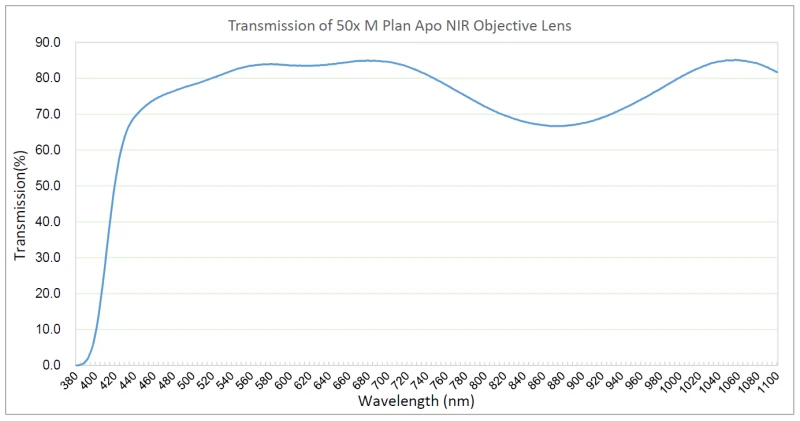
| Wavelength: | 430 - 660 nm and 1064nm |
| Object Side Resolution: | 0.41 um |
| Parfocal Distance: | 95 mm |
| Depth Of Field: | 0.61 um |
| Compatible Tube Lens Focal Length: | 200 mm |
| Compatible Cover Glass Thickness: | 0.7 mm |
| Weight: | 509g |
| Manufacturer Part Number (MPN): | OBJ-50X0.67-NIR-W26-WD10 |
| FindLight SKU: | FL-24364 |
Got questions about specs? Use the inquiry form to ask.
 Download Data Sheet

Features
- Infinity Corrected
- Flat Field
- Apochromatic
- Both VIS and NIR optimized,
- VIS+NIR Broadband AR coating
- High Transmission at both VIS and NIR
- High laser damaged threshold
- Large NA
Applications
Visible and NIR laser processing objective lenses are widely used in laser micromachining, semiconductor manufacturing, biomedical imaging, precision metrology, additive manufacturing, and industrial materials processing applications.
Their high numerical aperture, long working distance, and coaxial imaging capability make them ideal for laser drilling, laser cutting, welding, surface structuring, laser marking, and microfabrication systems operating with femtosecond, picosecond, and Nd:YAG laser sources.
These objective lenses are also commonly integrated into semiconductor inspection platforms, machine vision systems, optical research instruments, and precision laser alignment setups where accurate beam focusing and real-time imaging are required.
Export & Trade Information
| ECCN: | EAR99 |
|---|---|
| HTS Code: | 9002.19.00 |
| Estimated US Tariff: | 25% |
Frequently Asked Questions
What are visible and NIR laser processing objective lenses?
What wavelengths do NIR objective lenses support?
What is an infinity-corrected objective lens?
Why is high numerical aperture important for laser processing?
Can microscope objectives be used for laser focusing?
What are coaxial imaging objective lenses?
What applications use NIR laser processing optics?
What is the advantage of long working distance objectives?
Are these objectives compatible with femtosecond lasers?
What is the difference between standard microscope objectives and laser processing objectives?
Got more questions? Use the RFQ form to ask the supplier directly.
Similar Products
Need pricing for this product? Send a quick inquiry
Your inquiry has been received.
Create an account by adding a password
Why create an account?
- Auto-complete inquiry forms
- View and manage all your past messages
- Save products to your favorites
- Close your account anytime — no hassle