


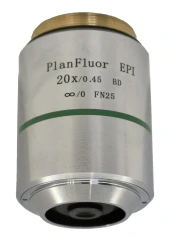

Description
This brightfield and darkfield microscope objective lens is designed for high-resolution imaging, precision optical inspection, and advanced microscopy applications. Featuring an infinity-corrected apochromatic optical design with high numerical aperture (NA), the objective delivers diffraction-limited performance across the visible spectrum while minimizing chromatic and spherical aberrations.
Optimized for both brightfield and darkfield illumination configurations, the objective enables high-contrast imaging of fine surface details, defects, edges, and microstructures. Its long working distance and W26×0.706 thread make it ideal for integration into industrial microscopy systems, machine vision platforms, laser focusing systems, semiconductor inspection setups, and scientific imaging applications.
The lens supports coaxial observation and precision visible laser focusing, making it particularly suitable for metrology, laser processing alignment, electronics inspection, biomedical imaging, and precision manufacturing environments.
Key technical features include:
- High numerical aperture (NA) for high-resolution imaging and fine detail capture
-
Ideal for Brightfield and Darkfield Microscopy Applications
- Chromatic aberration correction for accurate color reproduction and minimized color fringing
- Plan Apochromat Design
- Standard RMS threading for compatibility with conventional microscopes and optical mounts
These objective lenses are ideal for applications in microscopy, machine vision, laser systems, and precision optical inspection where superior resolution and image quality are critical.
Benefits of Darkfield Microscopy for Precision Inspection
Darkfield microscopy enhances the visibility of edges, particles, defects, and surface irregularities by illuminating the sample with oblique light that does not directly enter the objective lens. Only scattered light from the specimen is collected, producing high-contrast images against a dark background.
This imaging technique is widely used in semiconductor inspection, materials science, precision manufacturing, and biological imaging because it reveals fine details that may remain invisible under standard brightfield illumination.
Infinity-Corrected Brightfield and Darkfield Microscope 20x Objective Lens
Specifications
| Magnification: | 20 |
|---|---|
| Numerical Aperture: | 0.45 |
| Focal Length: | 10 mm |
| Working Distance: | 3 mm |
| Design Type: | Air Immersion |
| Wavelength Range: | Visible |
| Wavelength: | 430-660 nm |
| Object Side Resolution: | 0.61um |
| Parfocal Distance: | 45 mm |
| Depth Of Field: | 1.36 um |
| Compatible Tube Lens Focal Length: | 200 mm |
| Mount: | W26×0.706 |
| Weight: | 137 g |
| Manufacturer Part Number (MPN): | OBJ-20X0.45-W26-WD3 |
| FindLight SKU: | FL-24365 |
Got questions about specs? Use the inquiry form to ask.
 Download Data Sheet

Features
- High numerical aperture (NA)
- High-resolution with diffraction-limited performance
- Plan Field
- Apochromatic aberration correction
- Accurate color reproduction
- Ideal for Brightfield and Darkfield Microscopy Applications
Applications
Brightfield and darkfield microscope objective lenses are widely used in industrial inspection, semiconductor metrology, machine vision, biomedical imaging, and laser processing systems where high contrast and high-resolution imaging are required.
Darkfield microscopy is particularly effective for detecting surface defects, scratches, contamination, edge features, and fine microstructures that are difficult to observe under conventional brightfield illumination.
These objective lenses are also commonly integrated into precision optical inspection systems, laser alignment platforms, electronics manufacturing equipment, and scientific imaging instruments.
Export & Trade Information
| ECCN: | EAR99 |
|---|---|
| HTS Code: | 9002.19.00 |
| Estimated US Tariff: | 25% |
Frequently Asked Questions
What is a darkfield microscope objective lens?
What is the difference between brightfield and darkfield microscopy?
What are infinity-corrected microscope objectives?
Why is high numerical aperture important in microscopy?
What applications use darkfield microscope objectives?
Can microscope objectives be used for laser focusing?
What is an apochromatic microscope objective?
Got more questions? Use the inquiry form to ask the supplier directly.
Similar Products
Your inquiry has been received.
Create an account by adding a password
Why create an account?
- Auto-complete inquiry forms
- View and manage all your past messages
- Save products to your favorites
- Close your account anytime — no hassle