
Description
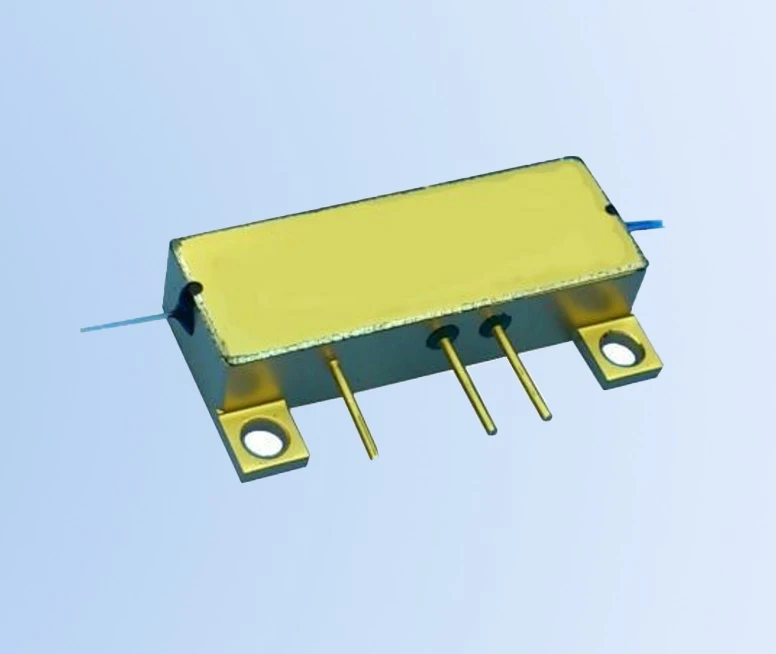
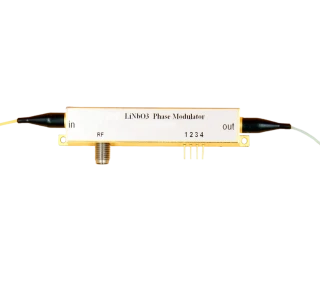
The R-MIOC Series Y-Waveguide Modulator is a highly integrated lithium niobate (LiNbO3) multifunction optical circuit engineered for demanding fiber-optic sensing and interferometric applications. Based on mature microelectronic fabrication technology, this integrated LiNbO3 modulator combines polarizer/analyzer, beam splitting and combining, and phase modulation functions on a single chip. It is designed to offer excellent optical performance, long-term stability, and compactness, making it suitable for next-generation fiber optic gyroscopes (FOG), fiber optic current sensors (FOCS), hydrophones, and other precision fiber sensing systems.
At the core of the device is an X-cut LiNbO3 substrate with annealed proton-exchanged (APE) waveguides that deliver low insertion loss and a high polarization extinction ratio. Push–pull electrodes are integrated directly on the chip to realize efficient electro-optic phase modulation with low half-wave voltage. This enables precise, linear modulation of the optical phase at relatively low drive voltages, helping reduce power consumption and simplify the associated driving electronics. The typical operating wavelength windows cover 1290–1330 nm and 1530–1570 nm, making the modulator compatible with standard telecom and sensing bands.
The R-MIOC Series modulator maintains an insertion loss of ≤3.5 dB with a full-temperature insertion loss variation of ≤0.5 dB, ensuring stable performance under changing environmental conditions. A nominal 50:50 coupling ratio (50% ± 2%) provides balanced splitting and combining, which is critical for interferometric measurement accuracy in closed-loop FOG systems and other high-precision phase-sensitive setups. The device also features very low residual intensity modulation (≤1/1000), which helps minimize parasitic amplitude noise and enhances measurement resolution. Back reflection is strongly suppressed (≤ -55 dB), reducing feedback into upstream laser sources and improving overall system stability.
Polarization handling is a key aspect of the R-MIOC design. The APE waveguide structure and polarization-maintaining (PM) fiber pigtails ensure high polarization extinction and low cross talk, even under thermal stress. Typical ambient pigtail polarization crosstalk is better than -30 dB, with full-temperature crosstalk maintained at ≤ -25 dB. This high polarization purity is especially important in interferometric gyroscopes and current sensors, where polarization fluctuations can directly translate into measurement error or bias drift. By tightly controlling polarization behavior, the device supports long-term, low-drift system operation in field environments.
Electrically, the modulator is optimized for low driving voltage and stable, predictable modulation characteristics. The half-wave voltage (Vπ) is typically ≤3.5 V in the 1310 nm band and ≤4.0 V in the 1550 nm band, reducing the burden on the modulation driver circuitry. The waveform slope is specified at ≤1/250, contributing to a clean and repeatable transfer function beneficial for closed-loop control systems. With a modulation bandwidth of ≥300 MHz, the R-MIOC Series supports high-speed modulation schemes and fast interrogation techniques often required in modern fiber-optic sensing and navigation systems.
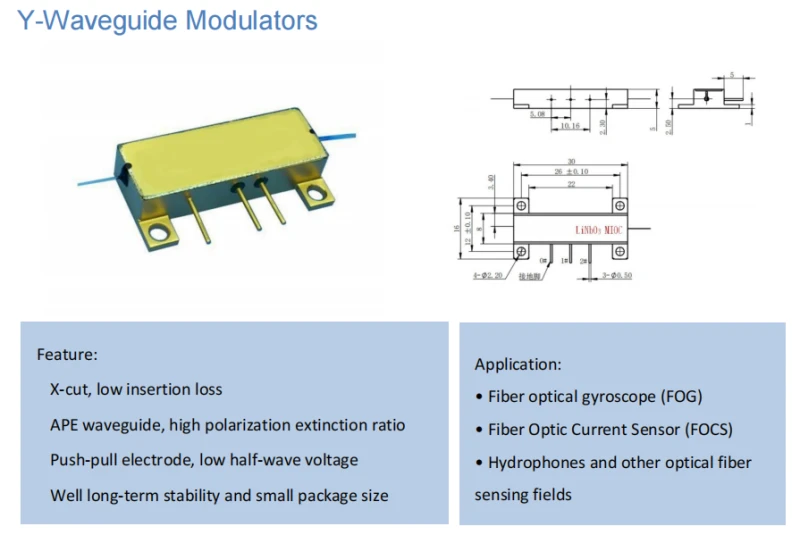
For ruggedness and reliability, the LiNbO3 chip, integrated waveguides, and electrodes are hermetically packaged inside a gold-plated Kovar or ceramic housing. This packaging approach delivers robust protection against mechanical shock, vibration, and environmental contaminants, while maintaining excellent thermal stability. The typical device dimensions (excluding pins) are 30 × 8 × 5 mm, offering a compact footprint that facilitates integration into densely packed optical modules and inertial navigation units. The PM fiber pigtails feature a small mode field diameter (~6.0 μm class) and standard lengths of ≥1.0 m or ≥1.2 m, supporting flexible routing within system enclosures.
The R-MIOC Series is engineered for extended environmental performance, with an operational temperature range of -45 °C to +70 °C and a storage temperature range of -55 °C to +85 °C. This wide temperature tolerance makes the modulator suitable for aerospace, marine, and industrial environments where systems may experience significant thermal cycling. Stable insertion loss, coupling ratio, and polarization characteristics across the full temperature range help reduce the need for active thermal control and calibration, thus simplifying overall system design.
To match diverse system architectures, the series supports multiple wavelength options, input/output fiber configurations, and connector interfaces. Typical configurations include 1310 nm or 1550 nm operation, PM/PM fiber pigtails, and connectorized or non-connectorized ends (for example, FC/PC, FC/APC, or bare fiber).
Y-Waveguide LiNbO3 Integrated Optical Modulator
Specifications
| Aperture Diameter: | Not Specified |
|---|---|
| Peak Optical Power Density: | Not Specified |
| Wavelength Range: | 1290 – 1570 nm |
| Transmission: | Not Specified |
| Extinction Ratio: | Not Specified |
| Operating Wavelength: | 1290–1330 nm, 1530–1570 nm |
| Insertion Loss: | ≤3.5 dB |
| Change Of Insertion Loss Over Full Temperature: | ≤0.5 dB |
| Coupling Ratio: | 50 ± 2 % |
| Change Rate Of Spectral Ratio Over Full Temperature (1290–1330 Nm): | ≤3.0 % |
| Change Rate Of Spectral Ratio Over Full Temperature (1530–1570 Nm): | ≤2.0 % |
| Backward Light Reflection (RL): | ≤ -55 dB |
| Residual Intensity Modulation (RIM): | ≤ 1/1000 |
| Ambient Temperature Pigtail Polarization Crosstalk (PER): | ≤ -30 dB |
| Full Temperature Pigtail Polarization Crosstalk (PERT): | ≤ -25 dB |
| Half Wave Voltage Vπ (1290–1330 Nm): | ≤ 3.5 V |
| Half Wave Voltage Vπ (1530–1570 Nm): | ≤ 4.0 V |
| Waveform Slope: | ≤ 1/250 |
| Bandwidth: | ≥ 300 MHz |
| Packaging Form: | Metal or ceramic |
| Device Size (excluding Pins): | 30 × 8 × 5 mm |
| Pigtail Type: | Small mode field (6.0 μm) PM fiber |
| Fiber Type: | PM fiber |
| Fiber Length (1290–1330 Nm): | ≥ 1.0 m |
| Fiber Length (1530–1570 Nm): | ≥ 1.2 m |
| Working Temperature: | -45 to +70 ℃ |
| Storage Temperature: | -55 to +85 ℃ |
| Wavelength Code 13: | 1310 nm |
| Wavelength Code 15: | 1550 nm |
| In-Out Fiber Type Code PP: | PM/PM |
| Optical Connector FA: | FC/APC |
| Optical Connector FP: | FC/PC |
| Optical Connector N: | No connector |
Got questions about specs? Use the inquiry form to ask.
 Download Data Sheet

Features
- Multifunctional Integrated LiNbO₃ Optical Circuit (MIOC) – Combines polarizer, analyzer, beam splitter/combiner, and phase modulator on a single X‑cut LiNbO₃ chip for compact, high‑performance interferometric systems.
- Y‑Waveguide Design for Interferometric Applications – Precision Y‑branch waveguide provides a 50:50 coupling ratio (50% ± 2%), ideal for Sagnac interferometers in fiber optic gyroscopes (FOG) and fiber optic current sensors (FOCS).
- Low Insertion Loss for High Signal-to-Noise Ratio – Fiber‑to‑fiber insertion loss ≤ 3.5 dB reduces system attenuation, improving sensitivity and measurement accuracy in demanding fiber sensing setups.
- Excellent Thermal Stability Across Wide Temperature Range – Change of insertion loss over full operating temperature is ≤ 0.5 dB, and spectral ratio variation ≤ 2–3%, ensuring stable bias point and system performance from -45 °C to +70 °C.
- APE Waveguide Technology with High Polarization Extinction – Annealed Proton Exchanged (APE) waveguides deliver low loss and high polarization extinction ratio, supporting precise control of state of polarization for interferometric and coherent systems.
- High Polarization Crosstalk Suppression – Ambient temperature pigtail polarization crosstalk PER ≤ -30 dB and full‑temperature PERT ≤ -25 dB minimize polarization‑induced errors and drift in rotation and current sensors.
- Push–Pull Electrodes for Low Half-Wave Voltage – Symmetric push‑pull electrode structure provides low half‑wave voltage (Vπ ≤ 3.5 V / 4.0 V), enabling efficient phase modulation with reduced drive power and lower‑voltage electronics.
- Wide Operating Wavelength Options – Optimized for key telecom and sensing bands with versions for 1290–1330 nm and 1530–1570 nm, compatible with standard 1310 nm and 1550 nm fiber‑optic infrastructures.
- High Modulation Linearity and Low Residual Intensity Modulation – Waveform slope ≤ 1/250 and residual intensity modulation (RIM) ≤ 1/1000 provide highly linear phase modulation, improving accuracy in closed‑loop FOG and precision measurement systems.
- High Bandwidth for Dynamic Sensing – Electrical bandwidth ≥ 300 MHz supports high‑frequency phase modulation and rapid signal processing, suitable for high‑dynamic‑range gyroscopes and advanced fiber sensing schemes.
- Ultra-Low Back Reflection for Stable Interferometry – Backward light reflection ≤ -55 dB reduces parasitic interference and noise, improving long‑term scale factor stability in interferometric sensors.
- Rugged Gold-Plated Kovar or Ceramic Package – LiNbO₃ chip, electrodes, and fibers are hermetically packaged in a gold‑plated Kovar or ceramic housing, ensuring mechanical robustness, corrosion resistance, and long‑term field reliability.
- Compact Footprint for System Integration – Small device size of approximately 30 × 8 × 5 mm (excluding pins) saves valuable space in navigation‑grade FOG coils, sensor heads, and compact OEM modules.
- Polarization-Maintaining Fiber Pigtails – Equipped with PM/PM pigtails (small mode field ~6.0 μm PM fiber) and length ≥ 1.0–1.2 m for straightforward splicing into PM fiber coils and sensing networks.
- Flexible Connector Options for Easy Deployment – Available with FC/APC, FC/PC, or no connector, allowing users to choose low‑reflection APC terminations or bare fiber for custom fusion‑spliced assemblies.
- Broad Environmental Operating and Storage Ranges – Designed for harsh environments with operating temperature from -45 °C to +70 °C and storage from -55 °C to +85 °C, suitable for aerospace, defense, marine, and industrial installations.
- Low Drift and Long-Term Stability – Optimized materials, packaging, and electrode design yield low bias drift and stable modulation characteristics, essential for navigation‑grade FOG and long‑life infrastructure monitoring.
- Ideal for High-Precision Fiber Sensing Systems – Purpose‑built for fiber optic gyroscopes (FOG), fiber optic current sensors (FOCS), hydrophones, and other advanced interferometric fiber‑optic sensing applications.
- OEM-Ready with Defined Ordering Codes – Clear ordering structure (ROFMIOC‑XX‑XX‑XX) for wavelength (1310/1550 nm), in‑out fiber type (PM/PM), and connector style simplifies configuration and integration into volume manufacturing.
Applications
- Fiber Optic Gyroscopes (FOG) – Core interference element for closed-loop and open-loop fiber optic gyros used in inertial navigation systems for aircraft, UAVs, missiles, ships, satellites, and autonomous vehicles.
- Fiber Optic Current Sensors (FOCS) – Polarimetric and interferometric current sensing in high‑voltage AC/DC power lines, GIS substations, transformers, and smart grid monitoring with high stability over temperature.
- Interferometric Fiber Optic Sensors – Phase modulation and beam splitting/combining in Mach–Zehnder, Michelson, and Sagnac interferometer configurations for precision phase and intensity sensing.
- Fiber Optic Hydrophones – Phase modulation and polarization control in interferometric acoustic sensing arrays for underwater sonar, seismic exploration, and marine environmental monitoring.
- Distributed Fiber Sensing Systems (DAS, DVS) – Integrated phase modulator and beam splitter for coherent Rayleigh and vibration sensing in perimeter security, pipeline monitoring, and structure health monitoring.
- Polarization-Maintaining Interferometer Modules – On‑chip polarizer, analyzer, and Y‑splitter for compact PM interferometers in laboratory and OEM photonics subsystems.
- Optical Phase Modulation and Coherent Detection – Low Vπ phase modulator for coherent detection schemes, optical heterodyne/homodyne receivers, and pilot-tone based system stabilization.
- Laser Frequency and Phase Stabilization – Phase modulation in fiber‑coupled reference interferometers for frequency locking, cavity locking (Pound–Drever–Hall), and laser linewidth narrowing at 1310 nm and 1550 nm.
- Optical Signal Processing and Beamforming – Phase-controlled splitting/combining for RF-over-fiber links, photonic microwave true-time-delay networks, and phased‑array antenna beam steering.
- Fiber-Based Interferometric Metrology – Precision phase control in interferometric measurement systems for displacement, vibration, strain, and pressure metrology.
- Optical Fiber Sensor Interrogation Units – Integrated LiNbO3 MIOC as the modulation and polarization conditioning element in readout units for interferometric and polarimetric fiber sensors.
- High-Stability Polarization Control Modules – Built‑in polarizer, analyzer, and PM pigtails for fixed, highly stable polarization handling in test setups and field-deployed sensing units.
- Seismic and Geophysical Sensing – Interferometric phase sensing in downhole and surface arrays for oil & gas exploration, micro‑seismic monitoring, and structural geology studies.
- Acoustic and Vibration Monitoring – Fiber‑optic acoustic sensors for industrial equipment monitoring, pipeline leak detection, and railway/bridge vibration diagnostics.
- Magnetic and Electric Field Sensing – Interferometric or polarimetric fiber sensors for magnetic field and electric field measurements in high‑EMI environments and high‑voltage equipment.
- Quantum Optics and Quantum Communication Experiments – Stable 1310/1550 nm interferometers for time-bin encoding, phase stabilization, and entanglement-based quantum key distribution testbeds.
- Optical Coherence and Interference Experiments – Education and R&D labs using an integrated Y‑junction interferometer with phase modulation for coherent optics demonstrations and system prototyping.
- Test and Measurement Instruments – Embedded MIOC modules in polarization analyzers, interferometric analyzers, phase noise measurement systems, and optical modulators for telecom testing.
- Harsh-Environment Fiber Sensing – Long‑term stable, low-loss, hermetically packaged interferometric modules for aerospace, defense, marine, and field‑deployed sensor networks with wide temperature range.
- Custom OEM Interferometric Modules – Integration into customer-specific LiNbO3-based multifunctional optical circuits where compact size, low insertion loss, and high polarization extinction ratio are required.
Frequently Asked Questions
What is the R-MIOC Series Y-Waveguide LiNbO3 multifunctional integrated optical circuit and what does it do?
What are the key optical and electrical performance specifications of this integrated LN modulator?
Why is the X-cut APE LiNbO3 waveguide design and push-pull electrode structure important?
What fiber type, pigtail options, and optical connectors are available for the R-MIOC Y-waveguide modulator?
What is the mechanical size and packaging form, and how does it impact reliability?
What are the operating and storage temperature ranges and long-term stability characteristics?
How do I select and order the correct R-MIOC Y-waveguide modulator configuration for my application?
Got more questions? Use the inquiry form to ask the supplier directly.
Similar Products



Your inquiry has been received.
Create an account by adding a password
Why create an account?
- Auto-complete inquiry forms
- View and manage all your past messages
- Save products to your favorites
- Close your account anytime — no hassle