

Description
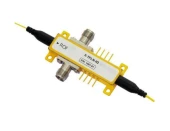
The ROF-TFLN-IQ series is a family of high‑performance thin‑film lithium niobate (TFLN) IQ modulators engineered for next‑generation coherent optical communication and microwave photonics. Built on advanced lithium niobate on insulator (LNOI) technology, these integrated modulators inherit the superior electro‑optic properties of bulk LiNbO₃ while delivering a dramatically smaller footprint, reduced drive voltage, and higher bandwidth. Compared with conventional bulk lithium niobate modulators commonly used in long‑haul and metro coherent systems, the ROF‑TFLN‑IQ platform offers lower insertion loss, higher modulation efficiency, and enhanced stability, making it an excellent choice for demanding high‑speed optical links and integrated photonic systems.
Optimized for operation in the C‑band (1530–1565 nm), the ROF‑TFLN‑IQ‑C‑20/40/60‑0PPS and ROF‑TFLN‑IQ‑C‑20‑0PPLV variants provide a 20 GHz or 40 GHz 3 dB electrical bandwidth, supporting advanced modulation formats such as QPSK and higher‑order QAM in coherent transceivers. A key advantage of the thin‑film platform is its low RF half‑wave voltage, with typical Vπ values down to 2.5–3.5 V at 50 kHz, enabling direct drive from modern high‑speed drivers and reducing overall system power. The integrated heater bias structure ensures stable quadrature operating point and precise phase control across a wide operating temperature range from −55 °C to +85 °C, which is critical for field‑deployed coherent systems and temperature‑variable laboratory environments.
From an optical perspective, these IQ modulators are designed to deliver stable, high‑contrast modulation with typical optical insertion loss ≤5.5–6 dB and an extinction ratio ≥25 dB, matching and often exceeding performance seen in many state‑of‑the‑art commercial TFLN and bulk LiNbO₃ IQ modulators. The devices support input optical powers up to 200 mW, allowing operation with high‑power narrow‑linewidth lasers and integrated amplifiers without compromising reliability. Low optical return loss (≤ −26 dB) reduces back‑reflection into the laser source, which is essential for achieving low phase noise and high‑OSNR coherent transmission. For seamless integration into existing fiber systems, the ROF‑TFLN‑IQ modules are supplied with PM1550 polarization‑maintaining input fiber and standard SM1550 single‑mode output fiber, both with typical lengths of 0.6 m, ensuring stable polarization handling at the input and compatibility with standard telecom infrastructure at the output.
Electrically, the modulators exhibit broadband S‑parameter performance with 20–40 GHz 3 dB bandwidth and RF return loss better than −10 dB, enabling efficient coupling to 50‑ohm RF drivers and minimizing reflections that can degrade high‑speed signals. The RF input power handling up to 23 dBm provides ample margin for intense modulation schemes and high symbol‑rate operation. Integrated heater bias control with half‑wave power levels around 30–50 mW and bias voltage below 8 V enables fine tuning of the operating point without significant additional power consumption, which is advantageous in dense photonic integration and data center settings where thermal budgets are tightly controlled.
In practical deployment, the compact TFLN chip and packaged module design allow dense integration in coherent transponders, test and measurement setups, and photonic research platforms. The small size and low drive voltage, combined with high bandwidth and robustness over a wide temperature range, make the ROF‑TFLN‑IQ series well suited for long‑distance coherent transmission, 400G/800G‑class and beyond coherent interfaces, microwave photonic links, and advanced modulation experiments in universities and research institutes. When compared with similar thin‑film lithium niobate IQ modulators available globally, the ROF‑TFLN‑IQ products stand out for their balance of bandwidth, insertion loss, extinction ratio, and operating stability, offering a competitive solution for both system integrators and photonic researchers seeking state‑of‑the‑art electro‑optic modulation technology.
ROF Thin-Film Lithium Niobate IQ Modulator
Specifications
| Aperture Diameter: | Not Specified |
|---|---|
| Peak Optical Power Density: | Not Specified |
| Wavelength Range: | 1530 – 1565 nm |
| Transmission: | Not Specified |
| Extinction Ratio: | Not Specified |
| Operating Wavelength: | 1530–1565 nm |
| Optical Insertion Loss (standard): | ≤5.5 dB |
| Optical Insertion Loss (low Vπ Version): | ≤6 dB |
| Optical Extinction Ratio: | ≥25 dB |
| Optical Return Loss: | ≤-26 dB |
| Optical Input Power: | ≤200 mW |
| Bandwidth (3 DB, Standard): | 20/40 GHz |
| Bandwidth (3 DB, Low Vπ Version): | 20 GHz |
| RF Half-wave Voltage @ 50 KHz (standard): | ≤3.5 V |
| RF Half-wave Voltage @ 50 KHz (low Vπ Version): | ≤2.5 V |
| RF Return Loss: | ≤-10 dB |
| RF Input Power: | ≤23 dBm |
| Heater Bias Half-wave Power: | 50(30) mW |
| Heater Bias Voltage: | <8 V |
| Operating Temperature: | -55 to +85 ℃ |
| Storage Temperature: | -55 to +85 ℃ |
| Input Fiber Type: | PM1550 polarization-maintaining fiber |
| Input Fiber Length: | 0.6 m |
| Output Fiber Type: | SM1550 standard single-mode fiber |
| Output Fiber Length: | 0.6 m |
| RF Port Connector: | 1.85 mm female |
Got questions about specs? Use the inquiry form to ask.
 Download Data Sheet

Features
- Advanced Thin-Film LNOI Platform – Based on lithium niobate on insulator (LNOI), inheriting the excellent electro‑optic properties of bulk LiNbO₃ while enabling chip‑scale integration, compact footprint, and high modulation efficiency.
- High‑Speed IQ Modulation for Coherent Systems – Integrated in‑phase and quadrature (IQ) structure optimized for advanced modulation formats (QPSK, 16QAM and beyond), ideal for long‑haul coherent optical communication and high‑capacity DWDM systems.
- Wide 3 dB Electrical Bandwidth: 20 / 40 / 60 GHz – Supports 20 GHz and 40 GHz standard options (and higher bandwidth roadmap), enabling symbol rates compatible with 100G/200G/400G+ coherent links and broadband microwave‑photonic applications.
- Low RF Half‑Wave Voltage (Vπ) – RF Vπ as low as ≤2.5–3.5 V @ 50 kHz (LV versions available), significantly reducing drive power and easing requirements on RF drivers and DAC electronics compared with traditional bulk LiNbO₃ modulators.
- Low Optical Insertion Loss – Typical insertion loss ≤5.5–6 dB over 1530–1565 nm C‑band, minimizing system OSNR penalties and improving link budget in long‑distance and metro applications.
- High Extinction Ratio and Excellent Modulation Quality – Extinction ratio ≥25 dB ensures clean on/off contrast, improved BER performance, and high fidelity for high‑order modulation formats in coherent detection schemes.
- Optimized for C‑Band Operation – Operating wavelength range 1530–1565 nm, matching standard C‑band EDFA, transceiver, and coherent detection infrastructures used in modern optical networks.
- Integrated Photodetector Option – Configurable with co‑packaged photodetector (PD = 1) for compact optical front‑end solutions, reduced footprint, and simplified alignment in coherent receivers and microwave‑photonic links.
- Polarization‑Maintaining Input and Flexible Output Fiber – PM1550 polarization‑maintaining input fiber for stable polarization state (key at high baud rates); output available as PM or standard SM fiber for easy integration into existing fiber networks.
- Excellent RF Performance and Matching – RF return loss S11 ≤ –10 dB with 1.85 mm RF input ports, ensuring low reflection, efficient RF power transfer, and stable high‑frequency operation up to 40 GHz and beyond.
- High Optical and RF Power Handling – Supports optical input power up to 200 mW and RF input power up to 23 dBm, suitable for high‑power links, analog optical transmission, and linear microwave‑photonic systems.
- Thermal Bias Control with Low Heater Power – Integrated heater with half‑wave power around 30–50 mW and bias voltage <8 V for stable quadrature biasing and drift compensation without excessive power consumption.
- High Stability and Low Drift – Thin‑film LNOI design offers improved temperature stability and reduced bias drift over conventional bulk LiNbO₃ modulators, enhancing long‑term reliability in field deployments.
- Rugged Wide Temperature Operation – Operating temperature range –55 to +85 °C (storage –55 to +85 °C), supporting demanding telecom, data‑center, industrial, and defense environments.
- Compact, Integrated Package – Small‑size package with 0.6 m fiber pigtails and clearly defined pins (IN, OUT, RF1/2, heater) simplifies assembly on line cards and test benches, while supporting dense integration in coherent transceivers.
- Low Return Loss and Reduced Back‑Reflection – Optical return loss ≤ –26 dB helps maintain signal integrity, protects upstream lasers, and reduces penalties in coherent and analog systems.
- Ideal for Microwave Photonics and RF‑over‑Fiber – High linearity, broad bandwidth, and low Vπ make the device well‑suited for analog photonic links, phased‑array radar, 5G/6G fronthaul, satellite communications, and other RF‑over‑fiber applications.
- Future‑Proof Platform – Thin‑film LNOI technology is compatible with photonic integrated circuit (PIC) processes, supporting future evolution toward higher baud rates, higher‑order modulation formats, and more complex integrated photonic systems.
Applications
- High‑speed coherent optical communication systems – IQ modulation for 100G/200G/400G/800G coherent transponders and coherent pluggable modules in data center interconnect (DCI), metro, long‑haul, and submarine links.
- Advanced modulation format generation – Creation of QPSK, 8QAM, 16QAM, and higher‑order QAM constellations in testbeds, enabling research and deployment of spectrally efficient coherent formats.
- Optical transmitters for DWDM systems – Integration in dense wavelength‑division multiplexing transmitters for flexible grid networks, ROADMs, and colorless, directionless, contentionless (CDC) architectures.
- Microwave photonics links – Low‑Vπ, broadband electro‑optic conversion for analog optical links, RF‑over‑fiber, and distribution of high‑frequency microwave and millimeter‑wave signals.
- 5G/6G fronthaul and backhaul – Transport of high‑bandwidth CPRI/eCPRI and radio‑over‑fiber signals between centralized baseband units and remote radio heads in advanced mobile networks.
- Photonics‑enabled radar and electronic warfare – Linear, broadband modulation for radar front‑ends, phased‑array beamforming networks, and low‑probability‑of‑intercept (LPI) RF systems.
- Optical arbitrary waveform generation (OAWG) – Fine control of amplitude and phase to synthesize complex optical waveforms for spectroscopy, advanced metrology, and coherent control experiments.
- High‑speed optical signal processing – IQ modulation for optical mixing, frequency translation, optical filtering, and all‑optical signal conditioning in fiber‑optic signal processing chains.
- Coherent LIDAR and ranging systems – Phase‑stable modulation for frequency‑modulated continuous‑wave (FMCW) LIDAR, coherent Doppler ranging, and high‑resolution distance/velocity measurement.
- High‑purity microwave generation from optics – Optical heterodyne and frequency comb applications where low‑noise, linear phase modulation is required to generate ultra‑low‑phase‑noise RF signals.
- Quantum key distribution (QKD) and quantum communications – Precise amplitude/phase control in continuous‑variable and discrete‑variable QKD transmitters operating around 1550 nm.
- Integrated photonic research on LNOI platforms – Use as a reference LNOI IQ modulator in academic and industrial R&D for integrated LiNbO3 photonics, including chip‑to‑fiber interfacing and hybrid integration.
- Optical coherent detection test and measurement – Generation of well‑defined test signals for coherent receiver characterization, EVM measurements, and performance benchmarking of coherent DSP algorithms.
- High‑speed bit‑error‑rate (BER) and system testing – IQ modulation of PRBS patterns up to tens of GHz symbol rates for validating line cards, EDFAs, ROADMs, and complete optical links.
- Educational and demonstration platforms – Laboratory use in universities and training centers to demonstrate principles of coherent communications, complex modulation formats, and microwave photonics.
- Secure and encrypted optical links – Complex phase and amplitude modulation to support advanced optical layer encryption and spreading techniques in high‑security communication systems.
- Optical frequency comb shaping – Amplitude and phase shaping of comb lines for telecommunications superchannels, dual‑comb spectroscopy, and optical frequency metrology.
- Reconfigurable optical transceivers – Use in software‑defined transmitters where modulation format, baud rate, and spectral occupancy can be dynamically adapted via the IQ modulator.
- Low‑latency data center interconnects – Integration in short‑reach and medium‑reach coherent DCI links that require compact, low‑power, low‑latency modulators with high stability.
- Optical sensing and interferometry – Stable phase modulation for fiber‑optic interferometers, distributed acoustic sensing (DAS), and coherent optical sensors requiring high extinction ratio and low insertion loss.
Frequently Asked Questions
What is the ROF‑TFLN‑IQ thin‑film lithium niobate IQ modulator and what are its key features?
What are the operating wavelength range, bandwidth options, and typical applications of this TFLN IQ modulator?
What is the difference between the standard and low‑Vπ (LV) versions of the ROF‑TFLN‑IQ modulators?
How do I interpret the ordering code ROF‑TFLN‑IQ‑λ‑BW‑PD‑IF‑OF‑S/LV/DP and choose the right configuration?
What are the electrical drive requirements, including Vπ, RF power, and impedance matching, for the ROF‑TFLN‑IQ modulators?
What optical power handling, losses, and extinction ratio should I expect, and how does this affect system design?
What are the thermal, bias, and packaging considerations for reliable operation of the ROF‑TFLN‑IQ modulator?
Got more questions? Use the inquiry form to ask the supplier directly.
Similar Products



Your inquiry has been received.
Create an account by adding a password
Why create an account?
- Auto-complete inquiry forms
- View and manage all your past messages
- Save products to your favorites
- Close your account anytime — no hassle