


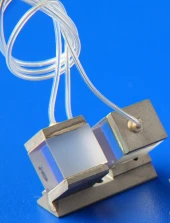
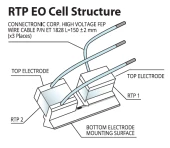
Description
RTP (Rubidium Titanyl Phosphate) is an advanced member of the KTP crystal family, engineered specifically for electro-optic applications where reliability, speed, and power handling are critical. Compared with conventional KTP- or LiNbO3-based devices frequently found in Q-switching and modulation setups, RTP EO cells combine a very low half-wave voltage with a significantly higher laser-induced damage threshold. This makes them particularly well suited for high-peak-power solid-state lasers operating around 1064 nm, as well as for demanding multi-wavelength systems across the 500–3000 nm spectral range.
The EO cells employ a thermally compensated design based on two precisely matched RTP crystals. These crystals are arranged in-line along the propagation axis (X or Y), with one crystal rotated by 90 degrees relative to the other. This configuration effectively compensates for thermal and piezoelectric effects, resulting in stable operation over a wide temperature range from -50 °C to +70 °C. Compared with single-crystal designs often used in standard modulators and Q-switches, this matched-pair structure minimizes drift, reduces residual birefringence changes, and improves long-term pointing and contrast stability in the laser system.
RTP EO cells are optimized for fast electro-optic performance with rise times, fall times, and achievable pulse widths below 1 ns, which is ideal for high-speed Q-switching, pulse picking, and modulation schemes. Their low half-wave voltage (around 3.6 kV for a 9 × 9 × 10 mm2 cell) allows more compact, efficient driver electronics compared with many alternative EO materials that require substantially higher drive voltages. In addition, these cells exhibit minimal electrical ringing and support repetition rates above 1 MHz, making them suitable for modern high-repetition-rate DPSS and fiber laser platforms used in micromachining, precision marking, lidar, and scientific instrumentation.
The material properties of RTP offer a distinct advantage over other crystals widely used in the industry. Non-hygroscopic behavior means the crystals do not absorb moisture from the environment, simplifying handling, storage, and integration—unlike hygroscopic alternatives that typically require hermetic sealing or protective covers. RTP also exhibits very low absorption losses at 1064 nm and delivers an exceptionally high damage threshold of more than 1 GW/cm2 (10 ns pulses at 1064 nm), with typical values exceeding 2 GW/cm2. This level of robustness allows reliable operation in high-intensity cavities and power-scaling scenarios, helping to extend system lifetime and reduce the risk of catastrophic optical damage.
In terms of optical quality, RTP EO cells are manufactured with high homogeneity across apertures up to 15 × 15 mm2, supporting both narrow and large-beam configurations commonly used in industrial and research lasers. Standard clear apertures range from 2 × 2 mm2 for compact, low-capacitance devices up to 15 × 15 mm2 for high-energy or large-mode-area beams. Crystal lengths up to 50 mm enable optimization of interaction length versus required drive voltage, while an acceptance angle below 4 degrees ensures robust alignment tolerances and compatibility with various cavity geometries.
The operational bandwidth of 500–3000 nm makes RTP a highly versatile choice for electro-optic components spanning visible, near-infrared, and mid-IR wavelengths. Standard anti-reflection coatings are optimized for 1064 nm with residual reflectivity below 0.2%, but the material’s wide transparency and favorable EO coefficients make it equally attractive for frequency-converted sources, tunable lasers, and multi-line systems. As a result, RTP EO cells are commonly employed as Q-switches and pulse pickers, phase and amplitude modulators, cavity dumpers, shutters, attenuators, and beam deflectors in both OEM and custom laser architectures.
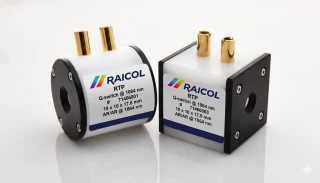
RTP EO cell offerings typically include thermally compensated matched pairs of RTP elements for Q-switching and amplitude modulation, single RTP elements for phase modulation, and complete plug-and-play assemblies with or without housings. This range of configurations enables seamless integration into existing driver electronics and mechanical interfaces, whether in compact benchtop systems or volume-produced industrial laser platforms. By combining a wide temperature operating range, low loss, high homogeneity, and exceptional damage tolerance, RTP EO cells deliver a robust, field-proven solution for advanced electro-optic control in today’s most demanding laser applications.
RTP EO Cells Thermally Compensated High Speed Electro Optical Modulators
Specifications
| Aperture Diameter: | Not Specified |
|---|---|
| Peak Optical Power Density: | Not Specified |
| Wavelength Range: | 500 – 3000 nm |
| Transmission: | Not Specified |
| Extinction Ratio: | Not Specified |
| Operational Spectral Range: | 500-3000 nm |
| Transmission @ 1064 Nm: | > 98.5% |
| Half-wave Voltage: | 3.6 kV (for EO Cell size: 9 x 9 x 10 mm²) |
| Extinction Ratio: | > 35 dB |
| Clear Aperture: | 2 x 2 mm² to 15 x 15 mm² |
| Crystal Length: | Up to 50 mm |
| Acceptance Angle: | < 4° |
| Standard AR Coating @ 1064 Nm: | R < 0.2% |
| Laser-induced Damage Threshold (fluence): | > 10 J/cm², typical > 2 GW/cm² |
| Laser-induced Damage Threshold (intensity): | > 1 GW/cm² @ 1064 nm, 10 ns pulse |
| Temperature Stability Range: | -50 °C to 70 °C |
| Rise/fall Time And Pulse Width: | < 1 ns |
| Repetition Rate Compatibility: | > 1 MHz |
| Standard EO Cell Size Example: | 9mm x 9mm x 10mm |
| Maximum Standard EO Cell Aperture: | 15 x 15 mm² |
Got questions about specs? Use the inquiry form to ask.
 Download Data Sheet

Features
- Exceptional Electro-Optic Performance – RTP (Rubidium Titanyl Phosphate) offers high electro-optic coefficients with low half-wave voltage (~3.6 kV @ 1064 nm for 9 × 9 × 10 mm³), enabling compact, efficient EO cell designs.
- Ultra-Fast Response Time – Rise time, fall time, and pulse width < 1 ns support extremely fast switching, pulse picking, and high-speed modulation, ideal for demanding high‑repetition‑rate laser systems.
- Innovative Thermally Compensated Design – Uses a precisely matched pair of RTP crystals arranged in-line with a 90° rotation between elements, providing thermal compensation, reduced drift, and enhanced long‑term stability over a wide temperature range.
- Wide Operating Temperature Range – Engineered for stable performance from -50 °C to +70 °C, ensuring reliable operation in laboratory, industrial, and defense environments without active temperature control in many cases.
- High Laser-Induced Damage Threshold – Supports intensities of > 1 GW/cm² @ 1064 nm, 10 ns pulse (typical > 2 GW/cm² or 10 J/cm²), suitable for high‑peak‑power Nd:YAG and other solid‑state laser systems.
- Broad Spectral Transmission Range (500–3000 nm) – Optimized for electro‑optic applications across the visible to mid‑IR, including common laser wavelengths such as 532 nm, 800–900 nm, 1064 nm, 1550 nm, and 2 µm.
- Low Optical Loss and High Transmission – Very low absorption losses with transmission > 98.5% @ 1064 nm, supporting high overall system efficiency and minimal thermal loading.
- Excellent Extinction Ratio – Typically > 35 dB extinction ratio, enabling high‑contrast Q‑switching, amplitude modulation, shuttering, and precise beam attenuation.
- Large Clear Aperture Options – Standard clear aperture sizes from 2 × 2 mm² up to 15 × 15 mm², with crystal lengths up to 50 mm, supporting both narrow and large‑diameter beams.
- Precision Acceptance Angle – Acceptance angle of < 4° for controlled beam propagation, excellent mode quality, and predictable EO performance.
- High-Performance AR Coatings – Standard anti‑reflection coating at 1064 nm with R < 0.2%, minimizing Fresnel losses and back reflections for improved system stability and power handling.
- Non-Hygroscopic and Robust – RTP is non‑hygroscopic and mechanically stable, allowing easy handling and operation without protective covers, unlike many alternative EO materials.
- Minimal Ringing for High Repetition Rates – Cell design minimizes electrical and optical ringing, supporting reliable operation at > 1 MHz repetition rates for advanced pulsed laser architectures.
- Superior Crystal Homogeneity – Extremely high optical homogeneity enables up to 15 × 15 mm² EO cells as standard, ensuring uniform phase retardation and low wavefront distortion across the full aperture.
- Optimized for Multiple EO Functions – Ideal for use as Q‑switches, pulse pickers, phase modulators, amplitude modulators, cavity dumpers, shutters, attenuators, and deflectors in high‑end laser systems.
- Thermally Compensated Matched Pairs or Single Elements – Available as matched thermal-compensation pairs for EO cells, or as single RTP elements optimized for phase modulation or custom integration.
- Plug-and-Play EO Cell Assemblies – Offered as complete electro‑optic cell assemblies (with or without housing), simplifying integration into OEM laser platforms and research setups.
- Industry-Proven Material vs. LiNbO₃ and KD*P – Compared with traditional EO materials such as LiNbO₃ and KD*P, RTP offers higher damage threshold, non‑hygroscopic behavior, wide transparency range, and low loss, making it a preferred choice for modern high‑power lasers.
- Global Leader in RTP Technology – Produced by Raicol Crystals, a company with 50 years of crystal growth experience and a track record as global pioneers of RTP, HGTR KTP, and PPKTP, ensuring consistent, repeatable quality.
- One-Stop Manufacturing and Fast Delivery – In‑house capabilities from crystal growth, cutting, polishing, coating, to EO cell assembly, supporting both mass production and R&D.
Applications
RTP electro‑optic (EO) cells, as a high‑performance member of the KTP crystal family, are widely used in advanced laser and photonics systems that require fast switching, high damage threshold, and excellent thermal stability. Below is a comprehensive, SEO‑optimized list of typical and emerging applications for RTP EO cells in scientific, industrial, medical, and defense markets.
Laser Q‑Switching and Pulse Control- Q‑Switches for solid‑state lasers (e.g., Nd:YAG, Nd:YVO4, Nd:YLF) at 1064 nm and harmonics, enabling nanosecond and sub‑nanosecond pulse generation.
- Electro‑optic pulse pickers for selecting single pulses or pulse trains from high‑repetition‑rate mode‑locked or Q‑switched lasers.
- Cavity dumpers in regenerative amplifiers and ring cavities to extract high‑energy pulses with precise timing.
- Laser shutters and fast optical gates for rapid on/off beam control with rise and fall times below 1 ns.
- Repetition‑rate reduction and burst mode control in ultrafast and picosecond laser systems.
- Phase modulators for precise phase control in interferometers, coherent detection systems, and frequency modulation experiments.
- Amplitude modulators for intensity control of CW and pulsed lasers in the 500–3000 nm spectral range.
- Pulse shaping and temporal modulation in ultrafast optics, including pre‑compensation and waveform generation.
- Chirping and frequency modulation of laser beams for spectroscopy, LIDAR, and coherent radar applications.
- Stabilization of laser power and phase in high‑precision metrology and frequency comb systems.
- Electro‑optic attenuators for dynamic control of laser output power in test benches, optical characterization setups, and industrial tools.
- High‑speed beam deflectors and scanners for steering laser beams in imaging, micro‑machining, and patterning systems.
- Variable optical shutters for beam routing and protection of sensitive downstream components.
- Polarization‑based beam routing when combined with polarizers or polarizing beam splitters.
- Interferometry and holography, using phase modulation for fringe control, phase shifting, and optical path length modulation.
- Optical time‑domain reflectometry (OTDR) and time‑resolved measurements requiring fast gating and short optical pulses.
- Precision distance and displacement metrology using phase‑stable EO modulation.
- Optical coherence tomography (OCT) and advanced imaging systems that benefit from rapid modulation and beam control.
- High‑resolution spectroscopy, including modulation‑transfer and saturation spectroscopy in the near‑IR.
- Micromachining and micro‑structuring of metals, semiconductors, and dielectrics where tightly controlled nanosecond pulses enhance precision.
- PCB drilling, scribing, and trimming using Q‑switched lasers with stable pulse‑to‑pulse energy.
- Laser marking, engraving, and coding for industrial part identification and traceability.
- Thin‑film and solar cell processing, benefiting from high repetition rate and high damage threshold modulation.
- Medical laser surgery and tissue ablation where precisely shaped and gated pulses are critical for minimizing collateral damage.
- Dermatology and aesthetic lasers (e.g., tattoo removal, skin resurfacing) requiring stable Q‑switched operation at 1064 nm and its harmonics.
- Ophthalmic lasers for retinal treatments and photo‑disruption with carefully timed pulse delivery.
- Fluorescence and multiphoton microscopy with gated excitation and controlled pulse trains.
- LIDAR transmitters utilizing Q‑switched or cavity‑dumped pulses for atmospheric sensing, mapping, and 3D imaging.
- Range‑finders and laser altimeters operating at eye‑safe or near‑IR wavelengths in the 500–3000 nm window.
- Differential absorption LIDAR (DIAL) and other spectroscopic LIDAR techniques requiring controlled pulse sequences.
Frequently Asked Questions
What is an RTP electro‑optic (EO) cell and how does it differ from standard KTP EO modulators?
What are typical applications of RTP EO cells in laser systems?
What are the key optical and electrical specifications of Raicol RTP EO cells?
How does the thermally compensated matched‑pair design improve RTP EO cell performance?
What are the driving requirements and switching performance of RTP EO cells?
How robust are RTP EO cells in terms of environmental stability and handling?
What RTP EO cell configurations does Raicol offer and can they be customized?
Got more questions? Use the inquiry form to ask the supplier directly.
Similar Products



Your inquiry has been received.
Create an account by adding a password
Why create an account?
- Auto-complete inquiry forms
- View and manage all your past messages
- Save products to your favorites
- Close your account anytime — no hassle