


Description
The iRTP Pockels Cell is an advanced electro‑optic (EO) modulation solution engineered around RTP, a crystal belonging to the KTP family and optimized for demanding industrial laser systems. Leveraging the exceptional EO coefficients of RTP along with its inherently high laser damage threshold, the iRTP Pockels Cell is designed to deliver precise, repeatable modulation in applications where reliability and stability are critical. Its robust performance makes it well suited for Q‑switching, pulse picking, cavity dumping, and intensity modulation in high‑power solid‑state and diode‑pumped laser platforms operating around 1064 nm and harmonics.
Unlike traditional EO materials that may suffer from hygroscopic behavior or limited power handling capabilities, the RTP crystal employed in the iRTP Pockels Cell is non‑hygroscopic and exhibits excellent thermal and mechanical stability. This allows the device to maintain performance over a broad operating temperature range and under elevated average power levels. With low absorption losses and a typical damage threshold at the level of ~1 GW/cm², the iRTP Pockels Cell can be integrated into compact, high‑brightness laser architectures where beam quality and long‑term durability are essential. The result is a reliable, alignment‑friendly modulator that supports high repetition rates and short pulse durations without compromising beam integrity.
The iRTP Pockels Cell series is offered as a standard, off‑the‑shelf solution intended to bring RTP technology to the broader EO mass market. It is a modified and industrially optimized variant of earlier RTP designs, with particular attention paid to manufacturability, repeatability, and cost effectiveness. By combining high electro‑optic performance with pricing comparable to more conventional Pockels cells, the iRTP line provides a practical upgrade path for OEM laser manufacturers and system integrators looking to increase throughput, reduce maintenance, and extend system lifetimes. This makes the device especially attractive for industrial micromachining, materials processing, LIDAR, medical laser systems, and scientific instrumentation where uptime and cost of ownership are key metrics.
In terms of optical and electrical behavior, the iRTP Pockels Cell is optimized for fast switching and clean modulation. It supports sub‑nanosecond rise times, enabling the generation and control of very short optical pulses with well‑defined temporal edges. The low capacitance design (typically under 6 pF) reduces driver load and facilitates efficient coupling with compact, high‑voltage drivers. At 1064 nm, the quarter‑wave voltage is on the order of 3.3 kV, balancing the requirements for low‑voltage operation with the intrinsic properties of the RTP crystal. High transmission (greater than 99%) and an extinction ratio of 27 dB or higher at 1064 nm ensure that the modulator introduces minimal insertion losses while providing strong on/off contrast for precise pulse gating and energy control.
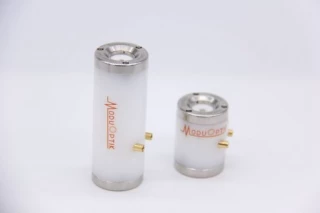
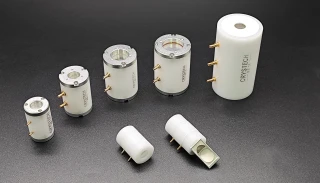
The device architecture has been tailored for straightforward system integration in industrial environments. The iRTP Pockels Cell is available with clear apertures of 6×6 mm, 8×8 mm, and 10×10 mm, supporting a wide range of beam sizes and laser powers. Round and square housing options with typical outer dimensions around 35 mm are offered, including designs compatible with 1‑inch optomechanical hardware, simplifying mounting into standard optical rails and cavity layouts. A one‑axis alignment access layout enables rapid and repeatable alignment within the laser head, reducing assembly time and service complexity. Combined with the non‑hygroscopic nature of RTP, this design enables operation without complex environmental sealing or desiccation measures.
Another important advantage of the iRTP Pockels Cell is its resistance to acoustic ringing, which is suppressed up to at least the tens of kilohertz range. Many EO modulators based on alternative crystals can suffer from piezoelectric‑induced resonances that distort the temporal profile of the laser pulses or lead to amplitude instability at certain repetition rates. By minimizing such acoustic effects, the iRTP Pockels Cell supports high‑repetition‑rate operation with clean pulse shapes and high stability, an essential factor for precision laser micromachining, additive manufacturing, and scanning‑based processing where process consistency depends strongly on uniform pulse‑to‑pulse energy.
Thermal stability across a typical operating window of approximately 10 °C to 50 °C further reinforces the suitability of the iRTP Pockels Cell for industrial environments. In many production and field‑deployed systems, internal temperatures can drift due to varying duty cycles or ambient conditions. The inherent thermal robustness of RTP ensures that the electro‑
Raicol iRTP Pockels Cell High Performance RTP EO Crystal for Lasers
Specifications
| Aperture Diameter: | 6 mm |
|---|---|
| Peak Optical Power Density: | 1000 MW/cm^2 |
| Wavelength Range: | Not Specified |
| Transmission: | 99 % |
| Extinction Ratio: | Not Specified |
| Product: | iRTP Pockels Cell |
| Model Variants: | iRTP 6, iRTP 8, iRTP 10 |
| Aperture (iRTP 6): | 6 x 6 mm |
| Aperture (iRTP 8): | 8 x 8 mm |
| Aperture (iRTP 10): | 10 x 10 mm |
| Capacitance: | < 6 pF |
| Quarter Wave Voltage @1064 Nm: | 3.3 kV |
| Optical Transmission: | > 99% |
| Extinction Ratio @1064 Nm: | ≥ 27 dB |
| Laser Damage Threshold: | typically > 1 GW/cm² |
| Alignment Access: | 1 axis alignment |
| Rise Time: | < 1 ns |
| Thermal Stability (operational Temperature Range): | 10 – 50 °C |
| Housing Dimensions (round): | Ø 35 mm, length 35 mm |
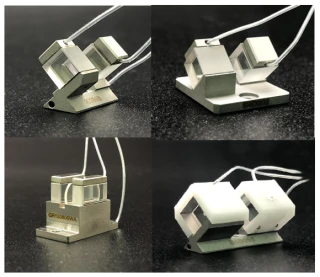
| Housing Dimensions (square): | 35 mm x 35 mm x 35 mm |
| Material: | RTP (Rubidium Titanyl Phosphate) |
| Acoustic Ringing: | No acoustic ringing up to at least ~100 kHz (approx.) |
| Material Property: | Non-hygroscopic |
| Absorption Losses: | Low |
Got questions about specs? Use the inquiry form to ask.
 Download Data Sheet

Features
- Industrial-Grade RTP Pockels Cell (iRTP) – Modified RTP design optimized specifically for industrial laser applications, delivering high-end electro‑optic performance in a cost-effective, off‑the‑shelf format.
- Belongs to the KTP Crystal Family – Based on RTP (Rubidium Titanyl Phosphate), a member of the KTP family, combining excellent electro‑optic coefficients with robust mechanical and thermal properties for demanding laser systems.
- High Laser Damage Threshold – Supports damage thresholds typically > 1 GW/cm², enabling reliable operation with high‑peak‑power and high‑average‑power lasers in industrial, scientific, and medical applications.
- Fast Electro‑Optic Response – Rise time < 1 ns with support for short pulse widths, ideal for Q‑switching, pulse picking, cavity dumping, and other ultrafast switching applications.
- High Extinction Ratio – Extinction ratio at 1064 nm of ≥ 27 dB ensures efficient on/off contrast and clean pulse shaping in precision laser beam control applications.
- Low Quarter‑Wave Voltage at 1064 nm – Typical quarter‑wave voltage of ≈ 3.3 kV @ 1064 nm reduces driver requirements and improves system efficiency compared to many conventional Pockels cells.
- Low Capacitance for High Repetition Rates – Cell capacitance of < 6 pF allows high‑repetition‑rate operation with reduced driver load, supporting modern high‑throughput laser systems.
- Non‑Hygroscopic Crystal – RTP is non‑hygroscopic, unlike many traditional EO crystals, eliminating the need for sealed housings or dry environments and significantly reducing maintenance and long‑term degradation.
- Excellent Thermal Stability – Stable performance over a wide operational temperature range of 10°C to 50°C, providing reliable modulation in varying industrial and laboratory environments.
- Minimal Acoustic Ringing – Engineered for no acoustic ringing up to at least tens of kHz, supporting clean, high‑repetition‑rate switching without oscillations that degrade pulse quality.
- Low Optical Absorption & High Transmission – Optical transmission > 99% with low absorption losses at 1064 nm helps maximize system efficiency, reduce thermal load, and maintain beam quality.
- Multiple Clear Aperture Options – Available in 6 x 6 mm, 8 x 8 mm, and 10 x 10 mm apertures, accommodating a wide range of beam diameters and allowing integration into different laser architectures.
- Versatile Housing Configurations – Offered in round housings (∅ ≈ 35 mm, length ≈ 35 mm, including a 1" option) and square housings (≈ 35 x 35 x 35 mm) for easy mechanical integration into standard opto‑mechanical mounts.
- Optimized Alignment Access – Provides 1‑axis alignment access for straightforward installation and alignment in laser cavities and beamlines, reducing setup time and complexity.
- High Reliability for Mass‑Market EO Applications – Designed as a standard, off‑the‑shelf Pockels cell that brings RTP advantages—stability, low loss, and high damage threshold—to the broader electro‑optic market.
- Ideal for 1064 nm and Nd:YAG / Yb‑Based Lasers – Optimized for 1064 nm operation, making it particularly suitable for Nd:YAG and Yb‑based laser systems used in micromachining, materials processing, and scientific research.
- Supports High‑Repetition‑Rate Laser Systems – Combination of low capacitance, fast rise time, minimal acoustic ringing, and high thermal stability makes the iRTP Pockels cell ideal for high‑rep‑rate pulsed and burst‑mode operation.
- Stable Polarization Control – High extinction ratio and low depolarization ensure precise control of laser polarization, benefiting applications like pulse picking, regenerative amplifiers, and polarization gating.
- Backed by a Global Leader in Nonlinear & EO Crystals – Manufactured by Raicol Crystals, with decades of expertise in RTP, HGTR KTP, and PPKTP crystal growth, coating, and EO cell assembly, ensuring consistent quality and dependable performance.
Applications
- Q-switching in high-power Nd:YAG and Nd:YVO4 lasers for industrial micromachining, drilling, cutting, scribing, and surface texturing at 1064 nm and harmonics
- Pulse picking and cavity dumping in ultrafast (picosecond and femtosecond) laser systems, enabling precise selection of single pulses from high repetition rate oscillators
- Regenerative amplifier pulse gating in high-energy, high-average-power laser amplifiers for materials processing, scientific research, and industrial OEM laser platforms
- High repetition rate laser modulation in systems operating from tens of kHz up to MHz, leveraging RTP’s absence of acoustic ringing and low absorption losses
- Laser intensity and power modulation for process control in precision welding, cutting, marking, and additive manufacturing (metal and polymer 3D printing)
- Laser contrast enhancement and pulse cleaning in amplifier chains, improving temporal contrast and suppressing pre‑ and post‑pulses in high‑performance laser setups
- Electro-optic beam shuttering for ultra‑fast on/off control in laser safety interlocks, beamline protection, and automated industrial workstations
- Mode-locking assist and cavity control in solid‑state and fiber laser cavities requiring robust, thermally stable EO elements
- EO switching in high‑average‑power IR laser systems where high damage threshold and excellent thermal stability over 10–50 °C are required
- Scientific research lasers in physics and photonics laboratories for pump‑probe experiments, nonlinear optics, and quantum optics testbeds
- Nonlinear optics and frequency conversion systems (SHG, THG, OPO pumping) requiring precise temporal control of pump pulses
- LIDAR and laser ranging for industrial metrology, atmospheric sensing, and 3D mapping systems that need fast, reliable pulse gating
- Time‑of‑flight measurement systems and laser radar modules using electro‑optic modulation for accurate timing and range resolution
- Laser micromachining of transparent and brittle materials such as glass, sapphire, and ceramics, where clean, well‑shaped pulses are crucial
- Semiconductor wafer processing (scribing, dicing, trimming, annealing) using Q‑switched or pulse‑picked IR and green lasers
- PCB drilling and micro‑via formation in electronics manufacturing using high‑repetition‑rate solid‑state lasers
- Precision marking and engraving on metals, plastics, and composites, benefiting from fast rise‑time and short achievable pulse widths
- Medical and aesthetic laser systems (e.g., dermatology, ophthalmic tools) that require compact, stable, non‑hygroscopic EO cells with high reliability
- Laser eye‑safe rangefinder and targeting modules where robust, compact EO switching is needed in demanding environmental conditions
- Defense and aerospace laser subsystems for gated imaging, target designation, and high‑repetition‑rate laser sources
- Electro‑optic sampling and measurement in ultrafast diagnostics and high‑speed optical test setups
- High‑speed optical choppers and modulators replacing mechanical choppers in sensitive or high‑power optical paths
- Quantum optics and quantum information experiments for fast polarization rotation, state preparation, and switching in single‑photon and entangled‑photon setups
- Optical communication test benches and R&D systems where high extinction ratio at 1064 nm is required for signal modulation and gating
- Optical trapping and manipulation (optical tweezers) where precise timing and power control of the trapping beam are needed
- High‑power laser safety and protection systems implementing fast beam blanking in case of fault detection
- Industrial OEM laser modules that need an off‑the‑shelf, cost‑effective Pockels cell with high performance, compact housing, and standard apertures (6×6, 8×8, 10×10 mm)
- Environmental and remote sensing lasers for DIAL, LIDAR, and spectroscopy systems requiring stable EO modulation over varying ambient temperatures
Frequently Asked Questions
What is the Raicol iRTP Pockels cell and what makes it different from standard Pockels cells?
What are the typical optical and electrical specifications of the iRTP Pockels cell?
For which laser wavelengths and applications is the iRTP Pockels cell best suited?
What are the key advantages of RTP material in the iRTP Pockels cell compared to KD*P or BBO?
How does the iRTP Pockels cell handle high repetition rates and acoustic ringing?
What are the mechanical and alignment features of the iRTP Pockels cell for integration into laser systems?
What operating temperature range and environmental conditions are recommended for the iRTP Pockels cell?
Got more questions? Use the inquiry form to ask the supplier directly.
Similar Products

Your inquiry has been received.
Create an account by adding a password
Why create an account?
- Auto-complete inquiry forms
- View and manage all your past messages
- Save products to your favorites
- Close your account anytime — no hassle