

Description
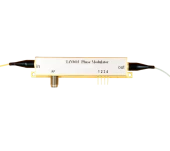
The ROF-PM-UV series is a high‑performance, low Vπ lithium niobate (LiNbO₃) phase modulator engineered for demanding optical fiber communication and sensing applications in the C‑band. Designed around a 1525–1565 nm operating wavelength range, this device provides precise and stable phase control for coherent optical systems, radio‑over‑fiber (ROF) links, and advanced research setups that require low drive voltage and excellent optical power handling. Its traveling‑wave electrode design enables high‑frequency operation while maintaining low insertion loss and high extinction integrity.
A key characteristic of the ROF-PM-UV phase modulator is its low half‑wave voltage. At low frequency (50 kHz), the typical Vπ is only 2.5 V, which significantly reduces the electrical drive requirements compared with standard LiNbO₃ phase modulators. Even at 10 GHz, the device maintains a typical Vπ of approximately 3.7 V, making it particularly attractive for high‑speed phase modulation, coherent detection schemes, and phase‑encoded modulation formats. This low‑voltage operation allows easier integration with conventional RF drivers, reduces overall system power consumption, and simplifies high‑speed circuit design in both laboratory and system‑level deployments.
The optical performance is optimized for low loss and high signal fidelity. Typical insertion loss is around 3.5 dB, while the optical return loss is better than −45 dB, ensuring minimal back‑reflections and stable operation in sensitive coherent and interferometric setups. Both input and output ports employ polarization‑maintaining (PM) PANDA fibers, helping to preserve the polarization state through the device and ensuring reliable phase modulation on the desired axis. Standard connector options include FC/PC and FC/APC, with other interface configurations available on request to match a wide variety of existing fiber‑optic infrastructures.
The ROF-PM-UV series offers a typical electro‑optic bandwidth of 10–12 GHz (−3 dB), making it suitable for high‑speed phase modulation in advanced optical communication systems and laboratory experiments. With a 50 Ω RF input impedance and SMA female electrical connector, it integrates smoothly with common test and measurement setups, vector network analyzers, arbitrary waveform generators, and RF driver amplifiers. The electrical design delivers an RF return loss better than −10 dB, contributing to cleaner modulation waveforms and reduced reflections in high‑frequency circuits.
High optical power endurance is another core strength of this modulator. The device is specified for input optical powers up to 20 dBm, enabling its use in systems where elevated launch powers are required to overcome fiber attenuation or to drive nonlinear processes at longer distances. This high damage threshold, paired with low half‑wave voltage, allows efficient implementation in applications such as Brillouin scattering mitigation, where controlled phase modulation reduces stimulated Brillouin scattering (SBS) in high‑power fiber links, particularly in long‑haul and specialty fiber systems.
Beyond classical communications, the ROF-PM-UV phase modulator is well suited for optical fiber sensing, laser coherent synthesis, and quantum optics experiments. In distributed and interferometric fiber‑optic sensors, stable and repeatable phase modulation is essential for improving resolution and sensitivity; the low Vπ and high bandwidth of this device support high‑frequency phase coding and multiplexing techniques. For coherent beam combining and laser phase locking, the modulator provides fine‑grained phase control with low drift, facilitating stable interferometric operation. In quantum communication and quantum key distribution (QKD) systems, its low‑noise phase modulation capability supports encoding of quantum states and implementation of phase‑encoded protocols.
The ROF-PM-UV is designed for robust operation across a broad range of environmental conditions. It supports operating temperatures from −10 °C to +60 °C and storage temperatures from −40 °C to +85 °C, with relative humidity from 5% to 90%. These specifications make it viable both for controlled laboratory environments and for integration into field‑deployed systems. With a maximum RF input power rating of 28 dBm and carefully engineered microwave structure, the device withstands demanding RF drive conditions needed for wideband modulation formats and multi‑tone or chirped modulation schemes.
The series supports flexible configuration through its ordering options, allowing users to select operating wavelength (centered near 1550 nm), RF bandwidth class (up to 10 GHz), fiber configuration (PM/PMF or hybrid PM/SMF), and connector facets such as FC/APC or FC/PC.
ROF PM UV Low Vpi 1550nm LiNbO3 Phase Modulator 10GHz
Specifications
| Aperture Diameter: | Not Specified |
|---|---|
| Peak Optical Power Density: | Not Specified |
| Wavelength Range: | 1525 – 1565 nm |
| Transmission: | Not Specified |
| Extinction Ratio: | Not Specified |
| Typical Wavelength: | 1550 nm |
| Insertion Loss (typical): | 3 dB |
| Insertion Loss (max): | 3.5 dB |
| Optical Return Loss: | ≥ 45 dB |
| Input Fiber Type: | Panda PM |
| Output Fiber Type: | Panda PM |
| Optical Fiber Interface: | FC/PC, FC/APC or user specified |
| Operating Bandwidth (-3 DB): | 10–12 GHz |
| RF Half-wave Voltage @ 50 KHz (min): | 2.4 V |
| RF Half-wave Voltage @ 50 KHz (typ): | 2.5 V |
| RF Half-wave Voltage @ 50 KHz (max): | 2.6 V |
| RF Half-wave Voltage @ 10 GHz (typ): | 3.4 V |
| RF Half-wave Voltage @ 10 GHz (max): | 3.7 V |
| Electrical Return Loss S11 (min): | 12 dB |
| Electrical Return Loss S11 (typ): | 10 dB |
| RF Input Impedance: | 50 Ω |
| Electrical Interface: | SMA (f) |
| Maximum Input Optical Power: | 20 dBm |
| Maximum Input RF Power: | 28 dBm |
| Operating Temperature Range: | -10 to +60 °C |
| Storage Temperature Range: | -40 to +85 °C |
| Humidity Range: | 5–90 % RH |
Got questions about specs? Use the inquiry form to ask.
 Download Data Sheet

Features
- Ultra-Low Half-Wave Voltage (~2.5 V) – Low Vπ (2.4–2.6 V @ 50 kHz, ~3.4–3.7 V @ 10 GHz) minimizes RF drive power requirements, enabling efficient integration with compact, low‑power electronic drivers.
- High Optical Power Handling – Engineered for high endurance to optical power (up to 20 dBm), suitable for demanding fiber‑optic links, coherent systems, and ROF (Radio-over-Fiber) deployments where high optical power is required.
- Low Insertion Loss for Maximum Link Budget – Typical insertion loss of ~3–3.5 dB reduces system penalties and improves overall transmission performance in long‑haul and high‑capacity optical communication systems.
- High Modulation Bandwidth up to 10–12 GHz – Wide electrical bandwidth (S21) supports high‑speed phase modulation for advanced modulation formats and next‑generation coherent communication systems.
- Excellent Signal Integrity and Impedance Matching – 50 Ω RF input impedance with SMA(f) interface and electrical return loss S11 ≤ −10 dB ensures efficient RF power transfer and reduced reflections over the operating band.
- Low Chirp, High Phase Linearity – Lithium niobate phase modulation design delivers low-chirp operation and linear phase response, ideal for advanced coherent modulation, phase shift keying, and phase-sensitive measurement systems.
- Optimized for C-Band Operation (1525–1565 nm) – Designed for standard 1550 nm telecom window, fully compatible with EDFAs, WDM systems, and common C‑band photonic components.
- PM Fiber Inputs and Outputs – Panda polarization-maintaining fibers on both input and output ports provide superior polarization stability for coherent detection, interferometry, and quantum communication experiments.
- Flexible Optical Connector Options – Available with FC/PC or FC/APC connectors, as well as user-specified terminations, simplifying integration into existing fiber-optic testbeds and production systems.
- Robust Environmental Performance – Wide operating temperature range from −10 °C to +60 °C and storage from −40 °C to +85 °C, with humidity tolerance 5–90% RH, supporting reliable performance in lab, field, and industrial environments.
- High Optical Return Loss – Optical return loss better than −45 dB minimizes back‑reflections, protecting upstream lasers and improving stability in interferometric and coherent applications.
- Ideal for Optical Fiber Sensing – High phase sensitivity and low Vπ make this modulator particularly suitable for distributed and interferometric fiber sensing systems, including phase-sensitive OTDR and interferometric sensors.
- Coherent Communication and Laser Synthesis – Supports phase control and phase noise manipulation for coherent communications, laser coherent synthesis, optical frequency transfer, and optical phase-locked loop (OPLL) systems.
- Precise Phase Delay and Phase Shifting – Designed for accurate and tunable phase delay, enabling use as a stable phase shifter in phased-array antenna systems, RF photonics links, and optical signal processing.
- Quantum Communication Compatible – Polarization-maintaining design, low noise, and precisely controlled phase modulation make it suitable for quantum key distribution (QKD), entanglement-based experiments, and other quantum photonics systems.
- Radio-over-Fiber (ROF) System Ready – Optimized performance in the 10 GHz range enables high‑fidelity RF signal transport over fiber, with reduced dispersion penalties and efficient sideband generation.
- Effective SBS Mitigation in Fiber Links – Phase modulation capability is suitable for stimulated Brillouin scattering (SBS) suppression schemes, allowing higher launch powers in long fiber links and high-power distribution networks.
- Integrated Lithium Niobate Platform – Based on mature LiNbO3 integrated modulator technology known for stability, repeatability, and proven reliability in telecom and photonic research environments.
- Standard RF Interface for Easy Integration – SMA female RF port simplifies connection to common RF signal generators, AWGs, and drivers used in laboratories and production test setups.
- Configurable Ordering Options – Multiple configurations available, including wavelength (1550 nm), bandwidth (10 GHz), fiber type (PM/PMF or PM/SMF), and connector facets (FC/APC, FC/PC, or custom), allowing optimization for specific system requirements.
Applications
- Optical fiber sensing systems – High-sensitivity phase modulation for interferometric fiber sensors (FOGs, DAS, hydrophones, strain and temperature sensing) requiring low Vπ and low insertion loss.
- Coherent optical fiber communication – Precise phase control in coherent transmitters and local oscillators for high-capacity DWDM, QPSK/QAM formats, and advanced coherent detection schemes.
- Laser coherent beam combining – Phase stabilization and control in coherent laser arrays to increase output power and beam quality in industrial, medical, and defense laser systems.
- Optical phase shifters and delay lines – Tunable phase shift in interferometers, optical phased arrays, and delay-line architectures for testing, metrology, and signal processing.
- Microwave photonics and RF-over-Fiber (ROF) systems – Linear phase modulation for analog RF signal transport over fiber, antenna remoting, radar links, and broadband wireless fronthaul.
- Low-chirp high-speed modulation – Generation of pure phase-modulated formats with minimal chirp for dispersion-managed fiber links and high spectral efficiency modulation.
- Sideband generation and frequency combs – Creation of optical sidebands and phase-modulated spectra for frequency comb generation, wavelength conversion, and optical subcarrier multiplexing.
- Stimulated Brillouin Scattering (SBS) mitigation – Phase dithering of high-power narrow-linewidth lasers to broaden linewidth and suppress SBS in long-haul and high-power fiber systems.
- Quantum communication and quantum key distribution (QKD) – Stable phase modulation for encoding quantum states (phase and time-bin encoding) in fiber-based QKD and other quantum optics experiments.
- Optical arbitrary waveform generation (OAWG) – High-speed phase control for synthesizing complex optical waveforms used in advanced communication formats and photonic signal processing.
- Optical coherent detection and receiver testing – Local oscillator phase control, calibration, and test setups for coherent receivers and optical front-ends.
- Metrology and precision timing – Phase control in ultra-stable laser systems, optical clocks, frequency transfer links, and fiber-delivered timing distribution.
- Spectroscopy and lidar – Phase and frequency modulation for coherent Doppler lidar, FMCW lidar, and high-resolution spectroscopic techniques.
- Optical signal processing and filtering – Implementation of phase-based optical filters, RF phase shifters, and photonic processors leveraging high-bandwidth phase modulation.
- Research and development in integrated photonics – Versatile phase modulation element for labs developing new coherent modulation formats, photonic circuits, and advanced interferometric architectures.
Frequently Asked Questions
What is the ROF-PM-UV low Vπ phase modulator and what are its key features?
What are the typical applications of the ROF-PM-UV 1550 nm low Vπ phase modulator?
What are the main optical and electrical specifications of the ROF-PM-UV modulator?
How do I properly operate and drive the ROF-PM-UV low Vπ phase modulator?
What are the maximum ratings (optical power, RF power, and environment) for the ROF-PM-UV?
What fiber types and connector options are available for the ROF-PM-UV modulator?
How does the low Vπ of the ROF-PM-UV benefit my optical fiber communication or RF-over-fiber system?
Got more questions? Use the inquiry form to ask the supplier directly.
Similar Products


Your inquiry has been received.
Create an account by adding a password
Why create an account?
- Auto-complete inquiry forms
- View and manage all your past messages
- Save products to your favorites
- Close your account anytime — no hassle