


Description
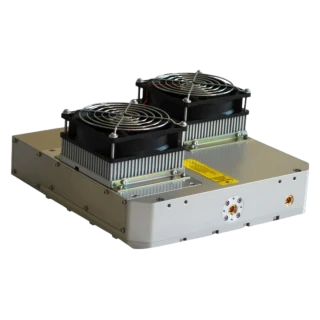
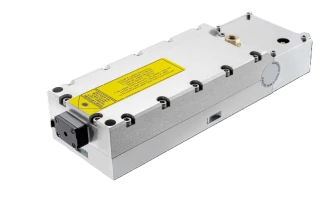
The Lampo SHG series represents the cutting edge in Diode-Pumped Solid State (DPSS) laser technology, designed to deliver ultrafast laser pulses in the green spectrum at 532 nm. This series is distinguished by its ability to produce picosecond (ps) pulses with high peak power capabilities up to 2.5 MW, alongside a highly configurable Pulse Repetition Rate (PRR) that spans from 50 kHz to 40 MHz, catering to a broad spectrum of precision applications.
Optimized Performance Parameters: Operating with pulse widths under 70 picoseconds, the Lampo SHG laser ensures minimal thermal impact on targeted materials, making it suitable for delicate and precision-intensive tasks. The series boasts an average power output of up to 10W, providing a balance between intensity and continuous operation for demanding application environments.
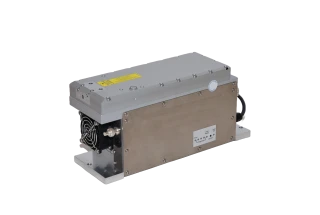
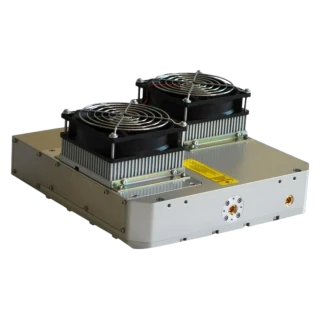
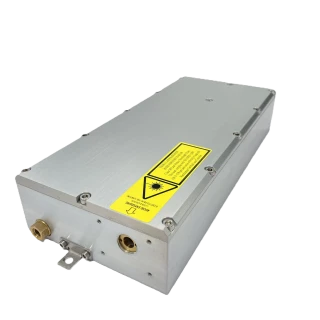
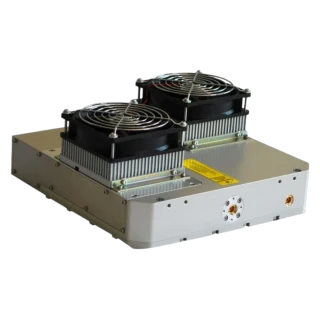
Innovative Design and Versatility: Encased in a compact, air-cooled design, the Lampo SHG laser is engineered for ease of integration into various setups, from laboratory benches to industrial assembly lines. The active Q-Switching technology employed allows for precise control over pulse parameters, enhancing the laser's adaptability across different operational requirements.
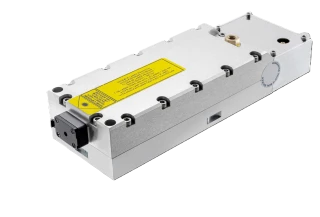
Lampo SHG 532nm: Compact Ultrafast DPSS Laser
Specifications
| Avg. Power: | 0.01 W |
|---|---|
| Wavelength: | 532 nm |
| Repetition Rate: | 50 – 40000 kHz |
| Pulse Duration: | 0.07 ns |
| Cooling: | Air |
| Peak Power: | 2.5 MW |
| Q-Switch: | Active |
| Laser Beam Quality: | <1.5 |
| Pulse Energy: | 150 uJ |
| Warranty: | 1 year |
| Laser Linewidth: | <0.2 nm |
| Sync Signal Output: | Yes |
| Laser Supply Voltage: | 24 V |
| Laser Supply Power: | <350 W |
| Operating Temperature Range: | 15-35 ℃ |
| Laser Head Dimensions: | 30x15x13 cm3 |
| Weigh: | <10 kg |
Got questions about specs? Use the inquiry form to ask.
 Download Data Sheet

Features
- Compact ultrafast DPSS laser platform: Lampo by Bright Solutions is a rugged, all-in-one picosecond laser designed for scientific, industrial, defense, medical, biological, and LIDAR applications.
- High peak power picosecond pulses: Delivers few-tens-of-picoseconds pulse duration, typically <70 ps, with peak power up to 4.5 MW for efficient precision laser processing and high-resolution optical measurements.
- Multiple wavelength options: Available at 1064 nm IR, 532 nm green SHG, and 266 nm deep UV, with 355 nm UV versions available on request for application-specific integration.
- Wide repetition-rate flexibility: Selectable pulse repetition rate from 50 kHz to 40 MHz, enabling optimization for micromachining, spectroscopy, LIDAR, materials processing, and research workflows.
- External trigger capability: Supports external pulse triggering for synchronization with scanners, motion stages, cameras, detectors, timing electronics, and advanced laser systems.
- High average output power: Provides up to 20 W at 1064 nm, up to 10 W at 532 nm, and up to 1.5 W at 266 nm, depending on configuration and operating conditions.
- High pulse energy: Offers pulse energy up to 250 µJ at 1064 nm, up to 150 µJ at 532 nm, and up to 30 µJ at 266 nm, with pulse energy dependent on repetition rate.
- Excellent beam quality: Beam quality better than M² < 1.6 for IR and M² < 1.5 for green and deep UV versions, supporting tight focusing and high-precision laser-material interaction.
- Narrow laser linewidth: Linewidth below 0.4 nm at 1064 nm, below 0.2 nm at 532 nm, and below 0.1 nm at 266 nm, making Lampo suitable for demanding optical and measurement applications.
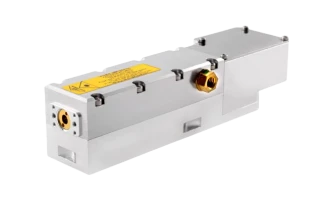
- Integrated single-unit laser head: Combines monolithic optical section, driving electronics, power electronics, and air-cooling fans in one compact laser head for easier installation and system integration.
- Rugged industrial design: Built for reliability, compactness, and efficient operation in laboratory and OEM environments requiring a robust ultrafast picosecond laser source.
- Air-cooled operation: Standard air cooling simplifies deployment and reduces facility requirements; water-cooling options are available for selected configurations or application needs.
- Low-voltage power supply: Operates from a 24 V supply with total supply power below 350 W, supporting integration into compact instruments and mobile systems.
- Compact and lightweight: Typical laser head dimensions are approximately 30 × 15 × 13 cm³ for IR/SHG versions and 40 × 15 × 13 cm³ for deep-UV versions, with weight below 10 kg.
- Built-in synchronization output: Sync signal output enables timing coordination with external acquisition systems, scanners, detectors, and control electronics.
- Precision micromachining ready: Ideal for laser processing of metals, semiconductors, polymers, glass, sapphire, ceramics, and optically transparent substrates.
- Optimized for LIDAR systems: Short pulse duration, high peak power, narrow bandwidth, and broad repetition-rate control support long-range and high-precision LIDAR with improved resolution and faster data acquisition.
- Suitable for UV laser processing: Deep-UV 266 nm output enables high-absorption, low-thermal-impact processing for delicate materials, microfabrication, thin films, and transparent substrates.
- Flexible pulse-train control: Freely controllable pulse trains make Lampo suitable for advanced timing schemes, burst-like operation strategies, triggered measurements, and customized processing recipes.
- Reliable OEM integration: Compact footprint, electrical efficiency, external triggering, sync output, and integrated electronics make Lampo a strong choice for OEM picosecond laser systems and automated production tools.
- Application versatility: Well suited for ultrafast laser micromachining, marking, drilling, ablation, surface structuring, spectroscopy, fluorescence excitation, remote sensing, medical device manufacturing, biological research, and defense instrumentation.
Applications
Applications for the Lampo Compact Ultrafast Picosecond DPSS Laser
- Precision laser micromachining: High peak power picosecond pulses enable clean, accurate micro-drilling, micro-cutting, scribing, patterning, and surface structuring with minimal heat-affected zone.
- Industrial materials processing: Suitable for processing metals, ceramics, semiconductors, polymers, glass, sapphire, and transparent substrates where high beam quality and short pulse duration are required.
- Semiconductor processing: Ideal for wafer dicing, thin-film patterning, selective material removal, micro-via drilling, and precision ablation of semiconductor materials.
- Glass and sapphire micromachining: Picosecond pulse operation supports controlled ablation, internal modification, cutting, drilling, and marking of hard, brittle, and optically transparent materials.
- UV laser processing: 266 nm deep-UV and optional 355 nm UV wavelengths are well suited for high-resolution polymer processing, microelectronics manufacturing, PCB drilling, thin-film removal, and precision surface modification.
- Polymer and plastic processing: Enables fine-feature laser marking, drilling, trimming, and ablation of polymers with reduced melting, charring, and thermal damage.
- Metal marking and engraving: Supports permanent, high-contrast laser marking, engraving, and traceability coding on stainless steel, aluminum, titanium, copper, and other industrial metals.
- Medical device manufacturing: Useful for precision laser cutting, micro-drilling, texturing, and marking of stents, catheters, surgical tools, implants, and miniature medical components.
- Electronics and microelectronics manufacturing: Applicable to PCB micro-drilling, flexible electronics processing, component trimming, resistor trimming, sensor fabrication, and high-precision electronic packaging workflows.
- Thin-film ablation and patterning: High-quality picosecond pulses enable selective removal of coatings, conductive films, dielectric layers, optical coatings, and functional thin films.
- Laser surface texturing: Suitable for creating micro- and nano-scale surface features to improve adhesion, wettability, friction behavior, tribology, biocompatibility, and optical properties.
- Scientific research and laboratory integration: Compact, air-cooled, externally triggerable operation makes Lampo suitable for spectroscopy, nonlinear optics, pump-probe experiments, optical testing, and advanced photonics research.
- LIDAR and laser range finding: Short picosecond pulse duration, narrow linewidth, high peak power, and selectable repetition rate support long-range, high-resolution LIDAR, time-of-flight measurements, and precision distance sensing.
- Remote sensing and atmospheric measurements: Suitable for integration into compact laser-based sensing systems requiring stable pulsed operation, high beam quality, and flexible pulse repetition frequency.
- Defense and aerospace systems: Rugged single-unit construction, compact footprint, and 24 V operation support integration into airborne, mobile, and field-deployable laser systems.
- Biophotonics and life science instrumentation: Applicable to fluorescence excitation, laser-induced breakdown spectroscopy, microscopy support, bio-sensing, and precision interaction with biological samples when appropriate wavelength and energy settings are selected.
- Laser-induced breakdown spectroscopy: Megawatt-level peak power pulses support plasma generation for LIBS material identification, elemental analysis, industrial inspection, and field-deployable analytical systems.
- Nonlinear optics and harmonic generation: The 1064 nm, 532 nm, 355 nm, and 266 nm wavelength options support nonlinear optical experiments, frequency conversion studies, and wavelength-dependent material interaction research.
- Optical component testing: Useful for damage-threshold testing, coating evaluation, detector characterization, beam delivery testing, and validation of optics designed for high-peak-power pulsed laser systems.
- Precision ablation and cold processing: Picosecond laser pulses reduce thermal diffusion compared with longer pulse lasers, making Lampo suitable for delicate parts, miniaturized components, and high-value materials.
- High-speed laser processing: Repetition-rate control from 50 kHz to multi-MHz operation supports scalable industrial throughput, synchronized motion control, and process optimization.
- Externally synchron
Frequently Asked Questions
What is the peak power capability of the Lampo SHG laser?
How adjustable is the repetition rate in the Lampo SHG series?
What are the pulse width specifications for the Lampo SHG laser?
What cooling mechanism is employed in the Lampo SHG series?
Can the Lampo SHG laser be integrated into various systems?
In which applications does the Lampo SHG laser excel?
How does the Lampo SHG laser ensure consistent pulse quality?
Got more questions? Use the inquiry form to ask the supplier directly.
Similar Products
Your inquiry has been received.
Create an account by adding a password
Why create an account?
- Auto-complete inquiry forms
- View and manage all your past messages
- Save products to your favorites
- Close your account anytime — no hassle