


Description
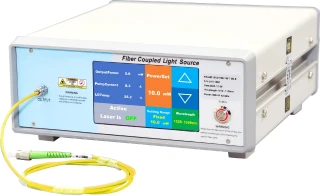
The 1064 nm Pulsed Laser Source Module is a compact, diode-based pulsed laser designed specifically for demanding industrial, research, and OEM applications. Operating in the 1032–1080 nm wavelength range with a typical center wavelength of 1064 nm, it provides high peak power up to 1 W in a space‑saving module form factor. This source is engineered as an ideal seed laser for pulsed fiber lasers, combining short pulse capability, narrow spectral width, and excellent stability in one integrated platform.
Built around a high‑performance semiconductor laser diode optimized for pulsed operation, the module uses direct current modulation through a carefully designed pulse driver circuit. This architecture enables pulse widths from 1 ns to 1 µs, with fast rise and fall times around 2 ns, supporting repetition rates up to 1 MHz (1000 kHz). Such a wide operating window allows users to fine‑tune pulse parameters for time‑resolved measurements, nonlinear optics experiments, and fiber‑based sensing systems. With a spectral width (FWHM) of ≤1 nm and side‑mode suppression ratio of at least 20 dB, the source delivers clean, well‑defined pulses suited for precision optical test and measurement tasks.
For seamless integration into larger systems, the 1064 nm pulsed laser source adopts a robust module package powered from a standard 12 V DC supply. It incorporates an industrial‑standard RS‑232 control interface that allows full parameter control via upper‑computer software, making remote configuration, automation, and monitoring straightforward. A built‑in signal generator simplifies stand‑alone operation, while an external TTL trigger input enables synchronous pulsed output driven by user electronics, which is crucial in timing‑critical setups such as gated detection, pump‑probe experiments, and synchronized multi‑laser platforms.
The optical output is provided through single‑mode fiber (with polarization‑maintaining fiber optional) and a standard FC/APC connector, ensuring stable beam delivery and low back‑reflection into the source. Output isolation is integrated to further protect the laser diode from return loss and environmental perturbations. With more than 1 m of fiber pigtail as standard and other connector options available on request, the module can be easily incorporated into fiber‑based measurement benches, interferometers, and distributed sensing networks. This fiber‑coupled configuration mirrors the approach used by many advanced 1064 nm seed sources and pulsed laser modules in the broader photonics market.
Stability and reliability are central to the design. The module offers excellent output power stability, typically within ±0.5% over 15 minutes and ±1.0% over 8 hours after warm‑up under standard laboratory conditions. This level of performance is comparable to or better than many similar pulsed diode sources used in precision metrology and optical characterization systems. The output power can be adjusted from 0 to 100% using both coarse and fine control modes, allowing users to set and maintain the optimal operating level for sensitive detectors, nonlinear crystals, or fiber components without over‑illumination or damage.
With a maximum power consumption of up to 30 W and an operating temperature range from 0 to 50 °C, the module is well‑suited to integration into OEM systems and 24/7 setups where long‑term stability and low maintenance are required. The compact housing, typically around 150 mm × 125 mm × 25 mm, allows straightforward installation in crowded optical racks, enclosures, or portable instruments. Its robust construction and extended storage temperature range from −40 to 85 °C support reliable operation in diversified environments, from standard labs to industrial test lines and field‑deployable instrumentation.
Typical application areas include use as a seed laser for pulsed fiber lasers, time‑resolved test and measurement, optical fiber sensing (including distributed sensors and interferometric detection), spectral analysis, and a wide range of general laboratory experiments requiring a stable, pulsed 1064 nm source. Thanks to its combination of short pulse operation, high peak power, narrow linewidth, fiber‑coupled output, and flexible control interfaces, this 1064 nm Pulsed Laser Source Module offers a highly versatile platform for developers, system integrators, and researchers working in advanced photonics and laser‑based measurement systems.
Connet 1064nm Pulsed Laser Source Module 1W Seed Laser for Fiber
Specifications
| Wavelength: | 1064 nm |
|---|---|
| Average Output Power: | 0.4 W |
| Pulse Duration: | 1 – 1000 ns |
| Beam Quality (M^2): | 1.1 |
| Max Pulse Repetition Rate: | 1000 kHz |
| Part Number: | VLSS-1064-M-PL |
| Operating Wavelength: | 1032–1080 nm (1064 nm typ.) |
| Spectral Width (FWHM): | ≤ 1 nm |
| Peak Power: | up to 1 W (1000 mW max) |
| Pulse Rise And Fall Time: | 2 ns typ. |
| Pulse Width: | 1–1000 ns |
| Repetition Rate: | up to 1000 kHz |
| Side-mode Suppression Ratio (SMSR): | ≥ 20 dB |
| Output Power Stability (15 Min): | ±0.5% typ., ±1.0% max |
| Output Power Stability (8 Hrs): | ±1.0% typ., ±2.0% max |
| Output Power Adjustable Range: | 0–100 % |
| Output Power Adjustable Mode: | Coarse/Fine |
| Operating Voltage: | 12 V DC |
| Power Consumption: | ≤ 30 W |
| Operating Temperature: | 0–50 ℃ |
| Storage Temperature: | -40–85 ℃ |
| Output Fiber Type: | SM fiber (PM optional) |
| Output Fiber Length: | > 1 m |
| Optical Connector: | FC/APC (other options available) |
| Dimension: | 150 × 125 × 25 mm (L × W × H) |
| Control Interface: | RS232 |
| Supply Type: | 12 V DC module |
| Trigger Input: | External TTL trigger supported |
Got questions about specs? Use the inquiry form to ask.
 Download Data Sheet

Features
- High-Performance 1064 nm Pulsed Laser Source – Operating wavelength range of 1032–1080 nm centered at 1064 nm, ideal as a seed laser for pulsed fiber lasers and precision test setups.
- Short Pulse Operation (1 ns – 1 µs) – Flexible pulse width adjustment from 1 ns to 1000 ns, supporting nS-level and MHz-class pulsed operation for a wide variety of time‑resolved applications.
- Up to 1 W Peak Power – Delivers peak power up to 1 W (higher peak powers available on request), suitable for seeding high‑gain fiber amplifiers, nonlinear optics experiments, and demanding sensing systems.
- High Repetition Rates up to 1 MHz – Supports repetition rates up to 1000 kHz (1 MHz), enabling high‑throughput measurements and fast data acquisition in laboratory and industrial environments.
- Fast Rise and Fall Times – Typical pulse rise/fall time of about 2 ns ensures clean pulse edges and high temporal resolution, critical for time‑of‑flight, optical sampling, and transient phenomena studies.
- Narrow Spectral Width & Good SMSR – Spectral width (FWHM) ≤ 1 nm with side‑mode suppression ratio ≥ 20 dB, providing spectrally clean output for fiber sensing, spectroscopy, and coherent detection systems.
- Excellent Power Stability – Output power stability of ±0.5% (15 minutes) and ±1.0% (8 hours) typical, minimizing drift and improving measurement repeatability in long‑term experiments.
- Integrated Pulse Generation & External Triggering – Built‑in signal generator allows direct pulse generation; the module also supports external TTL trigger input for precise synchronization with external equipment.
- Wide Dynamic Output Power Control – 0–100% output power adjustment range with coarse and fine control modes, enabling easy optimization of power levels for different optical components and setups.
- Output Isolation for System Protection – Integrated optical isolation protects the internal diode laser from back reflections, enhancing stability and extending the lifetime of the source.
- Compact Module for Easy Integration – Space‑saving footprint of approximately 150 (L) × 125 (W) × 25 (H) mm, designed for OEM and system integrators looking to embed a stable 1064 nm pulsed source.
- Standard 12 V DC Operation with Low Power Consumption – Operates from a single 12 V DC supply with maximum power consumption up to 30 W, compatible with typical industrial and laboratory power systems.
- Industrial RS232 Control Interface – Standard RS232 interface and user‑friendly host computer software enable convenient control of pulse width, repetition rate, and output power for remote or automated operation.
- Fiber-Coupled Output for Plug-and-Play Use – Standard single-mode fiber output (PM fiber optional) with fiber length > 1 m and FC/APC connector (other connectors available), simplifying coupling into fiber systems and reducing back‑reflection.
- Rugged Design with Wide Operating Temperature Range – Engineered for high stability and reliability with an operating temperature range of 0 to 50 °C and storage from -40 to 85 °C, suitable for both lab and light‑industrial environments.
- Customizable Pulse Parameters & Peak Power – Ordering options allow configuration of pulse width (ns), repetition rate (kHz), and peak power (W) to match specific application requirements in sensing, spectroscopy, and laser system development.
- Ideal for Fiber Laser Seeding and Optical Sensing – Optimized for applications such as seed laser for pulsed fiber lasers, optical fiber sensing, test and measurement, spectrum analysis, and other research and industrial lab uses.
Applications
- Seed Laser for Pulsed Fiber Lasers
Designed as an ideal master oscillator for high‑power pulsed fiber laser systems in materials processing, LIDAR, and medical equipment, providing ns–µs pulse seeding at 1032–1080 nm with up to 1 W peak power. - Test and Measurement of Photonic Components
Used as a stable 1064 nm pulsed source for characterizing optical components such as isolators, couplers, AOMs, EO modulators, and photodetectors, enabling precise response and dynamic range measurements. - Optical Fiber Sensing and Distributed Sensing Systems
Suitable for BOTDA/BOTDR, Φ‑OTDR, and other distributed fiber sensing systems (temperature, strain, and vibration monitoring) that require narrow-linewidth, high‑stability pulsed laser sources in the 1 µm band. - Spectrum Analysis and Optical Spectroscopy
Provides a narrow 1064 nm pulsed beam for high‑resolution optical spectrum analysis, gain spectrum measurements, nonlinear spectral broadening studies, and spectroscopic research in solids, liquids, and gases. - Nonlinear Optics and Frequency Conversion Experiments
Used as a pump or seed in nonlinear crystals and waveguides for second‑harmonic generation (532 nm), sum‑frequency generation, supercontinuum generation, and other χ(2)/χ(3) nonlinear optics experiments. - Laser Ranging, LiDAR, and Time‑of‑Flight Systems
Acts as a compact pulsed 1064 nm source for time‑of‑flight ranging, 3D scanning LiDAR prototypes, and optical altimetry systems that need controllable pulse widths from 1 ns to 1 µs and kHz repetition rates. - Optical Time‑Domain Reflectometry (OTDR)
Integrated in OTDR and related diagnostic tools for characterizing fiber links, splices, and connectors, where short, high‑peak‑power pulses at 1064 nm improve spatial resolution and backscatter signal levels. - Laser System Integration and OEM Modules
With 12 V DC supply, RS‑232 control, and external TTL triggering, it is ideal for OEM integration into industrial laser subsystems, instrumentation racks, and portable photonics platforms. - Laboratory Research and Development
Serves as a general‑purpose 1064 nm pulsed laser source for university and corporate R&D labs conducting experiments in laser physics, photonics, fiber components, and prototype system development. - Pump and Seed Source for Fiber Amplifiers
Used as a seed for ytterbium‑doped fiber amplifiers (YDFA/YDFA‑like stages) in pulsed mode, enabling scalable energy and power while preserving pulse characteristics defined at the seed stage. - Photoacoustic and Ultrasound Generation
Employed in compact photoacoustic setups where nanosecond and microsecond 1064 nm pulses are used to generate acoustic waves in solids or tissues for imaging, sensing, or nondestructive testing. - Micro‑Machining and Materials Interaction Studies
Suitable as a seed or low‑power source for studying laser–material interaction at 1064 nm, including ablation thresholds, surface modification, and development of micromachining process parameters. - Calibration of Detection and Timing Electronics
Used to calibrate high‑speed photodetectors, oscilloscopes, timing electronics, and photon‑counting modules by providing repeatable, narrow optical pulses over a wide range of repetition rates. - Education and Training in Laser Technology
Integrated into teaching setups in photonics and laser engineering courses to demonstrate principles of pulsed laser operation, modulation, fiber coupling, and system control via RS‑232 and TTL triggers. - Prototype Development for 1 µm Laser Systems
Acts as a flexible core source for prototyping new 1 µm laser products, including medical lasers, industrial marking systems, and sensing platforms that later scale to higher power architectures.
Frequently Asked Questions
What is the Connet VLSS-1064-M-PL 1064 nm pulsed laser source module and what are its main applications?
What are the key optical performance specifications of the VLSS-1064-M-PL pulsed laser source?
How is the pulse timing generated and controlled on this 1064 nm pulsed laser module?
How stable and reliable is the VLSS-1064-M-PL 1064 nm pulsed laser source for long‑term operation?
What fiber output options and connectors are available on the VLSS-1064-M-PL pulsed laser module?
How is the VLSS-1064-M-PL powered and controlled, and what are the electrical requirements?
How do I specify pulse width, repetition rate, and peak power when ordering the VLSS-1064-M-PL module?
Got more questions? Use the inquiry form to ask the supplier directly.
Similar Products


Your inquiry has been received.
Create an account by adding a password
Why create an account?
- Auto-complete inquiry forms
- View and manage all your past messages
- Save products to your favorites
- Close your account anytime — no hassle