

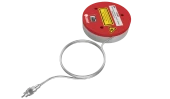
Description
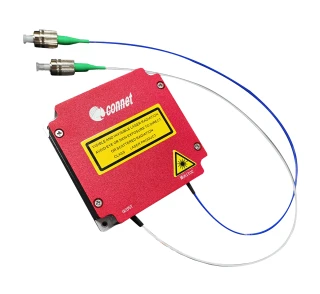
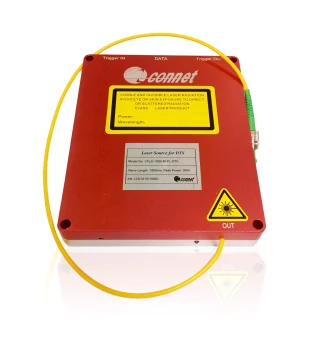
The CoLID-I-1550 is a compact, high‑performance short pulse fiber laser specifically engineered for modern LiDAR and time‑of‑flight applications. Operating at an eye‑safer 1550 nm wavelength, this laser module delivers high peak power up to 10 kW and pulse energy up to 100 µJ in a miniature disc‑type housing. Its MOPA (Master Oscillator Power Amplifier) architecture and optimized multi‑stage amplification enable very short pulse widths from 0.5 ns to 250 ns and repetition rates from 1 kHz to 3 MHz, making it well suited for both long‑range and high‑resolution ranging systems.
Designed for seamless integration into OEM platforms, the CoLID-I-1550 combines an internal trigger mode with an external TTL trigger option, allowing precise synchronization with system electronics, scanners, or detectors. This flexibility is critical in advanced LiDAR, 3D scanning, and telemetry systems where timing control and waveform shaping can significantly influence measurement accuracy and detection probability. With random polarization and near diffraction‑limited beam quality (M² < 1.1), the laser supports efficient beam shaping and focusing for a variety of optical setups, including free‑space and fiber‑coupled configurations.
A key advantage of this 1550 nm fiber laser source is its robust performance over a wide operating temperature range from −35 °C to +65 °C, with typical output power stability of ±1.5% over 8 hours after warm‑up. This environmental resilience positions the CoLID-I-1550 as a strong candidate for outdoor and mobile LiDAR units, unmanned platforms, and industrial metrology equipment that must operate reliably in harsh or fluctuating conditions. Compared with many bulk solid‑state pulsed lasers, the fiber‑based design offers improved stability, reduced maintenance requirements, and intrinsically better beam quality, helping to lower total cost of ownership in demanding field deployments.
The module’s low power consumption (typically around 16 W at room temperature) and DC supply range of 5.5–12 V simplify integration into battery‑powered or space‑constrained systems. A footprint of approximately 90 mm in diameter and 23.5 mm in height, along with a weight under 300 g, makes it easy to incorporate into compact LiDAR heads, handheld rangefinders, or multi‑channel sensor arrays. Output is available via FC/APC fiber connector or collimated free‑space beam, enabling straightforward coupling into existing optical assemblies or custom front‑end optics for scanning and beam steering.
In comparison with conventional 905 nm pulsed diode sources, 1550 nm fiber lasers like the CoLID-I-1550 enable higher allowable transmit power under eye‑safety regulations, increasing effective detection range and signal‑to‑noise ratio without compromising safety. This makes the laser especially attractive for long‑range LiDAR, eye‑safe rangefinding, and high‑precision telemetry. The broad repetition‑rate range supports both low‑duty‑cycle, high‑energy pulses for extended‑distance measurements and higher‑frequency operation for dense 3D point clouds in scanning and mapping systems.
Typical applications include automotive and industrial LiDAR, long‑range rangefinders, telemetry systems, 3D scanning and imaging, atmospheric metrology, and pollution or particulate detection, as well as general scientific research requiring controllable, high‑peak‑power, nanosecond‑class pulses at 1550 nm. Custom configurations are possible, with selectable pulse width, repetition rate, and peak power combinations, along with optional collimated output, enabling users to tailor the CoLID-I-1550 to the specific optical and performance requirements of their measurement platform.
CoLID-I 1550nm Short Pulse Fiber Laser for LiDAR
Specifications
| Wavelength: | 1550 nm |
|---|---|
| Average Output Power: | 1.5 W |
| Pulse Duration: | 0.5 – 250 ns |
| Beam Quality (M^2): | 1.1 |
| Max Pulse Repetition Rate: | 3000 kHz |
| Part Number: | CoLID-I-1550 |
| Center Wavelength: | 1540–1565 nm (typ. 1550 nm) |
| Pulse Energy @ <10 KHz: | up to 100 μJ |
| Peak Power: | up to 10 kW |
| Average Power @ >100 KHz: | up to 1.5 W |
| Pulse Width: | 0.5–250 ns |
| Repetition Rate: | 1–3000 kHz |
| Beam Quality M²: | <1.1 |
| Polarization: | Random |
| Output Power Stability (8 Hrs): | ±1.5 % |
| Output Isolation: | ≥45 dB |
| Operating Temperature: | -35 to +65 ℃ |
| Storage Temperature: | -40 to +85 ℃ |
| Power Consumption (room Temp.): | 16–18 W |
| Operating Voltage: | 5.5–12 V DC |
| Trigger Mode: | Internal or External TTL Trigger |
| Output Fiber Length: | >0.3 m |
| Optical Connector: | FC/APC or Collimator |
| Weight: | <300 g |
| Dimension: | 90 × 23.5 mm (D × H) |
| Eye-safe Wavelength: | 1550 nm |
Got questions about specs? Use the inquiry form to ask.
 Download Data Sheet

Features
- Eye-Safe 1550 nm Wavelength for LiDAR – Operates in the 1550 nm eye‑safe band (1540–1565 nm), ideal for automotive LiDAR, range finding, and outdoor sensing where laser safety and long‑range performance are critical.
- High Peak Power up to 10 kW – Delivers very high peak power pulses (up to 10 kW), enabling long detection ranges, high signal‑to‑noise ratio, and high‑resolution time‑of‑flight measurements even in challenging environments.
- Short Pulse Width from 0.5 ns to 250 ns – Ultra‑short pulse capability down to 0.5 ns for superior distance resolution, with adjustable pulse width up to 250 ns to optimize for different LiDAR, telemetry, and metrology requirements.
- Wide Repetition Rate Range: 1 kHz to 3 MHz – Flexible repetition rate from single‑shot/low‑rate operation (1 kHz) up to 3 MHz, supporting diverse system architectures from long‑range scanning LiDAR to high‑speed 3D imaging.
- High Pulse Energy up to 100 µJ – Generates up to 100 µJ per pulse at low repetition rates (<10 kHz), increasing detectable range and improving performance under fog, dust, and other adverse atmospheric conditions.
- Near Diffraction-Limited Beam Quality (M² < 1.1) – Excellent beam quality allows tight focusing and low divergence, maximizing on‑target energy density and improving spatial resolution for scanning and mapping applications.
- MOPA Architecture for Stable, Clean Pulses – Master Oscillator Power Amplifier (MOPA) design with optimized multi‑stage amplification delivers clean, stable pulses with low noise, well‑suited for precise timing and coherent detection schemes.
- Internal and External TTL Trigger Modes – Supports both integrated internal triggering and external TTL trigger input, simplifying synchronization with LiDAR controllers, scanners, and data‑acquisition electronics for easy system integration.
- Excellent Power Stability (±1.5% over 8 Hours) – Output power stability of ±1.5% (after warm‑up at 25 °C) ensures repeatable measurements and reduces calibration time in demanding industrial and scientific setups.
- Wide Operating Temperature Range: -35 °C to +65 °C – Designed for harsh field environments, from cold outdoor conditions to elevated ambient temperatures, making it suitable for automotive, aerospace, and outdoor surveying systems.
- Low Power Consumption, Compact Mini Disc-Type Module – Typical electrical consumption around 16 W (max 18 W) in a compact 90 × 23.5 mm disc‑type housing (<300 g), ideal for space‑ and power‑constrained platforms such as drones, robots, and mobile instrumentation.
- Random Polarization with High Output Isolation – Random polarization provides robust performance in a variety of optical setups, while ≥45 dB output isolation protects the laser from back‑reflections common in LiDAR optics and measurement systems.
- Flexible Output Interface Options – Standard FC/APC fiber connector for low‑back‑reflection coupling, with optional collimator (Col) to simplify free‑space beam delivery into scanners, telescopes, or custom optics.
- Configurable Pulse Parameters at Ordering – User‑selectable pulse width (XX, in ns), repetition rate (YY, in kHz), and peak power (ZZ, in kW) at order time provide easy customization for specific LiDAR, telemetry, or 3D scanning designs.
- Broad Application Coverage – Optimized for LiDAR, range finding, telemetry, 3D scanning, metrology, pollution detection, and scientific research, matching or exceeding performance of comparable 1550 nm short‑pulse fiber lasers used in modern sensing platforms.
- Robust, Integration-Ready Design – Short output fiber length (>0.3 m), DC 5.5–12 V supply compatibility, and compact mechanical footprint make this source easy to embed into OEM LiDAR engines, measurement modules, and research systems.
- Available at Other Wavelengths on Request – While optimized at 1550 nm, the CoLID series can be provided at other wavelengths, allowing system designers to tailor the source to specific atmospheric windows or detector technologies.
Applications
- Automotive LiDAR Systems – Short‑pulse 1550 nm source for long‑range, eye‑safe automotive LiDAR, adaptive cruise control, collision avoidance, and autonomous driving perception stacks.
- Robotics and Mobile Platform LiDAR – Compact, low‑power laser engine for SLAM, obstacle detection, and navigation in AGVs, warehouse robots, drones, and delivery robots.
- Aerial and UAV‑Based LiDAR – Lightweight, vibration‑tolerant pulsed laser for UAV/drone‑mounted LiDAR used in mapping, surveying, and corridor inspection.
- 3D Scanning and 3D Imaging – High peak power, short pulsewidth source for time‑of‑flight 3D scanners, structured‑light alternatives, and high‑resolution depth imaging systems.
- Long‑Range Distance Measurement (Range Finding) – Eye‑safe fiber laser for long‑range rangefinders in defense, security, and industrial distance‑measurement instruments.
- Telemetry and Time‑of‑Flight (ToF) Measurements – Stable, narrow pulses for precision ToF telemetry, target tracking, and line‑of‑sight measurement systems.
- Topographic and Terrain Mapping – Airborne and ground‑based LiDAR for creating high‑accuracy DEM/DTM, contour maps, and digital surface models for civil engineering and mining.
- Bathymetric and Coastal LiDAR – Eye‑safe pulsed source suitable for dual‑wavelength and multi‑channel LiDAR used in shallow‑water mapping and coastline monitoring.
- Forestry and Vegetation Canopy Analysis – LiDAR systems for biomass assessment, canopy height measurement, and ecological monitoring in forestry management.
- Infrastructure and Power Line Inspection – High‑resolution LiDAR for power‑line, railway, and pipeline monitoring, clearance analysis, and vegetation encroachment detection.
- Smart City and Traffic Monitoring – Integrated in LiDAR sensors for traffic flow analytics, vehicle counting, pedestrian detection, and intelligent transportation systems.
- Industrial Automation and Safety Scanners – Range‑finding core for safety LiDAR scanners, perimeter guards, collision‑avoidance systems, and robot cell safety curtains.
- Metrology and Precision Alignment – Short‑pulse laser source for high‑precision distance metrology, machine alignment, and dimensional control in manufacturing.
- Geospatial Surveying and GIS – Primary illumination source for geospatial LiDAR payloads used in urban mapping, corridor surveys, and large‑area GIS data acquisition.
- Construction and Mining Survey – Ruggedized LiDAR modules for stockpile volume calculation, pit wall profiling, and site monitoring in harsh outdoor environments.
- Wind and Atmospheric LiDAR (1550 nm) – Suitable for Doppler and backscatter LiDAR configurations for boundary‑layer studies, aerosol profiling, and wind‑field mapping.
- Pollution and Gas Detection – Eye‑safe wavelength range for differential absorption LiDAR (DIAL) and remote sensing of aerosols, particulates, and atmospheric pollutants.
- Environmental and Climate Research – Remote sensing of clouds, fog, and atmospheric constituents using compact LiDAR transmitters in field research platforms.
- Security and Surveillance LiDAR – Covert, eye‑safe illumination for perimeter surveillance, intrusion detection, and target recognition in low‑visibility conditions.
- Maritime and Port Monitoring – LiDAR‑based ranging for vessel detection, port traffic management, and obstacle detection in harbors and coastal zones.
- Railway and Tunnel Profiling – 3D LiDAR scanners for tunnel clearance verification, rail infrastructure mapping, and obstacle detection along tracks.
- Warehouse and Logistics Automation – Compact laser for indoor LiDAR sensors used in automated storage, forklift guidance, and precise pallet localization.
- SLAM and Real‑Time Mapping Modules – Integrated into LiDAR units for real‑time 3D mapping in robotics, AR/VR spatial sensing, and mobile mapping platforms.
- Optical Time‑Domain Reflectometry (OTDR) – Short pulses and high peak power for extended‑range OTDR and fiber infrastructure diagnostics in the 1550 nm window.
- Laboratory Time‑Resolved Experiments – Triggerable nanosecond pulses for time‑correlated measurements, lifetime studies, and fast transient phenomena.
- Nonlinear Optics Pump Source (1550 nm) – MOPA‑based, high peak power source for supercontinuum generation, harmonic generation, and other nonlinear experiments.
- Optical Component and System Characterizat
Frequently Asked Questions
What is the Connet CoLID-I-1550 1550 nm short pulse fiber laser and what are its key specifications?
Is the CoLID-I-1550 laser eye-safe and why is 1550 nm commonly used for LiDAR and range finding?
How do I configure the pulse width, repetition rate, and peak power when ordering a CoLID-I-1550 fiber laser?
What trigger modes does the CoLID-I-1550 support and how is it integrated into a LiDAR or ranging system?
What beam quality and output characteristics does the CoLID-I-1550 provide and why are they important for LiDAR and 3D scanning?
What environmental and electrical conditions are required to operate the CoLID-I-1550 short pulse fiber laser?
What output interface options are available for the CoLID-I-1550 and how do connector choices affect system design?
Got more questions? Use the inquiry form to ask the supplier directly.
Similar Products
Your inquiry has been received.
Create an account by adding a password
Why create an account?
- Auto-complete inquiry forms
- View and manage all your past messages
- Save products to your favorites
- Close your account anytime — no hassle