


Description
The MARS series 1.0 µm high power pulsed fiber amplifiers are engineered for demanding short-pulse amplification applications where high peak power, beam quality, and stability are critical. Optimized specifically for pulse widths below 50 ns, these amplifiers leverage advanced double-cladding ytterbium-doped fiber technology to deliver peak output powers up to 50 kW while maintaining excellent beam characteristics (M² < 1.2). With a typical wavelength range from 1040 to 1083 nm and commonly used operating points at 1053 nm, 1064 nm, and 1083 nm, the MARS series provides the flexibility and performance required for modern industrial, scientific, and defense-grade photonics systems.
Designed with a focus on high optical-to-optical conversion efficiency and minimized nonlinear effects, the MARS amplifiers ensure that pulse shape and spectral integrity are preserved throughout the amplification process. The specialized fiber architecture and carefully managed gain dynamics help avoid undesirable spectral broadening, self-phase modulation, and other nonlinear phenomena that can degrade temporal and spectral pulse quality. This robust performance makes the MARS series comparable to leading short-pulse fiber amplifiers available globally for LiDAR, fiber laser seeding, nonlinear optics experiments, and precision micromachining.
Long-term operational stability is supported by a unique thermal treatment process applied to the active fiber and amplifier assembly. This proprietary thermal management approach enhances component reliability and enables stable operation over extended periods, even under high average power and high repetition rate conditions (10 kHz to 500 kHz). In addition, an integrated high-speed response protection circuit continuously monitors both input and output optical power. This fast-acting protection intelligently adjusts or shuts down the amplifier in abnormal conditions, safeguarding upstream seed lasers, downstream optics, and the amplifier itself from damage due to back-reflections, misalignment, or system faults.
The MARS series is available with both single-mode and polarization-maintaining output configurations to suit a wide range of system architectures. Single-mode versions are ideal where diffraction-limited beam quality and flexible polarization are sufficient, while PM versions with a high polarization extinction ratio (typically ≥20 dB) are well suited for coherent detection, interferometry, polarization-sensitive nonlinear conversion, and coherent beam combining. Output power is tunable from 10% to 100%, allowing users to precisely match power levels to varying experimental conditions or process requirements without compromising stability or beam quality.
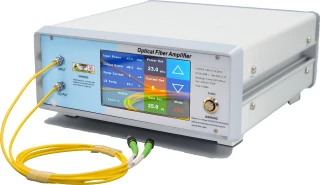
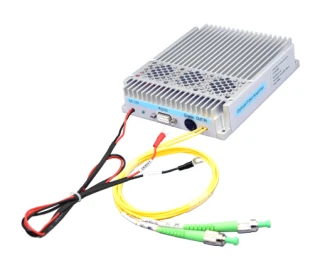
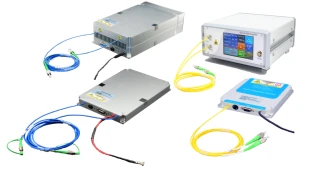
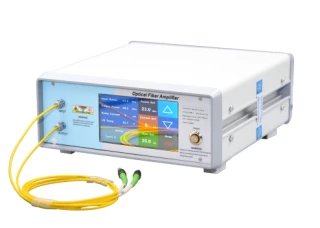
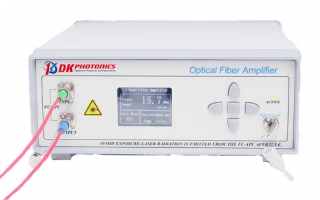
To simplify integration into new and existing platforms, the amplifiers are offered in multiple package formats, including benchtop, 19" rack-mount, and module-level configurations. Each package supports AC input from 100–240 V and uses efficient air cooling for straightforward thermal management. The compact 19" 2U or 3U form factors are particularly suitable for multi-channel LiDAR systems, laboratory optical benches with limited space, and OEM integration in industrial laser processing equipment. Standard output is fiber-coupled (SM, LMA, or PM fiber) with FC/APC connectors and a fiber length greater than 1 m, ensuring easy connection to standard photonics components and fiber delivery systems used across research and industry.
With its combination of high peak power, low noise, and excellent stability (typical power stability of ±1% over 8 hours at 25 °C following warm-up), the MARS 1.0 µm pulsed fiber amplifier is well suited to a broad array of applications. These include fiber optic sensing and distributed measurement systems, LiDAR and LADAR for automotive, aerospace, and security, biological and medical diagnostics requiring clean picosecond-to-nanosecond pulses at 1 µm, and precision laser processing such as micromachining, scribing, and materials modification. The amplifier’s performance and configuration options also make it attractive for research and development in ultrafast photonics, nonlinear optics, and coherent combination schemes, where consistent, controllable high peak power at 1 µm is essential.
For system designers and OEMs looking to build scalable, high-performance optical platforms, the MARS series offers a reliable foundation. The combination of robust thermal design, active protection circuitry, tunable output, and availability in both SM and PM variants ensures a smooth path from laboratory prototyping to field-deployed or production-grade systems. Customized versions can be tailored for specialized wavelength targets within the 1.0 µm band, specific pulse formats, or unique mechanical and interface requirements, aligning the amplifier’s capabilities with the exact needs of a<
MARS Series 1.0um High Power Pulsed Fiber Amplifier
Specifications
| Amplifier Type: | YDFA - Ytterbium-Doped Fiber Amplifier |
|---|---|
| Wavelength Range: | 1040 – 1083 nm |
| Max Output Power: | 37 dBm |
| Nominal Gain: | 30 dB |
| Output Fiber Type: | Other (see Data Sheet) |
| Product Series: | MARS 1.0 µm High Power Pulsed Fiber Amplifier |
| Part Number (SM): | MFAS-Yb-10xx-PL |
| Part Number (PM): | MFAP-Yb-10xx-PL |
| Typical Operating Wavelengths: | 1053 nm, 1064 nm, 1083 nm |
| Average Power: | 5 W (typ.) |
| Peak Power: | up to 50 kW |
| Pulse Width: | 1–50 ns |
| Repetition Rate: | 10–500 kHz |
| Operation Mode: | Pulsed |
| Output Power Tunable Range: | 10–100 % |
| Polarization: | Random or Linear |
| Polarization Extinction Ratio (PER): | 15–20 dB |
| Output Power Stability (8 H): | ±1–±2 % at 25 ℃ after 30 min warm-up |
| Beam Quality M²: | < 1.2 |
| Input Isolation: | ≥ 30 dB |
| Output Isolation: | ≥ 30 dB |
| Output Fiber Type (SM): | SM or LMA fiber |
| Output Fiber Type (PM): | PM fiber |
| Output Fiber Length: | > 1 m |
| Optical Connector: | FC/APC (other options available) |
| Power Supply: | AC 100–240 V |
| Operating Temperature: | 0 to +30 ℃ |
| Storage Temperature: | -40 to +85 ℃ |
| Cooling Mode: | Air-cooling |
| Dimension: | 19 |
| Available Packages: | Benchtop (B), Rack-mount (R), Module (M) |
Got questions about specs? Use the inquiry form to ask.
 Download Data Sheet

Features
- High Peak Output Power up to 50 kW
Engineered for demanding short-pulse applications, delivering peak powers up to 50 kW for efficient nonlinear processes, long-range LiDAR, and advanced laser material interaction. - Optimized for Short Pulses (< 50 ns)
Specifically designed for nanosecond and sub‑50 ns pulse amplification, minimizing pulse distortion and maintaining temporal fidelity across the full repetition rate range (10–500 kHz). - 1.0 µm Ytterbium-Doped Fiber Technology
High-performance Yb-doped double‑clad fiber amplification in the 1.0 µm band, ideal for 1040–1083 nm operation including common lines such as 1053 nm, 1064 nm, and 1083 nm. - High Optical–Optical Conversion Efficiency
Advanced double-cladding fiber design and optimized pump coupling provide excellent conversion efficiency, reducing power consumption and thermal load for long-term, cost‑effective operation. - Low Nonlinear Effects and Minimal Spectral Broadening
Carefully engineered fiber parameters and amplification stages minimize SPM and other nonlinearities, preserving spectral purity and preventing unwanted spectral broadening of the amplified pulse. - Excellent Beam Quality (M² < 1.2)
Near-diffraction-limited beam quality for tight focusing, high spatial coherence, and efficient coupling into subsequent optical systems or nonlinear stages. - Single-Mode (SM) and Polarization-Maintaining (PM) Outputs
Available in both single‑mode and PM configurations, supporting random or linear polarization. PM versions offer a high Polarization Extinction Ratio (PER) of typically 20 dB for polarization-sensitive applications. - Wide Operating Wavelength Range: 1040–1083 nm
Supports a broad 1.0 µm window, making the amplifier compatible with common seed lasers at 1053 nm, 1064 nm, 1083 nm, and other 10xx nm wavelengths. - Adjustable Output Power (10–100%)
Continuously tunable output power range from 10% to 100% of rated power, enabling fine optimization for different samples, detection schemes, or safety requirements. - Superior Power Stability (±1% Typical over 8 Hours)
Long-term average power stability of ±1% (typ.) ensures repeatable results in fiber optic sensing, R&D experiments, and production environments, reducing recalibration needs. - Unique Thermal Treatment for Long-Term Stability
Proprietary thermal management and treatment technology allow stable operation over extended periods, minimizing drift, component stress, and performance degradation. - High-Speed Response Protection Circuit
Integrated fast protection electronics continuously monitor input and output power, providing automatic shut‑down or limiting to protect the seed source, amplifier chain, and downstream optics. - High Input and Output Isolation (≥ 30 dB)
Built‑in optical isolators at both input and output (typically ≥ 30 dB) effectively suppress back reflections and feedback, improving system robustness and protecting sensitive components. - Flexible Pulse Repetition Rate: 10–500 kHz
Supports a wide range of pulse repetition frequencies, enabling optimization of average power, pulse energy, and SNR for applications from time‑of‑flight LiDAR to high‑throughput processing. - Air-Cooled, Compact Rack or Benchtop Configuration
Efficient air-cooling eliminates the need for external chillers. Available in 19" 2U or 3U rack‑mount and benchtop configurations for easy integration into laboratory or OEM systems. - Multiple Package Options: Benchtop, Rack-Mount, and Module
Standard benchtop units for R&D, 19" rack‑mount for system integration, and OEM modules for volume deployments provide mechanical flexibility across different environments. - Robust Output Fiber Options (SM, LMA, PM)
Choice of standard single‑mode, large mode area (LMA), and polarization-maintaining fibers with > 1 m fiber length for convenient integration into existing fiber networks or free-space setups. - Standard FC/APC Optical Interface
Delivered with FC/APC output connector for low-reflection, high‑reliability coupling; other connector options are available on request to match existing infrastructure. - Wide Operating and Storage Temperature Range
Operating temperature from 0 to +30 °C and storage from −40 to +85 °C ensure reliable performance and safe transport in typical laboratory, industrial, and field environments.
Applications
Applications of MARS Series 1.0 µm High Power Pulsed Fiber Amplifiers
The MARS series 1.0 µm high power pulsed fiber amplifiers are designed for short-pulse (<50 ns) amplification with up to 50 kW peak power, excellent beam quality (M2 < 1.2), and high stability. Their combination of single-mode or polarization-maintaining outputs, wide repetition rate range (10–500 kHz), and robust thermal management enables reliable integration into demanding industrial, scientific, and defense systems. Below is an SEO-optimized, application-focused overview tailored to common use-cases of high‑power pulsed Yb-doped fiber amplifiers in the 1.0 µm band.
1. Fiber Optic Sensing
MARS series pulsed fiber amplifiers are well suited for advanced fiber optic sensing systems that require high peak power, short pulse widths, and excellent stability. Comparable 1 µm pulsed fiber amplifiers on FindLight and from leading photonics manufacturers are routinely used in:
- Distributed Acoustic Sensing (DAS) for pipeline monitoring, perimeter security, rail and traffic monitoring, and structural health diagnostics.
- Distributed Temperature Sensing (DTS) using Raman or Brillouin scattering for fire detection in tunnels, power cable monitoring, and oil and gas well logging.
- Distributed Strain and Deformation Sensing in bridges, dams, tunnels, wind turbine blades, and civil engineering structures.
- Phase-Sensitive OTDR (φ-OTDR) and Coherent OTDR systems requiring narrow spectral broadening and stable high-peak pulses.
- Interferometric Fiber Sensors (Mach–Zehnder, Michelson, Sagnac) for precision vibration, acceleration, and rotation measurements.
- Brillouin and Rayleigh Scattering–Based Sensors for long‑range distributed monitoring with high signal-to-noise ratio.
The short pulse capability (1–50 ns), tunable output power (10–100 %), and polarization-maintaining options enable precise timing, long sensing distances, and improved measurement resolution in these fiber sensing applications.
2. LiDAR and LADAR
High peak power, high repetition rates and excellent beam quality make these pulsed fiber amplifiers ideal seed or booster stages for LiDAR and LADAR platforms. Typical uses include:
- 3D Time-of-Flight (ToF) LiDAR for long-range distance measurement and mapping.
- Coherent FMCW LiDAR where narrow spectral broadening and stable polarization are critical for velocity and range resolution.
- Automotive and ADAS LiDAR as part of scanning or solid-state LiDAR systems in the 1 µm wavelength band.
- Aerospace and Defense LADAR for target ranging, tracking, designation, and imaging.
- Terrain Mapping and Topographic Survey in airborne and UAV‑borne LiDAR systems.
- Wind LiDAR and Atmospheric Sensing for profiling wind speed, turbulence, and aerosol distributions.
The built‑in high‑speed protection circuitry, high isolation, and air‑cooled rack or benchtop packaging provide robust, turn‑key performance for field‑deployed LiDAR subsystems.
3. Biological and Medical Applications
Short‑pulse 1.0 µm fiber amplifiers are widely adopted in bio‑photonics and medical laser platforms due to their compact size, high efficiency, and reliability. MARS series amplifiers can be used for:
- Multiphoton and Nonlinear Microscopy (Pump Sources) where high peak power and good beam quality enhance signal generation.
- Photoacoustic Imaging and Optoacoustic Tomography, using pulsed 1 µm light to generate acoustic waves in tissue.
- Optogenetics and Neuroscience Experiments as pump or excitation sources in customized setups.
- Therapeutic Laser Systems (e.g., micro‑surgery, dermatology, ophthalmology) after appropriate wavelength conversion or integration into OEM systems.
- OCT (Optical Coherence Tomography) and Interferometric Diagnostics as part of high‑power sources or amplifiers in the 1 µm band.
The combination of high stability (±1 % typ.), tunable output, and polarization-maintaining options facilitates repeatable measurements and stable imaging performance in clinical and research environments.
Frequently Asked Questions
What is the MARS series 1.0 µm high power pulsed fiber amplifier and what are its key specifications?
How does this pulsed fiber amplifier handle short pulses without significant nonlinear effects or spectral broadening?
What are the polarization options (SM vs PM) and when should I choose each for my application?
What package types, fiber/cabling options, and connectors are available, and how do I specify them when ordering?
What are the electrical and environmental operating conditions for reliable long-term use?
Is the output power adjustable, and how do peak power, pulse width, and repetition rate affect performance?
What typical applications does this 1.0 µm pulsed fiber amplifier support and how does it compare to similar products?
Got more questions? Use the inquiry form to ask the supplier directly.
Similar Products


Your inquiry has been received.
Create an account by adding a password
Why create an account?
- Auto-complete inquiry forms
- View and manage all your past messages
- Save products to your favorites
- Close your account anytime — no hassle