


Description
The Ytterbium‑Doped Fiber Amplifier (YDFA) for 1.0 µm from DK Photonics is a high‑performance optical amplifier designed for applications in the 1030–1100 nm wavelength band. Based on ytterbium‑doped gain fiber and a highly stable semiconductor pump architecture, this amplifier delivers high saturated output power levels (up to 33 dBm class), wide gain bandwidth, and low noise figure. It is available with either HI1060 single‑mode fiber or PM980 polarization‑maintaining panda fiber, making it suitable for both conventional fiber‑optic systems and polarization‑sensitive setups such as precision sensors and coherent laser sources.
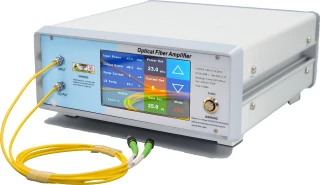
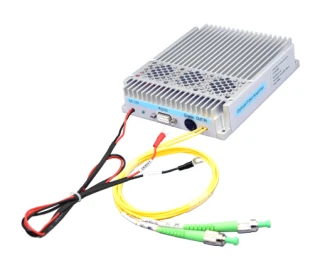
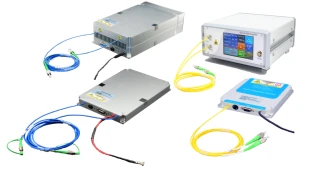
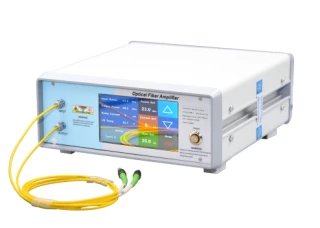
Engineered for flexibility and ease of integration, the YDFA platform is offered in two configurations: a user‑friendly desktop unit and an ultra‑compact module. The desktop version is ideal for laboratory and R&D environments, providing front‑panel controls for pump current and output power adjustment, as well as clear status indications. The modular version is optimized for embedded use in OEM systems, where small footprint, low power consumption, and remote control are critical. Both formats support host‑computer control and serial command operation, ensuring seamless integration into automated test setups and industrial systems.
In typical operation, the amplifier accepts input powers from 0 to +10 dBm and provides a range of saturated output power options (17, 20, 23, 25, 26, 27, 30, and 33 dBm). A low typical noise figure around 5 dB and gain flatness of approximately 3 dB across the 1030–1100 nm band help preserve signal integrity, while high input/output isolation (greater than 30 dB) improves system stability and minimizes back‑reflection sensitivity. Polarization‑related parameters are carefully controlled: polarization dependent gain is typically below 0.3 dB and polarization mode dispersion is on the order of 0.5 ps, supporting demanding applications where polarization and phase must be maintained.
The amplifier incorporates both Automatic Current Control (ACC) and Automatic Power Control (APC) modes, allowing users to select between pump‑stabilized and output‑power‑stabilized operation depending on system requirements. This dual‑mode control strategy is common in advanced fiber amplifiers worldwide and enables stable long‑term performance, even under varying environmental conditions or input‑power fluctuations. In laboratory use, researchers can benefit from straightforward front‑panel operation, while system designers can leverage digital control via RS‑232 (DB9 interface on the module) to fine‑tune gain, monitor status, and implement feedback loops.
From an integration standpoint, the YDFA is designed to align with typical mechanical and electrical requirements found across similar products in the global market. The desktop version operates from a universal 100–240 V AC power supply with power consumption under 30 W and is housed in a rugged enclosure measuring approximately 260 mm (W) × 280 mm (D) × 120 mm (H). The compact module version is powered from a low‑voltage 5 V DC supply with power consumption below 15 W and comes in a 125 mm (W) × 150 mm (D) × 20 mm (H) package that can be mounted into higher‑level assemblies or 19‑inch rack systems. Both options are specified for operation in the −5 °C to +55 °C temperature range and 0–70% relative humidity, enabling deployment in typical laboratory, industrial, and field environments.
Thanks to its combination of high output power, broad wavelength coverage, and low noise, this ytterbium‑doped fiber amplifier is well suited for a wide variety of 1.0 µm‑band applications. In fiber communications and free‑space optical links, it can boost signals in specialty 1 µm systems, testbeds, and experimental transmission lines. In fiber laser setups, the YDFA can act as a power amplifier or pre‑amplifier stage for narrow‑linewidth seed lasers around 1030–1080 nm, supporting both continuous‑wave and modulated operation. In fiber‑optic sensor systems, such as distributed or point sensors operating in the 1.0 µm window, the amplifier provides the high gain and stability required for enhancing signal‑to‑noise ratio and extending sensing range, while maintaining the polarization characteristics needed for interferometric or polarization‑based measurement techniques.
The use of HI1060 single‑mode fiber output is well aligned with many commercial 1.0 µm sources and components, providing low‑loss splicing and compatibility with standard components found in the market. For applications requiring strict polarization control, the PM980 panda fiber output helps maintain a defined polarization state over the full amplifier chain, matching industry practices for coherent detection, high‑precision metrology, and advanced laser processing. The standard FC/APC connector interface minimiz
Ytterbium-doped Fiber Amplifier for 1.0um
Specifications
| Amplifier Type: | YDFA - Ytterbium-Doped Fiber Amplifier |
|---|---|
| Wavelength Range: | 1030 – 1100 nm |
| Max Output Power: | 33 dBm |
| Nominal Gain: | 0.3 dB |
| Output Fiber Type: | Other (see Data Sheet) |
| Product Type: | Ytterbium-doped Fiber Amplifier (YDFA) for 1.0 µm |
| Wavelength Range: | 1030~1100 nm |
| Input Power: | 0~+10 dBm |
| Saturated Output Power Options: | 17/20/23/25/26/27/30/33 dBm |
| Noise Figure: | 5.0 dB |
| Gain Flatness: | 3 dB |
| Polarization Dependent Gain: | <0.3 dB |
| Polarization Mode Dispersion: | 0.5 ps |
| Input/Output Isolation: | >30 dB |
| Fiber Type Options: | HI1060 SM fiber or PM980 panda fiber, 1.0 m length |
| Optical Connector: | FC/APC |
| Control Modes: | Automatic Current Control (ACC) / Automatic Power Control (APC) |
| Package Type Options: | Module (M) or Desktop (B) |
| Desktop Control Mode: | Button |
| Module Control Mode: | RS232 |
| Communication Interface (Module): | DB9 Female (optional) |
| Desktop Power Supply: | 100~240 V AC, <30 W |
| Module Power Supply: | 5 V DC, <15 W |
| Desktop Dimensions: | 260(W)×280(D)×120(H) mm |
| Module Dimensions: | 125(W)×150(D)×20(H) mm |
| Operating Temperature Range: | -5~+55 °C |
| Operating Humidity Range: | 0~70% |
| P/N Code - Output Power: | 17/20/23/25/26/27/30/33 (dBm) |
| P/N Code - Fiber Type: | H06: HI1060 SM fiber; P98: PM980 panda fiber |
| P/N Code - Package Type: | M: Module; B: Desktop |
Got questions about specs? Use the inquiry form to ask.
 Download Data Sheet

Features
- Wide 1.0 µm Operating Range (1030–1100 nm) – Optimized Ytterbium-doped fiber design provides high, stable gain across a broad wavelength window, ideal for tunable and fixed-wavelength 1.0 µm laser systems.
- Multiple High Output Power Levels – Saturated output power options of 17/20/23/25/26/27/30/33 dBm (50 mW to 2 W class) to match diverse application requirements, from low‑power seed amplification to high‑power fiber laser pre‑amplification.
- High Gain with Low Noise Figure – Typical noise figure ~5 dB with optimized YDFA architecture, delivering clean amplification and excellent optical signal-to-noise ratio (OSNR) for demanding fiber communication and sensing links.
- Excellent Gain Flatness – Typical gain flatness ~3 dB over the specified wavelength range helps maintain uniform amplification and minimizes spectral distortion for broadband or swept-source systems.
- Low Polarization Sensitivity – Very low polarization dependent gain (PDG < 0.3 dB) and polarization mode dispersion (PMD ~0.5 ps) ensure stable performance for both polarization‑maintaining and standard single‑mode applications.
- Choice of Fiber Types: HI1060 or PM980 – Available with HI1060 single‑mode fiber for general applications or PM980 Panda polarization‑maintaining fiber for polarization‑sensitive systems such as interferometers and coherent detection setups.
- High Input/Output Isolation & Reliability – Typical input/output isolation > 30 dB protects the seed source and suppresses back reflections, enhancing long‑term reliability of both amplifier and upstream components.
- Flexible Control Modes: ACC & APC – Supports Automatic Current Control (ACC) for pump stability and Automatic Power Control (APC) for constant output power, allowing easy optimization for laboratory experiments or integrated OEM systems.
- Desktop and Module Package Options – Offered as a desktop unit (B) with front‑panel controls for R&D and test, or a compact module (M) for system integration and OEM equipment where space and weight are critical.
- User‑Friendly Desktop Operation – Desktop YDFA provides front‑panel buttons for pump current and output power adjustment, clear status indication, and straightforward plug‑and‑play use in laboratory and production environments.
- Compact, Low‑Power OEM Module – Space‑saving 125(W) × 150(D) × 20(H) mm module with 5 V DC, <15 W power consumption, well‑suited for integration into fiber laser systems, measurement instruments, and sensing platforms.
- Stable AC-Powered Desktop Unit – Desktop version operates from a standard 100–240 V AC power supply with <30 W power consumption, compatible with global laboratory and industrial power standards.
- Standard FC/APC Fiber Connectors – Equipped with FC/APC connectors to reduce back reflections and simplify integration with existing 1.0 µm fiber laser, communication, and sensing setups.
- Remote Control & System Integration – Supports RS232 serial communication (DB9 female, optional) and host computer software control, enabling remote monitoring, automation, and easy integration into larger control systems.
- Wide Operating Temperature and Humidity Range – Designed for reliable operation over -5 to +55 °C and 0–70% humidity, suitable for laboratory, industrial, and field‑deployed environments.
- Continuously Adjustable Output Power – Output power is continuously tunable within the specified range, providing fine control for experiments, power leveling, and protection of sensitive downstream components.
- High-Quality Ytterbium-Doped Fiber Design – Proven YDFA platform with efficient semiconductor pumping delivers high optical efficiency, robust long‑term stability, and low maintenance requirements.
- Ideal for Fiber Communications and Lasers – Tailored for 1.0 µm fiber optic communication links, fiber laser pre‑amplification, seed laser boosting, and as a building block in high‑power Yb‑fiber laser systems.
- Optimized for Fiber Sensing & Measurement – Low noise figure and stable gain make this YDFA well‑suited for fiber sensor interrogation systems, distributed sensing, and oth
Applications
- High-Power 1.0 µm Fiber Lasers – Pre‑amplification and power boosting stages for Yb-doped fiber lasers operating in the 1030–1100 nm band.
- Master Oscillator Power Amplifier (MOPA) Systems – Signal amplification for narrow-linewidth seed lasers to achieve high output power with low noise.
- Pulsed Fiber Laser Amplification – Gain stages for picosecond and nanosecond pulsed sources used in micromachining and materials processing.
- Ultrafast and Mode-Locked Lasers – Amplification of femtosecond and picosecond Yb-based oscillators for scientific and industrial applications.
- Free-Space Optical Communication Links – Power amplifiers for 1.0 µm transmitters in ground-to-ground or ground-to-air optical communication systems.
- Fiber-Optic Communication at 1.0 µm – Booster and in-line amplification of 1030–1100 nm signals in short-reach and specialty fiber links.
- LiDAR and Ranging Systems – Amplification of 1.0 µm seed lasers in coherent and direct-detection LiDAR for mapping, navigation, and autonomous systems.
- Optical Time-Domain Reflectometry (OTDR) – High-gain amplification of probe pulses in 1.0 µm OTDR and distributed fiber test systems.
- Fiber Sensing Interrogators – Power boosting for fiber Bragg grating (FBG), interferometric, and distributed sensors operating near 1060 nm.
- Structural Health Monitoring – Enhanced optical power for long‑range fiber sensor networks in civil, aerospace, and energy infrastructure.
- Distributed Acoustic and Temperature Sensing (DAS/DTS) – Amplification for 1.0 µm sensing architectures requiring long-distance coverage and high SNR.
- Spectroscopy and Metrology – Amplification of narrow-linewidth 1.0 µm lasers for absorption spectroscopy, frequency metrology, and precision measurement.
- Nonlinear Frequency Conversion – Pump source amplification for second-harmonic generation (SHG), sum-frequency generation (SFG), and supercontinuum generation.
- Supercontinuum Light Source Pumping – High-power pump amplification in photonic crystal fibers for broadband supercontinuum generation around 1.0 µm.
- Optical Coherence Tomography (OCT) at 1.0 µm – Signal amplification in 1060 nm OCT systems for enhanced penetration depth and image quality.
- Biomedical and Diagnostic Instrumentation – Power amplification of 1.0 µm sources in imaging, therapeutic, and diagnostic equipment.
- Laser Micromachining and Materials Processing – Amplified 1.0 µm beams for fine cutting, drilling, marking, and surface structuring of metals and polymers.
- Additive Manufacturing and 3D Printing – High-power amplification of Yb fiber lasers for precision metal and polymer additive manufacturing systems.
- Scientific Research and Laboratory Experiments – General-purpose gain modules for university and R&D labs experimenting with 1.0 µm laser physics and photonics.
- Coherent Beam Combining and Phased Arrays – Amplifier modules for scaling power in coherent fiber laser combining architectures.
- Laser Pumping of Solid-State Media – YDFA-based pump sources for ytterbium- and neodymium-doped bulk or waveguide lasers in the 1.0 µm band.
- Remote Sensing and Environmental Monitoring – Amplified transmitters for atmospheric studies, gas sensing, and remote target characterization around 1.0 µm.
- Defense and Security Systems – High-power 1.0 µm amplification for range finding, target designation, and optical countermeasure subsystems.
- Test and Measurement Equipment – Use as a calibrated gain block in production lines and labs for characterizing components at 1030–1100 nm.
- System Integration in OEM Modules – Compact module versions for integration into laser engines, measurement platforms, and turnkey photonic systems.
Frequently Asked Questions
What is the DK Photonics Ytterbium-Doped Fiber Amplifier (YDFA) for 1.0 µm and what wavelengths does it cover?
What output power levels and gain performance are available for this 1.0 µm YDFA?
What fiber types and connector options are available for the 1.0 µm YDFA?
What are the package, control, and interface options for integrating this YDFA into my system?
What are the power supply and environmental requirements for the DK Photonics 1.0 µm YDFA?
How do I select or specify the correct part number (P/N) for this YDFA?
What are typical applications and integration tips for this 1030–1100 nm YDFA?
Got more questions? Use the inquiry form to ask the supplier directly.
Similar Products


Your inquiry has been received.
Create an account by adding a password
Why create an account?
- Auto-complete inquiry forms
- View and manage all your past messages
- Save products to your favorites
- Close your account anytime — no hassle