


Description
The Polarization Maintaining Erbium-Doped Fiber Amplifier (PM-EDFA) for C-band from DK Photonics is a high-performance optical amplification solution engineered for demanding polarization-maintaining systems. Designed around a fully PM architecture and built with PM1550 panda fiber, this amplifier delivers stable, linearly polarized output across the 1530–1565 nm C-band. Its robust design, high gain, and high output power make it ideal for precision applications where polarization extinction ratio (PER) and low noise are critical.
This PM-EDFA series is available as both small-signal preamplifiers (PA) and high-power booster amplifiers (BA), enabling designers to optimize amplification stages across a complete fiber-optic link. The PA version supports very low input levels down to –30 dBm with a typical small-signal gain factor of 30 dB, making it well suited for weak signal detection, coherent systems, and long-haul preamplification. The BA version offers saturated output powers of 17 dBm, 20 dBm, or 23 dBm, providing strong amplification for transmission, distribution, and high-power subsystem integration.
With a typical noise figure of 5 dB and gain flatness within 3 dB across the C-band, the PM-EDFA maintains signal integrity in multi-channel and broadband applications. A typical PER of 23 dB (minimum 20 dB) ensures preservation of the input polarization state, which is essential in polarization-sensitive systems such as interferometric sensors, coherent communication links, and PM fiber lasers. The low polarization mode dispersion (around 0.5 ps) further contributes to maintaining signal quality and minimizing distortion in high-speed or long-distance links.
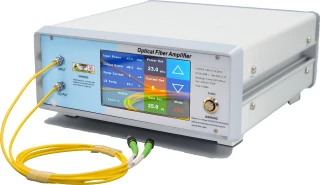
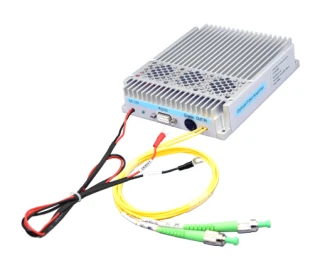
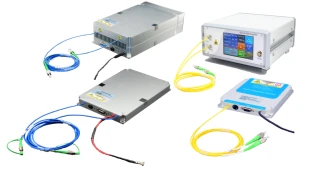
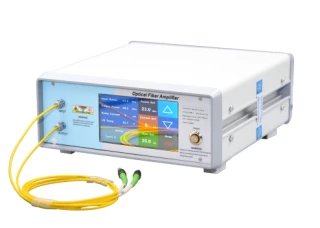
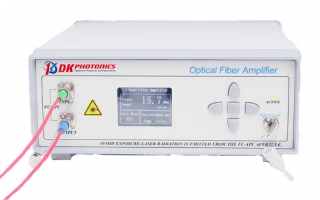
DK Photonics offers this PM-EDFA series in both compact module and benchtop configurations to simplify deployment in laboratory, OEM, and field environments. The module package, with a footprint of approximately 125 × 150 × 20 mm, is optimized for system integration and supports RS232 control in ACC or APC/ACC modes for precise, automated power management. The benchtop unit, powered from a universal 100–240 V AC supply, features front-panel button control for straightforward use in R&D and testing environments. Both versions are designed for reliable operation over a wide temperature range from –5°C to +55°C with operating humidity from 0 to 70%.
The polarization maintaining erbium-doped fiber amplifier series is particularly well suited to fiber communication systems, PM fiber lasers, and fiber sensor networks that require stable polarization and controlled amplification. In advanced fiber communications, these amplifiers can function as preamplifiers in front of receivers or as booster amplifiers after transmitters, extending reach and improving link budgets without compromising polarization control. In PM fiber laser architectures, the amplifier can be used to scale power while maintaining a defined polarization axis for applications such as nonlinear frequency conversion, coherent beam combining, and precision material processing.
In fiber sensor applications, especially interferometric and distributed sensing systems, the PM-EDFA helps increase system dynamic range and sensing distance while preserving polarization alignment crucial for measurement accuracy. The FC/APC connectors are aligned to the slow axis of the PM fiber, simplifying integration with existing PM infrastructure and helping to minimize back reflections. High input/output isolation (> 35 dB) protects both the amplifier and upstream components from unwanted reflections and backward-propagating signals, which is vital in multi-stage amplification chains.
Designed with flexibility in mind, the C-band PM-EDFA series allows selection of amplifier type (PA or BA), output power level, fiber type, and package style via a clear part-number configuration scheme. This enables system designers to precisely match amplifier characteristics to specific link budgets, noise requirements, and mechanical constraints. The combination of compact form factor, high gain, high output power, low noise, and strong polarization maintenance makes this amplifier series a robust choice for cutting-edge photonic systems in research, telecommunications, sensing, and industrial laser platforms.
Polarization Maintaining Erbium-doped Fiber Amplifier for C-band
Specifications
| Amplifier Type: | EDFA - Erbium-Doped Fiber Amplifier |
|---|---|
| Wavelength Range: | 1530 – 1565 nm |
| Max Output Power: | 14 dBm |
| Nominal Gain: | 5 dB |
| Output Fiber Type: | Other (see Data Sheet) |
| Input Power (PA): | -30~-20 dBm |
| Input Power (BA): | -6~+3 dBm |
| Saturated Output Power (PA): | 14 dBm |
| Saturated Output Power (BA): | 17/20/23 dBm |
| Small Signal Gain Factor (PA): | 30 dB |
| Small Signal Gain Factor (BA): | 25 dB @ -3 dBm input |
| Noise Figure: | 5 dB |
| Gain Flatness: | 3 dB |
| PER: | 23 dB (Type), 20 dB (Min) |
| Polarization Mode Dispersion: | 0.5 ps |
| Input/Output Isolation: | >35 dB |
| Fiber Type: | PM1550-XP panda, 1.0m length |
| Optical Connector: | FC/APC (Connector key is aligned to slow axis) |
| Control Mode (Desktop): | Button |
| Control Mode (Module): | RS232 |
| Communication Interface: | DB9 Female (Optional) |
| Power Supply (Desktop): | 100~240V AC, <30W |
| Power Supply (Module): | 5V DC, <15W |
| Dimensions (Desktop): | 260(W)×280(D)×120(H) mm |
| Dimensions (Module): | 125(W)×150(D)×20(H) mm |
| Operation Temperature Range: | -5~+55°C |
| Operation Humidity Range: | 0~70% |
Got questions about specs? Use the inquiry form to ask.
 Download Data Sheet

Features
- All-Polarization-Maintaining C‑Band Design
Engineered with an all-PM structure for 1530–1565 nm, ensuring stable polarization state throughout the amplification chain for demanding coherent and interferometric applications. - High Output Power Options up to +23 dBm
Configurable as PA (Pre‑Amplifier) or BA (Booster Amplifier), with saturated output power options of 14 / 17 / 20 / 23 dBm to match both low‑power and high‑power system requirements. - High Small-Signal Gain and Low Input Power Operation
Supports input powers from −30 dBm to −20 dBm (PA) and −6 dBm to +3 dBm (BA) with a typical small-signal gain factor of 30 dB, ideal for extending link budgets in long‑haul and low‑power systems. - Low Noise Figure for Superior OSNR
Typical 5 dB noise figure minimizes signal degradation, maintaining high optical signal-to-noise ratio (OSNR) in dense WDM and high‑fidelity sensing applications. - Excellent Polarization Extinction Ratio (PER)
Typical PER ≥ 23 dB (minimum 20 dB) with FC/APC connectors aligned to the slow axis of the PM fiber, ensuring reliable polarization alignment for polarization‑sensitive systems. - Flat Gain Over the Entire C‑Band
Gain flatness of approximately ≤ 3 dB across 1530–1565 nm delivers consistent amplification performance over multiple channels in DWDM and broadband systems. - Low Polarization Mode Dispersion
Typical PMD of 0.5 ps supports high data-rate transmission and precision timing applications by minimizing pulse broadening and polarization‑related impairments. - High Input/Output Isolation & Stable Operation
Input/output optical isolation of > 35 dB reduces back reflections and crosstalk, improving system stability and protecting upstream and downstream components. - True PM1550 Panda Fiber Output
Uses PM1550‑XP panda fiber (standard 1.0 m pigtails), ensuring compatibility with common PM1550 components and maintaining polarization integrity throughout the fiber chain. - Multiple Control Modes: ACC / APC / RS232
Supports ACC (Automatic Current Control) and optional APC (Automatic Power Control) modes, with RS232 communication for module versions to allow precise remote monitoring and control. - Flexible Packaging: Desktop and Module Versions
Available in a compact module (125 × 150 × 20 mm) for OEM and system integration, or a desktop unit (260 × 280 × 120 mm) with front‑panel controls for lab and benchtop use. - Universal Power Supply and Low Consumption
Desktop units use a 100–240 V AC universal power input (< 30 W), while module versions operate from 5 V DC (< 15 W), simplifying integration in space‑ and power‑constrained systems. - Wide Operating Temperature and Humidity Range
Designed for reliable operation from −5°C to +55°C and 0–70% RH, suitable for both controlled lab environments and demanding field deployments. - Customizable Performance and Interface Options
Output power, gain, control interface, fiber length, and connector options can be customized to match specific OEM, research, or telecom requirements. - Ideal for PM Fiber Communications, Lasers, and Sensors
Optimized for PM fiber communication links, fiber lasers, coherent detection, interferometry, and precision fiber sensing in the C‑band. - Compact, Easy-to-Integrate Design
Slim module form factor with standard electrical and optical interfaces simplifies drop‑in integration into existing equipment, rack systems, and OEM platforms. - Host Computer Software Control Ready
Supports host‑side control via serial communication, enabling automated testing, remote diagnostics, and integration with higher‑level system software. - Robust Construction from a Specialized Fiber Amplifier Manufacturer
Developed by DK Photonics, a dedicated fiber amplifier and passive components manufacturer, ensuring long‑term reliability, consistent performance, and professional technical support.
Applications
- Polarization-maintaining fiber-optic communication links – C‑band EDFA‑PM for extending reach and improving OSNR in long‑haul and metro PM fiber networks, coherent transmission systems, and PM‑QPSK/QAM links.
- DWDM and CWDM transmission systems – Inline, booster, and pre‑amplifier use in dense WDM C‑band networks where polarization stability and high gain are required.
- PM fiber laser seeding and pre‑amplification – Small‑signal amplification of PM seed lasers for high‑power fiber laser systems, including CW and pulsed operation.
- Booster amplification for high‑power PM fiber lasers – Power amplifier stage delivering saturated output up to 17/20/23 dBm for industrial and scientific laser platforms.
- Coherent optical communication testbeds – Stable PM EDFA gain for lab test systems evaluating coherent modulation formats, polarization‑multiplexed channels, and advanced DSP algorithms.
- Fiber‑optic gyroscopes (FOG) – Low‑noise PM amplification of 1550 nm light in interferometric fiber gyro systems to increase sensitivity while preserving polarization state.
- Interferometric and coherent sensing – Polarization‑maintaining amplification in interferometers (Mach–Zehnder, Michelson, Sagnac) and coherent detection setups for precision phase and amplitude measurements.
- Distributed fiber sensing (DTS/DFS) – Use in PM‑based distributed temperature, strain, and acoustic sensing systems (e.g., coherent OTDR/Φ‑OTDR, BOTDA, BOTDR) to extend sensing distance and improve SNR.
- Fiber Bragg grating (FBG) and array sensor systems – C‑band gain for interrogation of PM‑coupled FBGs in structural health monitoring, aerospace, civil engineering, and energy infrastructure.
- Quantum communication and quantum optics experiments – PM amplification of single‑photon‑level or weak coherent states in 1550 nm quantum key distribution (QKD) setups and entanglement‑based experiments, where preserving polarization is critical.
- Optical metrology and precision timing distribution – Low‑PMD, low‑noise gain in stabilized optical frequency transfer, optical clock distribution, and ultra‑stable laser systems operating in the C‑band.
- Optical coherence tomography (OCT) and imaging at 1550 nm – Amplification of PM light sources in long‑range OCT and interferometric imaging where eye safety and deeper penetration at 1550 nm are desired.
- Research on nonlinear fiber optics – Pumping and pre‑amplifying PM fibers for studies of four‑wave mixing, supercontinuum generation, solitons, and other nonlinear phenomena at C‑band wavelengths.
- General laboratory and R&D use – Flexible PM EDFA module or desktop unit for university and industrial labs requiring a compact, controllable C‑band amplifier for experiments and prototyping.
- System integration in OEM photonic equipment – Integration into PM optical subsystems such as test instruments, fiber laser platforms, sensing interrogators, and communication modules needing robust C‑band gain in a compact module form factor.
Frequently Asked Questions
What is the Polarization Maintaining Erbium-Doped Fiber Amplifier for C-band and what does it do?
What are the main performance specifications of this PM C-band EDFA?
What configuration options and ordering code are available for this EDFA-PM?
What is the difference between the PA (pre-amplifier) and BA (booster amplifier) versions and how do I choose?
How does this PM EDFA maintain polarization, and why is PER important for my application?
What control modes, interfaces, and power supplies are available for the module and desktop versions?
What are the mechanical and environmental specifications and how do I integrate this EDFA into my system?
Got more questions? Use the inquiry form to ask the supplier directly.
Similar Products


Your inquiry has been received.
Create an account by adding a password
Why create an account?
- Auto-complete inquiry forms
- View and manage all your past messages
- Save products to your favorites
- Close your account anytime — no hassle