


Description
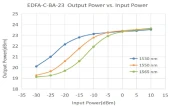
The Erbium-Doped Fiber Booster Amplifiers (EDFA) are high-performance C-band optical amplifiers designed to boost signal power in demanding fiber-optic systems. Operating across the 1530–1565 nm wavelength range, these amplifiers are optimized for use at standard telecom wavelengths and are suitable for both short- and long-haul links. With saturation output power options ranging from 15 dBm up to 26 dBm, they provide the high optical power levels required for backbone communication networks, fiber laser seeding, and high-sensitivity sensing applications.
Based on proven erbium-doped fiber technology, these booster amplifiers deliver low-noise amplification with a noise figure of ≤ 5.0 dB at a typical input of −3 dBm. This performance is comparable to advanced C-band EDFAs widely used in DWDM and long-haul telecom systems, making them ideal for applications where signal integrity and OSNR are critical. Excellent polarization performance, including a polarization dependent gain of ≤ 0.3 dB and polarization mode dispersion of ≤ 0.5 ps, ensures stable amplification for both polarization-maintaining and standard single-mode signal paths, minimizing signal distortion in complex networks.
The devices support a wide input power range from −6 dBm to +3 dBm, allowing flexible deployment as booster amplifiers directly after transmitters or in intermediate stages of an optical chain. High input/output isolation levels greater than 35 dB help prevent back reflections and undesired feedback into upstream components, contributing to long-term reliability of lasers, modulators, and other active devices. Integrated optical power monitoring for both input and output enables precise supervision of system performance and facilitates feedback-based power stabilization in demanding optical setups.
Multiple operation modes are available, including ACC (Automatic Current Control), APC (Automatic Power Control), and AGC (Automatic Gain Control). This allows the amplifiers to be configured either for constant drive, constant output power, or constant gain, depending on the requirements of the network or experiment. Such flexibility is particularly advantageous in dense wavelength-division multiplexing (DWDM) environments, test and measurement systems, and distributed sensing networks where operating conditions and loading can vary substantially over time.
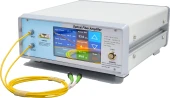
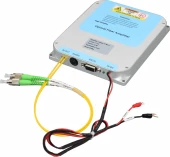
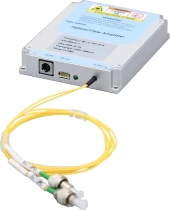
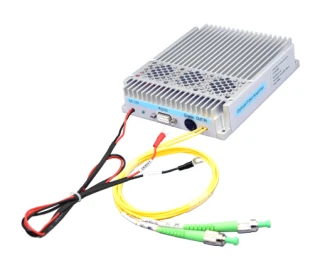
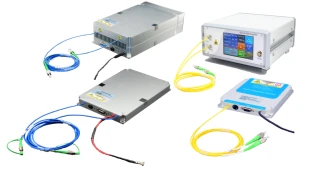
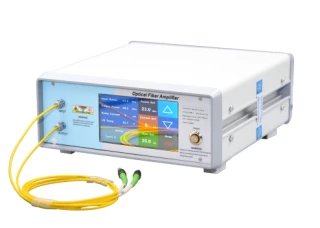
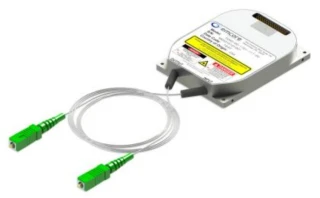
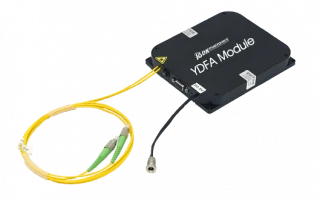
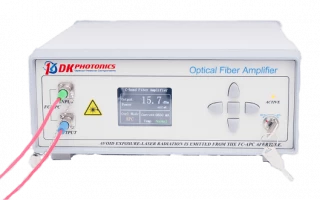
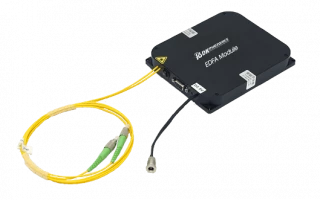
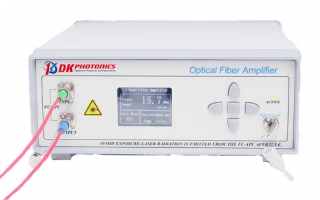
For optical interfacing, the amplifiers are equipped with SMF‑28 fiber and FC/APC connectors, offering low back-reflection and compatibility with standard telecom-grade infrastructure. The product line includes both compact modules (M15/M20) and benchtop units (B1), allowing easy integration into OEM platforms as well as use in laboratory or production test environments. Module versions are designed for contact cooling, supporting embedded installations in tightly packed enclosures, while the benchtop version employs internal air cooling for convenient use as a standalone instrument.
Control and communication options are designed for straightforward integration into automated systems. Benchtop versions support intuitive touchscreen control in addition to RS232 serial communication via DB9 interface. Module configurations use a ZH1.5‑3Pin connector and RS232 communication, simplifying remote control from PCs, PLCs, or embedded controllers. Standard power requirements (AC 100–240 V for benchtop and DC 5 V for modules) ensure compatibility with typical laboratory and industrial power environments. The specified operating temperature and humidity range of −5 °C to +35 °C and 0–70 % humidity supports a wide range of indoor deployment scenarios.
These Erbium-Doped Fiber Booster Amplifiers are well suited for fiber-optic communication links, where they can function as transmitter-side boosters to extend transmission distance or improve system margin. In fiber lasers, they can serve as pre-amplifiers or power amplifiers to increase seed power before further amplification stages, supporting applications such as materials processing, remote sensing, and LIDAR. In fiber-optic sensing systems, including distributed temperature and strain sensing or interferometric sensors, the low noise figure and high output power help improve measurement dynamic range and signal-to-noise ratio over long distances.
With a combination of broad C-band coverage, configurable saturation output power levels, low noise performance, and flexible control modes, these EDFAs provide a robust, scalable platform for modern optical systems. Whether for R&D laboratories, telecom infrastructure, industrial monitoring, or custom OEM equipment, they deliver reliable, high-quality amplification that meets the requirements of advanced photonics applications.
Erbium-Doped Fiber Booster Amplifiers
Specifications
| Amplifier Type: | EDFA - Erbium-Doped Fiber Amplifier |
|---|---|
| Wavelength Range: | 1530 – 1565 nm |
| Min Input Power: | -6 dBm |
| Max Output Power: | 3 dBm |
| Nominal Gain: | 0.3 dB |
| Output Fiber Type: | SMF-28 |
| Wavelength Range: | 1530–1565 nm |
| Band: | C-band |
| Input Power: | -6 to +3 dBm |
| Saturation Output Power: | 15/17/20/23/25/26 dBm @ -3 dBm input |
| Noise Figure: | ≤5.0 dB @ -3 dBm input |
| Polarization Dependent Gain: | ≤0.3 dB |
| Polarization Mode Dispersion: | ≤0.5 ps |
| Input/output Isolation: | >35 dB |
| Optical Power Monitoring: | Input and output optical power monitoring |
| Fiber Type: | SMF-28 |
| Connector Type: | FC/APC |
| Operation Mode: | ACC/APC/AGC |
| Control Method (Benchtop): | Touchscreen / RS232 serial communication |
| Control Method (Module): | RS232 serial communication |
| Communication Interface (Benchtop): | DB9 female |
| Communication Interface (Module): | ZH1.5-3Pin, DB9 female |
| Power Supply (Benchtop): | AC 100–240 V |
| Power Supply (Module): | DC 5 V |
| Cooling Method (Benchtop): | Internal air cooling |
| Cooling Method (Module): | Contact cooling |
| Package Dimensions/Code: | B1 (Benchtop), M15/M20 (Module) |
| Operating Temperature Range: | -5 to +35 °C |
| Operating Humidity Range: | 0–70% |
| Operating Wavelength (Ordering Code): | C = C-band |
| Amplifier Type (Ordering Code): | BA = Power Amplifier |
| Saturation Output Power Options (Ordering Code): | 15/17/20/23/25/26 dBm |
| Fiber Type (Ordering Code): | SM = SMF-28 |
| Package Type (Ordering Code): | M15/M20 = Module; B1 = Benchtop |
Got questions about specs? Use the inquiry form to ask.
 Download Data Sheet

Features
- Wide C-Band Operating Range (1530–1565 nm) – Optimized for standard C-band erbium-doped fiber amplification, ideal for dense WDM systems, long-haul links, and high-capacity optical networks.
- High Saturation Output Power up to 26 dBm – Delivers multiple power levels (15/17/20/23/25/26 dBm @ –3 dBm input) to support booster amplification for long-distance transmission, power-budget-limited links, and high-loss system architectures.
- Low Noise Figure ≤ 5 dB – Ensures excellent OSNR performance and minimal signal degradation, enhancing link margin in demanding fiber-optic communication and sensing applications.
- Booster Amplifier Design – Specifically engineered as an erbium-doped fiber booster amplifier (EDFA-BA) to be placed directly after transmitters for extending reach and compensating for insertion and distribution losses.
- High Input Power Flexibility – Supports –6 to +3 dBm input power, enabling straightforward integration with a wide range of transmitters, lasers, and upstream amplification stages.
- Excellent Polarization Characteristics – Low polarization dependent gain (PDG ≤ 0.3 dB) and low polarization mode dispersion (PMD ≤ 0.5 ps) for stable performance with polarization-sensitive systems and high-bit-rate signals.
- High Isolation > 35 dB – Superior input/output isolation reduces back reflections and prevents system-level interference, improving signal integrity and system reliability.
- Integrated Optical Power Monitoring – Built-in input and output optical power monitoring enables real-time performance supervision, easier system diagnostics, and closed-loop control in advanced fiber networks.
- Multiple Control Modes: ACC / APC / AGC – Supports automatic current control (ACC), automatic power control (APC), and automatic gain control (AGC) for flexible operation under varying channel counts and network conditions.
- User-Friendly Benchtop Option with Touchscreen – Benchtop version offers intuitive touchscreen control and RS232 communication, ideal for laboratories, R&D, prototyping, and production test setups.
- Compact Module Versions for OEM Integration – Module packages (M15 / M20) with RS232 serial interface are optimized for OEM and system-level integration where space and thermal management are critical.
- Robust Electrical and Power Options – Supports universal AC 100–240 V input for benchtop units and DC 5 V for modules, simplifying deployment in both lab and embedded environments.
- Efficient Thermal Management – Benchtop units use internal air cooling; modules support contact cooling for stable operation and long-term reliability in compact enclosures.
- Standard Telecom Fiber and Connectors – Uses SMF-28 fiber with FC/APC connectors for low-reflection, easy integration into existing telecom and test infrastructures.
- Wide Operating Temperature & Humidity Range – Designed for –5 to +35 °C operation and 0–70% humidity, providing dependable performance in typical lab and controlled field environments.
- Versatile Applications – Well suited for fiber-optic communication systems, fiber-optic sensing, and as a high-power stage in fiber laser architectures and test platforms.
Applications
Applications of Erbium-Doped Fiber Booster Amplifiers (C‑Band EDFA, BA Series)
Yogel Erbium-Doped Fiber Booster Amplifiers are high-power, low-noise C-band EDFAs designed to boost optical signals in the 1530–1565 nm window. With saturation output power up to 26 dBm, low polarization dependent gain, and flexible control modes (ACC/APC/AGC), they are suitable for a wide spectrum of demanding photonic systems.
1. Fiber-Optic Communication Systems
- Long-Haul DWDM Transmission – Used as booster amplifiers at transmitter sites to increase launch power in dense wavelength division multiplexing (DWDM) systems, extending reach over hundreds of kilometers.
- Metro and Regional Optical Networks – Power amplification at node outputs to compensate for splitter and ROADM losses in metropolitan rings and regional backbones.
- FTTx and Access Networks – Signal boosting for point-to-multipoint C-band links in fiber-to-the-building (FTTB), fiber-to-the-cell (FTTCell), and enterprise access networks.
- High-Capacity Data Center Interconnects – Used at the transmit side of 100G/200G/400G coherent and IM-DD links to extend reach between data centers and cloud POPs.
- Submarine/Ultra-Long-Haul Pre-Emphasis – Transmitter-side power pre-emphasis in subsea and ultra-long-haul terrestrial links (with proper system design for nonlinearity management).
2. Fiber-Optic Sensing
- Distributed Temperature Sensing (DTS) – Provides high optical power to interrogate long spans of sensing fiber for Raman-based temperature monitoring in oil & gas, tunnels, and power cables.
- Distributed Acoustic Sensing (DAS) – Boosts probe pulses in phase-sensitive OTDR systems for seismic, intrusion, and infrastructure monitoring.
- Distributed Strain and Structural Health Monitoring – Power amplification for Brillouin and Rayleigh-based systems used on bridges, pipelines, dams, and large civil structures.
- Interferometric and Coherent Sensing – Enhances signal levels in Mach–Zehnder, Sagnac, and Michelson interferometer-based sensors for rotation, acceleration, and pressure measurements.
- Pipeline and Perimeter Security – Extends sensing range and sensitivity in perimeter protection and border surveillance using buried or fence-mounted fibers.
3. Fiber Lasers and Laser Subsystems
- Seed Laser Boosting – Acts as a pre-amplifier or power amplifier for narrow-linewidth C-band seed lasers in multi-stage fiber laser architectures.
- Test and Characterization of Laser Sources – Used in laboratories and production lines to evaluate linewidth, RIN, and stability of low-power lasers at higher power levels.
- Research Lasers for Nonlinear Optics – Provides sufficient power to drive nonlinear processes (e.g., supercontinuum generation, wavelength conversion) in specialty fibers.
- Mode-Locked and Ultrashort Pulse Systems – Power amplification of mode-locked or pulsed sources (with suitable pulse management) for spectroscopy and metrology.
4. Test & Measurement, R&D, and Production
- Optical Component and Module Testing – Provides stable C-band power to characterize insertion loss, return loss, and spectral response of filters, WDM components, and passive/active devices.
- System Prototyping in Labs – Essential tool in academic and industrial labs to prototype new coherent and IM-DD communication formats and transmission schemes.
- Receiver Sensitivity and BER Testing – Enables stress testing of optical receivers and transceivers by varying input power levels over a wide dynamic range.
- Manufacturing and Burn-In Lines – Deployed in automated test stations for production quality control of transceivers, photodiodes, and integrated photonic circuits.
5. CATV, RF-over-Fiber, and Broadcasting
- CATV Headend Booster Amplifier – Used in C-band fiber links for high-quality analog and digital cable TV distribution.
- RF-over-Fiber Links – Increases optical carrier power in microwave and RF-over-fiber systems for cellular, satellite, and broadcast infrastructure.
- Studio-to-Transmitter Links (STL) – Provides clean, high-power optical signals in point-to-point broadcast links where low noise and high linearity are critical.
Frequently Asked Questions
What is an Erbium-Doped Fiber Booster Amplifier and what is it used for?
What wavelength range and output power levels does this C-band EDFA support?
What is the noise figure and how does it affect system performance?
What control modes and interfaces are available (ACC, APC, AGC, RS232, touchscreen)?
What fiber type, connectors, and polarization characteristics does the EDFA have?
What mechanical formats, power supply options, and cooling methods are available?
How do I select and order the correct YOGEL C-band EDFA model for my application?
Got more questions? Use the inquiry form to ask the supplier directly.
Similar Products


Your inquiry has been received.
Create an account by adding a password
Why create an account?
- Auto-complete inquiry forms
- View and manage all your past messages
- Save products to your favorites
- Close your account anytime — no hassle