


Description
The DK Photonics Single Channel Erbium-Doped Fiber Booster Amplifier for C-band is engineered to deliver high optical output power and stable gain for demanding fiber-optic links. Designed around proven erbium-doped fiber amplifier (EDFA) technology, this booster amplifier efficiently raises input signals in the –6 dBm to +3 dBm range to saturated output levels up to 26 dBm. This makes it a robust solution for extending transmission distance, overcoming splitter and component losses, and enhancing overall system power budgets in modern C-band communication networks.
Operating across the standard C-band from 1530 nm to 1565 nm, the amplifier offers a carefully optimized balance between high gain and low noise performance. With a typical noise figure of 5 dB at –3 dBm input, it preserves signal integrity even in multi-span or cascaded configurations where noise accumulation can be a limiting factor. Gain flatness within 3 dB helps maintain consistent amplification across the operating wavelength range, which is particularly important in systems using multiple channels or tunable laser sources. The low polarization dependent gain (<0.3 dB) and small polarization mode dispersion (0.5 ps) further contribute to signal stability in real-world fiber infrastructures.
The amplifier is offered with saturated output power options of 15, 17, 20, 23, 25, or 26 dBm (measured at –3 dBm input), allowing users to select a configuration that precisely matches their link budget and application requirements. It is built on standard SMF-28 fiber with 1 m pigtails and FC/APC connectors, ensuring straightforward integration into existing setups and minimizing back-reflection. High input/output isolation of greater than 35 dB helps prevent unwanted feedback and crosstalk, which is critical when interfacing with sensitive laser sources, high-power components, or complex optical networks.
From a system design perspective, this EDFA booster is well suited for use directly after a laser or transmitter module to lift the launch power into long-haul fibers, passive optical networks, or distribution systems. It is widely applicable in fiber communications, fiber lasers, and fiber sensing architectures where elevated signal levels are needed to drive long distances, feed multiple branches, or overcome insertion losses of filters, multiplexers, and other in-line devices. Comparable C-band booster EDFAs used in telecom, CATV transmission, and lab testbeds follow similar performance envelopes, and this unit has been designed to be competitive with those in terms of power, noise, and reliability.
The amplifier supports both automatic current control (ACC) and automatic power control (APC) modes, giving users flexibility in how the device is stabilized. In ACC mode, the pump current is fixed, and the output power follows changes in input level, which is convenient for many laboratory and controlled-source scenarios. APC mode, by contrast, regulates the output power to a preset level, compensating for moderate input fluctuations and providing a more constant output, as typically required in communication and measurement systems. This dual-mode capability aligns with industry practice for high-quality EDFAs and simplifies deployment across a variety of configurations.
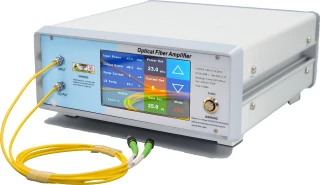
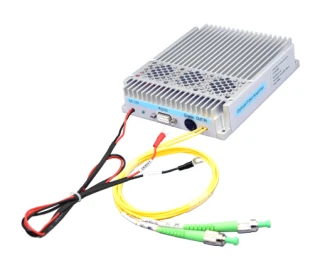
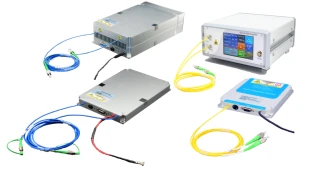
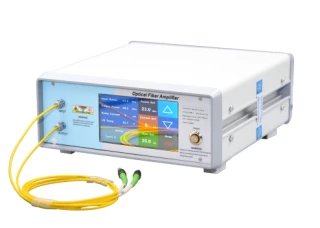
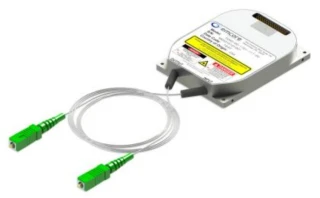
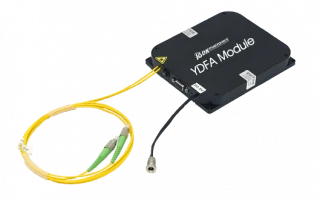
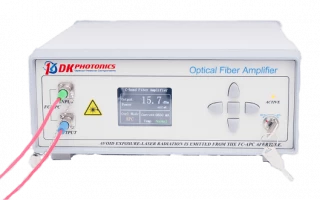
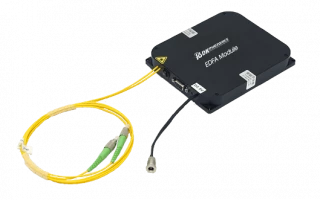
To accommodate different integration needs, the EDFA booster is available as a compact module or as a desktop unit. The module version, powered by a 5 V DC supply at less than 15 W, is ideal for OEM integration inside instruments, rack systems, or custom enclosures and can be controlled via RS232 with a DB9 interface. The desktop version includes front-panel buttons for user-friendly local control, runs from 100–240 V AC at under 30 W, and is suitable for laboratory benches, testing environments, and small-scale production setups. Both formats share the same optical performance and are specified for operation in typical indoor environments with an operating temperature range of –5°C to +55°C and humidity from 0% to 70%.
Overall, this Single Channel Erbium-Doped Fiber Booster Amplifier for C-band provides a reliable, high-gain, and high-dynamic-range solution for increasing optical power in a wide range of applications. Its combination of high saturated output power, controlled noise performance, low polarization sensitivity, and flexible control modes positions it as a competitive choice among C-band booster EDFAs used in telecommunications, sensing, and research systems worldwide. Whether deployed to extend link reach, compensate for component losses, or drive complex optical architectures, it delivers the performance, stability, and integration options expected in advanced fiber-optic infrastructures.
Single Channel C Band ErbiumDoped Fiber Booster Amplifier High Power
Specifications
| Amplifier Type: | EDFA - Erbium-Doped Fiber Amplifier |
|---|---|
| Wavelength Range: | 1530 – 1565 nm |
| Max Output Power: | 26 dBm |
| Nominal Gain: | 3 dB |
| Output Fiber Type: | Other (see Data Sheet) |
| Product Type: | Single Channel Erbium-doped Fiber Booster Amplifier for C-band |
| Band: | C-band |
| Input Power Range: | -6~+3 dBm |
| Saturated Output Power Options: | 15/17/20/23/25/26 dBm (@ -3 dBm input) |
| Noise Figure: | 5.0 dB (@ -3 dBm input) |
| Gain Flatness: | 3 dB |
| Polarization Dependent Gain: | <0.3 dB |
| Polarization Mode Dispersion: | 0.5 ps |
| Input/Output Isolation: | >35 dB |
| Fiber Type: | SMF-28, 1.0 m length |
| Optical Connector: | FC/APC |
| Control Modes (Optical): | ACC (Automatic Current Control) / APC (Automatic Power Control) |
| Package Types: | Module (M) / Desktop (B) |
| Operation Wavelength Option Code: | C: C-band |
| Fiber Type Code: | S28: SMF-28e |
| Amplifier Type: | BA: Booster Amplifier |
| Desktop Control Mode: | Button |
| Module Control Mode: | RS232 |
| Communication Interface (Module): | DB9 Female (optional) |
| Desktop Power Supply: | 100~240 V AC, <30 W |
| Module Power Supply: | 5 V DC, <15 W |
| Desktop Dimensions: | 260(W)×280(D)×120(H) mm |
| Module Dimensions: | 125(W)×150(D)×20(H) mm |
| Operation Temperature Range: | -5~+55 °C |
| Operation Humidity Range: | 0~70% RH |
| Maximum Saturation Power (series Description): | 26 dBm |
| Input Power Range (series Description): | -6~+3 dBm or higher |
Got questions about specs? Use the inquiry form to ask.
 Download Data Sheet

Features
- High-Gain C-Band Booster Amplifier – Single-channel Erbium-Doped Fiber Amplifier (EDFA) optimized for the 1530–1565 nm C-band, ideal for boosting transmitter output power in fiber optic links.
- Wide Input Power Range – Designed to efficiently amplify input signals from -6 dBm to +3 dBm, making it suitable for a broad variety of laser sources and communication transmitters.
- High Saturated Output Power – Available output levels of 15 / 17 / 20 / 23 / 25 / 26 dBm (typical @ -3 dBm input), enabling flexible power budgeting for short-, medium-, and long-haul fiber systems.
- Low Noise Figure – Typical 5 dB noise figure (at -3 dBm input) helps maintain excellent Optical Signal-to-Noise Ratio (OSNR), crucial for high-speed and long-distance transmission.
- Excellent Gain Flatness – Typical gain flatness of ≤ 3 dB across the C-band ensures minimal signal distortion over wavelength, supporting multi-wavelength and DWDM applications.
- Low Polarization Sensitivity – Polarization Dependent Gain (PDG) < 0.3 dB and Polarization Mode Dispersion (PMD) ≈ 0.5 ps provide stable performance for polarization-sensitive systems and high-bit-rate modulation formats.
- High Input/Output Isolation – Optical isolation of > 35 dB minimizes back reflections and prevents destabilization of upstream laser sources, improving system reliability.
- Standard Telecom Fiber – Integrated with SMF‑28e single-mode fiber pigtails (typical 1.0 m length), ensuring seamless compatibility with standard telecom infrastructure.
- Industry-Standard Connectors – Equipped with FC/APC connectors for low back-reflection and easy integration into laboratory setups and field systems; other connectors can typically be customized on request.
- Flexible Control Modes (ACC/APC) – Supports Automatic Current Control (ACC) for constant pump current and Automatic Power Control (APC) for stabilized output power, allowing optimization for dynamic or fixed optical environments.
- Module and Desktop Configurations – Offered as a compact module (125 × 150 × 20 mm) for OEM integration, or as a user-friendly desktop unit (260 × 280 × 120 mm) for lab and production use.
- User-Friendly Interfaces – Desktop version features front-panel button control; module version supports RS232 (DB9 female) communication, enabling easy remote monitoring and control from system controllers or PCs.
- Universal Power Options – Desktop unit powered by 100–240 V AC, <30 W; module powered by 5 V DC, <15 W, supporting low-power, space-constrained OEM designs.
- Wide Operating Temperature Range – Reliable operation from -5°C to +55°C with operating humidity of 0–70%, suitable for both controlled lab environments and demanding field conditions.
- High Dynamic Range Amplification – Engineered for high dynamic range, enabling stable amplification over varying input power levels without signal degradation, ideal for systems with fluctuating launch power.
- Optimized for Fiber Communications – Well-suited for long-haul, metro, access networks, CATV, and FTTx as a booster amplifier at the transmitter end to extend link distance and improve power margins.
- Compatible with Fiber Lasers – Can be used as a power booster for C-band fiber lasers and narrow-linewidth CW lasers, delivering higher output power for R&D, interferometry, and coherent detection systems.
- Ideal for Fiber Sensing Systems – Supports distributed and discrete fiber sensing (e.g., DTS, DAS, FBG interrogation) by providing sufficient launch power while maintaining low noise for accurate measurements.
- Designed for Easy Integration – Compact footprint, standard telecom fiber/connectors, and simple electrical/communication interfaces make the amplifier straightforward to integrate into existing testbeds and commercial equipment.
- Custom Configurations Available – Output power levels, fiber type, connector types, and package options can be tailored on request, allowing optimization for specific OEM projects and niche applications.
Applications
- Long-Haul Fiber-Optic Communication Links
Ideal as a booster amplifier at the transmitter side to increase launch power in C-band DWDM and CWDM systems, extending reach in metro, regional, and long-haul telecom networks. - High-Capacity DWDM Transmission Systems
Enhances output power of multi-channel DWDM transmitters, improving OSNR for dense wavelength-division multiplexing applications in backbone and data-center interconnect networks. - Metro and Access Networks
Used in metro rings, FTTx, and access networks to compensate for splitting and distribution losses, ensuring sufficient optical budget for multiple subscribers. - Optical Fiber Laser Seed/Booster Stage
Serves as a booster stage for C-band fiber lasers, amplifying low-power seed lasers to higher power levels required for subsequent amplification or nonlinear conversion. - CATV and HFC Optical Transmission
Boosts C-band optical carriers for analog and digital CATV / HFC distribution networks, improving signal level over long distribution fibers and passive split networks. - Coherent Communication Systems
Provides high-gain, low-noise amplification for coherent transceivers in 100G/200G/400G and beyond coherent optical links, enhancing system margin. - Test and Measurement Setups
Used in fiber-optic test benches, BER testers, and system simulators to emulate high-power transmitters, compensate insertion losses, and support component characterization. - Optical Component and Module Characterization
Provides stable, high-power C-band output for testing filters, multiplexers, attenuators, circulators, and passive/active components that require higher input power. - Optical Sensing Systems (DAS, DTS, FBG)
Amplifies probe or interrogation signals in distributed sensing systems such as distributed acoustic sensing (DAS), distributed temperature sensing (DTS), and FBG sensor interrogation units. - Optical Time-Domain Reflectometry (OTDR) Extension
Acts as a booster for OTDR or OSA sources, extending dynamic range for long-distance fiber characterization and fault location. - Laboratory Research and Photonics R&D
Suitable as a general-purpose C-band booster in university and industrial labs for nonlinear optics, optical communications experiments, and EDFA research. - Nonlinear Fiber Optics Experiments
Provides the higher optical power required to study nonlinear effects such as four-wave mixing, self-phase modulation, supercontinuum generation, and Brillouin/Raman scattering in fibers. - Optical Signal Distribution and Broadcasting
Used in systems where a single C-band source must be split into multiple branches, compensating for splitter and distribution losses in optical broadcasting networks. - Data Center and Cloud Interconnects
Functions as a booster amplifier at the output of transponders or muxponders to improve reach between data centers over dark fiber using DWDM C-band links. - Secure and Encrypted Optical Links
Supports encrypted C-band transmission systems and quantum-safe communication infrastructures by boosting signal power while maintaining low noise. - Military and Aerospace Fiber-Optic Links
Applied in robust, high-reliability C-band communication links for defense, airborne, and shipboard platforms requiring extended reach and improved link margin. - Industrial and Oil & Gas Monitoring Networks
Enhances signal power in long-distance fiber monitoring and control networks deployed in industrial plants, pipelines, and offshore platforms. - Redundancy and Protection Paths in Networks
Used to equalize power in protection paths, restoration routes, and ring topologies, ensuring consistent performance across primary and backup links. - Optical Repeater and Regenerator Nodes
Serves as the optical amplification stage in repeater sites, pre-regenerator nodes, and inline amplifier stations for C-band transmission systems. - Educational Training Systems
Integrated into training platforms to demonstrate EDFA principles, gain control modes (ACC/APC), amplifier saturation, noise figure, and system design in photonics education.
Frequently Asked Questions
What is the Single Channel Erbium-Doped Fiber Booster Amplifier for C-band used for?
What input and output power levels does this C-band EDFA support?
What are the key optical performance specifications (noise figure, gain flatness, PMD, isolation)?
How do I select and order the correct DK Photonics EDFA model and configuration?
What are the differences between ACC and APC control modes on this EDFA?
What package options, power supply requirements, and interfaces are available?
What are the environmental operating conditions and typical use constraints?
Got more questions? Use the inquiry form to ask the supplier directly.
Similar Products


Your inquiry has been received.
Create an account by adding a password
Why create an account?
- Auto-complete inquiry forms
- View and manage all your past messages
- Save products to your favorites
- Close your account anytime — no hassle