


Description
The Single Channel Erbium-Doped Fiber In-Line Amplifier for C-band is a high‑performance optical amplifier specifically engineered for mid‑span signal boosting in modern fiber networks and laser systems. Designed around a high-gain erbium-doped fiber core and optimized for the 1530–1565 nm C-band window, this in-line amplifier delivers strong optical gain with low noise, enabling efficient extension of transmission distances and reliable power scaling. It is ideally suited for use as a line amplifier in long‑haul and metro fiber communication links, as well as in demanding fiber laser and fiber sensing architectures where stable, high‑quality amplification is essential.
Unlike simple pre‑amplifier or booster amplifier stages, this device integrates the functional advantages of both PA and BA configurations into a single in‑line module. It offers high small‑signal gain and saturated output power options from 13 dBm up to 26 dBm (typical, at −10 dBm input), with a wide dynamic input range from −25 dBm to −3 dBm. This allows system designers to efficiently compensate for fiber attenuation, splitter losses, and passive component insertion losses across a broad variety of network topologies, including single‑span links, multi‑span relays, and single‑to‑multipoint access segments. The relatively low typical noise figure of about 5.5 dB at −10 dBm input helps preserve signal integrity and OSNR in both analog and digital transmission systems.
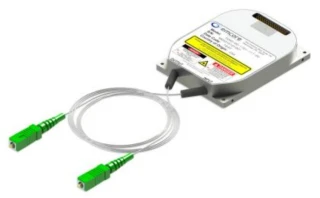
The amplifier is based on standard SMF‑28 fiber, with FC/APC connector interfaces for straightforward integration into existing optical infrastructures. Its gain flatness of approximately 3 dB across the C‑band helps maintain consistent performance over multiple DWDM channels, while polarization dependent gain below 0.5 dB and polarization mode dispersion under 0.5 ps minimize polarization‑related signal distortions. High input/output isolation greater than 35 dB further protects upstream and downstream components from unwanted back reflections and amplified spontaneous emission, supporting robust operation in complex, cascaded optical systems.
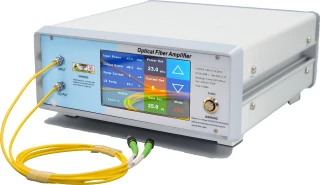
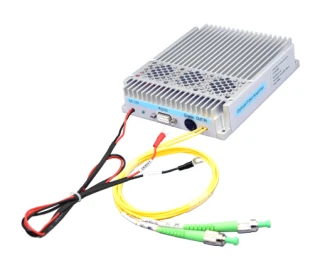
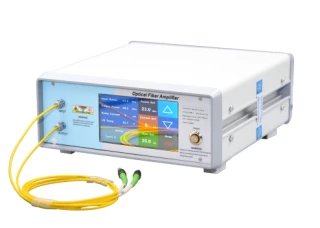
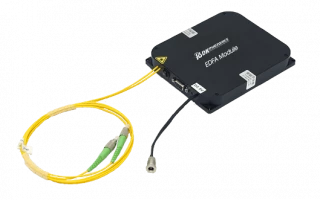
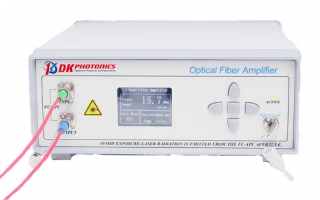
For system control and integration flexibility, the amplifier supports both Automatic Current Control (ACC) and Automatic Power Control (APC) modes, enabling stable operation under varying input conditions and simplifying power management in dynamic networks. Users can choose between a compact module package and a desktop unit. The module version offers a low‑power 5 V DC supply and RS232 control interface, making it easy to embed into OEM equipment, test platforms, and rack‑mounted subsystems. The desktop configuration is powered from 100–240 V AC and provides front‑panel button control for lab environments, prototyping, and small‑scale deployments without the need for additional control electronics.
Engineered for real‑world deployment, this C‑band in‑line EDFA operates over a broad temperature range from −5 °C to +55 °C and humidity from 0 % to 70 %, ensuring reliable performance in both controlled laboratory settings and field installations. Typical use cases include extending reach in long‑haul backbone links, reinforcing power in metro and access networks, compensating splitter and filter losses in PON and WDM systems, boosting return signals in fiber sensing arrays, and providing gain stages within fiber lasers and amplified light sources. Its combination of high gain, flexible output power levels, wide dynamic range, and compact form factor makes it a versatile, cost‑effective solution for upgrading existing C‑band infrastructure and for building new high‑capacity optical platforms.
Single Channel Erbium-doped Fiber Pre-Amplifier for C-band
Specifications
| Amplifier Type: | EDFA - Erbium-Doped Fiber Amplifier |
|---|---|
| Wavelength Range: | 1530 – 1565 nm |
| Min Input Power: | -25 dBm |
| Max Output Power: | 35 dBm |
| Nominal Gain: | 0.3 dB |
| Output Fiber Type: | SMF-28 |
| Product: | Single Channel Erbium-doped Fiber In-Line Amplifier for C-band |
| Model Series: | EDFA LA C-band |
| Wavelength Range: | 1530–1565 nm |
| Band: | C-band |
| Input Power Range: | -25 to -3 dBm |
| Saturated Output Power Options: | 13 / 17 / 23 / 25 / 26 dBm (@ -10 dBm input) |
| Small Signal Gain Factor: | 35 dB (@ -25 dBm input) |
| Noise Figure: | 5.5 dB (@ -10 dBm input) |
| Gain Flatness: | 3 dB |
| Polarization Dependent Gain: | < 0.5 dB |
| Polarization Mode Dispersion: | < 0.5 ps |
| Input/Output Isolation: | > 35 dB |
| Fiber Type: | SMF-28, 1.0 m length |
| Optical Connector: | FC/APC |
| Control Modes (optical): | ACC / APC |
| Desktop Control Mode: | Button |
| Module Control Mode: | RS232 |
| Communication Interface (module): | DB9 Female (optional) |
| Desktop Power Supply: | 100–240 V AC, < 30 W |
| Module Power Supply: | 5 V DC, < 15 W |
| Desktop Dimensions: | 260(W) × 280(D) × 120(H) mm |
| Module Dimensions: | 125(W) × 150(D) × 20(H) mm |
| Operating Temperature Range: | -5 to +55 °C |
| Operating Humidity Range: | 0–70 % RH |
Got questions about specs? Use the inquiry form to ask.
 Download Data Sheet

Features
- High-Gain C-Band Erbium-Doped In-Line Amplifier – Optimized for 1530–1565 nm operation, providing strong optical signal amplification in the C-band for long-haul and metro fiber networks, fiber lasers, and sensor systems.
- Wide Input Power Range – Supports input levels from -25 dBm to -3 dBm, enabling flexible deployment in diverse system architectures, including weak-signal links and multi-span networks.
- Multiple Saturated Output Power Options – Available saturated output power levels of 13/17/23/25/26 dBm (typical @ -10 dBm input) help designers match amplifier power precisely to link budget and nonlinear tolerance requirements.
- High Small-Signal Gain – Typical small-signal gain of up to 35 dB (@ -25 dBm input) ensures efficient boosting of low-level signals for extended transmission distance and improved system margin.
- Low Noise Figure for Improved OSNR – Typical noise figure of 5.5 dB (@ -10 dBm input) comparable with high‑performance telecom EDFAs, preserving signal quality and optimizing optical signal-to-noise ratio in dense WDM and long-reach links.
- Line Amplifier Optimized Design – Dedicated in-line amplifier (LA) configuration combines the benefits of booster and pre-amplifier designs, delivering high gain and relatively low noise for mid-span amplification between fiber sections.
- High Dynamic Range Performance – Engineered to handle a broad range of input powers and signal conditions with stable output, improving system robustness in real-world network environments.
- Good Gain Flatness Across C-Band – Typical gain flatness of ≤3 dB helps maintain uniform amplification over the working spectrum, supporting multi-wavelength and WDM applications.
- Low Polarization Sensitivity – Polarization Dependent Gain (PDG) < 0.5 dB and Polarization Mode Dispersion (PMD) < 0.5 ps minimize polarization-induced impairments, enhancing performance in high-speed and polarization-sensitive systems.
- High Input/Output Isolation – > 35 dB isolation reduces back-reflection and crosstalk between stages, improving amplifier stability and protecting upstream/downstream components.
- Telecom-Grade Fiber and Connectors – Built with SMF-28 fiber (1.0 m pigtails) and standard FC/APC connectors, ensuring low return loss, low splicing loss, and easy integration with existing optical infrastructure.
- Automatic Control Modes (ACC/APC) – Supports Automatic Current Control (ACC) and Automatic Power Control (APC), enabling stable output under varying input power and environmental conditions for reliable unattended operation.
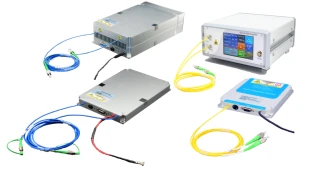
- Flexible Mechanical Configurations – Offered in compact module (approx. 125 × 150 × 20 mm) for OEM and system integration, and desktop housing (approx. 260 × 280 × 120 mm) for laboratory, production, and field use.
- Easy Operation and System Integration – Desktop units feature front-panel button control, while module versions support RS232 (DB9) communication interface for remote monitoring and control in automated or networked systems.
- Universal Power Options – Desktop version accepts 100–240 V AC (typ. < 30 W), and module version uses 5 V DC input (typ. < 15 W), simplifying deployment in lab, rack, or embedded environments.
- Wide Operating Temperature and Humidity Range – Designed to operate from -5°C to +55°C and 0–70% RH, ensuring stable performance in controlled labs as well as telecom and industrial environments.
- Ideal for Fiber Communications, Lasers, and Sensors – Suited for long-haul and access networks, CATV and DWDM lines, fiber laser amplification stages, and distributed fiber sensing systems requiring robust in-line amplification.
- Customizable Configurations Available – Multiple gain levels, output power options, fiber types, package styles, and interfaces can be tailored to specific OEM or project requirements on request.
Applications
- In‑line amplification in long‑haul DWDM and CWDM links to compensate for span loss between optical repeaters.
- Extension of link distance in metro and backbone networks without electrical regeneration.
- Power equalization along terrestrial or submarine cable systems using C‑band amplification.
- Upgrade of existing links from lower data rates to 10G/40G/100G and beyond by adding optical gain without redesigning the fiber plant.
- Optical access networks as line amplifiers in single‑to‑multipoint topologies to compensate for splitter and branching losses.
- FTTH/FTTx backhaul to boost C‑band signals from the central office to remote nodes or aggregation points.
- Regional/metro ring networks for span loss compensation between reconfigurable optical add‑drop multiplexers (ROADMs).
- PON extension and reach enhancement in GPON, XG‑PON, and NG‑PON systems operating in or overlapping the C‑band.
- Pre‑amplification and in‑line amplification of narrow‑linewidth C‑band seed lasers in fiber laser architectures.
- Power boosting of tunable or fixed‑wavelength 1550 nm lasers for use as high‑power optical sources.
- Master‑oscillator power‑amplifier (MOPA) chains where a compact EDFA stage is needed between fiber sections.
- Signal distribution in multi‑branch laser systems, compensating for splitting and coupling losses.
- Distributed sensing systems (DTS, DAS, DVS, BOTDA, OTDR‑based sensors) requiring high optical launch power over long sensing ranges.
- Interferometric fiber sensors where additional gain is required to overcome connector, splice, and coupler losses.
- Structural health monitoring in oil & gas pipelines, power cables, tunnels, and bridges based on C‑band interrogation.
- Environmental and security sensing (temperature, strain, vibration, intrusion detection) using long‑span fiber sensor arrays.
- General‑purpose C‑band booster for optical component and subsystem testing (filters, WDMs, couplers, modulators, receivers).
- BER and system margin testing by emulating in‑line loss and compensation in transmission experiments.
- Optical spectrum analysis where signal levels must be raised to meet OSA sensitivity or dynamic range requirements.
- R&D on advanced modulation formats and coherent systems needing stable, low‑noise EDFA amplification.
- Educational and training setups in universities and labs to demonstrate EDFA and in‑line amplification principles.
- In‑line amplifiers for multi‑channel DWDM transmission in the 1530–1565 nm C‑band window.
- Post‑amplification after multiplexers or ROADMs to restore channel power levels.
- Pre‑amplification before receivers to improve sensitivity and system reach.
- Power equalization across channels where gain flatness and low polarization dependence are required.
- Analog and digital CATV transmission in the 1550 nm band, boosting optical carriers to cover large service areas.
- Video‑over‑fiber distribution for campus, stadium, and IPTV networks, compensating for distribution and splitting losses.
- Headend to hub links in broadcast and media networks requiring high C‑band optical power over long distances.
- Harsh‑environment fiber links in industrial plants, mining, and transportation infrastructure requiring longer reach.
- Secure military and aerospace communication using low‑noise C‑band amplification for encrypted optical channels.
- Remote control and telemetry over extended fiber runs in power utilities, railways, and smart grid networks.
Frequently Asked Questions
What is the Single Channel Erbium‑Doped Fiber In‑Line Amplifier for C‑band used for?
What are the key optical performance specifications of this C‑band in‑line EDFA?
How do I choose and specify the correct DK Photonics in‑line EDFA model (ordering information)?
What control modes, interfaces, and power supplies are available for the module and desktop EDFA versions?
What are the environmental operating conditions and mechanical dimensions?
How does this in‑line EDFA compare to typical C‑band EDFAs in terms of gain and noise figure?
Is customization available (wavelength, gain, connectors, or interfaces) for this EDFA line amplifier?
Got more questions? Use the inquiry form to ask the supplier directly.
Similar Products


Your inquiry has been received.
Create an account by adding a password
Why create an account?
- Auto-complete inquiry forms
- View and manage all your past messages
- Save products to your favorites
- Close your account anytime — no hassle