


Description
The Pulsed Erbium-Doped Fiber Amplifier for C-band is a specialized fiber amplifier engineered for short-pulse amplification in the 1530–1565 nm window. Designed specifically for picosecond and nanosecond pulse regimes, this amplifier delivers high peak power while carefully managing fiber nonlinear effects such as self-phase modulation and stimulated Brillouin scattering. By combining high gain, low noise, and optimized pulse handling, it is an ideal solution for demanding optical systems where signal integrity and stability are critical.
Operating over the standard C-band used in modern optical communications and sensing, the amplifier supports pulse widths from 0.1 ns to 50 ns and repetition rates from 1 kHz to 1 MHz. It accommodates low peak-power seed pulses in the 1–10 mW range and boosts them up to peak powers from 1 W to as high as 1000 W, depending on configuration. Carefully optimized erbium-doped fiber and gain management provide a noise figure of about 5.5 dB and gain flatness around 3 dB, helping preserve the temporal and spectral characteristics of the input pulses for consistent, repeatable system performance.
From an integration standpoint, the amplifier is built around standard telecom-grade SMF-28 fiber with FC/APC connectors, ensuring straightforward connection with existing C-band sources, modulators, and downstream components. Low polarization-dependent gain (<0.5 dB) and minimal polarization mode dispersion (<0.5 ps) help maintain polarization quality and pulse fidelity in systems where state of polarization is important, such as coherent communication links and interferometric sensor setups. Optional bandpass filtering can be included to further refine the output spectrum and suppress out-of-band noise.
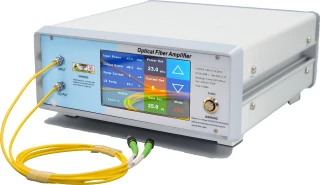
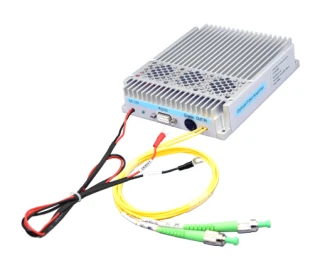
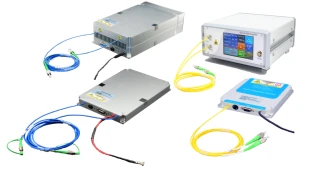
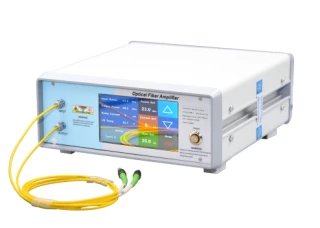
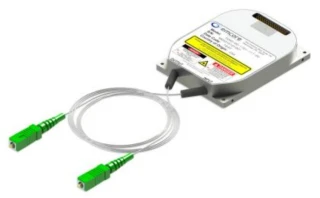
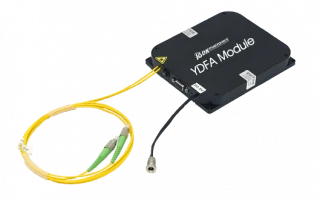
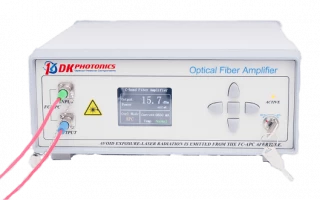
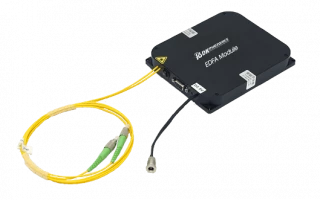
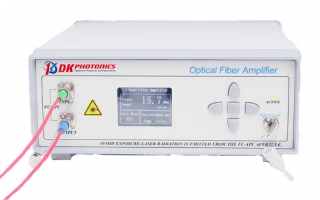
The product line is available in both modular and desktop form factors to cover a broad range of deployment scenarios, from OEM integration in compact instruments to use as a benchtop source in laboratories. The module version offers RS232 control, making it easy to integrate into automated test platforms, fiber-laser subsystems, and embedded optical equipment. The desktop configuration supports ACC (Automatic Current Control) operation via front-panel controls and runs from a universal 100–240 V AC power supply, offering a turn-key solution for research labs, prototyping environments, and production test stations. Both versions are designed for reliable operation in typical laboratory and light-industrial environments with an operating temperature range from -5°C to +55°C.
To match diverse system requirements, the Pulsed Erbium-Doped Fiber Amplifier for C-band series is offered with multiple output peak power options, including typical configurations such as 100 W, 200 W, 500 W, and 1000 W peak. This flexibility allows users to select the appropriate gain and output level for applications ranging from moderate-power amplification in fiber communication testbeds to high-peak-power pulse generation in fiber laser chains. With its combination of short-pulse optimization, robust C-band performance, and flexible packaging, this amplifier series provides a powerful and adaptable building block for fiber communications, pulsed fiber lasers, and advanced fiber-optic sensing systems.
Pulsed Erbium-doped Fiber Amplifier for C-band
Specifications
| Amplifier Type: | EDFA - Erbium-Doped Fiber Amplifier |
|---|---|
| Wavelength Range: | 1530 – 1565 nm |
| Max Output Power: | 60 dBm |
| Nominal Gain: | 3 dB |
| Output Fiber Type: | Other (see Data Sheet) |
| Pulse Width: | 0.1–50 ns |
| Pulse Frequency: | 1–1000 kHz |
| Input Pulse Peak Power: | 1–10 mW |
| Output Peak Pulse Power: | 1–1000 W |
| Noise Figure: | 5.5 dB |
| Gain Flatness: | 3 dB |
| Polarization Dependent Gain: | <0.5 dB |
| Polarization Mode Dispersion: | <0.5 ps |
| Input/Output Isolation: | >35 dB |
| Fiber Type: | SMF-28, 1.0 m length |
| Optical Connector: | FC/APC |
| Control Mode (optical): | Automatic current control (ACC) |
| Control Mode (Desktop): | Button |
| Control Mode (Module): | RS232 |
| Communication Interface: | DB9 Female (optional) |
| Power Supply (Desktop): | 100–240 V AC, <30 W |
| Power Supply (Module): | 5 V DC, <15 W |
| Dimensions (Desktop): | 260(W) × 280(D) × 120(H) mm |
| Dimensions (Module): | 125(W) × 150(D) × 20(H) mm |
| Operation Temperature Range: | -5 to +55 °C |
| Operation Humidity Range: | 0–70% |
| Operation Wavelength Option: | C-band |
| Amplifier Type Option: | PL: pulse amplifier |
| Output Pulse Peak Power Options: | 100 / 200 / 500 / 1000 W |
| Fiber Type Option Code: | S28: SMF-28e |
| Package Type Options: | M: Module; B: Desktop |
Got questions about specs? Use the inquiry form to ask.
 Download Data Sheet

Features
- Dedicated C-Band Pulsed EDFA Design
Optimized specifically for 1530–1565 nm C‑band operation, ensuring excellent compatibility with common pulsed fiber laser and communication wavelengths. - High Peak Power Output (Up to 1 kW)
Supports output peak pulse power from 1 W up to 1000 W, enabling amplification of weak seed pulses to very high peak power levels for demanding applications. - Wide Pulse Width and Repetition Rate Range
Efficiently amplifies 0.1–50 ns pulse widths with repetition rates from 1–1000 kHz, suitable for both picosecond‑like short nanosecond and longer nanosecond pulsed regimes. - Low Input Power Requirement
Accepts input pulse peak power as low as 1–10 mW, allowing direct amplification of low‑energy seed lasers or modulators without additional pre‑amplification stages. - High Gain with Low Noise Figure
Typical noise figure of 5.5 dB and low ASE make it ideal for applications that demand high SNR and clean pulse profiles after amplification. - Excellent Gain Flatness
Typical gain flatness of about 3 dB across the operating band helps maintain consistent amplification over the signal spectrum, supporting multi‑wavelength and spectrally broadened pulses. - Low Polarization Sensitivity
Polarization Dependent Gain < 0.5 dB and Polarization Mode Dispersion < 0.5 ps provide stable performance for both polarization‑maintaining systems (with external PM handling) and standard single‑mode setups. - High Input/Output Isolation
>35 dB optical isolation at both input and output protects seed sources and internal components from back‑reflections, improving system stability and lifetime. - Optimized for Short Pulse Amplification
Internal design and fiber length are engineered to support short pulse amplification while minimizing nonlinear effects such as SPM, SBS and four‑wave mixing, preserving pulse shape and spectrum. - SMF‑28 Fiber Interface with FC/APC Connectors
Standard SMF‑28 fiber pigtails (~1.0 m) and FC/APC connectors provide low back‑reflection coupling and straightforward integration with common telecom and lab fiber infrastructure. - Automatic Current Control (ACC)
Built‑in ACC mode stabilizes pump current for reliable, repeatable output characteristics, simplifying operation and ensuring long‑term stability. - Optional Bandpass Filter Integration
Can be configured with an internal bandpass filter (optional) to narrow the spectral bandwidth, suppress ASE, and improve signal spectral purity for high‑precision applications. - Multiple Peak Power Levels Available
Standard configurations for 100 / 200 / 500 / 1000 W peak power outputs allow selection of the optimal model for system requirements, cost, and safety margin. - Compact Module or Turnkey Desktop Package
Offered in a compact module (125 × 150 × 20 mm) for OEM integration, or a desktop unit (260 × 280 × 120 mm) for benchtop use, covering both R&D and industrial needs. - Flexible Control and Communication Options
Desktop: front‑panel button operation for plug‑and‑play use.
Module: RS‑232 control (DB9 female) and PC software support for easy remote configuration and monitoring. - Wide Operating Temperature and Humidity Range
Designed to operate from ‑5 to +55 °C and 0–70% RH, suitable for both controlled laboratory environments and more demanding industrial conditions. - Universal Power Supply Options
Desktop: 100–240 V AC input, <30 W typical power consumption.
Module: 5 V DC input, <15 W, ideal for integration into compact systems. - Robust Construction for OEM and System Integration
Industrial‑grade design, stable thermal management, and reliable components provide long‑term, maintenance‑friendly performance in continuous or high‑duty‑cycle pulsed operation. - Customizable Performance and Interfaces
Custom configurations available for wavelength range within C‑band, output peak power, repetition rate, fiber type, connector type, and control interface to match specific system architectures. - Ideal for Pulsed Fiber Lasers and Photonic Systems
Well‑suited for pulsed fiber laser amplification, lidar, range‑finding, nonlinear optics pumping, fiber sensing
Applications
- High-speed optical fiber communications – Boosting picosecond and nanosecond signal levels in C-band DWDM, metro, long-haul, and access networks while maintaining low noise and minimal nonlinear distortion.
- Optical transmitter and receiver test setups – Amplifying short optical pulses for characterization of optical transceivers, modulators, and receivers in R&D and production environments.
- Fiber laser seeding and pre‑amplification – Serving as a pulsed pre‑amplifier for Er‑doped or Er/Yb‑doped fiber laser systems to reach higher peak powers with controlled gain.
- Optical time‑domain reflectometry (OTDR) – Enhancing the peak power of probe pulses in C‑band OTDR systems to extend measurement range and improve spatial resolution.
- LIDAR and 3D ranging systems – Providing high‑peak‑power, short‑pulse amplification in eye‑safer 1.5 µm band for coherent and direct‑detection fiber‑based LIDAR and range‑finding.
- Distributed fiber sensing (DAS, DTS, DVS) – Amplifying interrogation pulses in distributed acoustic, temperature, and vibration sensing systems based on Rayleigh, Raman, or Brillouin scattering.
- Brillouin and Raman fiber sensing experiments – Generating strong pump pulses for BOTDA/BOTDR, ROTDR, and related nonlinear sensing schemes in the C‑band.
- Coherent optical communication research – Providing stable, low‑noise pulsed amplification for coherent transmission experiments and advanced modulation format testing.
- Optical signal processing and waveform generation – Used in time‑domain multiplexing, pulse shaping, and optical logic experiments where high‑peak‑power short pulses are required.
- Nonlinear fiber optics studies – Driving nonlinear effects (SPM, FWM, XPM, supercontinuum generation) in specialty fibers while controlling input peak power and minimizing unwanted nonlinearities in the amplifier itself.
- Supercontinuum and broadband source pumping – Acting as a high‑peak‑power C‑band pump stage for generating broadband supercontinuum in highly nonlinear or photonic crystal fibers.
- Mode‑locked and Q‑switched fiber laser research – Amplifying seed pulses from mode‑locked or Q‑switched 1.55 µm lasers to explore new regimes of pulse energy and peak power.
- Optical metrology and timing distribution – Providing amplified short pulses for precision timing, synchronization, and optical clock distribution over fiber networks.
- Photonics and telecom component characterization – Testing optical switches, filters, modulators, gratings, and isolators with controllable high‑peak‑power pulses in the 1530–1565 nm range.
- Laboratory R&D in ultrafast optics – General‑purpose pulsed C‑band amplifier for university and corporate labs working on ultrafast fiber optics, integrated photonics, and optical communications.
- Optical encryption and secure communication – Supporting experimental secure links and quantum‑inspired communication schemes that rely on pulsed C‑band signals.
- Microwave photonics and RF‑over‑fiber – Amplifying modulated optical pulses used to transport RF and microwave signals over fiber links with high dynamic range.
- Optical sensor networks and interrogation units – Increasing interrogation pulse energy for FBG sensor arrays and multiplexed fiber sensor networks in industrial and structural health monitoring.
- Defense and aerospace photonics – Enabling compact, rugged, high‑peak‑power pulsed C‑band sources for targeting, ranging, and secure communication subsystems.
- Medical and bio‑photonics research – Supporting experimental imaging and diagnostic setups at 1.5 µm where deep tissue penetration and eye‑safety are beneficial.
Frequently Asked Questions
What is the Pulsed Erbium-Doped Fiber Amplifier for C-band and what does it do?
What are the main applications of this C-band pulsed EDFA?
What pulse and wavelength specifications does the DK Photonics pulsed EDFA support?
How do I choose or specify the correct model using the part number?
What are the optical performance characteristics such as noise figure, gain flatness, and polarization effects?
What control and interface options are available for desktop and module versions?
What are the mechanical dimensions and environmental operating conditions, and can the EDFA be customized?
Got more questions? Use the inquiry form to ask the supplier directly.
Similar Products


Your inquiry has been received.
Create an account by adding a password
Why create an account?
- Auto-complete inquiry forms
- View and manage all your past messages
- Save products to your favorites
- Close your account anytime — no hassle