
Description
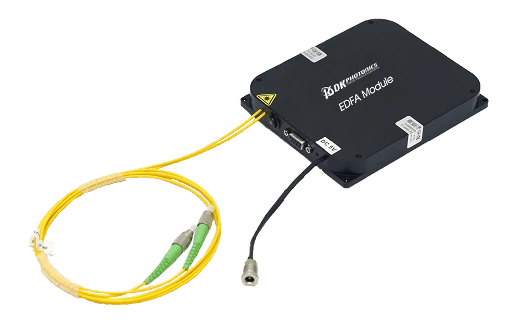
The DK-XS-DT-006-A/2 Erbium-doped Fiber Booster Amplifier for L-band from DK Photonics is a high-performance optical amplifier designed to meet the demanding requirements of modern fiber optic communication and laser systems. Engineered to operate efficiently within the 1570–1603 nm wavelength range, this amplifier is tailored for L-band applications, making it an ideal solution for extending the reach and capacity of optical networks where C-band amplifiers are insufficient.
This fiber amplifier series is distinguished by its high gain factor and robust output power, supporting saturated output levels up to 25 dBm. The device ensures low noise operation, with a typical noise figure of 5.0 dB, which is critical for maintaining signal integrity over long distances. Its gain flatness of 3 dB and polarization dependent gain of less than 0.3 dB further contribute to stable and reliable performance, even in complex network environments.
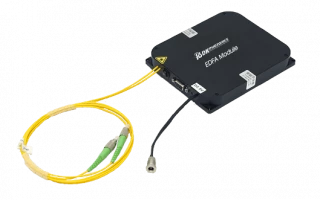
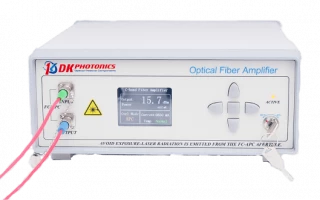
Designed for versatility, the DK-XS-DT-006-A/2 is available in both desktop and compact module configurations, catering to a variety of integration needs. The amplifier utilizes industry-standard SMF-28 fiber and FC/APC connectors, ensuring compatibility with existing infrastructure. Advanced control options, including automatic current control (ACC) and automatic power control (APC), provide users with precise management over amplification parameters, enhancing operational flexibility and system optimization.
With its combination of high output power, low noise, and broad wavelength coverage, this L-band EDFA is well-suited for use in fiber communications, fiber lasers, and fiber sensor applications. Its robust design and reliable performance make it a preferred choice for network operators and system integrators seeking to boost signal strength and quality in advanced optical systems.
L Band Erbium Doped Fiber Booster Amplifier High Gain Low Noise
Specifications
| Amplifier Type: | EDFA - Erbium-Doped Fiber Amplifier |
|---|---|
| Wavelength Range: | 1570 – 1603 nm |
| Min Input Power: | 6 dBm |
| Max Output Power: | 25 dBm |
| Nominal Gain: | 0.3 dB |
| Output Fiber Type: | Not Specified |
| Wavelength Range: | 1570~1603 nm |
| Input Power: | -6~+3 dBm |
| Saturated Output Power: | 15/17/20/23/25 dBm |
| Noise Figure: | 5.0 dB |
| Gain Flatness: | 3 dB |
| Polarization Dependent Gain: | <0.3 dB |
| Polarization Mode Dispersion: | 0.5 ps |
| Input/output Isolation: | >35 dB |
| Fiber Type: | SMF-28, 1.0m length |
| Optical Connector: | FC/APC |
| Control Mode: | Automatic current control (ACC) / Automatic power control (APC) |
| Power Supply (Desktop): | 100~240V AC, <30W |
| Power Supply (Module): | 5V DC, <15W |
| Dimensions (Desktop): | 260(W)×280(D)×120(H) mm |
| Dimensions (Module): | 125(W)×150(D)×20(H) mm |
| Operation Temperature Range: | -5~+55°C |
| Operation Humidity Range: | 0~70% |
Got questions about specs? Use the inquiry form to ask.
 Download Data Sheet

Features
- Wavelength Range: 1570–1603 nm
- Input Power Range: -45 to -25 dBm
- Saturated Output Power Options: 14, 17, 20, 23 dBm
- Noise Figure: 5–5.5 dB
- Gain Flatness: ≤1.5 dB
- Polarization Dependent Gain: ≤0.3 dB
- Polarization Mode Dispersion: ≤0.5 ps
- Input/Output Isolation: 35 dB
- Fiber Type: SMF-28 or PM1550
- Connector Type: FC/APC
- Control Modes: Automatic Current Control (ACC), Automatic Power Control (APC),
- Automatic Gain Control (AGC)
- Control Interface: Button or RS232 (DB9 Female)
- Power Supply: Desktop: 100–240V AC, <30W, Module: 5V DC, <15W
- Dimensions: Desktop: 260(W)×280(D)×120(H) mm, Module: 125(W)×150(D)×20(H) mm
- Operating Temperature Range: -5 to +35°C
- Operating Humidity Range: 0–70%
Applications
- Long-Haul Optical Fiber Communication
Ideal for boosting signal strength in long-distance fiber optic links, ensuring minimal signal degradation over extended ranges in L-band wavelengths (1570–1603 nm). - Dense Wavelength Division Multiplexing (DWDM) Systems
Enhances channel capacity and transmission distance in DWDM networks by amplifying multiple L-band channels simultaneously with high gain and low noise. - Optical Add-Drop Multiplexers (OADM)
Used in OADM nodes to compensate for insertion losses and maintain signal integrity in complex optical networks. - Fiber Laser Systems
Provides high output power and stable amplification for L-band fiber lasers, supporting applications in industrial processing, medical devices, and scientific research. - Optical Test and Measurement Equipment
Serves as a reliable source of amplified L-band signals for testing, calibration, and characterization of optical components and systems. - Fiber Sensor Networks
Amplifies weak signals in distributed and point fiber optic sensor systems, improving sensitivity and detection range for structural health monitoring, environmental sensing, and security. - CATV and Video Transmission
Supports high-quality, long-distance video and CATV signal transmission over optical fiber by compensating for losses in the L-band. - Research and Development
Enables advanced R&D in photonics, quantum optics, and telecommunications by providing a versatile, high-performance L-band amplification platform. - Metropolitan Area Networks (MANs)
Enhances signal reach and reliability in urban fiber optic networks, supporting high-bandwidth data, voice, and video services. - Satellite Ground Stations and Free-Space Optical Communication
Used to amplify L-band signals in ground-based optical communication links, including satellite and free-space optical (FSO) systems.
Frequently Asked Questions
What is the DK Photonics Erbium-doped Fiber Booster Amplifier for L-band?
What are the key features of the DK Photonics L-band EDFA?
What applications are suitable for the DK Photonics L-band Erbium-doped Fiber Amplifier?
What control modes are available for the DK Photonics L-band EDFA?
What are the available output power levels and fiber types for this L-band EDFA?
What package types and control interfaces are offered for this amplifier?
How does the DK Photonics L-band EDFA compare to similar products on the market?
Got more questions? Use the RFQ form to ask the supplier directly.
Similar Products
Need pricing for this product? Send a quick inquiry
Your inquiry has been received.
Create an account by adding a password
Why create an account?
- Auto-complete inquiry forms
- View and manage all your past messages
- Save products to your favorites
- Close your account anytime — no hassle