


Description
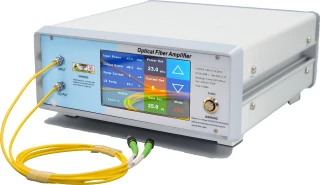
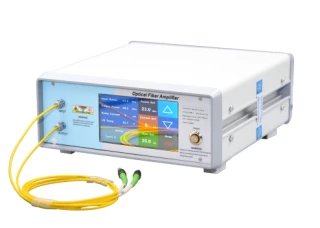
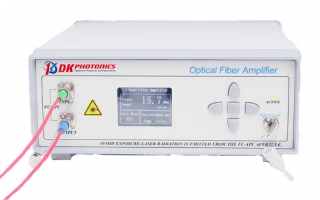
The MARS series C-band polarization maintaining optical fiber amplifiers are advanced, turn-key benchtop and module systems designed for precision amplification of linearly polarized light in the 1528–1560 nm range. Built around an integrated all-fiber architecture and controlled by an internal microprocessor, these PM fiber amplifiers deliver high output power with excellent polarization extinction ratio (PER), making them ideal for demanding laboratory and field applications where signal quality, stability, and polarization integrity are critical. An intuitive LCD front panel interface offers clear, real-time visibility into pump current, temperature, and operating status, enabling quick setup and confident operation even in complex experimental environments.
Engineered for C-band operation, the MARS series MFAP-ER-C amplifiers support input powers from −3 dBm to +10 dBm and provide typ. output levels up to 23 dBm (with common configurations at 50 mW, 100 mW, and 200 mW). Thanks to sophisticated polarization control and advanced PM fiber splicing technology, the system maintains a high PER of typically 20 dB, ensuring a clean, linearly polarized output that is crucial for coherent detection, interferometric setups, and polarization-sensitive measurements. With a typical noise figure below 5.5 dB and power stability within ±1–2% over 8 hours after warm-up, the amplifier delivers reliable long-term performance comparable to other high-end PM EDFA platforms used in cutting-edge research worldwide.
This C-band PM optical fiber amplifier is particularly well suited for nonlinearity research, coherent beam combination, free-space optical communication links, and advanced fiber optic sensing. In these applications, maintaining both polarization and amplitude stability is essential for accurate measurements and high system efficiency. The integrated monitoring of both input and output power, along with a tunable output power range from 10% to 100%, allows users to precisely adjust the launched power into downstream components, mitigating nonlinear effects in fiber, optimizing signal-to-noise ratio, or carefully driving sensitive photonic devices and sensors.
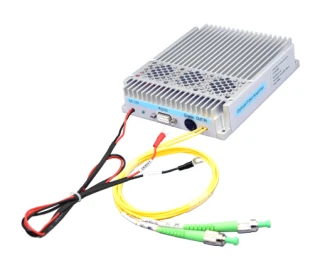
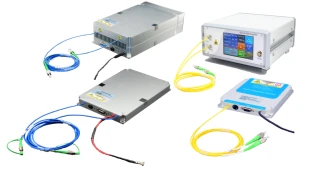
From a usability standpoint, the MARS series emphasizes robust, user-friendly operation. The LCD interface provides instant feedback on key operating parameters and displays warning messages when abnormal conditions are detected, helping protect both the amplifier and connected equipment. Input and output are based on PM1550 fiber with lengths greater than 1 m, terminated in standard FC/APC connectors (other connector options are available for seamless integration into existing setups). The 19" 2U benchtop package operates from a universal 100–240 V AC power supply with modest power consumption, making it practical for crowded optical benches and rack-mounted measurement systems. For OEM and space-constrained environments, a compact module version is also available.
Designed for reliability as well as performance, the amplifier is specified for operation from 0 °C to +50 °C, with a storage temperature range from −40 °C to +85 °C, aligning with the environmental requirements of many research labs and industrial facilities. High isolation between input and output helps safeguard upstream lasers and instrumentation, while the all-fiber construction minimizes alignment issues and enhances mechanical robustness. Taken together, these attributes position the MARS series C-band PM fiber amplifiers as a powerful and dependable choice for researchers and engineers working at the forefront of optical communications, photonics R&D, and precision fiber optic sensing.
C-Band PM Optical Fiber Amplifier
Specifications
| Amplifier Type: | EDFA - Erbium-Doped Fiber Amplifier |
|---|---|
| Wavelength Range: | 1528 – 1560 nm |
| Min Input Power: | -3 dBm |
| Max Output Power: | 23 dBm |
| Nominal Gain: | 30 dB |
| Output Fiber Type: | PM1550-XP |
| Part Number: | MFAP-ER-C |
| Operating Wavelength: | 1528–1560 nm (typ. 1550 nm) |
| Input Power: | -3 to +10 dBm (typ. 0 dBm) |
| Output Power @ 0 DBm Input: | 10 to 23 dBm |
| Typical Output Power Options: | 50 mW, 100 mW, 200 mW |
| Noise Figure @ 0 DBm Input: | < 5.5 dB |
| Polarization Extinction Ratio (PER): | ≥ 18 dB (typ. 20 dB) |
| Input/output Isolation: | ≥ 30 dB |
| Output Power Stability (8 Hrs): | ±1% to ±2% (at 25 ℃ after 30 min warm-up) |
| Input Power Monitoring: | Yes |
| Output Power Monitoring: | Yes |
| Output Power Tunable: | Yes |
| Output Power Tunable Range: | 10–100 % |
| Polarization: | Linear polarization |
| Input/output Fiber Type: | PM1550 |
| Input/output Fiber Length: | > 1 m |
| Optical Connector: | FC/APC (other options available) |
| Operating Temperature: | 0 to +50 ℃ |
| Storage Temperature: | -40 to +85 ℃ |
| Power Supply (benchtop): | AC 100–240 V |
| Power Consumption: | ≤ 20 W |
| Dimension: | 19 |
| Package Options: | Benchtop (B), Module (M) |
| Ordering Code Format: | MFAP-ER-C-<P>-<PW>, where P=B/M, PW=output power in dBm (e.g., 20 for 100 mW, 23 for 200 mW) |
Got questions about specs? Use the inquiry form to ask.
 Download Data Sheet

Features
- High-Power C-Band PM Fiber Amplifier – Delivers up to 23 dBm output (@ 0 dBm input), with typical power options of 50 mW, 100 mW, and 200 mW, ideal for demanding research and system applications.
- Polarization-Maintaining Design with High PER – Utilizes advanced all-fiber PM architecture and precision splicing to ensure linear polarization with a high Polarization Extinction Ratio (PER) of ≥ 20 dB, supporting polarization‑sensitive experiments and coherent systems.
- Low Noise Figure for Superior Signal Quality – Noise figure < 5.5 dB at 0 dBm input preserves signal integrity, improves OSNR, and enhances performance in free-space links, sensing, and R&D setups.
- Wide C-Band Operating Range – Operates from 1528 to 1560 nm, covering the standard C‑band for telecom and test applications, compatible with common laser sources and optical components.
- Broad Input Power Range – Accepts input from -3 dBm to +10 dBm, providing flexible integration with low- to medium-power seed lasers and complex optical setups.
- Excellent Output Power Stability – Output power stability of ±1–2% over 8 hours (after warm‑up at 25 ℃) ensures consistent, repeatable performance required in precision measurements and long‑term experiments.
- Integrated Turn‑Key Benchtop System – Microprocessor-controlled, all‑in‑one design with internal control electronics; no need for external controllers, simplifying setup and daily operation.
- Front-Panel LCD Display & User-Friendly Interface – Real-time LCD display of pump current, temperature, and operating status, with intuitive controls and on-screen warning messages for safe, easy operation.
- Comprehensive Monitoring and Control – Built-in input/output power monitoring, pump and temperature monitoring, and output power tunability to optimize performance for different operating conditions.
- Adjustable Output Power – Output power continuously tunable from 10% to 100% of rated power, enabling fine control of launch levels for nonlinearity research, component testing, and system optimization.
- High Reliability and Long-Term Stability – All-fiber construction with robust PM splices, high isolation (≥ 30 dB), and proven pump laser control ensure stable, low‑maintenance operation in laboratory and system environments.
- High Input/Output Isolation – ≥ 30 dB optical isolation minimizes back reflections and feedback into the seed laser, protecting upstream components and improving overall system stability.
- Optimized for Polarization-Sensitive Applications – Linear polarization output and high PER make it ideal for coherent combination, interferometry, quantum optics experiments, and polarization-based fiber sensing.
- Ideal for Nonlinearity and Fiber Optic Research – High output power, low noise, and stable polarization enable accurate study of nonlinear effects (SPM, FWM, Raman, Brillouin) and advanced fiber transmission experiments.
- Free-Space and Coherent Communication Ready – C‑band operation with stable, polarized high‑power output supports coherent free-space optical links and coherent communication testbeds.
- Fiber Optic Sensing Compatibility – PM1550 I/O fiber and stable power make it well suited for distributed sensing, interferometric sensors, and other phase‑ or polarization‑sensitive sensing systems.
- PM1550 Fiber Interfaces – Input/output fiber type is PM1550 with >1 m pigtails, ensuring easy splicing and integration with standard telecom‑grade and PM components.
- Flexible Optical Connectors – Standard FC/APC connectors minimize back reflections; other connector options are available to match existing setups and system requirements.
- Benchtop and Module Package Options – Available as a 19” 2U benchtop unit (AC 100–240 V) or as a compact module version (on request), allowing integration into racks, test systems, or OEM equipment.
- Wide Operating Temperature Range – Reliable operation from 0 ℃ to +50 ℃ and storage from -40 ℃ to +85 ℃, suitable for varied laboratory and light industrial environments.
- Energy-Efficient Design – Low power consumption (typically ≤ 20 W for benchtop configuration) with intelligent pump management, reducing heat load and improving component lifetime.
- Built-In Protection and Alarms – Onboard microprocessor actively manages pump current and temperature, with alarm/warning outputs via the LCD interface to protect the amplifier and connected equipment.
Applications
- Nonlinearity research in optical fibers – Ideal for studying self-phase modulation (SPM), cross-phase modulation (XPM), four‑wave mixing (FWM), stimulated Brillouin scattering (SBS), and other nonlinear effects that require high‑power, polarization‑maintaining C‑band amplification.
- Free-space optical (FSO) communication links – Provides stable, linearly polarized, high‑power C‑band output to boost signal levels in ground‑to‑ground, ground‑to‑air, and air‑to‑satellite FSO communication systems, improving link margin and data throughput.
- Fiber optic sensing and distributed measurement – Enhances interrogation range and sensitivity in systems such as Φ‑OTDR, BOTDR, BOTDA, ROTDR, and interferometric fiber sensors that benefit from high PER and low noise figure amplification.
- Coherent beam combining – Supplies phase‑stable, high‑PER, polarization‑maintaining seed or pre‑amplified signals for coherent beam combination setups, coherent detection schemes, and phase‑locked laser arrays.
- Coherent optical communication systems – Serves as a polarization‑maintaining pre‑amplifier or booster amplifier in coherent C‑band DWDM links, improving OSNR and receiver sensitivity while preserving state of polarization.
- Quantum communication and quantum optics experiments – Provides stable, linearly polarized amplification for entangled photon sources, quantum key distribution (QKD) systems, and other quantum optics experiments that are highly sensitive to polarization state.
- Laser seeding and master oscillator power amplifier (MOPA) systems – Acts as the polarization‑maintaining power amplifier stage for narrow‑linewidth seed lasers in MOPA architectures used in precision metrology, coherent LIDAR, and high‑resolution spectroscopy.
- Interferometric measurements and fiber gyroscopes – Offers low‑noise, polarization‑maintaining gain for Mach‑Zehnder, Michelson, and Sagnac interferometers, as well as fiber optic gyroscopes that demand high PER and excellent power stability.
- Optical coherence tomography (OCT) and imaging – Enables higher sensitivity and longer imaging depth ranges in polarization‑sensitive and swept‑source OCT systems operating in or near the C‑band.
- Raman and Brillouin spectroscopy in fibers – Delivers high‑power, stable pump signals for fiber‑based Raman and Brillouin spectroscopy and distributed temperature/strain analysis, where polarization control is critical for measurement accuracy.
- Laboratory R&D on polarization‑sensitive devices – Suitable as a flexible, turn‑key light source for the development and characterization of PM fiber components, polarization controllers, PM couplers, isolators, and other polarization‑dependent photonic devices.
- Optical test and measurement setups – Used as a general‑purpose C‑band polarization‑maintaining amplifier in test benches for OSNR characterization, BER testing, receiver sensitivity measurements, and component qualification.
- Microwave photonics and RF‑over‑fiber – Improves link gain and dynamic range in RF‑over‑fiber and microwave photonics systems, where linear polarization and low noise are necessary for high‑fidelity signal transport.
- Polarization‑sensitive remote sensing and LIDAR – Supports laser‑based remote sensing, atmospheric studies, and coherent LIDAR by offering stable, linearly polarized high‑power C‑band output to increase detection range and signal quality.
- Prototype development and system integration – Turn‑key benchtop architecture with LCD monitoring is well suited for OEMs and system integrators building next‑generation PM C‑band systems for telecom, defense, and scientific instrumentation.
Frequently Asked Questions
What is the MARS series C-band polarization maintaining optical fiber amplifier and what does it do?
What are the typical applications of the MFAP-ER-C C-band PM fiber amplifier?
What are the key specifications and performance parameters of the MARS series C-band PM amplifier?
How do I connect and operate the MFAP-ER-C PM C-band fiber amplifier safely?
What makes this PM C-band amplifier suitable for coherent and polarization-sensitive applications?
What package options, connectors, and output power levels are available, and how do I specify them when ordering?
What are the electrical, mechanical, and environmental requirements for using the MARS series amplifier?
Got more questions? Use the inquiry form to ask the supplier directly.
Similar Products


Your inquiry has been received.
Create an account by adding a password
Why create an account?
- Auto-complete inquiry forms
- View and manage all your past messages
- Save products to your favorites
- Close your account anytime — no hassle