


Description
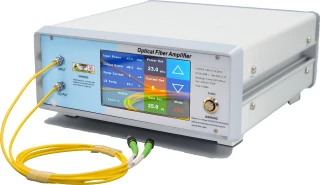
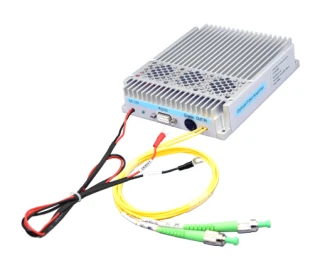
The MARS Series C-band Booster EDFA module is a compact, high-gain erbium-doped fiber amplifier engineered for demanding single-channel and multi-channel optical transmission systems in the 1528–1560 nm range. Designed as an OEM-ready building block, it delivers saturated output powers up to 23 dBm while maintaining a low noise figure and excellent optical stability. This makes it well suited for modern SDH/SONET, ATM, and high-capacity DWDM or CWDM backbone links where consistent amplification and long-term reliability are critical.
With typ. output power options of 15 dBm, 17 dBm, 20 dBm, and 23 dBm, the module can be easily matched to different network budgets and fiber spans, from short metro aggregation rings to extended long-haul routes. The design focuses on high isolation between input and output (typically 35 dB) to reduce back reflections and crosstalk, while the integrated gain-flattening approach helps maintain uniform amplification across the C-band. This ensures that even in multi-wavelength applications the relative signal levels remain well balanced, which is important for system performance and bit-error-rate optimization.
The amplifier supports both ACC (Automatic Current Control) and APC (Automatic Power Control) modes, allowing system designers to choose the most suitable control strategy for their network architecture. In ACC mode, the pump current is stabilized for highly predictable gain behavior, whereas APC mode maintains a constant output power, compensating for changes in input level and fiber conditions. A tunable output power range from 0 % to 100 % provides additional flexibility for fine-tuning link budgets, pre-emphasis, and protection switching scenarios in complex optical networks.
Integration into OEM equipment is facilitated by the module’s RS‑232 interface, which enables straightforward software control and monitoring from a host controller or network management system. Engineers can configure operating parameters, monitor status, and implement remote diagnostics without additional hardware overhead. Optional input/output optical power monitoring further enhances manageability, enabling dynamic performance optimization and early fault detection in live systems. Electrical connectivity is provided through standard DB30 or DB25 interfaces, simplifying wiring and harness design in chassis-based platforms.
From a mechanical perspective, the MARS Series C-band Booster EDFA module is designed for compactness and ease of deployment. For output powers up to 20 dBm, it is housed in a 90 mm × 70 mm × 15 mm form factor, suitable for dense card-level integration or space-constrained enclosures. Higher power variants up to 23 dBm use a 150 mm × 125 mm × 20 mm footprint to accommodate the increased pump and thermal management requirements. The module employs SMF‑28e single-mode fiber pigtails (length > 1 m) with FC/APC connectors as standard, helping to minimize back reflection and facilitating straightforward plug‑and‑play installation with typical telecom-grade patch cords.
Stability over a wide range of environmental conditions is a key advantage of this C-band booster EDFA. The specified operating temperature range of −35 °C to +65 °C and storage range of −40 °C to +85 C make it suitable for both controlled indoor racks and more challenging outdoor or cabinet-mounted deployments. With a DC supply requirement of 5–12 V and typical power consumption under 8 W, the module offers an efficient solution for systems where power budget and heat dissipation must be carefully managed. High reliability, solid gain performance, and robust temperature tolerance make the MARS Series a strong fit for SDH/ATM transport, optical light distribution systems, and video/Ethernet transmission links that demand consistent C-band signal boosting.
C Band Booster EDFA Module MARS Series High Power Low Noise
Specifications
| Amplifier Type: | EDFA - Erbium-Doped Fiber Amplifier |
|---|---|
| Wavelength Range: | 1528 – 1560 nm |
| Min Input Power: | -5 dBm |
| Max Output Power: | 23 dBm |
| Nominal Gain: | 20 dB |
| Output Fiber Type: | SMF-28, Single Mode |
| Part Number: | MFAS-Er-C-M-BA |
| Operating Wavelength: | 1528–1560 nm (typ. 1550 nm) |
| Input Power Range: | -5 to +10 dBm |
| Output Power Options: | 15, 17, 20, 23 dBm |
| Maximum Output Power: | 23 dBm |
| Noise Figure @ 0 DBm Input, 23 DBm Output: | ≤ 5.5 dB |
| Input/output Isolation: | ≥ 30 dB (typ. 35 dB) |
| Output Power Tunable Range: | 0–100 % |
| Input/output Monitor: | Optional |
| Control Mode: | ACC or APC |
| Power Supply: | DC 5–12 V |
| Power Consumption: | ≤ 8 W |
| Operating Temperature: | -35 to +65 ℃ |
| Storage Temperature: | -40 to +85 ℃ |
| Electrical Interface: | DB30 or DB25 |
| Output Fiber Type: | SMF-28e |
| Output Fiber Length: | > 1 m |
| Optical Connectors: | FC/APC (other options available) |
| Dimensions (≤20 DBm Version): | 90 × 70 × 15 mm (L×W×H) |
| Dimensions (≤23 DBm Version): | 150 × 125 × 20 mm (L×W×H) |
Got questions about specs? Use the inquiry form to ask.
 Download Data Sheet

Features
- High-Gain C-Band Booster EDFA Module – Optimized for single-channel or multi-channel wideband optical transmission in the 1528–1560 nm C-band, ideal for SDH/ATM, CATV, and high‑speed data links.
- Wide Output Power Options (15–23 dBm) – Multiple saturated output power levels (15 dBm, 17 dBm, 20 dBm, 23 dBm) available, enabling flexible design from short‑reach boosts to long‑haul power amplification.
- Low Noise Figure (≤ 5.5 dB) – Advanced erbium-doped fiber design delivers high gain with a low noise figure at 0 dBm input and 23 dBm output, preserving OSNR in demanding DWDM and single‑channel systems.
- Full 0–100% Tunable Output Power – Wide dynamic control range allows precise power management, system equalization, and protection of downstream components in complex optical networks.
- Excellent Input/Output Isolation (≥ 35 dB typical) – High isolation minimizes back‑reflection and crosstalk, improving channel stability and protecting upstream optical transceivers.
- High Stability & High Reliability Design – Proven EDFA platform with robust optical and electronic components ensures long‑term stable operation in carrier‑grade and industrial environments.
- Gain Flattening for WDM Applications – Integrated gain‑flattening design offers more uniform gain across the C‑band, improving performance in multi‑wavelength and DWDM systems.
- Flexible Control Modes (ACC/APC) – Supports Automatic Current Control (ACC) and Automatic Power Control (APC) for easy integration with different system control strategies and stable output performance.
- RS232 Interface for Remote Management – Built‑in RS232 port enables software control, configuration, status monitoring, and diagnostics via PC or host controller, simplifying OEM integration.
- Optional Input/Output Optical Power Monitoring – Real‑time power monitoring options support closed‑loop control, network management feedback, and fault detection.
- Broad Input Power Range (–5 to +10 dBm) – Accommodates variable input signal levels while maintaining performance, reducing the need for additional pre‑conditioning components.
- Compact OEM Module Footprint – Space‑saving mechanical design:
- ≤ 20 dBm: 90 × 70 × 15 mm
- ≤ 23 dBm: 150 × 125 × 20 mm
- Wide Operating Temperature Range – Rated from –35 °C to +65 °C (storage –40 °C to +85 °C), suitable for telecom central offices, remote cabinets, and industrial environments.
- Low Power Consumption (≤ 8 W) – Efficient EDFA design minimizes thermal load and power budget, simplifying system power supply and cooling requirements.
- Flexible DC Power Supply (5–12 V) – Wide supply voltage range makes it easy to interface with diverse system power architectures in OEM equipment.
- Standard Electrical Interfaces – DB30 or DB25 electrical connectors provide straightforward electrical integration and easy harness design.
- Telecom‑Grade Fiber & Connectors – Output fiber: SMF‑28e, length >1 m; standard FC/APC connector with other options available for compatibility with existing fiber infrastructure.
- Optimized for Multiple Application Scenarios – Ideal for:
- SDH/SONET and ATM backbone amplification
- Optical power boosting in metro and long‑haul links
- Video, CATV, and Ethernet over fiber transmission
- Passive optical distribution and FTTx booster stages
- OEM‑Friendly Design & Ordering Flexibility – Module form factor with customizable wavelength within C‑band and selectable output power (e.g., 20 dBm ~ 100 mW, 23 dBm ~ 200 mW) for easy integration into system vendor product lines.
Applications
The MARS series C-band booster EDFA (Erbium-Doped Fiber Amplifier) module is engineered for high-performance optical signal amplification in the 1528–1560 nm C-band. With compact size, low noise figure, tunable output power up to 23 dBm, and RS232 software control, it is ideal for OEM system integration and a wide spectrum of fiber-optic communication and test applications.
- SDH / SONET and ATM Backbone Amplification
Used as a booster amplifier at the output of SDH/SONET/ATM transmission equipment to extend reach over long-haul and metro fiber links, compensate for insertion loss, and improve power budget in high-capacity transport networks. - Metro and Long‑Haul DWDM / CWDM Optical Networks
Deployed in single-channel or multi-channel DWDM/CWDM transmission systems as a booster EDFA to provide high saturated output power, gain flattening, and low noise figure for extended transmission distances and improved OSNR. - Optical Line Amplifier in Point‑to‑Point Links
Serves as an in-line amplifier to compensate fiber attenuation in point-to-point C-band optical links, allowing longer spans between regenerators in carrier, enterprise, and campus backbone networks. - FTTx and Optical Access Networks
Integrated into FTTx/FTTH, PON, and active Ethernet access networks as a power amplifier for downstream broadcast or point-to-multipoint distribution, supporting higher split ratios and wider coverage. - Optical Distribution and CATV / HFC Systems
Used in light distribution systems and hybrid fiber-coax (HFC) CATV networks as a booster to drive multiple fiber branches, optical splitters, and node feeds, ensuring sufficient optical power for RF video, digital TV, and broadband services. - Video, Gigabit Ethernet, and Multiservice Transmission
Provides gain for analog and digital video, Gigabit/10G Ethernet, and multiservice traffic over fiber in campus, industrial, and municipal networks, maintaining signal integrity over extended distances. - Data Center Interconnect (DCI) and Cloud Connectivity
Acts as a compact booster for high-speed DCI links between data centers, enhancing link margin for 10G, 40G, 100G, and higher-rate C-band optical interfaces over metro and regional distances. - Power Amplifying at the Transmitter Side
Used directly after a transmitter or transponder as a power amplifier to raise launch power, enabling longer spans, higher splitting ratios, and more robust system performance. - Pre‑Amplifier for Sensitive Receivers
Can be configured as a pre‑amp in front of an optical receiver in long‑reach links, improving receiver sensitivity by boosting weak incoming signals while maintaining a low noise figure. - ROADM and Optical Add‑Drop Multiplexer Systems
Integrated into ROADMs and OADMs for power equalization and gain flattening across multiple C-band channels, ensuring uniform channel performance in reconfigurable wavelength-routed networks. - Optical Test and Measurement Setups
Used in laboratories and production test setups as a general-purpose C-band amplifier in conjunction with tunable lasers, modulators, and OSAs for component, subsystem, and system characterization. - Optical Sensor Interrogation Systems
Applied in distributed or multiplexed fiber-optic sensing (e.g., FBG, temperature, strain, and structural health monitoring) to amplify C-band probe or return signals and increase sensing range. - R&D, Prototyping, and OEM Integration
Ideal for OEMs and research institutes integrating compact C-band EDFAs into custom optical modules, test instruments, communication platforms, and experimental setups, leveraging RS232 control and small form factor. - Military, Aerospace, and Harsh‑Environment Links
Suitable for ruggedized and industrial optical communication systems that require wide operating temperature range, high reliability, and stable gain in demanding environments. - Industrial and Utility Fiber Networks
Deployed in power grid, oil & gas, transportation, railway, and pipeline communication networks to extend reach and enhance reliability of supervisory control, SCADA, and protection signaling over fiber. - Broadcast and Media Contribution Networks
Used to boost optical signals carrying uncompressed or lightly compressed broadcast video for contribution and distribution links between studios, headends, and remote venues.
Frequently Asked Questions
What is the MARS series C‑band booster EDFA module and what does it do?
What are the key specifications of the MFAS-Er-C-M-BA C‑band booster EDFA module?
What are typical applications for this C‑band booster EDFA module?
How do I select the correct output power and ordering code for this EDFA?
What control and monitoring options does the MARS C‑band EDFA provide?
How should this C‑band booster EDFA be integrated into an OEM system?
What is the reliability and operating environment of the MARS series EDFA module?
Got more questions? Use the inquiry form to ask the supplier directly.
Similar Products


Your inquiry has been received.
Create an account by adding a password
Why create an account?
- Auto-complete inquiry forms
- View and manage all your past messages
- Save products to your favorites
- Close your account anytime — no hassle