


Description
The MARS Series 1.5 µm high power pulse optical fiber amplifiers are advanced, eye‑safe Erbium‑Ytterbium (EY) doped fiber amplifiers specifically engineered for short‑pulse signal amplification around the 1550 nm telecom window. Designed to deliver high peak power up to the 10 kW class while maintaining excellent beam quality, these amplifiers provide a robust platform for demanding industrial, scientific, and defense‑related photonics applications. By optimizing the internal optical path for nanosecond‑scale pulse amplification, the MARS Series achieves efficient gain with strongly suppressed amplified spontaneous emission (ASE), preserving pulse integrity even at high repetition rates.
Leveraging high‑power, high‑performance multimode pump laser diodes, the MARS amplifiers offer high optical‑to‑optical conversion efficiency that rivals or exceeds typical commercial 1.5 µm pulsed fiber amplifiers used in lidar, free‑space communication, and nonlinear optics. The proprietary gain management and component selection significantly mitigate nonlinear effects such as self‑phase modulation and stimulated Brillouin and Raman scattering, which are common challenges in high‑peak‑power fiber systems. This careful control of nonlinearities enables the amplifiers to support short pulse widths down to about 10 ns and repetition rates up to the MHz range while still maintaining stable operation.
The MARS family is available in both single‑mode (SM) and polarization‑maintaining (PM) variants to address a wide spectrum of application requirements. The MFAS‑EY‑C‑PL configuration provides a high‑quality single‑mode output suitable for general pulsed amplification and fiber‑based systems that do not require strict polarization control. The MFAP‑EY‑C‑PL configuration offers a polarization‑maintaining output with a high polarization extinction ratio, ideal for coherent detection, coherent beam combining, and applications that rely on stable polarization, such as interferometric sensing or advanced lidar schemes. This dual offering makes the MARS Series comparable to leading pulsed EY‑doped amplifiers found in high‑end optical testbeds and field‑deployed remote sensing instruments worldwide.
Each amplifier integrates a high‑speed response protection circuit that continuously monitors both input and output optical power. If abnormal power levels or reflections are detected, the system reacts quickly to protect the internal pump diodes and fiber components. This form of active safeguarding is critical for pulsed systems where transient spikes can otherwise cause rapid damage. In combination with rigorous electrical and optical design, this protection scheme supports long‑term reliability and consistent performance, making the MARS Series suitable for 24/7 operation in laboratory and system‑integration environments.
A distinctive aspect of the MARS design is its advanced thermal management. The amplifiers employ a carefully engineered thermal treatment and heat‑dissipation architecture that ensures stable operation across a broad temperature range. Components are arranged to minimize thermal gradients along the gain fiber and pump modules, which helps maintain output stability and spectral characteristics over time. Compared with more basic pulsed amplifiers, this results in tighter output power stability over extended periods, reduced drift of operating parameters, and lower maintenance requirements for continuous, mission‑critical applications.
The MARS Series supports pulse amplification in the typical 1530–1563 nm band with operation centered near 1550 nm, a region highly valued for eye safety and low atmospheric attenuation. The amplifiers are specified for average output power levels on the order of several watts, with peak powers reaching up to approximately 10 kW depending on the selected configuration, pulse width, and repetition rate. With support for pulse widths from around 10 ns and repetition rates extending from the tens of kilohertz up to about 1 MHz, the platform provides the flexibility required for a wide range of time‑of‑flight, ranging, and high‑speed modulation applications. Output power is user‑tunable over a defined range, allowing users to optimize their system for the best balance of signal‑to‑noise ratio, dynamic range, and component safety.
In terms of output beam quality, the MARS amplifiers deliver a near‑diffraction‑limited single‑mode beam (M² typically below approximately 1.2), which is essential for long‑distance propagation and tight focusing in free‑space and fiber‑coupled systems. Single‑mode output fibers are typically SMF‑28‑class (9/125 µm, NA≈0.13), while the PM variants use polarization‑maintaining fibers such as PM1550 or application‑specific alternatives. Standard output terminations include angled physical contact (APC) connectors to reduce back‑reflection, wit<
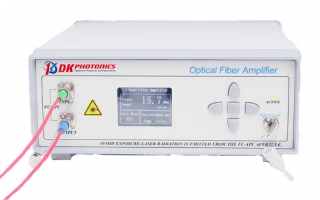
1.5um High Power Pulsed Optical Fiber Amplifier
Specifications
| Amplifier Type: | EDFA - Erbium-Doped Fiber Amplifier |
|---|---|
| Wavelength Range: | 1530 – 1563 nm |
| Max Output Power: | 37 dBm |
| Nominal Gain: | 30 dB |
| Output Fiber Type: | Single Mode |
| Peak Output Power: | 10 kW |
| Pulse Width: | 0.5-200 ns |
| Repetition Rate: | 1-1000 kHz |
| Operating Mode: | Pulse |
| Output Power Tunable Range: | 10-100 % |
| Polarization Extinction Ratio(PER): | 15-20 dB |
| Input Light Isolation: | 30 dB |
| Output Light Isolation: | 30 dB |
| Power Consumption: | 150 W |
Got questions about specs? Use the inquiry form to ask.
 Download Data Sheet

Features
- Eye‑Safe 1.5 μm Operation – Works in the eye‑safe telecom band (1530–1563 nm, typical 1550 nm), ideal for applications requiring enhanced user safety compared to shorter‑wavelength systems.
- High Peak Power up to 10 kW – MARS series architecture supports peak output powers up to 10 kW, enabling efficient amplification of high‑energy nanosecond pulses for demanding lidar and ranging systems.
- Short Pulse Amplification (10 ns) – Optimized for short pulse amplification around 10 ns with repetition rates from 200 kHz up to 1 MHz, supporting both high‑resolution time‑of‑flight and fast scanning systems.
- High Average Output Power – Delivers up to 5 W average output power in the 1.5 μm band, providing sufficient energy for long‑range free‑space links, coherent combination experiments, and advanced sensing.
- Optimized Optical Path for Pulsed Signals – Internal optical path structure is specifically engineered for pulsed operation, minimizing gain distortion and preserving pulse shape and timing.
- Efficient ASE Suppression – Advanced erbium‑ytterbium gain design and optimized filtering significantly suppress amplified spontaneous emission (ASE), improving signal‑to‑noise ratio and measurement accuracy.
- High Optical‑to‑Optical Conversion Efficiency – Uses high‑power, high‑performance multimode pump diodes and proprietary gain‑fiber design to achieve high pump‑to‑signal efficiency and reduced operating cost.
- Low Nonlinear Effects – Proprietary design and carefully selected fiber lengths minimize nonlinearities (SPM, SBS, SRS), maintaining pulse integrity at high peak powers.
- Single‑Mode (SM) and Polarization‑Maintaining (PM) Options –
- MFAS‑EY‑C‑PL: single‑mode output for general high‑brightness applications.
- MFAP‑EY‑C‑PL: polarization‑maintaining output for coherent detection, interferometry, and polarization‑sensitive sensing.
- High Polarization Extinction Ratio (PM Versions) – PM models provide a typical PER of 20 dB, ensuring stable polarization for coherent combining, coherent communication, and precise metrology.
- Output Power Tunability – Built‑in electronic control enables smooth output power adjustment (typ. ±2 % tuning window or better), allowing easy optimization for different targets and environments.
- Excellent Power Stability – Output power stability better than ±1 % over 8 hours (after 30‑minute warm‑up at 25 °C), suitable for long‑term measurements and unattended operation.
- High Beam Quality – Near‑diffraction‑limited single‑mode output (M² < 1.2 typical) enables tight focusing for high spatial resolution and efficient fiber or free‑space coupling.
- Integrated Input and Output Isolation – High‑performance optical isolators on input and output reduce the risk of back‑reflection damage and improve overall system robustness.
- Fast Protection & Automatic Monitoring – High‑speed response protection circuitry continuously monitors input and output power, shutting down or limiting the amplifier in case of anomalies or fiber breaks.
- Robust Thermal Management – Unique thermal treatment technology and air‑cooled design (no external chiller required) ensure stable performance and long component lifetime under continuous operation.
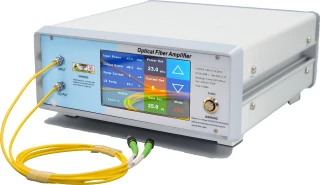
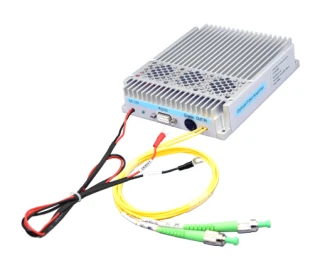
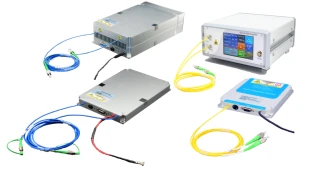
- Flexible Package Options – Available in benchtop (B), rack‑mount (R), and module (M) configurations to fit laboratory setups, OEM integration, and system‑level deployments.
- Standard Telecom Fiber Interfaces – SM outputs use SMF‑28‑type 9/125 μm fiber (NA ≈ 0.13); PM outputs use PM1550 or equivalent, with standard FC/APC connectors (other connector types available on request).
- Wide Operating Temperature Range – Designed for operation from 0 °C to +40 °C (storage −40 °C to +85 °C), supporting both controlled lab environments and demanding field applications.
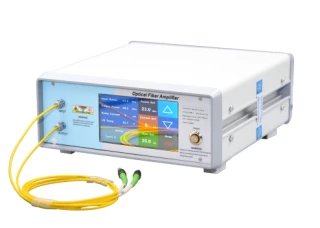
- Compact Footprint for Benchtop – Typical benchtop unit size around 420 (L) × 485 (W) × 150 (H) mm, providing high power and functionality in a compact, lab‑friendly enclosure.
- Universal AC Power Input – Benchtop versions support 220 VAC mains (other voltages available on request), simplifying deployment in standard laboratory and industrial environments.
Applications
Applications of MARS Series 1.5 µm High Power Pulse Optical Fiber Amplifiers (MFAS‑EY‑C‑PL / MFAP‑EY‑C‑PL)
The Connet Laser MARS Series 1.5 µm high‑power pulsed Erbium/Ytterbium co‑doped fiber amplifiers (MFAS‑EY‑C‑PL single‑mode and MFAP‑EY‑C‑PL polarization‑maintaining) are eye‑safe, short‑pulse fiber amplifiers with peak power up to 10 kW, pulse widths down to 10 ns, and repetition rates up to 1 MHz. Their optimized design for short‑pulse amplification, high optical‑to‑optical efficiency, low nonlinear effects, and robust thermal management make them suitable for a wide range of advanced industrial, scientific, and defense applications.
- Optical Fiber Communication and Telecom Test
High‑gain pulsed amplification at 1.5 µm is ideal for:- Long‑haul and metro optical link testing
- Pulsed OTDR (Optical Time‑Domain Reflectometry) for long‑distance fiber characterization
- Component and subsystem qualification (EDFAs, filters, WDM devices, switches)
- System margin testing and stress testing in coherent and IM/DD links
- Free‑Space Optical (FSO) Communication / Lasercom
Eye‑safe 1.5 µm wavelength with high peak power enables:- Ground‑to‑ground, ground‑to‑air, and air‑to‑air free‑space communication links
- FSO backhaul for 5G and high‑capacity data links in urban or remote environments
- Experimental space and near‑space optical communication terminals
- Coherent Beam Combining and High‑Energy Pulse Generation
Available in both SM and PM versions, the MARS Series supports:- Coherent and spectral beam combining at 1.5 µm for higher effective power
- Master oscillator power amplifier (MOPA) architectures for high‑energy pulsed sources
- Seed amplification for coherent lidar, high‑resolution spectroscopy, and optical phased arrays
- Atmospheric and Environmental Monitoring (LIDAR / DIAL)
The short‑pulse, kW‑level peak power performance in the eye‑safe band makes these amplifiers well‑suited for:- LIDAR (Light Detection and Ranging) for aerosol, cloud, and wind profiling
- DIAL (Differential Absorption LIDAR) for gas detection (e.g., CO2, CH4, water vapor in the 1.5 µm range)
- Ceilometers and visibility monitors
- Atmospheric turbulence and scattering studies
- Remote Sensing and Range‑Finding
Eye‑safe 1550 nm pulsed operation with 10 ns class pulses is widely used for:- Long‑range eye‑safe laser rangefinders
- 3D imaging and topographic mapping
- Surveillance, target designation, and tracking systems in the 1.5 µm band
- Distributed Fiber Sensing
Stable, high‑power pulsed amplification enables:- Distributed Temperature Sensing (DTS) and Distributed Acoustic Sensing (DAS) at 1550 nm
- Brillouin and Rayleigh‑based distributed sensing over tens of kilometers
- Pipeline, perimeter, and structural health monitoring with long sensing ranges
- Optical Coherence Tomography (OCT) and Imaging Research
Although OCT often uses broadband sources, pulsed 1.5 µm amplifiers are valuable for:- Eye‑safe imaging and depth‑resolved measurements in tissue and industrial samples
- Development of swept and pulsed OCT systems at longer wavelengths
- Time‑resolved imaging and photon‑counting system experiments
- Nonlinear Fiber Optics and Ultrafast Photonics
High peak power and good beam quality are key for:- Supercontinuum generation in highly nonlinear fibers at 1.5 µm
- Four‑wave mixing, Raman, and Brillouin scattering experiments
- Pulse shaping, compression, and nonlinear pulse propagation studies
- Generation of new wavelengths via nonlinear conversion in fibers or bulk media
- Spectroscopy and Metrology
The MARS Series can act as a powerful pump or probe source for:- Gas absorption spectroscopy around 1.5 µm telecom bands
- Remote and in‑situ environmental diagnostics
- Optical frequency metrology, frequency comb amplification, and precision timing distribution
- Industrial Process Monitoring and Control
Robust, air‑cooled operation and high reliability make these amplifiers suitable for:- In‑line process monitoring using 1.5 µm probe beams
- Long‑distance sensing and feedback loops in refineries, power plants, and factories
- Integration into OEM modules for smart manufacturing and industrial IoT systems
Frequently Asked Questions
What is the Connet MARS series 1.5 µm high power pulse optical fiber amplifier?
What are the key optical performance specifications of the MARS 1.5 µm pulse fiber amplifiers?
What is meant by “eye‑safe” 1.5 µm operation and what applications does it enable?
What is the difference between MFAS‑EY‑C‑PL (SM) and MFAP‑EY‑C‑PL (PM) models?
What input signal conditions are required and how does the MARS amplifier handle short pulses and ASE?
What power stability, electrical input, and environmental conditions are supported?
How do I choose the right configuration and what ordering options are available?
Got more questions? Use the inquiry form to ask the supplier directly.
Similar Products


Your inquiry has been received.
Create an account by adding a password
Why create an account?
- Auto-complete inquiry forms
- View and manage all your past messages
- Save products to your favorites
- Close your account anytime — no hassle