


Description
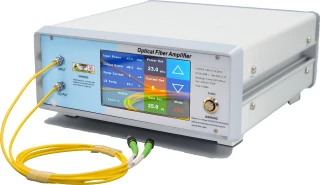
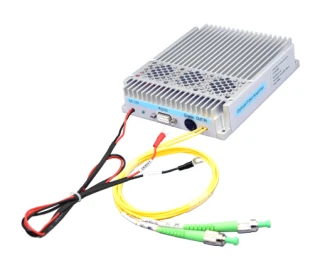
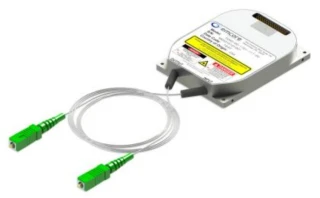
The MARS Series CoLIA-1550-M-SF-LP is a high‑performance 1550 nm long pulse, single frequency, polarization‑maintaining (PM) fiber amplifier engineered for demanding lidar and scientific applications. Operating in the eye‑safe 1550 nm band, this modular fiber amplifier is optimized for long pulse regimes from 200 ns to 2 µs, delivering pulse energies up to 120 µJ and peak powers in the hundreds of watts range. By combining a narrow‑linewidth seed source with advanced multi‑stage optical amplification, the system maintains single‑frequency operation while scaling to high pulse energies with excellent stability.
Developed for use with narrow‑linewidth lasers, the CoLIA-1550-M-SF-LP is ideal when sub‑MHz or kHz‑level spectral purity is required. The amplifier architecture is specifically designed to preserve and enhance the spectral characteristics of the seed, supporting Doppler‑sensitive measurements where frequency stability and minimal linewidth broadening are critical. Typical use cases include coherent Doppler wind‑measurement lidar, aerosol and particulate detection, atmospheric remote sensing, and precision optical metrology. The 1550 nm wavelength offers high atmospheric transmission and inherent eye safety, making it especially well suited for long‑range outdoor systems and field‑deployable instrumentation.
A key advantage of this amplifier is its optimized suppression of nonlinear effects, particularly stimulated Brillouin scattering (SBS), which commonly limits the performance of single‑frequency fiber systems at high peak power. Through careful design of the multi‑stage amplification chain, active fiber selection, and gain distribution, the CoLIA-1550-M-SF-LP achieves high pulse energy while maintaining near diffraction‑limited beam quality (M² typically around 1.2). This allows users to exploit tight focusing and long propagation distances, essential for high‑resolution range and velocity measurements in lidar and other coherent detection schemes.
The amplifier supports adjustable repetition rates from 10 to 20 kHz and configurable pulse widths in the 200–2000 ns range, allowing optimization of average power, range resolution, and signal‑to‑noise ratio for specific measurement scenarios. Output power stability is tightly controlled over both short (15‑minute) and extended (8‑hour) time scales, providing the consistency and repeatability required for continuous monitoring, industrial sensing, and long‑term scientific experiments. A typical configuration delivers up to 600 W peak power at 200 ns pulse width with 120 µJ pulse energy, while maintaining robust isolation and stable polarization.
The CoLIA-1550-M-SF-LP utilizes a polarization‑maintaining large mode area (PLMA) fiber output to support high peak powers while preserving linear polarization, which is critical for coherent detection and polarization‑sensitive measurements. The standard output configuration includes FC/APC fiber connectors or a collimated free‑space beam, providing flexibility for integration into existing optical setups. Near diffraction‑limited beam quality ensures clean spatial mode profiles, simplifying beam shaping, combination, or delivery through additional optical elements.
Designed as a compact, air‑cooled module with a typical footprint of 200 × 135 × 40 mm, the amplifier is well suited for OEM integration into lidar transmitters, portable measurement platforms, and rack‑mounted laboratory systems. RS‑232 control allows straightforward communication with system controllers or PCs for remote configuration, status monitoring, and automation. Operating from a 12–24 V DC supply, the unit can be easily incorporated into mobile or battery‑powered platforms, as well as standard industrial power architectures.
The CoLIA-1550-M-SF-LP is available in multiple customized configurations defined by pulse width, repetition rate, and peak power, enabling users to match the amplifier to their specific application requirements. This flexibility, combined with high pulse energy, narrow linewidth, excellent beam quality, and eye‑safe wavelength operation, makes the MARS Series amplifier a robust solution for cutting‑edge lidar systems, environmental monitoring, pollution tracking, aerosol characterization, and advanced research in atmospheric physics and optical science.
1550nm Long Pulse Single Frequency PM Fiber Amplifier
Specifications
| Amplifier Type: | EDFA - Erbium-Doped Fiber Amplifier |
|---|---|
| Wavelength Range: | 1530 – 1561 nm |
| Max Output Power: | 57 dBm |
| Nominal Gain: | 40 dB |
| Output Fiber Type: | PLMA |
| Model: | CoLIA-1550-M-SF-LP |
| Center Wavelength (min): | 1530 nm |
| Center Wavelength (typ): | 1550 nm |
| Center Wavelength (max): | 1561 nm |
| Pulse Width Range: | 200–2000 ns |
| Repetition Rate Range: | 10–20 kHz |
| Peak Power @200 Ns (max): | 600 W |
| Pulse Energy @200 Ns (max): | 120 µJ |
| Beam Quality M² (min): | 1.05 |
| Beam Quality M² (typ): | 1.2 |
| Beam Quality M² (max): | 1.3 |
| Output Power Stability 15 Min (typ): | ±0.5 % |
| Output Power Stability 15 Min (max): | ±1 % |
| Output Power Stability 8 H (typ): | ±1.5 % |
| Output Isolation (min): | 30 dB |
| Power Supply Voltage Range: | 12–24 VDC |
| Operating Temperature Range: | -10 to 50 ℃ |
| Storage Temperature Range: | -40 to 85 ℃ |
| Output Fiber Type: | PLMA fiber |
| Output Fiber Length (min): | 0.3 m |
| Output Fiber Connector: | FC/APC or collimator |
| Control Interface: | RS232 |
| Cooling Mode: | Air-cooled |
| Dimensions: | 200(L) × 135(W) × 40(H) mm |
| Eye-safe Wavelength: | 1550 nm |
Got questions about specs? Use the inquiry form to ask.
 Download Data Sheet

Features
- Eye-Safe 1550 nm Wavelength – Operates in the eye-safe telecom band, ideal for field-deployed LiDAR and atmospheric sensing where operator and bystander safety are critical.
- Long Pulse Operation (200–2000 ns) – Optimized for long pulse durations from 200 ns to 2 μs, matching the requirements of coherent Doppler wind LiDAR, aerosol detection, and ranging systems.
- High Pulse Energy up to 120 μJ – Delivers pulse energies up to 120 μJ (at 200 ns), enabling long-range detection, higher SNR, and improved measurement accuracy in demanding remote sensing applications.
- High Peak Power up to 600 W – Provides up to 600 W peak power (at 200 ns pulse width), supporting long-distance propagation and backscatter detection for advanced lidar configurations.
- Single-Frequency, Narrow Linewidth Performance – Designed to amplify single-frequency, narrow-linewidth seed lasers, maintaining kHz-level linewidth suitable for coherent detection and high-resolution Doppler measurements.
- Polarization-Maintaining (PM) Output – Built with polarization-maintaining PLMA fiber to preserve linear polarization state, essential for coherent LiDAR systems, interferometric measurements, and polarization-sensitive experiments.
- Near Diffraction-Limited Beam Quality (M² ≈ 1.05–1.3) – Multi-stage optimized amplification ensures excellent beam quality (M² typically 1.05–1.3), enabling efficient free-space coupling, tight focusing, and high measurement precision.
- Suppression of Nonlinear Effects (SBS Mitigation) – Carefully engineered multi-stage design and specialty fiber reduce stimulated Brillouin scattering and other nonlinearities, allowing higher usable pulse energy without spectral distortion.
- Repetition Rate Adjustable from 10–20 kHz – User-selectable repetition rate range of 10 to 20 kHz provides flexibility to balance energy per pulse, average power, and system update rate for different lidar and sensing scenarios.
- Excellent Output Power Stability – Output power stability of ±0.5% (15 min) and ±1% (8 hours) at 25°C (after warm-up) helps ensure repeatable measurements and long-term reliability in laboratory and industrial environments.
- High Output Isolation (≥ 30 dB Typical) – High isolation protects the amplifier from back-reflections, improving long-term reliability when interfacing with free-space optics, scanners, and external components.
- Air-Cooled, Compact Modular Design – Efficient air-cooled architecture in a compact 200(L) × 135(W) × 40(H) mm module simplifies integration into OEM systems, portable lidar units, and rack-mounted platforms.
- Robust PLMA Fiber Output – Uses polarization-maintaining large-mode-area (PLMA) fiber for high power handling, reduced nonlinear effects, and improved robustness under high peak power operation.
- Flexible Output Interface (FC/APC or Collimator) – Standard FC/APC connector for low-back-reflection fiber coupling, with optional integrated collimator for direct free-space use in lidar or sensing setups.
- RS232 Control Interface – Simple digital control via RS232 supports remote configuration, monitoring, and integration into automated measurement and lidar control systems.
- Wide Operating Voltage (12–24 VDC) – Accepts a broad DC input range of 12–24 V, simplifying power system design and enabling use in mobile, airborne, and remote installations.
- Industrial Operating Temperature Range – Designed to operate from –10°C to +50°C and store from –40°C to +85°C, making it suitable for outdoor and harsh-environment deployments.
- Configurable Pulse Parameters via Ordering Code – Customizable pulse width, repetition rate, and peak power (e.g., CoLIA-1550-M-SF-LP-200-10-100) enable tailoring the amplifier to specific system requirements without redesign.
- Ideal for Doppler Wind-Measurement LiDAR – Specifically engineered for Doppler wind-measurement LiDAR, aerosol detection, pollution monitoring, and other scientific research, combining eye-safe wavelength, narrow linewidth, and robust PM output.
Applications
- Doppler wind-measurement LiDAR
Optimized for coherent Doppler wind LiDAR systems that require high pulse energy, narrow-linewidth, single-frequency 1550 nm sources with excellent beam quality for precise wind speed and direction profiling in the lower and upper atmosphere. - Aerosol and particulate matter detection
Used as the transmitter amplifier in aerosol backscatter LiDAR and ceilometers to characterize cloud height, boundary layer structure, and aerosol concentration with eye-safe long-pulse operation. - Pollution and environmental monitoring
Integrated into atmospheric sensing platforms for monitoring pollutants, greenhouse gases, and particulate emissions, where narrow-linewidth 1550 nm pulses improve measurement sensitivity and range resolution. - Coherent detection and FMCW LiDAR
Suitable as a high-power amplifier for FMCW and coherent detection schemes requiring kHz-level linewidth and polarization-maintaining output to achieve long-range, high-accuracy distance and velocity measurements. - Range-finding and 3D mapping at eye-safe wavelengths
Applied in eye-safe long-range laser ranging, topographic mapping, and infrastructure monitoring, benefiting from 1550 nm emission and high pulse energy up to 120 µJ. - Atmospheric turbulence and boundary-layer studies
Used in research-grade LiDAR systems that investigate atmospheric dynamics, turbulence, mixing layers, and cloud microphysics requiring stable, high-coherence optical pulses. - Optical remote sensing and long-range telemetry
Deployed in free-space optical links and remote sensing heads where robust PM fiber output and stable pulse parameters are essential for reliable field operation. - Fiber-based coherent radar and vibrometry
Employed in coherent optical radar, laser vibrometers, and distributed vibration sensing systems that rely on narrow-linewidth 1550 nm light for precise phase and frequency measurements. - Distributed fiber sensing (DAS/DTSS/DTGS)
Serves as a high-power source in coherent distributed acoustic sensing, temperature, and strain sensing along optical fibers, where long-pulse operation and SBS management are critical. - Optical heterodyne and homodyne detection experiments
Provides a stable, single-frequency amplified source for optical phase-sensitive measurements, beat-note generation, and interferometric characterization in labs and metrology setups. - Nonlinear optics and fiber laser seeding
Used as a narrow-linewidth seed amplifier in multi-stage fiber laser systems and nonlinear fiber experiments (e.g., spectral broadening, frequency conversion) that demand preserved spectral purity and polarization. - Precision spectroscopy around 1550 nm
Supports high-resolution gas and molecular spectroscopy near the telecom C-band, where kHz-level linewidth and long interaction lengths improve detection limits and spectral accuracy. - Telecom component and subsystem testing
Utilized as a high-power, single-frequency test source for characterizing optical components, amplifiers, filters, and coherent receivers in the 1550 nm window. - Optical coherence and phase-noise characterization
Ideal for experiments evaluating coherence length, phase noise, and frequency stability of lasers and systems due to its narrow-linewidth, single-frequency output. - Quantum optics and cold-atom related research (C-band relevant)
Employed as an auxiliary or pump source in quantum communication testbeds and cold-atom experiments that leverage telecom-band infrastructure and require stable, polarized, narrow-linewidth light. - Military and security LiDAR applications
Applicable in defense and security LiDAR systems for surveillance, target detection, and tracking where eye safety, long range, and robust beam quality at 1550 nm are essential. - Infrastructure and power-line monitoring
Integrated into airborne or ground-based LiDAR platforms for power-line, pipeline, and transportation corridor inspection, benefiting from long-range eye-safe operation and high pointing stability. - Topographic and coastal mapping LiDAR
Supports mapping of terrain, coastal zones, and urban areas with high spatial resolution, especially in systems that combine 1550 nm eye-safe channels with other wavelengths. - R&D on SBS suppression and high-power PM fiber design
Used as a reference platform in laboratories studying stimulated Brillouin scattering, high-energy pulse amplification, and advanced PM fiber designs thanks to its multi-stage, SBS-optimized architecture.<
Frequently Asked Questions
What is the CoLIA-1550-M-SF-LP fiber amplifier and what makes it different from standard 1550 nm EDFAs?
What are the key optical specifications of the CoLIA-1550-M-SF-LP amplifier (wavelength, pulse width, repetition rate, energy, and beam quality)?
Is the CoLIA-1550-M-SF-LP suitable and safe for Doppler wind lidar and atmospheric sensing applications?
How do I select and configure the correct CoLIA-1550-M-SF-LP model for my laser source (ordering code explanation)?
What input signal characteristics are recommended to achieve single-frequency narrow-linewidth amplification and SBS suppression?
What are the electrical, mechanical, and interface details (power supply, control, cooling, and fiber output)?
What beam quality and power stability can I expect in long-term operation?
Got more questions? Use the inquiry form to ask the supplier directly.
Similar Products


Your inquiry has been received.
Create an account by adding a password
Why create an account?
- Auto-complete inquiry forms
- View and manage all your past messages
- Save products to your favorites
- Close your account anytime — no hassle