


Description
The 1.5 µm Single-Mode CW Fiber Laser VFLS-1550-B from the VENUS Series is a high-performance, eye-safe laser source designed for demanding research, sensing, and communication applications. Operating around 1550 nm with output power up to 10 W, this laser offers near diffraction-limited beam quality (M2 < 1.1) and a clean, narrow spectral profile, making it highly suitable for precision experiments and integration into advanced optical systems. The emission at 1.5 µm falls within the eye-safer telecom window, allowing higher usable power levels compared to many visible or near‑IR sources, which is a key reason this wavelength range is widely used in optical communications and LIDAR systems.
Built on an all-fiber, double-clad pumped architecture, the VFLS-1550-B delivers robust continuous-wave operation with excellent power stability. The integrated fiber design minimizes free-space optics, reducing sensitivity to misalignment, vibration, and contamination, and providing long-term, maintenance‑free operation. This architecture is in line with other state-of-the-art 1550 nm CW fiber lasers on the market, where double-cladding technology and optimized fiber gain media are leveraged to achieve high optical conversion efficiency and reliable, long-duration runs at elevated output powers.
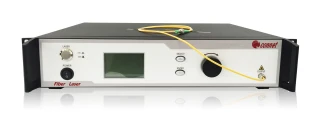
A microprocessor-based control system ensures precise and repeatable performance. The front-panel LCD provides real-time readout of output power and internal temperature, and it also reports warning and protection messages, enabling safe and intuitive operation. Users can monitor the laser status at a glance and quickly adjust parameters within the specified power tuning range. This type of intelligent control interface is common in premium laboratory fiber lasers, allowing for stable output over minutes and hours, low drift under typical laboratory conditions, and straightforward integration into automated setups.
From an integration standpoint, the VFLS-1550-B is engineered with flexibility in mind. The standard configuration provides a single-mode SMF-28 fiber output with FC/APC connectorization and random polarization, while polarization-maintaining (PM) output is optionally available for applications that require a defined state of polarization. The unit supports benchtop operation with standard AC input, and modularized configurations can be supplied for OEM and system-level integration. This makes the laser well-suited for incorporation into fiber optic communication testbeds, free-space optical links, interferometric sensing systems, and other platforms where stable, high-brightness 1550 nm radiation is essential.
Typical applications of the VFLS-1550-B include fiber optical communication experiments, free-space communication links, and a wide variety of fiber optic sensing schemes such as interferometric and distributed sensing. It is also widely applicable to test and measurement setups that require a stable, narrow-linewidth CW source around the telecom C-band, including component characterization and system calibration. In scientific and academic environments, this laser serves as a dependable workhorse for nonlinear optics at 1.5 µm, coherent detection research, and experimental teaching where both eye safety and performance are critical. With its combination of high output power, excellent beam quality, and robust design, the VENUS Series VFLS-1550-B is comparable to leading 1550 nm CW fiber lasers available globally and provides a solid platform for both current and future photonics applications.
1.5um Single-Mode CW Fiber Laser
Specifications
| Center Wavelength: | 1550 nm |
|---|---|
| Output Power: | 10 W |
| Beam Quality (M^2): | 1.1 |
| Spectral Linewidth: | 1 nm |
| Output Power Stability: | 0.4% ~ 0.5% |
| Output Fiber Type: | SMF-28 |
| Output Fiber Length: | 1 m |
| Interface: | Other / Not-specified |
| Cooling: | Air Cooled |
| Electrical Requirements: | 220V - 50Hz |
| Part No.: | VFLS-1550-B |
| Output Power (max): | 10 W |
| Output Power (options): | 0.5 W, 1 W, 2 W, 5 W, 10 W |
| Output Power Adjustment Range: | 0.1–100 % |
| Spectral Width (FWHM): | 0.1–0.5 nm |
| Side Mode Suppression Ratio: | ≥ 35 dB |
| Operation Mode: | CW |
| Output Polarization: | Random (PM optional) |
| Stability Of Output Power (15 Min): | ±0.5 % |
| Stability Of Output Power (8 H): | ±1 % |
| Light Isolation: | ≥ 35 dB |
| Return Loss: | ≥ 40 dB |
| Operating Temperature: | 0 to +50 °C |
| Storage Temperature: | -40 to +85 °C |
| Operating Voltage: | 170–260 VAC |
| Output Fiber Type: | SMF-28 single mode fiber (PM optional) |
| Length Of Output Fiber: | > 1 m |
| Output Connector: | FC/APC (other options available) |
| Output Mode: | Single-mode |
| Dimension (L×W×H): | 420 × 485 × 105 mm |
| Series: | VENUS SERIES |
| Model Type: | 1.5 μm Single-Mode CW Fiber Laser |
| Output Power Stability Test Condition: | 25 °C, 30 minutes after warm-up |
Got questions about specs? Use the inquiry form to ask.
 Download Data Sheet

Features
- Eye-Safe 1.5 µm Wavelength – Operates in the 1550 nm band, considered eye‑safe for many free‑space and fiber applications, ideal for laboratory and field use.
- High Continuous-Wave Output Power up to 10 W – Delivers robust CW power levels with typical options of 0.5 W, 1 W, 2 W, 5 W, and 10 W to match a wide range of experimental and system requirements.
- Single-Mode Output with Near Diffraction-Limited Beam Quality (M² < 1.1) – Ensures low divergence, excellent focusing, and high coupling efficiency into fibers and optical systems.
- All-Fiber, Double-Clad Pumped Design – Integrated, spliced all‑fiber architecture with double‑cladding pump technology offers high efficiency, compact form factor, and outstanding long‑term reliability.
- Excellent Power Stability – Output power stability of ±0.5% (15 min) and ±1% (8 h) at 25 °C (after warm‑up) for repeatable, drift‑free measurements and long experiments.
- Narrow Spectral Width (FWHM) – Spectral linewidth is factory‑configurable on request, supporting coherent detection, sensing, and precision test applications.
- High Side Mode Suppression Ratio (SMSR ≥ 35 dB) – Clean spectral profile with low spurious modes, improving performance in communication and sensing systems.
- Polarization Options: Random or PM Output – Standard random polarization with optional polarization‑maintaining (PM) output for interferometry, coherent communication, and polarization‑sensitive measurements.
- Integrated Microprocessor Control – Internal digital control system for intelligent monitoring, precise power control, self‑protection, and simplified operation.
- Front-Panel LCD Display & Easy Operation – Real‑time display of output power, temperature, and status, plus warning messages for intuitive use in labs and production environments.
- High Isolation & Low Back-Reflection Sensitivity – Built‑in optical isolation and high return‑loss design enhance system stability and protect the laser from feedback.
- Standard SMF-28 Fiber Output – Single‑mode fiber output (SMF‑28) for compatibility with common telecom and test setups; PM fiber output optional for polarization‑critical systems.
- Flexible Output Connectors – Supplied with FC/APC output connector as standard; other connector types available on request for easy system integration.
- Modular or Benchtop Configurations – Available as the VFLS‑1550‑B benchtop unit or as a modular, integrable source (on request) for OEM and system‑level deployment.
- Wide Output Power Adjustment Range – Smooth power tuning (from 10% to 100% of rated power, typ.) for optimizing signal levels in experiments and test setups.
- Compact, Rack-Mountable Form Factor – 420 (L) × 485 (W) × 105 (H) mm benchtop chassis fits standard lab benches and 19‑inch rack systems.
- Wide Operating Temperature Range – Reliable performance from 0 °C to +50 °C operating temperature and −40 °C to +85 °C storage range for demanding environments.
- Universal AC Power Input – Operates from standard VAC mains (typically 170–260 VAC), simplifying installation in global labs and industrial sites.
- Maintenance-Free, Long Lifetime Design – Solid‑state, all‑fiber architecture with no moving parts reduces maintenance costs and downtime over the life of the system.
- Optimized for Key 1.5 µm Applications – Suited for fiber‑optic communication, free‑space optical links, fiber sensing, LiDAR experiments, test and measurement, and scientific research requiring stable, high‑quality 1550 nm CW output.
Applications
Applications of 1.5 µm Single-Mode CW Fiber Lasers (up to 10 W)
The VFLS-1550-B VENUS Series 1.5 µm CW fiber laser from Connet Laser combines high output power (up to 10 W), near diffraction-limited beam quality, and all-fiber construction. These characteristics make it highly suitable for a wide range of industrial, scientific, and telecom applications where eye‑safer 1550 nm radiation, long-term stability, and single‑mode or PM output are required.
- Fiber Optic Communications (1550 nm C‑band)
Ideal for use as a continuous-wave source in long‑haul, metro, and access fiber networks, DWDM systems, and coherent transmission experiments. The narrow linewidth and high stability support testing and development of optical amplifiers, dispersion compensation modules, and advanced modulation formats. It can serve as a high‑power seed for optical transmitters, inline reference sources, and system margin testing in telecom laboratories. - Free-Space Optical (FSO) Communication Links
Well suited as the optical transmitter in terrestrial and near‑ground free‑space communication systems where eye‑safer 1550 nm operation is preferred. The high output power enables longer link distances and higher data rates, while the single‑mode beam quality simplifies collimation and beam steering. It is applicable to building‑to‑building links, last‑mile connectivity, backhaul links, and experimental high‑capacity FSO testbeds. - Fiber Optic Sensing and Distributed Sensing Systems
Widely used as a stable light source in fiber Bragg grating (FBG) interrogation, phase‑sensitive OTDR (Φ‑OTDR), Brillouin and Raman distributed sensing, and interferometric fiber sensors. The excellent power stability and low noise provide high measurement accuracy in structural health monitoring, oil and gas pipeline surveillance, perimeter security, and temperature/strain profiling over long fiber lengths. - Test and Measurement in Photonics Laboratories
Acts as a general‑purpose CW laser source for characterizing components at 1550 nm, such as optical isolators, circulators, WDM filters, couplers, splitters, VOAs, and photodetectors. The adjustable output power up to 10 W allows precise stress testing, insertion loss measurements, nonlinearity studies, and saturation behavior of EDFAs and Raman amplifiers. Suitable for use as a reference source in calibration setups and automated measurement systems. - Scientific Research and University Teaching
Provides a reliable platform for research in nonlinear fiber optics, ultrafast and coherent optics (as a CW pump/seed), photonics education, and guided‑wave optics demonstrations. Common uses include experiments on four‑wave mixing, self‑phase modulation, supercontinuum generation in highly nonlinear fibers, and optical parametric processes. The user‑friendly benchtop interface and modular options make it suitable for teaching laboratories and advanced student projects. - Eye‑Safer LIDAR and Ranging at 1.5 µm
Applicable as a high‑power CW or quasi‑CW source in frequency‑modulated continuous‑wave (FMCW) LIDAR and coherent Doppler LIDAR systems operating near 1550 nm. The wavelength region is considered eye‑safer compared to visible and near‑IR bands, enabling higher launch powers and longer detection ranges. Typical uses include wind speed measurement, atmospheric studies, obstacle detection, and proof‑of‑concept automotive and drone LIDAR research. - Laser Pump Source for Nonlinear Frequency Conversion
Serves as a robust pump for nonlinear crystals and specialty fibers used to generate mid‑IR or other wavelength bands via Raman shifting, parametric oscillation, and difference‑frequency generation. The combination of single‑mode output and up to 10 W CW power is beneficial for efficient nonlinear interactions in research‑grade frequency conversion setups in spectroscopy and sensing. - Optical Coherence Tomography and Interferometry at 1.3–1.6 µm
Can be employed as a stable coherence reference or narrowband source in long‑coherence OCT and interferometric metrology operating near the 1.5 µm window. It supports precision path‑length measurements, phase‑sensitive interferometry, and coherence‑based sensing in materials research and biomedical research prototypes where telecom‑band components are leveraged. - Component Burn‑In, Reliability, and Aging Tests
Useful for reliability qualification of passive and active telecom components that must withstand high optical powers at 1550 nm. The laser can perform accelerated aging, burn‑in, and lifetime tests on connectors, fibers, couplers, and integrated photonic devices. Its high stability and microprocessor‑based control enable repeatable test conditions over extended periods.
Frequently Asked Questions
What is the Connet VFLS-1550-B 1.5µm single‑mode CW fiber laser and what are its key features?
What are the typical applications of the VFLS-1550-B 1.5µm CW fiber laser?
How stable is the output power and beam quality of the VFLS-1550-B fiber laser?
What output power and wavelength options are available for the VFLS-1550-B?
What fiber and polarization options does the VFLS-1550-B provide at the output?
How is the VFLS-1550-B operated and controlled in a lab or system integration environment?
What environmental and safety considerations apply to the 1.5µm VFLS-1550-B fiber laser?
Got more questions? Use the inquiry form to ask the supplier directly.
Similar Products



Your inquiry has been received.
Create an account by adding a password
Why create an account?
- Auto-complete inquiry forms
- View and manage all your past messages
- Save products to your favorites
- Close your account anytime — no hassle