


Description
The 1310 nm Fiber Laser from DK Photonics is a precision light source designed for applications that demand exceptional wavelength stability, narrow linewidth, and reliable long-term performance. Built around a high-quality DFB (Distributed Feedback) semiconductor laser chip and coupled to single-mode optical fiber, this source offers a well-controlled, low-noise 1310 nm output ideal for advanced optical test and measurement setups, fiber sensing networks, and fiber laser seeding. Its carefully engineered driving circuitry and integrated TEC (Thermo-Electric Cooler) guarantee stable operation over a wide temperature range, making it suitable for both laboratory and field environments.
Operating at a center wavelength of 1310 ± 0.5 nm with a typical linewidth of ≤3 MHz, this laser provides a coherent, spectrally pure source that is well matched to the low-dispersion window of standard telecom fiber. Compared with generic 1310 nm laser diodes or broadband SLED sources, the laser’s narrow spectral width and sideband rejection ratio better than 50 dB significantly reduce noise and unwanted spectral components, improving measurement accuracy and system signal-to-noise ratio. Output powers of 10 mW or 20 mW are available, covering a broad range of use cases from low-power interferometric sensing to higher power reference sources for component characterization.
The 1310 nm Fiber Laser is offered with either standard single-mode fiber (SMF‑28e) or polarization-maintaining PM1300 panda fiber to suit different system architectures. The SM output is ideal for general-purpose testing, loss measurements, and telecom-oriented R&D, while the PM version is optimized for coherent detection, high-precision interferometry, and polarization-sensitive fiber sensors. Both configurations are terminated with an FC/APC connector to minimize back-reflection and preserve stability, aligning with industry practice for high-performance fiber laser sources and ensuring compatibility with standard optical test equipment and fiber networks.
Short-term and long-term power stability are critical for repeatable measurements, and this 1310 nm Fiber Laser is engineered to meet these requirements. With short-term stability of ≤ ±0.02 dB over 15 minutes and long-term stability of ≤ ±0.05 dB over 8 hours, users can rely on consistent output without frequent recalibration. These performance metrics compare favorably with similar narrow-linewidth 1310 nm laboratory sources found in metrology and sensing applications, reducing drift-induced measurement errors and increasing confidence in long-duration experiments or monitoring systems.
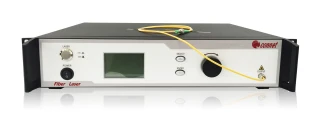
To accommodate diverse integration needs, the laser is available in both desktop and compact module formats. The desktop version includes front-panel button control and an internal AC power supply (100–240 V), providing a ready-to-use solution for benchtop laboratories, production lines, and teaching environments. The module version, powered by 5 V DC with an RS232 control interface via DB9 connector, is optimized for OEM integration into larger systems such as fiber sensor interrogators, optical coherence setups, and automated test platforms. Both formats maintain the same optical performance while offering flexibility in how the source is deployed.
In demanding environments, thermal and environmental robustness are essential. The integrated TEC and control electronics maintain stable diode temperature, which is directly tied to wavelength and power stability. Operating across a temperature range of -5 to +55 °C and humidity from 0 to 70%, the laser source is well suited for use not only in controlled laboratories but also in more challenging industrial settings and in-field installations. This combination of narrow linewidth, high sideband suppression, excellent stability, and flexible packaging positions the 1310 nm Fiber Laser as a reliable, high-performance solution for fiber sensing, fiber laser seeding, optical device testing, and general photonic research at the important 1310 nm telecom wavelength.
1310nm Fiber Laser
Specifications
| Center Wavelength: | 1310 nm |
|---|---|
| Output Power: | 0.02 W |
| Output Mode: | Continuous Wave (CW), Modulated |
| Output Power Stability: | 0.3% ~ 0.4% |
| Output Fiber Type: | SMF-28 |
| Interface: | Other / Not-specified |
| Cooling: | Air Cooled |
| Electrical Requirements: | 220V - 50Hz, 230V - 50Hz, 230V - 60Hz, 240V - 50Hz |
| Output Power Options: | 10/20 mW |
| Spectrum Linewidth: | ≤ 3 MHz |
| Sideband Rejection Ratio: | > 50 dB |
| Short-term Stability (15 Minutes): | ≤ ±0.02 dB |
| Long-term Stability (8 Hours): | ≤ ±0.05 dB |
| Fiber Type: | SMF-28e/PM1300 Panda |
| Optical Connector: | FC/APC |
Got questions about specs? Use the inquiry form to ask.
 Download Data Sheet

Features
- High-Purity 1310 nm Output
Engineered for the O-band at 1310 ± 0.5 nm, ideal for telecom, sensing, and test applications that require a precise and stable 1310 nm reference source. - Ultra-Narrow Linewidth for Coherent Applications
Delivers a typical linewidth of ≤ 3 MHz, enabling high-coherence operation suitable for interferometry, coherent detection, fiber sensing, and other precision optical measurements. - Exceptional Spectral Purity
High sideband rejection ratio of > 50 dB suppresses unwanted modes and noise, improving measurement accuracy and system signal-to-noise ratio in demanding lab and field setups. - Stable Output Power Over Time
Offers typical output powers of 10 mW or 20 mW with excellent stability: ±0.02 dB (15 min) short-term and ±0.05 dB (8 hours) long-term, reducing drift and re-calibration frequency. - DFB Semiconductor Laser Core
Uses a high-quality DFB (Distributed Feedback) laser chip with single-mode fiber output, delivering narrow-band, low-noise laser light well-suited for fiber-optic sensing and metrology. - Precise Temperature and Current Control
Integrated TEC temperature control and professionally designed driving electronics ensure laser safety, wavelength stability, and power consistency across a wide operating range. - SM or PM Fiber Output Options
Available with SMF-28e single-mode fiber for general use or PM1300 Panda polarization-maintaining fiber for polarization-sensitive applications such as coherent detection and interferometry. - Standard FC/APC Optical Interface
Equipped with FC/APC connectors to minimize back-reflections and easily integrate into existing optical test benches, sensing systems, and fiber networks. - Modular or Desktop Package Configurations
Flexible form factors: compact module (125 × 150 × 20 mm) for OEM integration and system embedding, or benchtop desktop unit (260 × 280 × 120 mm) for laboratory and R&D use. - Simple Operation and Control
Desktop version supports front-panel button control for quick setup, while module version offers RS232 communication via DB9 for remote monitoring, control, and system automation. - Wide Power Supply Compatibility
Desktop model runs on 100–240 V AC < 30 W for global lab use; module version operates from 5 V DC < 15 W, ideal for integration into compact or portable platforms. - Wide Operating Temperature and Humidity Range
Designed for reliable performance from -5 to +55 °C and 0–70% RH, suitable for both controlled laboratory environments and demanding industrial or field conditions. - Ideal 1310 nm Light Source for Fiber Sensing
Optimized for fiber sensor systems such as interferometric sensors, FBG interrogation, and distributed sensing, where narrow linewidth and high stability at 1310 nm are critical. - Reliable Source for Fiber Laser and Device Testing
Provides a clean, stable 1310 nm reference for fiber laser seeding, optical device testing, insertion loss/return loss measurement, component characterization, and R&D experiments. - OEM Customization Available
Supports custom output power, fiber type, connector, and packaging upon request, allowing seamless adaptation to specific system requirements and volume OEM projects. - Industrial-Grade Design from DK Photonics
Built by DK Photonics with robust engineering and strict quality control, comparable to leading 1310 nm narrow-linewidth fiber lasers worldwide, ensuring long-term, reliable operation.
Applications
- Fiber optic sensing systems – Ideal narrow-linewidth source for distributed and point fiber sensors, including fiber Bragg grating (FBG) sensors, interferometric sensors, and quasi-distributed sensing networks used in strain, temperature, and vibration monitoring.
- Optical time-domain reflectometry (OTDR) and optical frequency-domain reflectometry (OFDR) – Stable 1310 nm source for characterization of fiber links, component testing, fault localization, and backscatter-based measurements in access and metro networks.
- Telecommunications and data communications at 1310 nm – Reference laser for testing and calibrating 1310 nm transceivers, GBIC/SFP modules, and passive components in single-mode fiber systems (short-haul, metro, and data-center interconnects).
- Wavelength-division multiplexing (WDM) component testing – Suitable for lab and production testing of CWDM/DWDM components, filters, mux/demux units, and OADMs operating near the 1310 nm window.
- Optical device and component characterization – High-stability CW source for insertion loss, return loss, polarization dependent loss (PDL), and spectral response testing of couplers, splitters, switches, circulators, isolators, and connectors.
- Polarization-maintaining (PM) fiber systems – PM1300 panda fiber option enables evaluation and operation of PM components, polarization controllers, and interferometers requiring high polarization stability.
- Interferometry and coherent detection – Narrow linewidth and excellent short- and long-term stability make it suitable for Mach-Zehnder, Michelson, Sagnac, and other interferometric setups used in precision metrology and phase-sensitive measurements.
- Fiber laser seeding and reference sources – Can be used as a seed or reference laser in 1310 nm fiber laser architectures, or as a master oscillator for narrow-linewidth amplification stages.
- Optical coherence tomography (OCT) at 1.3 μm – Serves as a stable 1310 nm source for certain OCT configurations and as a reference/auxiliary laser in swept-source and interferometric OCT systems for biomedical imaging.
- Laboratory R&D and photonics education – Versatile laser for university labs, R&D centers, and training environments requiring a reliable and easy-to-use 1310 nm CW source for experiments, demonstrations, and prototype development.
- Material and bio-photonics experiments – Useful for optical property characterization of materials, biological tissues, and photonic structures in the near‑infrared window around 1310 nm.
- Metrology and calibration – Acts as a wavelength and power reference in calibration of optical power meters, wavelength meters, and test benches operating in the O-band.
- Integrated photonics and silicon photonics testing – Stable input source for characterizing waveguides, gratings, modulators, and other 1310 nm compatible integrated optical devices.
- Network installation, maintenance, and field testing – In desktop configuration, can serve as a bench or field reference light source for acceptance testing and troubleshooting of single-mode optical links at 1310 nm.
- Environmental and structural health monitoring systems – Core light source for FBG- and interferometer-based sensor networks used in bridges, tunnels, pipelines, wind turbines, and civil infrastructure monitoring.
Frequently Asked Questions
What is the DK Photonics 1310 nm fiber laser and what are its key features?
What applications are suitable for a 1310 nm narrow linewidth fiber laser?
What output power levels, fiber types, and package options are available for the 1310 nm fiber laser?
How do I specify or order a DK Photonics 1310 nm fiber laser, and can it be customized?
What are the electrical and control interfaces for the desktop and module versions?
What is the wavelength and power stability of this 1310 nm fiber laser compared with typical lab sources?
What environmental conditions and physical dimensions should I consider for integration?
Got more questions? Use the inquiry form to ask the supplier directly.
Similar Products



Your inquiry has been received.
Create an account by adding a password
Why create an account?
- Auto-complete inquiry forms
- View and manage all your past messages
- Save products to your favorites
- Close your account anytime — no hassle