
Description
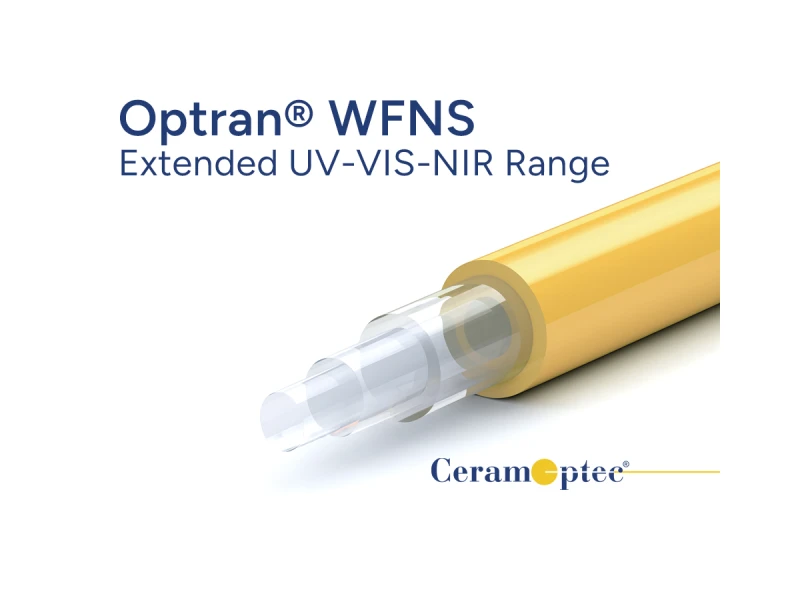
Optran® WFNS extends the usable spectral range down to 300 nm, enabling applications that require transmission from the UV to the near-infrared.
Optran® WFNS optical fibers have a silica core and fluorine-doped cladding, designed for light transmission in the 300–2400 nm spectral range. The fibers are available with a wide range of core diameters and numerical aperture configurations for integration into optical systems.
Optran® WFNS fibers are low-OH fibers and extend the transmission range into the UV region compared to standard VIS/NIR fibers. They are used in applications requiring broadband transmission from the UV through the visible and into the near-infrared wavelength range.
The fibers can be configured with different numerical aperture values and core/cladding ratios, depending on the application requirements. They are designed for operation across a wide temperature range from -190 to +350°C and can be supplied with various buffer and jacket materials.
Typical applications include spectroscopy, analytical instrumentation, optical sensing, and measurement systems requiring broadband UV–VIS–NIR transmission.
Optran® WFNS – Low-OH Silica Fibers for VIS-NIR (300–2400 nm)
Specifications
| Wavelength Range: | 300 – 2400 nm |
|---|---|
| Fiber Core Material: | Silica |
| Numerical Aperture (NA): | 0.12 ± 0.02 | 0.22 ± 0.02 | 0.28 ± 0.02 or customized |
| Operating Temperature: | -190 to +350°C |
| Core Diameter: | 30 to 3000 μm |
| Standard Core / Cladding Ratios: | 1 : 1.04 | 1 : 1.06 | 1 : 1.1 | 1 : 1.15 | 1 : 1.2 | 1 : 1.25 | 1 : 1.4 or customized |
| OH Content: | low (< 1 ppm) |
| OH Contents < 0.25 Ppm: | available upon request |
Got questions about specs? Use the inquiry form to ask.
 Download Data Sheet

Features
- Numerical Aperture (NA):
- 0.12 ± 0.02
- 0.22 ± 0.02
- 0.28 ± 0.02
- or customized to meet specific needs.
- Core Diameter: from 30 to 3000 μm, allowing for tailored solutions to fit your application requirements.
- Low OH Content: Standard fibers have low OH content (< 1 ppm), with options for even lower OH content (< 0.25 ppm) upon request.
- Prooftest Standards:
- 100 kpsi (Nylon, ETFE, Acrylate)
- 70 kpsi (Polyimide)
- Minimum Bending Radius:
- 50 × cladding diameter (for short-term stress)
- 150 × core diameter (for high laser power use)
- Buffer optional: Silicone or Hard Polymer
Applications
Low-OH all silica fibers such as Optran® WF and Optran® WFNS are engineered for high-performance light transmission from the visible to the near-infrared (VIS–NIR) and, for WFNS, down to the ultraviolet (UV). With spectral coverage from 300–2400 nm, low attenuation, and robust mechanical characteristics, these fibers support a wide range of demanding applications in scientific, industrial, medical, and OEM systems.
Astronomical Instrumentation- Fiber-fed spectrographs for multi-object and high-resolution stellar spectroscopy in the VIS–NIR range.
- Integral field units (IFUs) and fiber bundles for spatially resolved spectroscopy in telescopes.
- Guiding and calibration systems transmitting reference lamp and laser light to focal planes.
- Stellar and solar astronomy measurements where low attenuation and stable transmission are critical over long fiber runs.
- Fiber links between telescope and remote instrumentation in observatories requiring broad spectral coverage and low-OH content.
- UV–VIS–NIR spectroscopy for chemical, environmental, and process analysis (e.g., absorption, fluorescence, emission).
- Raman spectroscopy in the VIS–NIR, benefiting from low background and low OH-induced attenuation.
- NIR spectroscopy for moisture, protein, and material content analysis in food, pharma, and agriculture.
- Fiber-optic probes for in-line and at-line spectroscopic monitoring in reactors and pipelines.
- Chromatography detectors and optical sensor interfaces linking flow cells to benchtop spectrometers.
- Optical bench interconnects for compact OEM spectroscopy modules and photometric systems.
- NIR laser beam delivery for diode, fiber, and solid-state lasers operating in the 700–2400 nm range.
- Pulsed and CW laser transport in laboratory setups and industrial workstations where stable, low-loss delivery is required.
- Laser-based measurement and metrology, including interferometry and precision alignment systems.
- Excitation light delivery for fluorescence, photoacoustic, and pump–probe experiments from UV to NIR (WFNS).
- Beam routing in compact OEM laser modules and integrated photonic systems.
- Endoscopic illumination and imaging using VIS–NIR light for diagnostics and minimally invasive procedures.
- Laser therapy and surgical delivery (e.g., dermatology, ophthalmology, ENT, dental, and soft-tissue applications).
- Photodynamic therapy (PDT) requiring controlled light delivery in VIS–NIR bands.
- Biomedical spectroscopy (reflectance, fluorescence, NIR) for tissue characterization and non-invasive diagnostics.
- Fiber-based sensors in catheters and probes for monitoring oxygenation, perfusion, and other physiological parameters.
- Process control and inline monitoring in chemical, petrochemical, and pharmaceutical plants using NIR/UV–VIS spectroscopy.
- Combustion and emissions monitoring in engines, turbines, and furnaces where fibers must withstand elevated temperatures.
- Structural health monitoring with fiber-based sensors (e.g., Bragg gratings, interferometric sensors) operating in the VIS–NIR.
- Industrial machine vision and illumination for inspection systems needing stable broadband light delivery.
- Environmental sensing for water quality, gas detection, and pollutant monitoring using UV–NIR spectroscopic techniques.
- Broadband light transport from lamps, supercontinuum, and LED sources to experimental setups.
- UV–VIS–NIR pump and probe routing in time-resolved spectroscopy and ultrafast experiments (where allowed by power and bend-radius limits).
- Fluorescence and luminescence studies requiring low background and stable transmission across a wide spectral range.
- Quantum optics and photonics experiments where low-OH silica minimizes parasitic absorption and scattering.
Frequently Asked Questions
How does Optran® WFNS differ from Optran® WF?
When should Optran® WFNS be selected instead of WF?
Is Optran® WFNS suitable for UV applications?
What type of fiber is Optran® WFNS?
Does Optran® WFNS replace UV fibers?
Got more questions? Use the inquiry form to ask the supplier directly.
Similar Products
Your inquiry has been received.
Create an account by adding a password
Why create an account?
- Auto-complete inquiry forms
- View and manage all your past messages
- Save products to your favorites
- Close your account anytime — no hassle