
Description
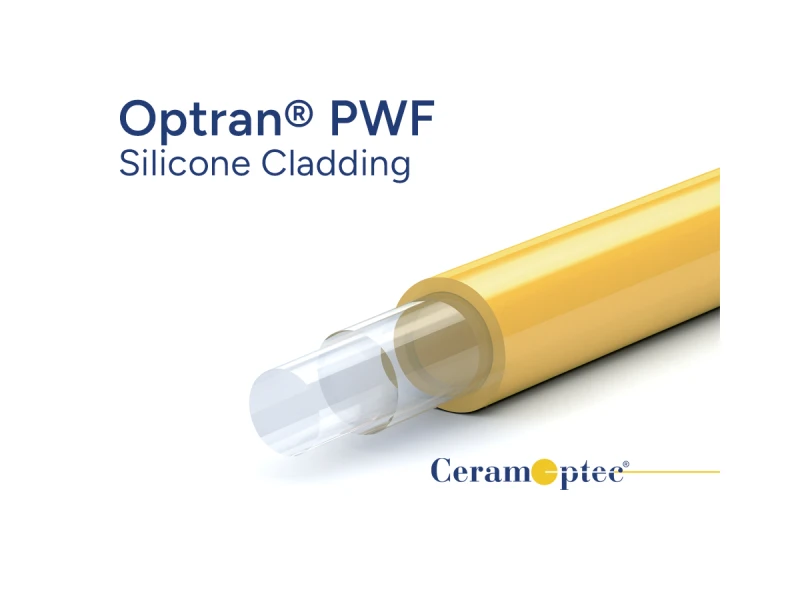
Optran® PWF optical fibers are multimode fibers with a silica core and silicone cladding, designed for light transmission in the 350–2200 nm spectral range. These fibers are low-OH fibers, which influences their attenuation characteristics, particularly in the visible and near-infrared wavelength range.
The silicone cladding results in higher numerical aperture values compared to all-silica fiber designs, enabling efficient light coupling and transmission. This makes Optran® PWF fibers suitable for applications where relaxed alignment tolerances or high light collection efficiency are required.
The fibers are available with a wide range of core diameters and numerical aperture configurations, supporting integration into different optical systems. The combination of material composition and geometry provides defined optical performance across the specified wavelength range.
Optran® PWF fibers are used in optical systems requiring efficient VIS and NIR transmission combined with high numerical aperture.
Optran® PWF – Low-OH Fiber with Silicone Cladding (350-2200 nm)
Specifications
| Core Diameter: | Not Specified |
|---|---|
| Wavelength Range: | 350 – 2200 nm |
| Cable Length: | Not Specified |
| Fiber Core Material: | Silica |
| Wavelength / Spectral Range: | 350 – 2200 nm |
| Numerical Aperture (NA): | 0.40 ± 0.02 |
| Operating Temperature: | -40 to +150°C |
| Core Diameter: | 100 to 2000 µm |
| OH Content (Optran PWF): | low (< 1 ppm) |
Got questions about specs? Use the inquiry form to ask.
 Download Data Sheet

Features
- Numerical Aperture (NA): 0.40 ± 0.02
- Operating Temperature: -40 to +150°C
- Core Diameter: 100 to 2000 µm
- OH Content: Low (< 1 ppm)
- Standard Prooftest: 100 kpsi
- Minimum Bending Radius:
- 50 × cladding diameter (short-term mechanical stress)
- 150 × core diameter (during use with high laser power)
- Material: Silica glass core with silicone cladding
- Jacket Options:
- ETFE: -40 to +150°C
- Nylon: -40 to +100°C
- Advantages:
- High concentricity
- Step-index profile
- Biocompatible material
- Sterilizable using ETO and other methods
- Customization: Tailored to your specific application needs
Applications
- Remote Illumination: Ideal for applications requiring efficient light transmission over distances.
- Sensing Applications: Suitable for various sensing technologies due to its high numerical aperture and wide spectral range.
- Medical Applications: Biocompatible and sterilizable, making it perfect for medical environments.
- UV to NIR Performance: Offers superior performance and fiber optic properties from UV to NIR wavelengths.
- Customizable: Available in a range of core diameters and assemblies to meet specific application needs.
- Cost-Effective: Provides high performance at a lower cost compared to traditional silica/silica fibers.
Frequently Asked Questions
What distinguishes Optran® PWF from Optran® PUV?
When should a low-OH fiber like Optran® PWF be used?
Is Optran® PWF suitable for UV applications?
What is the role of silicone cladding in Optran® PWF fibers?
Got more questions? Use the inquiry form to ask the supplier directly.
Similar Products
Your inquiry has been received.
Create an account by adding a password
Why create an account?
- Auto-complete inquiry forms
- View and manage all your past messages
- Save products to your favorites
- Close your account anytime — no hassle