
Description
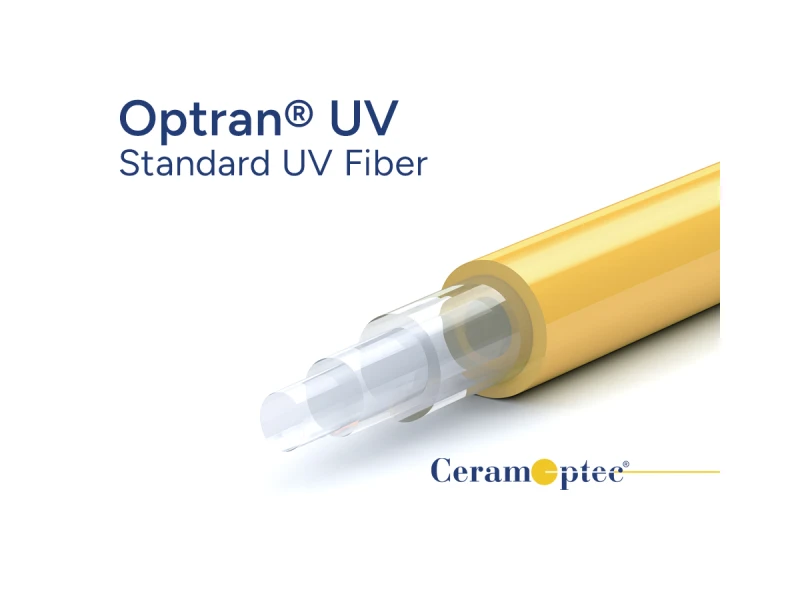
Optran® UV optical fibers are multimode fibers with a fused silica core and fluorine-doped cladding, designed for light transmission in the 220–1200 nm spectral range. These fibers represent a standard UV fiber type within the CeramOptec portfolio.
The fiber structure is based on an all-silica design with a defined refractive index profile, enabling controlled light guidance across the specified wavelength range. Optran® UV fibers are available with a range of core diameters and numerical aperture configurations to support integration into different optical systems.
Compared to UVNS fiber types, Optran® UV fibers exhibit similar initial attenuation characteristics, but differ in their behavior under prolonged or high-intensity UV exposure due to differences in preform manufacturing technology.
Optran® UV fibers are used in applications requiring UV transmission under standard operating conditions, where defined optical properties and system integration are the primary requirements.
Optran® UV – High-OH UV Fiber (220–1200 nm)
Specifications
| Wavelength Range: | 220 – 1200 nm |
|---|---|
| Fiber Core Material: | Silica |
| Numerical Aperture (NA): | 0.12 ± 0.02 | 0.22 ± 0.02 | 0.28 ± 0.02 or customized |
| Operating Temperature: | -190 to +350°C |
| Core Diameter: | 50 to 3000 μm |
| Standard Core / Cladding Ratios: | 1 : 1.04 | 1 : 1.06 | 1 : 1.1 | 1 : 1.15 | 1 : 1.2 | 1 : 1.25 | 1 : 1.4 or customized |
Got questions about specs? Use the inquiry form to ask.
 Download Data Sheet

Features
- Numerical Aperture (NA):
- 0.12 ± 0.02
- 0.22 ± 0.02
- 0.28 ± 0.02
- or customized options available
- OH Content:
- Optran® UV: High (> 700 ppm)
- Standard Prooftest:
- 100 kpsi (nylon, ETFE, acrylate jacket)
- 70 kpsi (polyimide jacket).
- Minimum Bending Radius:
- 50 × cladding diameter (short-term mechanical stress)
- 150 × core diameter (during use with high laser power)
- Material Composition:
- Silica glass core
- Buffer (if provided): Silicone, hard polymer
- Jacket Options:
- Polyimide: -190 to +350°C
- ETFE: -40 to +150°C
- Nylon: -40 to +100°C
- Acrylate: -40 to +85°C
Applications
Applications of High-OH All-Silica Fiber with Fluorine-Doped Cladding (Optran® UV / Optran® UVNS)
Optran® UV and Optran® UVNS high-OH all-silica fibers are engineered for reliable light delivery in the 190–1200 nm range, with excellent performance in the deep UV and visible. Their high solarization resistance (UVNS), tight numerical aperture control, and broad choice of rugged jackets make them suitable for numerous demanding industrial, scientific, and medical applications.
1. UV and Visible Spectroscopy
- Fiber-coupled UV/Vis spectrometers in laboratories and OEM instruments
- Process analytics in chemical and petrochemical plants (inline and at-line measurements)
- Water and wastewater UV absorbance monitoring (COD, BOD, TOC surrogates)
- Gas-phase spectroscopy for environmental monitoring and emissions testing
- Thin-film and coating characterization using UV reflectance or transmission
- UV Raman spectroscopy and resonance Raman systems requiring deep-UV delivery
2. Analytical and Scientific Instrumentation
- OEM light delivery in benchtop and portable analytical instruments
- Monochromator and lamp coupling (deuterium, xenon, mercury, excimer sources)
- Chromatography detectors (HPLC, UHPLC, IC) with UV/Vis detection
- Spectrophotometers and multi-channel detector arrays
- Fiber-fed spectrographs for scientific and industrial measurement systems
- Environmental sensors and optical probes deployed in harsh or remote locations
3. Fluorescence and Photoluminescence Excitation
- Excitation delivery for fluorescence spectroscopy and fluorometry
- Time-resolved fluorescence and phosphorescence measurements
- Confocal and widefield microscopy illumination in the UV and visible
- Bioassays and microplate readers requiring stable UV excitation
- Photoluminescence and electroluminescence testing of semiconductors and materials
- DNA, RNA, and protein analysis systems with UV excitation sources
4. Medical and Biomedical Instrumentation
- Endoscopic and minimally invasive diagnostic illumination in the UV/visible
- Fiber-delivered UV for dermatology and phototherapy systems (where permitted)
- Biomedical spectroscopy (tissue characterization, optical biopsy, fluorescence-guided surgery)
- Dental curing and diagnostic light-delivery systems employing UV/blue wavelengths
- Point-of-care diagnostic analyzers with fiber-coupled UV/Vis modules
- Ophthalmic diagnostic devices requiring well-controlled UV/blue transmission
5. UV Curing and Photopolymerization
- Guided delivery of UV light for curing adhesives, inks, coatings, and resins
- Spot curing systems in electronics and micro-assembly
- Medical device manufacturing where localized UV curing is required
- 3D printing and additive manufacturing systems using UV-curable materials
- Automotive and aerospace coatings inspection and repair (UV-cured materials)
- Optoelectronic assembly lines needing fiber-based UV exposure heads
6. Industrial Process Monitoring and Control
- Inline UV/Vis process spectroscopy for real-time quality control
- Monitoring of polymerization, bleaching, and chemical conversion reactions
- Food and beverage inspection (color, contamination, and composition analysis)
- Pharmaceutical process analytics (PAT) using UV/Vis probes and flow cells
- Optical sensors for turbine, engine, and combustion diagnostics using UV signals
- Harsh-environment sensing where wide temperature capability is required
7. Research and Laboratory Applications
- General-purpose UV/Vis light delivery in physics, chemistry, and life science labs
- Laser and pulsed-lamp experiments in the UV spectral range
- Prototype building of custom spectroscopy and metrology setups
- Optical bench experiments requiring flexible routing of UV and visible light
- Solar simulation and accelerated aging tests with UV components
- Education and training setups in optics and photonics laboratories
8. Metrology, Testing, and Calibration
- Reference channels for spectrometer and radiometer calibration in the UV/Vis
- Fiber-coupled integrating spheres and reference light sources
- Colorimetry and UV color measurement in quality inspection systems
- Optical characterization of UV LEDs, lasers, and lamp systems
- Wavelength, intensity, and uniformity mapping for UV exposure tools
Frequently Asked Questions
What is meant by a standard UV fiber?
How does Optran® UV differ from UVNS fibers?
When should Optran® UV be selected instead of UVNS?
Which types of applications typically use standard UV fibers?
Does Optran® UV include features for solarization resistance?
Got more questions? Use the inquiry form to ask the supplier directly.
Similar Products
Your inquiry has been received.
Create an account by adding a password
Why create an account?
- Auto-complete inquiry forms
- View and manage all your past messages
- Save products to your favorites
- Close your account anytime — no hassle