
Description
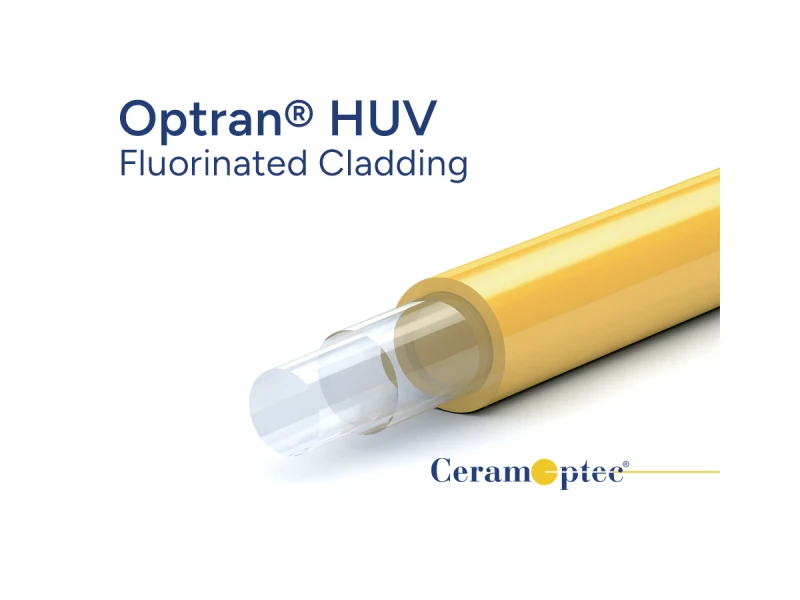
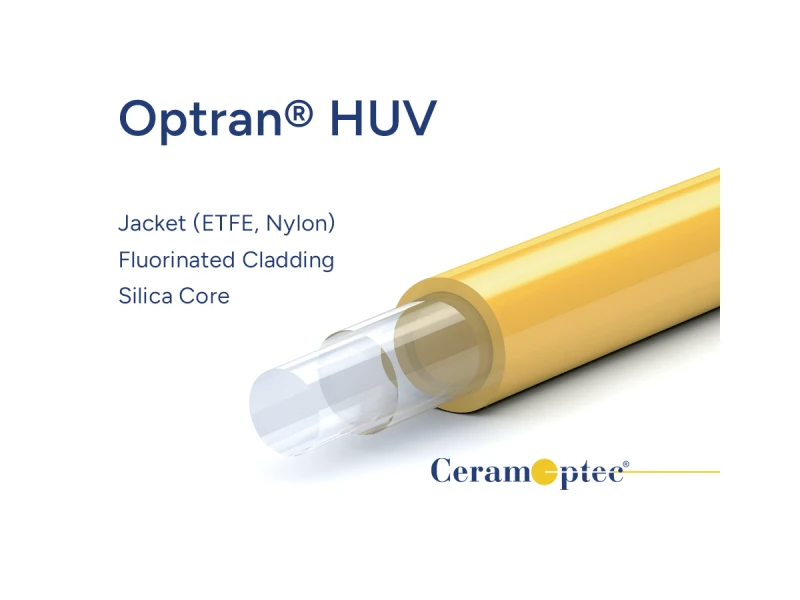
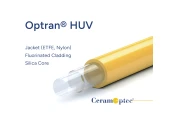
Optran® HUV optical fibers are multimode fibers with a fused silica core and a fluorine-doped acrylate cladding, designed for light transmission in the 350–2200 nm spectral range. The fibers are characterized by a high OH content, which influences their transmission behavior, particularly in the ultraviolet and visible wavelength range.The combination of silica core and fluorinated acrylate cladding results in defined numerical aperture values and stable light guiding properties.
Optran® HUV fibers are available with a wide range of core diameters and numerical aperture configurations, enabling integration into various optical system designs.These fibers are used in applications where transmission in the UV and visible range is required, while maintaining compatibility with broader wavelength ranges extending into the near-infrared.
The defined material composition and geometry support reproducible optical performance across different configurations.Optran® HUV fibers are typically integrated into optical assemblies, illumination systems, and measurement setups where controlled light delivery is required.
Optran® HUV – High-NA UV Fiber (350-2200 nm)
Specifications
| Wavelength Range: | 350 – 2200 nm |
|---|---|
| Fiber Core Material: | Silica |
| Core Diameter: | 100 to 2000 μm |
| Numerical Aperture (NA): | 0.37 ± 0.02 | 0.48 ± 0.02 | 0.52 ± 0.02 | 0.57 ± 0.02 |
| Operating Temperature: | -40 to +150°C |
| OH Content: | high (> 700 ppm) |
Got questions about specs? Use the inquiry form to ask.
 Download Data Sheet

Features
- High Numerical Aperture for Efficient Light Coupling
Optimized NA options (0.37, 0.48, 0.52, 0.57 ±0.02) provide excellent light capture and emission, ideal for tight coupling into LEDs, laser diodes, and broadband sources in demanding illumination and sensing systems. - Silica Core with Fluorinated Hard Polymer Cladding
Robust fluorinated polymer cladding on a pure silica core delivers strong mechanical protection, stable guidance, and reduced microbending sensitivity, making the fiber easier to handle than many all‑silica high‑NA fibers. - Cost-Effective Alternative to All-Silica High-NA Fibers
The hard polymer cladding architecture significantly lowers cost while maintaining high transmission performance, enabling economical deployment in OEM systems, disposable probes, and multi-channel bundles. - Broad Spectral Range: 350–2200 nm
Engineered for wideband operation from UV through VIS to NIR, supporting applications such as UV curing, photodynamic therapy, broadband spectroscopy, analytical instrumentation, and industrial sensing. - High-OH (HUV) and Low-OH (HWF) Variants
Optran® HUV (high >700 ppm OH) is optimized for UV and visible transmission, while Optran® HWF (low <1 ppm OH) is optimized for low-loss NIR and broadband applications, allowing precise fiber selection based on wavelength regime. - Wide Core Diameter Range: 100–2000 µm
Available with large core sizes to maximize coupled power, support high-intensity illumination, and simplify alignment in industrial and medical systems compared to small-core telecom fibers. - Flexible Core/Cladding Geometry
Standard core-to-cladding ratios from 1:1.04 to 1:1.4 and custom geometries upon request enable optimal mode control, mechanical robustness, and integration into existing connector and ferrule designs. - Wide Operating Temperature Range
Fiber rated from -40 °C to +150 °C, with jacket options supporting typical environments:- ETFE Jacket: up to approx. -40 °C to +150 °C for demanding industrial and outdoor use.
- Nylon Jacket: up to approx. -40 °C to +100 °C for general-purpose protection and flexibility.
- Consistent, In-House Preform and Drawing Processes
Fully controlled preform fabrication and fiber drawing ensure reproducible optical and mechanical properties from batch to batch, critical for OEM qualification, long-term series production, and multi-fiber system matching. - High Mechanical Strength and Reliability
Standard prooftest of 100 kpsi provides high tensile strength and long-term durability under bending, routing, and repeated handling in industrial and medical environments. - Optimized for Illumination and Sensing
Designed specifically for:- Illumination and UV curing in industrial, printing, and biomedical systems.
- Industrial and environmental sensing with robust, high‑NA light delivery and collection.
- Photodynamic Therapy (PDT) and other medical illumination procedures.
- Broadband sensing and analytical instrumentation where stable, low‑loss transmission is essential.
- Improved Handling vs. Fragile High-NA Glass Fibers
The fluorinated hard polymer cladding and available protective jackets increase crush resistance, abrasion resistance, and flexibility, enabling easier routing in tight spaces and repeated use without significant degradation. - Stable Attenuation Across Broad Wavelengths
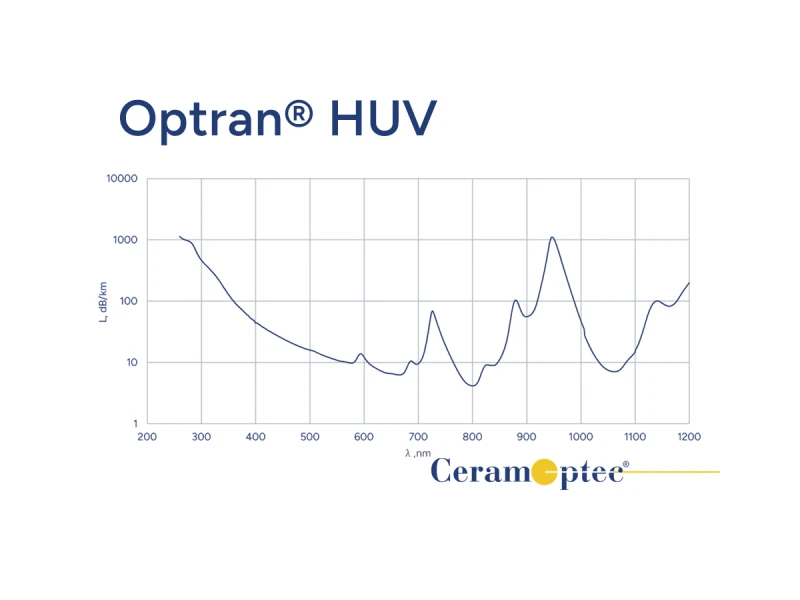
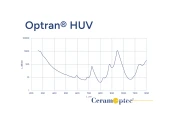
Typical attenuation performance (reference curves available from the manufacturer) supports low-loss transmission from UV through NIR, providing predictable throughput for calibrated measurement and illumination systems. - Custom Engineering and Project-Specific Qualification
Custom core sizes, NA configurations, jacketing, connectorization, and qualification data can be provided on request, supporting integration into specialized OEM, research, and medical device platforms. - Proven Optran® Fiber Platform
Part of the established Optran® fiber family, widely used in industrial, scientific, and medical markets worldwide, ensuring long-term availability, quality documentation, and application know-how.
Applications
- High-NA Illumination Systems
– Coupling high-power lamps and LEDs into fibers for uniform area illumination
– Machine vision lighting for inspection, alignment, and positioning
– Backlighting and coaxial illumination in automated optical inspection (AOI) systems
– Cold-light delivery in microscopy and endoscopy where low heat at the target is required - Industrial Process Monitoring and Sensing
– In-situ process monitoring in harsh industrial environments using fiber-coupled probes
– Inline quality control in manufacturing lines (metal, glass, semiconductor, plastics)
– Fiber-based temperature, strain, and displacement sensing using broadband interrogation
– Environmental monitoring of gases and liquids via fiber-coupled spectroscopic sensors - Broadband Spectroscopy and Analytical Instrumentation
– Fiber coupling for UV–VIS–NIR spectrometers (350–2200 nm) in laboratories and OEM systems
– Transmission, reflection, and absorbance measurements in chemical and pharmaceutical analysis
– Process analytical technology (PAT) in food, beverage, petrochemical, and biotech industries
– Fiber-coupled Raman, fluorescence, and LIBS (laser-induced breakdown spectroscopy) probes - UV and Visible Light Curing
– Fiber-delivered UV/visible light for spot curing of adhesives, inks, and coatings
– Precision curing in electronics assembly, optics bonding, and medical device manufacturing
– Multi-point illumination for simultaneous curing in automated production tools
– UV curing in confined or difficult-to-access geometries using flexible fiber bundles - Medical and Biomedical Applications
– Photodynamic Therapy (PDT) light delivery in dermatology, oncology, and ophthalmology
– Fiber-based illumination in minimally invasive medical instruments and endoscopes
– Fiber-coupled excitation and collection in fluorescence and absorbance-based diagnostics
– OEM integration in biomedical analyzers and point-of-care diagnostic platforms - Biotech, Life Science, and Laboratory Research
– Broadband light delivery for spectroscopy, cytometry, and imaging systems
– UV–NIR excitation in bioassays, DNA analysis, and protein characterization
– Optical probing in microfluidic chips and lab-on-a-chip platforms
– Fiber-based delivery for optogenetics, photostimulation, and photoactivation experiments - High-NA Laser Delivery and Beam Coupling
– Coupling of diode, solid-state, and fiber lasers into large-core, high-NA silica fibers
– Non-critical alignment laser delivery in industrial, medical, and research setups
– Beam homogenization and flexible routing for low to moderate power laser applications
– Pump-light delivery for specialty laser and amplifier systems (within fiber NA and power limits) - Illumination and Sensing in Harsh or Confined Environments
– Remote illumination and monitoring in high-temperature or chemically exposed areas
– Sensor integration in reactors, furnaces, vacuum systems, and pressurized vessels
– Long-distance routing of light in process plants, cleanrooms, and field installations
– Illumination and sensing in automotive, aerospace, and transportation test setups - Imaging, Inspection, and Metrology
– Fiber-optic light guides for borescopes, videoscopes, and industrial inspection cameras
– Structured light projection for 3D scanning and surface profilometry
– Fiber-fed illumination in coordinate measuring machines (CMM) and optical comparators
– Precision metrology systems using fiber-coupled broadband or narrowband light sources - UV–NIR Broadband Sensing Systems
– Multi-wavelength sensing for process control and material characterization
– Fiber links between broadband sources and detector modules in modular test setups
– OEM fiber harnesses for analytical instrumentation platforms
– Portable and handheld spectroscopic devices using flexible fiber interconnects - Environmental, Chemical, and Gas Analysis
– Fiber-coupled absorption and transmission measurements in gas cells and liquid cuvettes
– On-line monitoring of pollutants, emissions, and process gases
– Water quality and wastewater monitoring via UV–VIS spectroscopy
– Remote sensing in field-deployable analytical systems - OEM Integration in Instruments and Equipment
– Internal light routing in spectrometers, fluorimeters, and color measurement devices
– Fiber harnesses in medical analyzers, clinical diagnostics, and imaging systems
– Built-in illumination modules in semiconductor inspection and wafer metrology tools
– Standardized or custom fiber assemblies in scientific instruments and industrial equipment
Frequently Asked Questions
What are Optran HUV and Optran HWF high-NA silica fibers and how do they differ?
What is the spectral range and attenuation performance of Optran HUV/HWF fibers?
What numerical aperture (NA) options are available and why is high NA important?
What core sizes, cladding ratios, and jacketing options are available for Optran HUV/HWF fibers?
What are the operating temperature limits and environmental constraints of these polymer‑clad silica fibers?
What applications are Optran HUV/HWF high‑NA silica fibers suitable for?
What mechanical strength and handling characteristics do Optran HUV/HWF fibers offer?
Got more questions? Use the inquiry form to ask the supplier directly.
Similar Products
Your inquiry has been received.
Create an account by adding a password
Why create an account?
- Auto-complete inquiry forms
- View and manage all your past messages
- Save products to your favorites
- Close your account anytime — no hassle