
Description
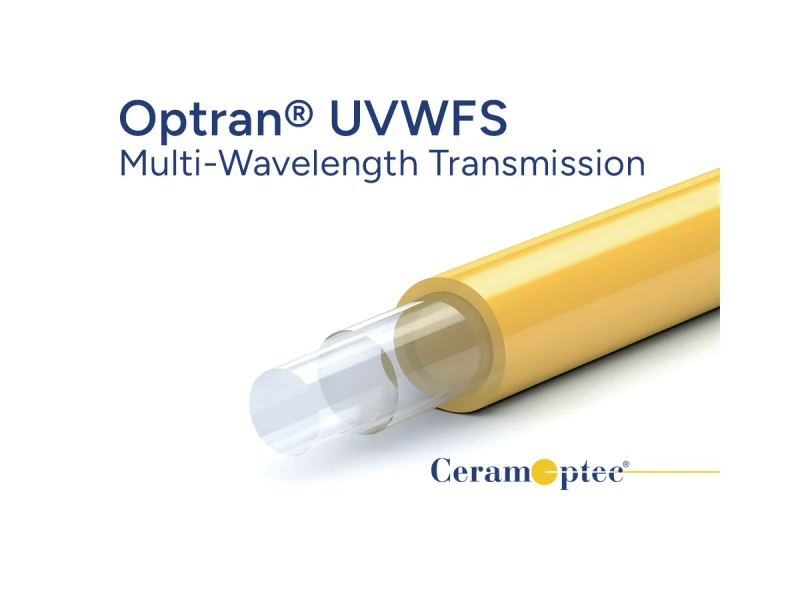
Optran® UVWFS optical fibers are all-silica fibers with a fused silica core and fluorine-doped cladding, designed for broadband light transmission across the 200–2000 nm spectral range.
The fibers are available with a range of core diameters and numerical aperture configurations for integration into optical systems.
As low-OH fibers, Optran® UVWFS supports stable transmission across the ultraviolet, visible, and near-infrared regions, making them suitable for applications requiring simultaneous use of multiple wavelength ranges.
Typical applications include spectroscopy, analytical instrumentation, and optical systems requiring consistent broadband light delivery.
Optran® UVWFS – Broadband Low-OH Fiber (200-2000nm)
Specifications
| Wavelength Range: | 200 – 2000 nm |
|---|---|
| Fiber Core Material: | Silica |
| Numerical Aperture (NA): | 0.12 ± 0.02 | 0.22 ± 0.02 | 0.28 ± 0.02 or customized |
| Operating Temperature: | -190 to +350°C |
| Core Diameter: | 100 to 800 µm | standard 200 µm |
| OH Content: | ~ 5 ppm |
Got questions about specs? Use the inquiry form to ask.
 Download Data Sheet

Features
- Broadband UV–VIS–NIR Transmission (200–2000 nm) – Engineered for high-performance light delivery from deep UV through visible to near‑infrared, ideal for multi-wavelength and white-light applications.
- Low-OH All-Silica Core (~5 ppm OH) – Minimizes absorption in the UV and NIR, delivering low attenuation across a broad spectral range for precise spectroscopy and sensing.
- Fluorine-Doped Silica Cladding – Optimized refractive index profile for stable guidance, low modal dispersion, and improved transmission efficiency over long lengths.
- High-Temperature All-Silica Fiber Design – Pure silica core and cladding enable continuous operation from -190 °C to +350 °C, supporting harsh-environment applications in aerospace, avionics, and industrial systems.
- Multiple Numerical Aperture (NA) Options – Available with NA 0.12, 0.22, and 0.28 (±0.02) to match various coupling optics, beam geometries, and collection efficiencies.
- Wide Core Diameter Range (100–800 µm) – Standard 200 µm core with options from 100 to 800 µm for easy alignment, high-power handling, and customized mode-field properties.
- Flexible Core/Cladding Ratios – Standard ratios from 1:1.06 to 1:1.4 and fully customizable dimensions to fit tight mechanical constraints and specialized connector systems.
- Polyimide Jacket for Extreme Temperatures – High-performance polyimide coating supports the full -190 °C to +350 °C temperature range and offers excellent chemical and abrasion resistance; additional coatings available on request.
- Standard Prooftest at 70 kpsi – Robust mechanical strength for demanding installation, routing, and long-term reliability in laboratory, field, and airborne environments.
- Excellent for Spectroscopy and Broadband Sensing – Optimized for UV–VIS–NIR spectroscopy, broadband sensing, fluorescence, Raman, and absorbance measurements where stable, low-loss transmission is critical.
- Optimized for Astronomy and Scientific Instrumentation – Low attenuation and stable properties make this fiber well suited for astronomy instrumentation, fiber-fed spectrographs, and precision metrology.
- Qualified for Aerospace and Avionics – All-silica construction, high proof strength, and wide thermal stability support integration in aerospace, defense, and avionics optical systems.
- In-House Preform and Controlled Drawing – CeramOptec® manufactures preforms and draws fiber in-house, ensuring tight process control, consistent performance, and traceability across production batches.
- Reproducible Optical and Mechanical Properties – Batch-to-batch consistency simplifies system qualification and allows seamless replacement or scaling across multi-channel systems.
- Standard and Custom Configurations – Available as a standard broadband solution or customized for core size, NA, coatings, and core/cladding ratio to match unique system requirements.
- Low Attenuation Attenuation Profile – Designed for minimal transmission loss from 200–2000 nm, providing reliable performance for long fiber runs and high signal-to-noise measurements (typical attenuation curve available on request).
- Ideal for Multi-Wavelength and White-Light Systems – Supports simultaneous transmission of multiple spectral bands, making it an excellent choice for multi-wavelength sources, broadband illumination, and tunable-laser setups.
- Ready for Integration and Qualification Support – Additional specifications, reference data, and project-specific qualification are available upon consultation to support regulatory, aerospace, and OEM integration needs.
- Trusted CeramOptec® Optran® UVWFS Platform – Part of the established Optran® family of all-silica broadband fibers, known worldwide for reliability in advanced photonics, research, and industrial applications.
Applications
- UV–VIS–NIR Spectroscopy – Ideal for broadband spectroscopic systems requiring stable low-loss transmission from 200–2000 nm, including absorption, emission, fluorescence, and reflectance spectroscopy in research and industrial environments.
- Broadband Optical Sensing – Used in fiber-based sensors that operate over wide spectral ranges, including chemical and biochemical sensing, fluorescence-based sensors, and broadband monitoring of process parameters.
- Environmental and Process Monitoring – Suited for inline and online monitoring of gases, liquids, and solids in harsh industrial environments where wide spectral coverage and high temperature resistance are needed.
- Industrial UV Curing and Illumination – Transmits deep UV to NIR for high-intensity UV curing systems, photolithography exposure, and broadband illumination of workpieces in manufacturing and printing.
- Laser Delivery (UV, VIS, NIR) – Delivers continuous-wave and pulsed laser light at multiple wavelengths for micromachining, marking, lithography, and materials processing where all-silica, low-OH fibers are preferred.
- Multi-Wavelength Instrumentation – Enables compact routing of different wavelengths in one fiber for instruments that combine UV, visible, and NIR sources (e.g., white-light systems, multi-line lasers, tunable sources).
- Astronomy and Astrophotonics – Applied in fiber-fed spectrographs, stellar light collection, and broadband astronomical instrumentation where low attenuation and stable transmission from UV to NIR are critical.
- Aerospace and Avionics Systems – Suitable for harsh aerospace environments requiring high-temperature, radiation-tolerant, and vibration-resistant broadband fiber links for sensing, diagnostics, and communication subsystems.
- Remote Sensing and Lidar – Used in UV–VIS–NIR lidar and remote sensing instruments for atmospheric studies, pollution monitoring, and range finding where low-loss, broadband fiber delivery is required.
- Medical Diagnostics and Biomedical Optics – Supports fiber-optic probes for spectroscopy-based tissue analysis, fluorescence diagnostics, photodynamic therapy monitoring, and broadband illumination in medical devices.
- OCT and Imaging Systems – Integrates into broadband optical coherence tomography and other imaging systems that demand wide spectral bandwidth and low dispersion over UV–NIR ranges.
- Metrology and Calibration Systems – Routes light from broadband calibration lamps and reference sources (deuterium, halogen, xenon) to spectrometers and detectors for precise radiometric and wavelength calibration.
- Laboratory Light Delivery and Collection – General-purpose fiber for guiding light to and from sample chambers, integrating spheres, microscopes, and test benches in R&D labs across multiple wavelength bands.
- Quality Control and Inline Inspection – Integrated into production lines for non-contact, broadband optical inspection, color and appearance measurements, and spectral verification of materials and coatings.
- Forensic and Security Applications – Used in portable and laboratory spectroscopic instruments for substance identification, trace analysis, and UV–VIS–NIR inspection of forensic samples.
- Semiconductor and Photonics Manufacturing – Provides stable broadband delivery for wafer inspection, photoresist characterization, thin-film metrology, and alignment systems operating from UV through NIR.
- Solar and Photovoltaic Characterization – Suitable for spectral response, quantum efficiency, and reflectance measurements of solar cells and photovoltaic materials over the full UV–VIS–NIR range.
- Research in Physics, Chemistry, and Materials Science – A versatile broadband fiber for laboratory experiments requiring controlled delivery and collection of light across a wide wavelength span, including pump–probe setups and time-resolved spectroscopy.
- Harsh-Environment Fiber-Optic Links – All-silica construction and polyimide jacket enable high-temperature, chemically resistant fiber runs for sensing and illumination in furnaces, reactors, and vacuum systems.
Frequently Asked Questions
What is Optran UVWFS broadband all‑silica fiber and what spectral range does it cover?
What are the main advantages of using an all‑silica, low‑OH core fiber like Optran UVWFS for UV–VIS–NIR transmission?
For which applications is Optran UVWFS fiber typically used?
What core sizes, numerical apertures, and core‑to‑cladding ratios are available for Optran UVWFS?
What temperature range and mechanical proof test does Optran UVWFS fiber support?
What jacket and coating options are available for Optran UVWFS fiber?
Can Optran UVWFS fiber be customized for specific UV–VIS–NIR applications and what information is needed for a quotation?
Got more questions? Use the inquiry form to ask the supplier directly.
Similar Products
Your inquiry has been received.
Create an account by adding a password
Why create an account?
- Auto-complete inquiry forms
- View and manage all your past messages
- Save products to your favorites
- Close your account anytime — no hassle