
Description
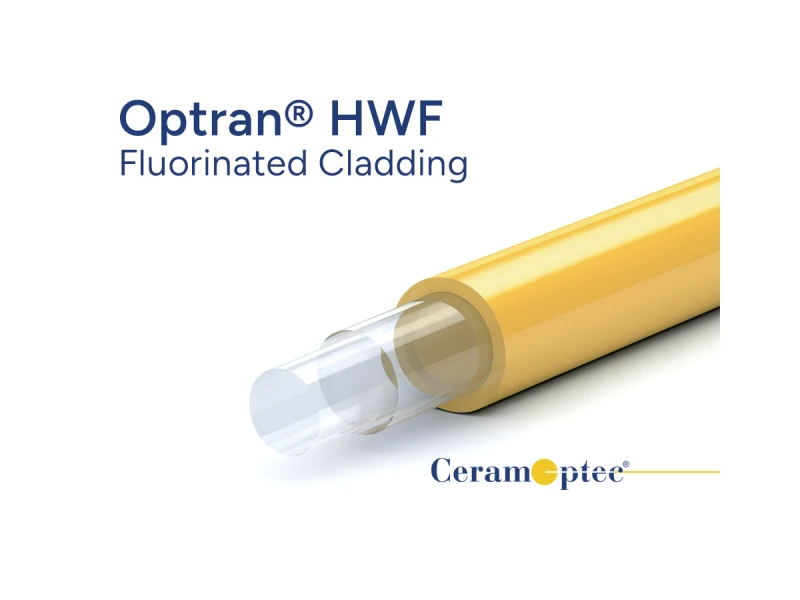
Optran® HWF optical fibers are multimode fibers with a silica core and a fluorine-doped acrylate cladding, designed for light transmission in the 350–2200 nm spectral range. In contrast to high-OH fiber types, Optran® HWF fibers are low-OH fibers, which affects their attenuation behavior across the visible and near-infrared wavelength range.
The fiber structure is based on a silica core combined with a fluorinated acrylate cladding, resulting in defined numerical aperture values and consistent light guiding characteristics. Optran® HWF fibers are available with a wide range of core diameters and numerical aperture configurations to match different optical system requirements.
Due to their low OH content, these fibers are typically used in applications focusing on VIS and NIR transmission. The material composition supports stable optical performance across the specified spectral range.
Optran® HWF fibers are integrated into optical systems requiring controlled light transmission in the visible and near-infrared region, including analytical, sensing, and illumination setups.
Optran® HWF can be customized to your application specific needs.
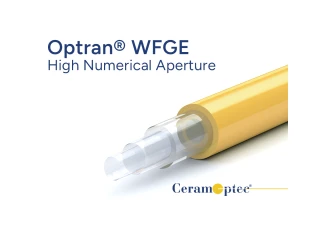
Optran® HWF – High Numerical Aperture VIS-NIR Optical Fiber
Specifications
| Fiber Core Material: | Silica |
|---|---|
| Core Diameter: | 100 to 2000 μm |
| Numerical Aperture (NA): | 0.37 ± 0.02 | 0.48 ± 0.02 | 0.52 ± 0.02 | 0.57 ± 0.02 |
| Operating Temperature: | -40 to +150°C |
| OH Content Optran HWF: | low (< 1 ppm) |
Got questions about specs? Use the inquiry form to ask.
 Download Data Sheet

Features
- Numerical Aperture (NA):
- 0.37 ± 0.02
- 0.48 ± 0.02
- 0.52 ± 0.02
- 0.57 ± 0.02
- Jacket Options:
- ETFE: -40 to +150°C
- Nylon: -40 to +100°C
- Standard Prooftest: 100 kpsi
- Minimum Bending Radius:
- 50 × cladding diameter for short-term mechanical stress
- 150 × core diameter when used with high laser power
- High NA at a Low Price: Offers excellent performance without breaking the bank
- Tailored to your specific application needs
Applications
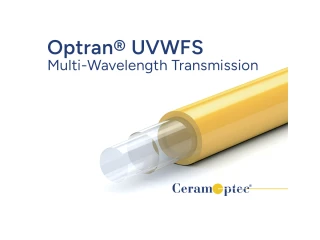
Applications of Optran® UVWFS All‑Silica Broadband Fiber (Low‑OH) for UV–VIS–NIR Transmission
- UV–VIS–NIR Spectroscopy
Ideal for laboratory and industrial spectroscopy systems that require stable, low-loss light delivery from 200–2000 nm. Common in absorption, emission, fluorescence, Raman, and time-resolved spectroscopy setups where broadband transmission and low background signal are critical. - Broadband Optical Sensing and Monitoring
Used in multi-wavelength optical sensors and analyzers for chemical, biological, and environmental monitoring. Suitable for broadband sensing heads in process control, gas analysis, liquid analysis, and color/reflectance measurements that span UV, visible, and NIR. - Astronomy and Astrophotonics Instrumentation
Employed in astronomical spectrographs, fiber-fed telescopes, and multi-object observation systems. The broad spectral coverage supports stellar, planetary, and interstellar medium studies, enabling efficient light collection from UV to NIR in observatory and space-based instruments. - Aerospace and Avionics Optics
Suitable for harsh-environment optical links in aircraft and spacecraft due to the all-silica design and high-temperature tolerance. Applied in on-board spectrometers, radiation monitoring units, guidance and navigation sensors, and health monitoring systems that rely on stable broadband optical paths. - Multi-Wavelength and Tunable Laser Systems
Integrates into systems that combine or switch among multiple laser wavelengths across UV, VIS, and NIR. Used for beam delivery in tunable laser sources, supercontinuum light sources, laser-based spectroscopy, and multi-line excitation platforms where consistent transmission over a wide band is essential. - OEM Fiber-Optic Light Delivery for Analytical Instruments
Designed into OEM instruments such as UV–VIS–NIR spectrophotometers, chromatography detectors, ellipsometers, and metrology tools. Provides reliable, repeatable broadband coupling between light sources, sampling accessories, and detectors. - Process Analytical Technology (PAT) and Inline Spectroscopy
Enables remote, inline, and online spectroscopy in chemical, pharmaceutical, and food and beverage production. Suitable for integration with immersion probes and flow cells to monitor concentration, reaction kinetics, and quality parameters over a wide spectral range. - Environmental and Atmospheric Sensing
Used in UV and NIR-based systems for air and water quality monitoring, including detection of pollutants, ozone, NOx, SOx, and organic compounds. The fiber’s broad range supports multi-species detection in both portable and fixed monitoring stations. - Medical and Biomedical Diagnostics
Applied in UV–VIS–NIR spectroscopy for tissue analysis, photodynamic therapy (PDT) research, blood and metabolite analysis, and optical biopsy concepts. The broad spectral coverage supports multi-chromatic diagnostic and therapeutic monitoring, especially in research-grade systems. - Industrial Inspection and Material Characterization
Suitable for non-destructive testing (NDT), coatings and thin-film inspection, colorimetry, and reflectance/transmittance measurements. Supports broadband reflectance probes and inspection heads used on production lines for quality control and materials verification. - UV Curing and Photochemistry Monitoring
Delivers UV light in curing, lithography, and photochemical processing setups while simultaneously enabling VIS–NIR monitoring of reaction progress. The low-OH design minimizes UV attenuation, increasing efficiency and process stability. - Solar and Photovoltaic Research
Used for spectral response measurements, quantum efficiency testing, and characterization of solar cells, modules, and optical coatings. The 200–2000 nm range covers the key solar spectrum bands needed for accurate device evaluation. - Metrology, Calibration, and Reference Systems
Integrated into radiometric and spectroradiometric calibration benches for lamps, detectors, and sensors. Provides stable broadband transfer of reference spectra from calibration sources to test devices with low spectral distortion. - Fiber-Optic Illumination and Imaging
Utilized in broadband illumination bundles for microscopy, machine vision, and inspection systems requiring UV to NIR coverage. Supports applications where a single fiber must deliver uniform, spectrally flat illumination for multi-spectral or hyperspectral imaging.
Frequently Asked Questions
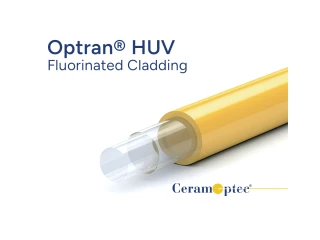
What distinguishes HWF fibers from HUV fibers?
When should a low-OH fiber like Optran® HWF be used?
Is Optran® HWF suitable for UV applications?
What materials are used in Optran® HWF fibers?
How does the OH content influence fiber performance?
Got more questions? Use the inquiry form to ask the supplier directly.
Similar Products
Your inquiry has been received.
Create an account by adding a password
Why create an account?
- Auto-complete inquiry forms
- View and manage all your past messages
- Save products to your favorites
- Close your account anytime — no hassle