
Description
This F-SMA (SMA 905) polymer optical fiber (POF) patch cable is a rugged, factory-assembled solution designed for reliable optical data transmission in demanding industrial environments. Equipped with simplex F-SMA connectors on both ends and a high-quality POF core, it supports short- to medium-range links where mechanical robustness, vibration resistance, and easy handling are more critical than very low attenuation over long distances. With typical distances up to about 150 m for data transmission at 650 nm, this cable is well suited for a wide variety of industrial control, sensing, and automation applications where copper or glass fiber solutions may be less practical.
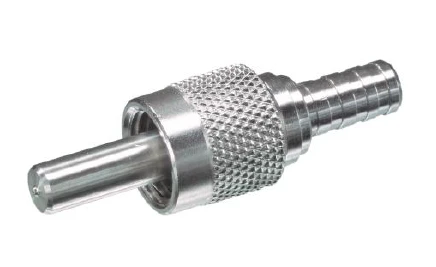
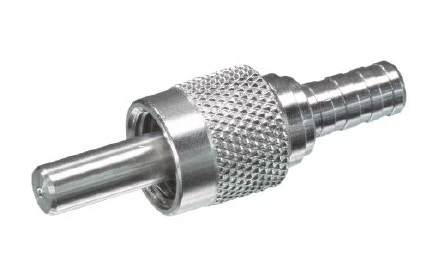
The assembly uses precision F-SMA (SMA 905) connectors compliant with IEC 61754-22 and DIN EN 61754-22. Each connector features a 3.175 mm metal ferrule with a 1,040 µm bore optimized for standard polymer optical fibers. A defined air gap at the connector interface helps stabilize optical performance and minimize physical contact wear, offering consistent insertion loss values of typically ≤ 0.70 dB (depending on the fiber used). The robust metal housing and ferrule construction make this connector style a well-established choice in industrial optics, laboratory systems, and LED or laser-based transmission setups where mechanical durability and repeatable alignment are essential.
At the heart of the cable is a single POF element housed in a PE buffer tube and protected by a high-strength PUR outer jacket. The 6.0 mm jacketed cable is designed for indoor industrial environments, including use in drag chains and moving cable carriers. A non-metallic aramid strain relief within the cable supports short-term tensile strengths up to 400 N, while the connectorized termination itself provides strain relief of ≥ 150 N. This combination allows the assembly to withstand frequent motion, bending, and mechanical stress typically encountered in automated production lines, robotics, and machine tools.
The optical performance of the POF core is tailored to visible-wavelength transmission, with attenuation values at 650 nm (laser) of ≤ 160 dB/km and at 660 nm (LED) of ≤ 230 dB/km. In practice, this translates to reliable data and signal transmission over tens of meters and up to around 150 m in optimized setups, which aligns with the capabilities of comparable industrial POF systems used in factory networking, sensor connections, and illumination feedback paths. These characteristics make the cable particularly attractive for applications such as industrial fieldbuses based on POF, optoelectronic sensors, position and speed measurement systems, and data links in environments with strong electromagnetic interference where optical isolation is advantageous.
The operating temperature range of −20 to +70 °C is determined by the cable construction and PUR jacket, providing a wide thermal window for use in control cabinets, production floors, and protected machine areas. The red outer jacket offers clear visual identification in complex cable harnesses and supports straightforward routing and maintenance. Since cable length is configurable on request and each end is equipped with one simplex F-SMA connector, the assembly can be integrated easily into new or existing systems built around the widely used SMA 905 interface standard, including light sources, receivers, and couplers from a broad range of industrial and laboratory equipment manufacturers.
Overall, this F-SMA (SMA 905) POF patch cable combines the mechanical robustness expected of metal SMA connectors with the flexibility and ease of handling of polymer optical fiber. It offers an attractive balance between performance, durability, and cost for short- and medium-distance optical links in industrial automation, sensor networks, test setups, and EMC-sensitive environments where dependable optical connectivity is required without the complexity of glass fiber systems.
F-SMA 905 POF Simplex Fiber Optic Cable Red Industrial
Specifications
| Core Diameter: | 980 um |
|---|---|
| Wavelength Range: | 0.65 – 0.66 um |
| Fiber Core Material: | Plastic |
| Cable Length: | 3 m |
| Cable Tensile Strength: | 400 N (short-term) |
| Temperature Range (assembly): | −20 … +70 °C (limited by cable) |
| Connectors Per End: | 1 × simplex |
| Jacket Color: | Red |
| Cable Jacket Material: | PUR |
| Max Recommended Transmission Distance: | up to 150 m |
| Typical Attenuation At 650 Nm: | ≤ 180 dB/km (depends on fiber) |
| Attenuation At 660 Nm (LED): | ≤ 230 dB/km |
| Attenuation At 650 Nm (laser): | ≤ 160 dB/km |
| Strain Relief (cable): | Non-metallic (aramid) |
| Operating Temperature Range: | −20 … +70 °C |
| Cable Core: | 1 POF element, PE buffer tube |
| Connector Type: | F-SMA (SMA 905), simplex, both ends |
| Cable Manufacturer: | Weinert Fiber Optics GmbH |
| Cable Outer Diameter: | 6.0 mm |
| Cable Type / Labeling: | I-V2Y(ZN)11Y 1P980/1000 6.0 mm |
| Strain Relief (connector): | ≥ 150 N |
| Mating Cycles: | 500 |
| Insertion Loss: | ≤ 0.70 dB (depends on fiber) |
| Ferrule Bore: | 1,040 µm |
| Fiber Type: | POF |
| Ferrule Outer Diameter: | 3.175 mm, metal |
| Standard Compliance: | IEC 61754-22, DIN EN 61754-22 |
Got questions about specs? Use the inquiry form to ask.
 Download Data Sheet

Features
- Pre-terminated F-SMA (SMA 905) POF cable assembly – Ready-to-use fiber optic cable with F‑SMA (SMA 905) simplex connectors on both ends for fast, error-free installation in industrial and automation environments.
- Standards-compliant connector design – F-SMA (SMA 905) connectors manufactured in accordance with IEC 61754‑22 / DIN EN 61754‑22, ensuring high compatibility with standard F‑SMA interfaces and existing POF systems.
- Optimized for Plastic Optical Fiber (POF) – Designed specifically for POF transmission, ideal for short- to medium-distance data links, sensor connections, and industrial controls where plastic fiber offers robustness and easy handling.
- Defined air-gap technology – F‑SMA connectors feature a defined air gap between the fiber faces, improving mating stability, reducing physical contact wear, and supporting consistent optical performance over many connection cycles.
- Robust 3.175 mm metal ferrule – Precision metal ferrule with 3.175 mm diameter and 1,040 µm ferrule bore provides accurate fiber alignment, low insertion loss, and long-term mechanical stability in demanding environments.
- Rugged full-metal connector housing – Metal F‑SMA housing offers excellent mechanical protection, resistance to vibration and shock, and reliable performance in industrial plants, machinery, and test setups.
- Low insertion loss for reliable data transmission – Typical insertion loss of ≤ 0.70 dB (fiber dependent) helps maintain signal quality and margin for data communication and industrial sensing applications.
- High durability with 500 mating cycles – Engineered for up to 500 mating cycles, supporting frequent connecting and disconnecting in laboratory, production, and test environments without significant performance degradation.
- Strong strain relief for secure installations – Connector strain relief rated at ≥ 150 N prevents damage to the fiber under tension, ensuring reliable operation in dynamic cable routing and moving machinery.
- Industrial-grade PUR outer jacket – Cable jacket made of PUR (polyurethane) provides high abrasion resistance, flexibility, and resistance to oils and many industrial chemicals, making it ideal for harsh indoor industrial use.
- Drag-chain suitable construction – Specifically described as suitable for drag chains, enabling use in moving applications such as automated assembly lines, robotics, and material handling systems.
- Wide operating temperature range – Cable assembly supports temperatures from −20 … +70 °C, allowing reliable performance in a broad range of indoor industrial climates and machinery cabinets.
- High tensile strength fiber cable – Short-term tensile strength up to 400 N (cable) and non-metallic aramid strain relief in the cable core enhance robustness against pulling forces during installation and operation.
- POF cable optimized for 650–660 nm sources – Very high optical flexibility with typical attenuation of ≤ 160 dB/km at 650 nm (laser) and ≤ 230 dB/km at 660 nm (LED); suitable for red light sources commonly used in POF data links and sensors.
- Typical system reach up to 150 m – With typical attenuation of ≤ 180 dB/km at 650 nm (fiber dependent), the assembly supports data transmission distances up to approx. 150 m, covering most short- and mid-range industrial networking and control needs.
- Single POF element with PE buffer tube – Cable core design with 1 POF element in a PE buffer tube combines mechanical protection, easy handling, and stable optical performance.
- Compact 6.0 mm outer diameter – The cable’s 6.0 mm OD allows space-saving routing in cable ducts, cabinets, and drag chains while still providing robust mechanical protection.
- Highly visible red jacket color – Red PUR jacket supports quick visual identification of fiber optic links among copper cables in control cabinets, panels, and machine installations.
- Aramid reinforcement without metal – Non-metallic aramid strength members offer high tensile load rating and flexibility while avoiding issues with electromagnetic interference and grounding.
Applications
- Industrial automation and control – Reliable optical links between PLCs, I/O modules, drives, and sensors in noisy factory environments where immunity to EMI/RFI is critical.
- Robotics and motion control – Data and control signal transmission to robots, gantries, and multi‑axis systems, especially where drag-chain capable cabling and high flex life are required.
- Machine tools and production lines – Connection of CNC machines, presses, packaging, printing, textile, and woodworking machines where rugged and vibration-resistant data links are needed.
- Drag chain and moving cable applications – Dynamic cable tracks on automated machinery, pick‑and‑place systems, and conveyor lines, benefiting from the PUR jacket and non‑metallic strain relief.
- Industrial sensor networks – Linking optical and optoelectronic sensors (position, speed, temperature, presence detection) to control cabinets using POF to overcome electrical noise and ground loops.
- Process control systems – Communication between distributed control units in chemical, pharmaceutical, food & beverage, and other process industries where a robust, non-metallic link is preferred.
- Factory Ethernet over POF (media-converted) – Use with media converters or POF transceivers to extend Ethernet-based protocols (e.g., PROFINET, EtherCAT, Modbus TCP) over short to medium distances up to about 150 m.
- Data transmission in harsh environments – Short-distance data links in areas with strong magnetic fields, high voltage, or heavy switching loads that would disturb copper-based cabling.
- Laboratory and test setups – Flexible, easy-to-handle patching in R&D labs, EMC test stands, and measurement setups that require repeatable optical performance and frequent mating cycles.
- Optical measurement and spectroscopy systems – Coupling of light sources and detectors in low- to medium-power spectroscopy, color measurement, fluorescence setups, and process monitoring systems.
- Laser and LED delivery for sensing – Transmission of light from visible-range lasers or LEDs (around 650–660 nm) to probes, sensors, and sample points in industrial or laboratory environments.
- Analytical instruments and medical diagnostics (non‑sterile areas) – Internal or external optical links in analyzers, photometers, and inspection devices where large-core POF and F‑SMA interfaces are commonly used.
- Custom OEM optoelectronic systems – Integration as a standard F‑SMA (SMA 905) pigtail or patch cable in OEM devices such as optical switches, receivers, transmitters, or signal conditioners.
- Education and training – Demonstrations of fiber optics, attenuation, and coupling efficiency in universities, technical schools, and training labs using robust, easy-to-handle POF assemblies.
- Short-range data and control links – Point‑to‑point transmission up to approximately 150 m at 650 nm, for serial links, fieldbus extensions (via appropriate transceivers), and proprietary optical interfaces.
- EMC-critical and high-voltage installations – Galvanic isolation between high-voltage equipment and control systems, helping protect electronics from surges and ground potential differences.
- Transportation and rail (interior equipment) – Optical connections inside rolling stock or vehicles, for diagnostic, monitoring, and control systems that benefit from vibration-resistant, non-conductive links.
- Energy and power systems – Optical communication in substations, inverters, and power quality monitoring equipment where immunity to strong electromagnetic fields is necessary.
- Audio, lighting, and show control – Robust optical control links for specialized stage lighting, effects equipment, and show automation where electrical interference or long copper runs are problematic.
- Security and surveillance infrastructure – Data links between remote sensors, access control points, or camera subsystems (via suitable converters) where electrical isolation and reliability are prioritized.
Frequently Asked Questions
What is the F-SMA (SMA 905) POF cable from Amphenol Sachsenkabel used for?
What are the key technical specifications of this F-SMA (SMA 905) POF patch cable?
How far can data be transmitted over this POF SMA 905 cable and at which wavelengths?
Is the Amphenol Sachsenkabel F-SMA POF cable suitable for industrial and drag chain applications?
What standards and connector type does this SMA 905 POF assembly comply with?
What is the operating temperature range and environmental resistance of this POF SMA cable?
Can I order custom lengths or configurations of this F-SMA (SMA 905) POF cable?
Got more questions? Use the inquiry form to ask the supplier directly.
Similar Products


Your inquiry has been received.
Create an account by adding a password
Why create an account?
- Auto-complete inquiry forms
- View and manage all your past messages
- Save products to your favorites
- Close your account anytime — no hassle