

Description
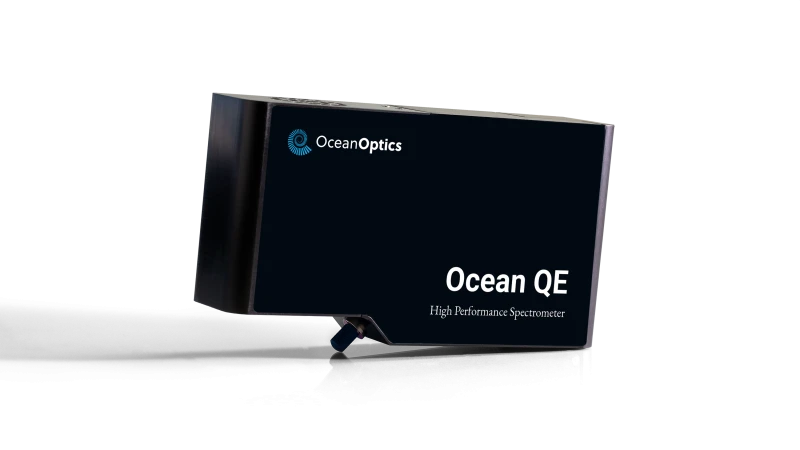
The QE Pro Spectrometer stands out as a high-performance, scientific-grade instrument designed to deliver exceptional spectral sensitivity and low noise across a broad wavelength range of 190-1100 nm. Engineered with a robust optical design, the QE Pro is ideal for researchers and professionals who require precise, reliable measurements in both laboratory and field environments. Its advanced detection capabilities make it a preferred choice for applications that demand high signal-to-noise ratios and accurate quantification, such as fluorescence, Raman spectroscopy, and absorbance studies.
One of the key strengths of the QE Pro is its adaptability. The spectrometer is available in several configurations, including UV-Vis, Vis-NIR, and XR models, each optimized for specific spectral regions and application needs. This flexibility allows users to select the most suitable model for their research, whether they are analyzing biological samples, measuring solar irradiance, or conducting material reflectance studies. The instrument’s low-noise electronics and high dynamic range ensure that even weak signals can be detected with confidence, making it particularly effective for low-light and trace-level measurements.
The QE Pro also supports a variety of Raman setups, with options for excitation lasers ranging from 532 nm to 1064 nm, further expanding its utility in advanced spectroscopic analysis. Its compact footprint and rugged construction make it suitable for integration into complex experimental setups or for use in challenging environments. With its combination of high sensitivity, configurable options, and reliable performance, the QE Pro Spectrometer is a powerful solution for scientists and engineers seeking precise, reproducible results in a wide array of optical measurement applications.
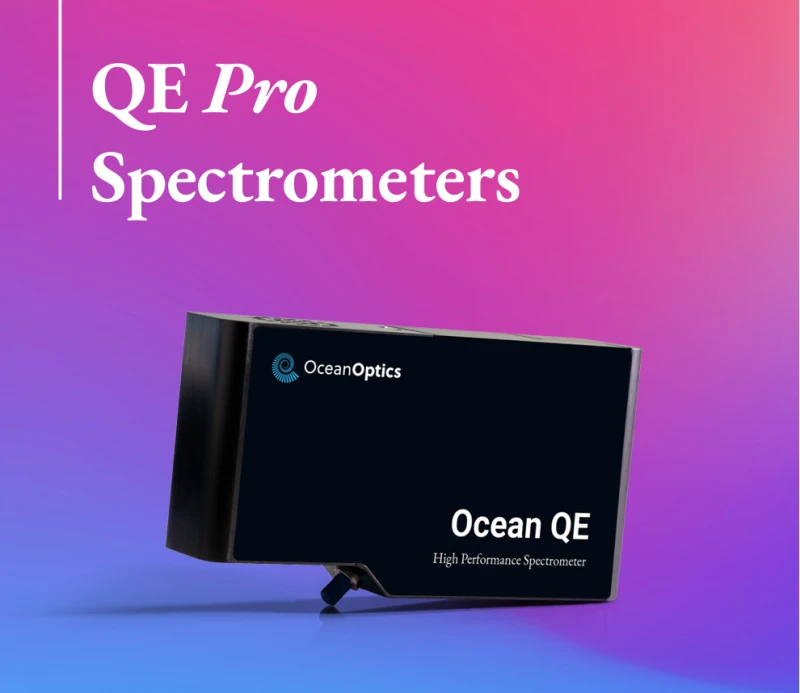
QE Pro Spectrometer High Sensitivity 190-1100 nm Optical Measurement
Specifications
| Wavelength Range (reflectance): | 190 – 1100 nm |
|---|---|
| Resolution: | 1.2 nm |
| Wavelength Range (UV-Vis Model): | 200-790 nm |
| Wavelength Range (Vis-NIR Model): | 220-1100 nm |
| Wavelength Range (XR Model): | 190-1100 nm |
| Minimum Integration Time: | 8 ms |
| Integration Time: | 8 ms - 60 min |
| Entrance Aperture: | 10 µm |
| Optical Resolution (FWHM): | 1.2 nm |
| Signal To Noise Ratio (single Scan): | 1000:1 |
| Dynamic Range (single Scan): | 85,000:1 |
| Stray Light: | 2.3 AU |
| Scan Rate: | 98 Hz |
| Buffering: | up to 15,000 spectra |
| Thermal Stability: | 0.05 pixels/°C |
| A/D Resolution: | 18-bit |
| Temperature (operation): | 0 °C to 50 °C |
| Temperature (storage): | -30 °C to 70 °C |
| Interfaces: | USB, RS-232, SMA 905 |
| Connector: | USB-C, SMA-905, 30-pin Pak 50™ accessory connector, RS-232 (via breakout) |
| Dimensions: | 182 mm x 110 mm x 47 mm |
| Weight: | 1.15 kg |
| High Speed Average Mode: | No |
| Order Sorting: | Yes |
Got questions about specs? Use the inquiry form to ask.
 Download Data Sheet

Features
- Wide Wavelength Range: Covers 190–1100 nm, ideal for UV, visible, and NIR applications.
- High Sensitivity & Low Noise: Advanced low-noise electronics and high quantum efficiency for superior detection of weak signals.
- Excellent Optical Resolution: Achieves ~1.2 nm (FWHM) with a 10 µm entrance slit, enabling precise spectral measurements.
- Flexible Configurations: Multiple models available (UV-Vis, Vis-NIR, XR) to suit a variety of application needs, including Raman spectroscopy with excitation lasers from 532 nm to 1064 nm.
- Order-Sorting Filters: Integrated order-sorting filters for accurate measurements across the full spectral range.
- High Dynamic Range: Designed for applications requiring detection of both strong and weak signals in a single scan.
- Superior Signal-to-Noise Ratio: Delivers a 1000:1 signal-to-noise ratio (single scan) for reliable, high-quality data.
- Onboard Buffering: Large onboard buffer enables fast data acquisition and transfer, minimizing data loss during high-speed measurements.
- Thermoelectric Cooling (TEC): Optional TEC for enhanced stability and reduced dark noise, especially in low-light or long integration time applications.
- Versatile Interface Options: Supports USB and other standard interfaces for seamless integration into laboratory and industrial setups.
- Robust & Compact Design: Engineered for durability and portability, suitable for both field and laboratory use.
- Wide Operating Temperature Range: Reliable performance across a broad range of environmental conditions.
- Ideal for Diverse Applications: Perfect for fluorescence, absorbance, reflectance, solar irradiance, blood and tissue analysis, and more.
- Global Support: Backed by Ocean Optics’ worldwide technical support and application expertise.
Applications
The Ocean QE Pro Spectrometer is engineered for high-sensitivity UV–NIR measurements, making it an excellent choice for research, industrial, and OEM applications where low-light performance and stability are critical. Common applications include:
- Fluorescence Spectroscopy – Ideal for detecting and quantifying fluorescence in proteins, dyes, and biological samples due to its high sensitivity and low noise performance.
- Raman Spectroscopy – Preconfigured models available for Raman applications with excitation lasers from 532 nm to 1064 nm, supporting material identification, chemical analysis, and pharmaceutical research.
- Absorbance and Transmission Measurements – Suitable for analyzing optical properties of liquids, solids, and thin films in research, quality control, and process monitoring.
- Reflectance Spectroscopy – Measures both specular and diffuse reflectance of materials, making it valuable for color analysis, material science, and surface characterization.
- Solar Irradiance Measurements – Wide wavelength range (190-1100 nm) enables accurate monitoring of solar spectra for photovoltaic research, environmental monitoring, and atmospheric studies.
- Blood and Tissue Analysis – High sensitivity and broad spectral coverage support non-invasive biomedical diagnostics and tissue characterization.
- Environmental Monitoring – Detects pollutants, water quality parameters, and atmospheric gases through UV-Vis-NIR spectral analysis.
- Process Monitoring and Quality Control – Real-time spectral analysis for industrial process control, food and beverage quality assurance, and pharmaceutical manufacturing.
- Thin Film and Coating Characterization – Measures thickness, uniformity, and optical properties of coatings and thin films in semiconductor and materials industries.
- Chemical and Biochemical Sensing – Enables detection of chemical and biological agents in laboratory and field settings.
- Forensic Analysis – Used in forensic labs for substance identification, trace evidence analysis, and counterfeit detection.
- Educational and Research Applications – Versatile tool for teaching and advanced research in physics, chemistry, biology, and engineering laboratories.
Why Choose the Ocean QE Pro Spectrometer?
With its back-thinned CCD detector, thermoelectric cooling, and superior sensitivity, the QE Pro delivers ultra-low-light detection and exceptional signal quality. Whether applied in advanced life sciences, environmental studies, or embedded into OEM platforms, it provides researchers and engineers with the precision, flexibility, and stability needed for the most demanding spectroscopic applications.
Frequently Asked Questions
What is the wavelength range of the QE Pro spectrometer?
What is the signal to noise ratio for a single scan with the QE Pro?
What applications are suitable for the QE Pro UV-Vis model?
What is the optical resolution of the QE Pro spectrometer with a 10 µm slit?
What are some example applications for the QE Pro Vis-NIR model?
What is the best use for the QE Pro XR model?
Got more questions? Use the inquiry form to ask the supplier directly.
Similar Products
Your inquiry has been received.
Create an account by adding a password
Why create an account?
- Auto-complete inquiry forms
- View and manage all your past messages
- Save products to your favorites
- Close your account anytime — no hassle