
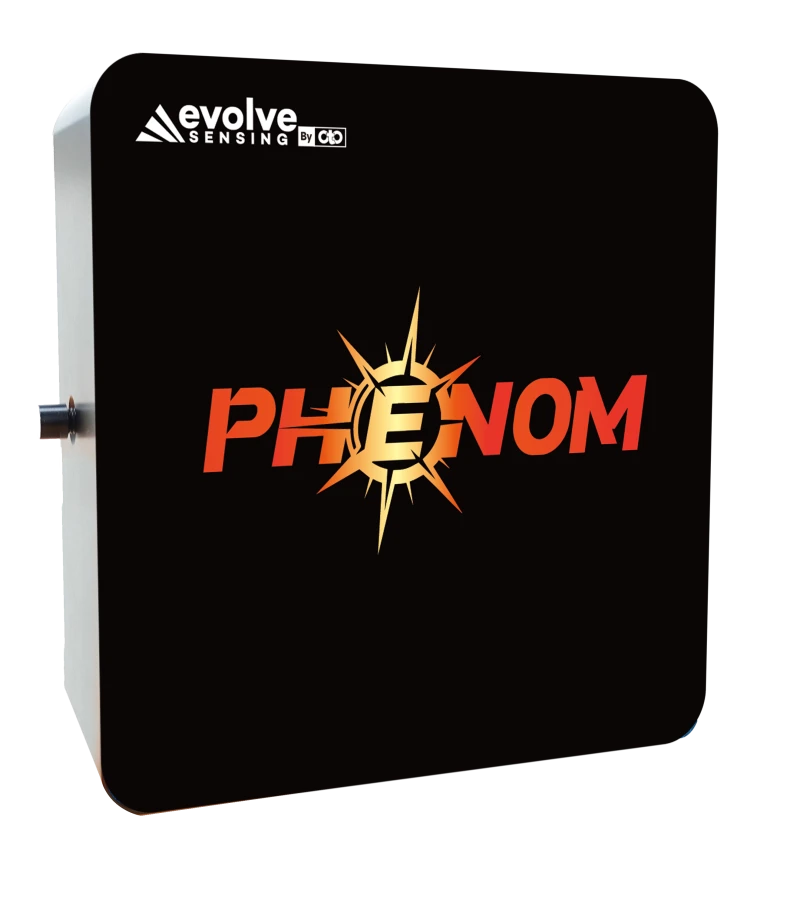
Description
The Phenom (PN) and Phenom-NIR (PN-NIR) Series spectrometers from Evolve Sensing represent a new standard in high-resolution, high-sensitivity spectral analysis across the visible and near-infrared regions. Engineered with a sophisticated T–R–T (Transmissive–Reflective–Transmissive) Czerny–Turner optical configuration, these spectrometers deliver exceptional wavelength stability and minimal stray light, making them ideal for demanding laboratory and OEM applications. The precision reflection gratings and advanced optical path ensure accurate, repeatable measurements even in challenging environments.
Designed for versatility and performance, the Phenom Series supports a wide range of spectral measurement needs. The PN models cover visible wavelengths (535–565 nm or 535–650 nm, with customizable options from 400–1000 nm), while the PN-NIR models extend into the near-infrared (1522–1578 nm, customizable from 900–1700 nm). This flexibility allows users to tailor the instrument to specific research, industrial, or process monitoring requirements. The modular design accommodates various slit widths, gratings, and sensor types—including CCD, CMOS, and InGaAs—enabling optimal configuration for sensitivity, resolution, and speed.
The Phenom Series is powered via USB and incorporates a 32-bit RISC microcontroller for fast, reliable data transfer and robust multi-mode triggering. Its compact, vibration-resistant housing ensures stable operation under thermal and mechanical stress, making it suitable for both benchtop and field deployment. The spectrometers feature onboard Flash ROM for storing calibration coefficients, ensuring consistent performance and easy integration into automated systems.
With a high-speed USB 2.0 interface, plug-and-play compatibility, and intuitive SpectraSmart software, the Phenom Series streamlines data acquisition and analysis. Advanced features such as ring-buffer spectrum storage, multiple trigger modes, and extensive digital I/O options provide seamless integration with external devices and automation platforms. Whether for scientific research, quality control, or process monitoring, the Phenom and Phenom-NIR spectrometers deliver the precision, reliability, and adaptability required for today’s most demanding spectral measurement applications.
Phenom Vis-NIR High Resolution Series Spectrometer
Specifications
| Dimensions: | 180 × 175 × 60.7 mm |
|---|---|
| Detector Type: | CCD (2048 px, PN1050) / CMOS (4096 px, PN1080, PN2080) / InGaAs (512 px, PN2570) |
| Cooling: | Uncooled (ambient operation, 0–50 °C) |
| Signal-To-Noise Ratio (SNR): | > 300:1 (single scan @ 10 ms); up to 1500:1 (averaged) |
| Thermal Stability: | < 0.01 nm / °C |
| A/D Resolution: | 16-bit |
| Integration / Scan Time Range: | 0.1 ms – 65 s (model dependent) |
| Minimum Scan Time: | 0.0001 s |
| Average Minimum Scan Time: | 0.0001 s |
| Dynamic Range: | Up to 4000 : 1 |
| Stray Light: | < 0.1 % (typical) |
| Interfaces: | USB 2.0 high-speed data interface |
| Connector Type: | SMA905 / FC-PC fiber input |
| Power Requirements: | +5 V DC ± 5%, 300 mA (USB powered) |
| Operating Temperature: | 0 °C – 50 °C |
| Storage Temperature: | –30 °C – 70 °C |
| Environmental Limits: | 0 – 90 % RH, non-condensing |
| A/D Converter Type: | 16-bit ADC |
Got questions about specs? Use the inquiry form to ask.
 Download Data Sheet

Features
- High-Resolution, High-Sensitivity Spectral Measurements: Designed for precise detection across visible and near-infrared regions, ideal for demanding laboratory and OEM applications.
- Advanced T–R–T Czerny–Turner Optical Design: Utilizes a transmissive–reflective–transmissive configuration with precision reflection gratings for superior wavelength stability and minimal stray light.
- Customizable Wavelength Ranges: Supports standard and custom ranges:
- PN1050, PN1080, PN2080: 535–565 nm or 535–650 nm (customizable 400–1000 nm)
- PN2570 (NIR): 1522–1578 nm (customizable 900–1700 nm)
- Sensor Flexibility: Choice of CCD, CMOS, or InGaAs sensors to match application requirements.
- Exceptional Dynamic Range & Low Noise: Delivers high signal-to-noise ratios and reliable performance even in low-light conditions.
- Wide Integration Time Range: Adjustable from 0.1 ms to 65 s (model dependent) for versatile measurement needs.
- Fast USB 2.0 Interface: High-speed (480 Mbps) data transfer with plug-and-play SpectraSmart software for seamless operation.
- Modular & Customizable Design: Easily configurable slit widths (10 μm or 25 μm), gratings, and sensors for tailored solutions.
- Onboard Flash ROM Calibration: Stores wavelength, linearity, and intensity correction coefficients for accurate, repeatable results.
- Large Spectra Buffering: Supports up to 4,000 spectra in ring-buffer mode for high-throughput applications.
- Comprehensive Triggering & I/O: External 8-pin I/O port for GPIO, UART, trigger, and light-source control; supports single, multiple, and software trigger modes with programmable delay.
- Compact & Robust Construction: Vibration-resistant design ensures stable measurements under thermal and mechanical stress.
- Flexible Fiber Interface: Compatible with SMA905 or FC/PC connectors (ferrule length < 9.812 mm) for easy integration.
- High-Performance A/D Conversion: 16-bit, 15 MHz analog-to-digital conversion for precise spectral data capture.
Applications
- Laser Wavelength Characterization
Ideal for precise measurement and monitoring of laser emission wavelengths in research, manufacturing, and quality control environments. - Raman Spectroscopy
Suitable for Raman signal detection and analysis in chemical, pharmaceutical, and material science applications. - Fluorescence Spectroscopy
Enables sensitive detection of fluorescence in biological assays, medical diagnostics, and environmental monitoring. - Absorption and Transmission Measurements
Used for quantifying absorbance and transmittance in optical filters, coatings, and transparent materials. - Color Measurement and Quality Control
Provides accurate color analysis for LED, display, textile, and paint industries to ensure product consistency. - Environmental Sensing
Detects pollutants, gases, and water quality parameters through spectral analysis in field and laboratory settings. - Process Monitoring in Industrial Automation
Integrates into production lines for real-time monitoring of chemical composition, thickness, and uniformity of materials. - Optical Component Testing
Characterizes optical fibers, filters, and gratings for telecommunications and photonics research. - Biomedical Diagnostics
Supports non-invasive tissue analysis, blood analysis, and point-of-care diagnostics using spectral signatures. - Food and Agriculture Analysis
Assesses food quality, ripeness, and contamination by measuring spectral fingerprints of agricultural products. - Solar Cell and Photovoltaic Testing
Measures spectral response and efficiency of solar cells and photovoltaic modules. - Forensic and Security Applications
Identifies substances and materials in forensic investigations and security screening through spectral analysis. - Educational and Research Laboratories
Provides a versatile tool for teaching and research in physics, chemistry, biology, and engineering courses. - OEM Integration for Custom Instrumentation
Modular design allows seamless integration into custom analytical instruments and measurement systems. - Light Source Characterization
Analyzes spectral output of LEDs, lasers, and lamps for R&D and quality assurance. - Thin Film and Coating Analysis
Measures thickness and uniformity of thin films and coatings in semiconductor and optics industries. - Fiber Optic Sensing
Used in distributed sensing systems for temperature, strain, and chemical detection via fiber optic networks.
Frequently Asked Questions
What are the main features of the Phenom Series spectrometers?
What wavelength ranges do the Phenom Series spectrometers cover?
What types of sensors are available for the Phenom Series spectrometers?
How is the Phenom Series powered and what are its power requirements?
What integration times are supported by the Phenom Series spectrometers?
What customization options are available for the Phenom Series spectrometers?
What environmental conditions can the Phenom Series spectrometers operate under?
Got more questions? Use the inquiry form to ask the supplier directly.
Similar Products
Your inquiry has been received.
Create an account by adding a password
Why create an account?
- Auto-complete inquiry forms
- View and manage all your past messages
- Save products to your favorites
- Close your account anytime — no hassle