
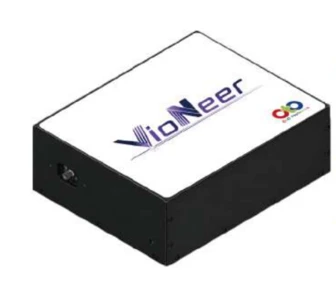
Description
The VioNeer Deep UV / VUV Spectrometer is an advanced, research-grade instrument engineered for accurate measurements in the 155–410 nm wavelength range. This spectral band covers the deep ultraviolet and vacuum ultraviolet regions that are critical for semiconductor manufacturing, photoresist development, gas and water phase analysis, and biomolecular absorption spectroscopy. By combining a back-thinned 2048‑pixel CCD detector with a high‑efficiency grating optimized around 200 nm, the VioNeer offers high sensitivity and low stray light performance that rival specialized deep‑UV spectrometers commonly used in process control and analytical laboratories.
With an optical resolution ranging from 0.3 to 1.8 nm, adjustable via 10–200 µm slit widths, users can tune the system for either high spectral resolution or enhanced throughput, depending on the application. This makes the VioNeer suitable for tasks that demand precise line shape characterization—such as monitoring excimer laser sources, characterizing photoresist absorption edges, or resolving narrow gas absorption lines—as well as for broader band measurements in environmental and industrial sensing. A numerical aperture of 0.11, coupled with low dark noise and a signal‑to‑noise ratio of 450, supports both low‑light measurements and high‑dynamic‑range spectral acquisition over integration times from 1.5 ms up to 65 s.
For maximum flexibility in system integration, the spectrometer provides both SMA905 fiber input and a free‑space optical interface. The SMA905 input simplifies connection to UV‑enhanced fibers and sampling probes for routine measurements above approximately 180 nm. For measurements deeper into the VUV, below about 180 nm where standard silica fibers exhibit strong absorption, the dedicated free‑space coupling path allows direct optical access, similar to what is found in more complex VUV bench systems. This design supports applications such as in‑line semiconductor process monitoring, plasma diagnostics, and high‑energy photochemistry studies that require robust coupling at shorter wavelengths.
On the electronics side, the VioNeer spectrometer supports USB Type B and Ethernet (RJ45) connectivity, along with a 16‑pin GPIO interface for triggering and synchronization in automated setups. This makes it easy to integrate into existing measurement platforms, OEM instruments, or industrial control systems where remote operation and data streaming are essential. The compact housing—approximately 180 mm × 144 mm × 59.9 mm and under 2 kg—allows the VioNeer to be mounted directly into equipment racks, optical enclosures, or mobile analytical systems without the footprint of traditional monochromator‑based setups.
Compared to many conventional UV‑VIS spectrometers that start above 190–200 nm, the VioNeer is specifically optimized to push further into the deep‑UV and VUV region. This enables more complete characterization of absorption edges, electronic transitions, and short‑wavelength emission lines that are inaccessible with standard laboratory instruments. Whether used for photoresist characterization in lithography R&D, monitoring trace species in gas and water analysis, or probing biomolecular structures via deep‑UV absorption, the VioNeer spectrometer offers a powerful combination of sensitivity, dynamic range, and wavelength coverage tailored to demanding next‑generation UV applications.
VioNeer Deep UV VUV Spectrometer 155–410 nm Back Thinned CCD
Specifications
| Wavelength Range (reflectance): | 155 – 410 nm |
|---|---|
| Resolution: | 0.3 nm |
| Grating: | 8xx grooves/mm, 200 nm blaze wavelength |
| Shipping Availability: | Q1 2027 |
| Weight: | <2 kg |
| Dimensions: | 180 (L) × 144 (W) × 59.9 (H) mm (excluding main board and connector) |
| Data Interface: | USB Type B, Ethernet (RJ45), 16-pin GPIO |
| Optical Interfaces: | Free-space and SMA905 |
| Fiber Input Interface: | SMA905 (optional free-space input port) |
| Stray Light: | <0.2% |
| Integration Time: | 1.5 ms – 65 s |
| Model: | VioNeer VN5190 / VN5194 |
| Numerical Aperture (NA): | 0.11 |
| Dark Noise (average): | Approx. 13 |
| Dynamic Range: | 5000 |
| Signal-to-Noise Ratio (SNR): | 450 |
| Slit Width: | 10–200 µm selectable |
| Optical Resolution: | 0.3–1.8 nm |
| Number Of Pixels: | 2048 |
| Sensor Type: | Back-thinned CCD |
Got questions about specs? Use the inquiry form to ask.
 Download Data Sheet

Features
- Deep-UV / VUV Coverage (155–410 nm) – Precisely engineered for measurements in the deep-UV and vacuum-UV range, ideal for applications that require reliable access below 200 nm where conventional spectrometers and silica-fiber–based systems fail.
- High-Performance Back-Thinned 2048-Pixel CCD Sensor – Uses a low-noise, back-thinned CCD array with 2048 pixels for high quantum efficiency in the deep-UV, improved sensitivity at short wavelengths, and excellent baseline stability.
- Tunable Optical Resolution (0.3–1.8 nm) – Selectable slit widths from 10–200 µm allow users to balance between spectral resolution and throughput; achieve up to 0.3 nm resolution for fine spectral features or higher throughput for low-light signals.
- Optimized for Direct VUV Access – For wavelengths below ~180 nm, the system supports free-space coupling to avoid silica fiber absorption, enabling accurate VUV measurements that many standard fiber-based spectrometers cannot perform.
- High Signal Quality: SNR 450 & Dynamic Range 5000 – Provides a signal-to-noise ratio of 450 and a 5000:1 dynamic range, supporting precise quantitative measurements across weak and strong signals in a single acquisition.
- Low Stray Light (<0.2%) – Carefully optimized optical design and grating minimize stray light below 0.2%, critical for deep-UV absorbance measurements, trace detection, and demanding analytical applications.
- Fast to Long Integration Times (1.5 ms–65 s) – Wide integration time range enables rapid process monitoring in high-signal environments as well as long exposures for low-intensity deep-UV or VUV sources.
- Precision Grating for Deep-UV – Equipped with an ~8xx grooves/mm grating with a 200 nm blaze wavelength, providing high efficiency and balanced performance across the 155–410 nm spectral range.
- Flexible Optical Interfaces: SMA905 & Free-Space Input – Standard SMA905 fiber input for convenient integration into existing setups, plus optional free-space input port for highest transmission at <180 nm and custom beam geometries.
- Numerical Aperture 0.11 – Optimized NA for stable coupling from typical UV/VUV optical systems, ensuring good throughput while preserving spectral performance.
- Robust Connectivity: USB & Ethernet with GPIO – Features USB Type B and Ethernet (RJ45) interfaces plus a 16‑pin GPIO port for integration into automated tools, industrial control systems, and remote data acquisition networks.
- Compact and Lightweight Form Factor – Measures approximately 180 (L) × 144 (W) × 59.9 (H) mm and weighs <2 kg, making it easy to integrate into OEM instruments, benchtop analyzers, and in-line monitoring systems.
- Designed for Semiconductor and Advanced Materials – Ideal for semiconductor process monitoring, photoresist characterization, thin-film metrology, and EUV-related precursor processes where accurate deep-UV response is essential.
- Suited for Gas, Water, and Biomolecular Analysis – Wavelength coverage supports key absorption bands for gas and water analysis as well as biomolecular and protein absorption spectroscopy in the deep-UV range.
- Stable Dark Noise Performance – Average dark noise around 13 counts (typical) allows detection of low-level signals and improves reliability in long integration time experiments.
- Future-Ready OEM Platform – The combination of Ethernet networking, GPIO control, flexible input optics, and compact size makes the VioNeer Series a strong candidate for OEM integration into commercial analytical, process, and inspection tools.
- Deep-UV Focus vs. Conventional Spectrometers – Unlike standard UV–VIS instruments that typically start at 190–200 nm and suffer from low efficiency below 200 nm, this spectrometer is specifically optimized for 155–410 nm, offering higher sensitivity and more accurate VUV/deep-UV measurements.
- Pre-Order Availability with Early-Bird Savings – Shipping planned for Q1 2027; pre-order customers can secure early access to deep-UV / VUV performance and benefit from a 10% discount off list price (preliminary specifications subject to change).
Applications
- Semiconductor Process Monitoring and Lithography
- Real-time monitoring of deep-UV (DUV) and VUV lithography sources at 193 nm, 248 nm, and neighboring wavelengths
- In-situ endpoint detection for plasma etch and deposition processes using emission lines in the 155–410 nm region
- Tracking photoresist outgassing and by‑product signatures during exposure and bake steps
- Verification and stability control of excimer lasers and VUV lamps used in wafer processing
- Process qualification of advanced patterning flows and multi-patterning schemes that rely on DUV exposure
- Photoresist and Photomask Characterization
- Absorption spectroscopy of deep‑UV photoresists for 193 nm and shorter wavelengths
- Measuring bleaching dynamics, standing wave effects, and film uniformity in the 155–410 nm range
- Optical density and transmission mapping of photomasks and pellicles at deep‑UV wavelengths
- Characterization of antireflective coatings (BARC/ARC) and topcoats in DUV and VUV
- Gas Phase Spectroscopy and Environmental Monitoring
- Detection and quantification of atmospheric gases with strong signatures in the VUV and deep‑UV, such as O3, SO2, NO, NO2, and VOCs
- Differential Optical Absorption Spectroscopy (DOAS) for air quality monitoring in the 155–410 nm band
- Monitoring exhaust gases and process effluents in semiconductor, chemical, and photovoltaic manufacturing
- Characterization of combustion emissions, plume analysis, and flame diagnostics
- Water Quality and Dissolved Species Analysis
- Deep‑UV absorption spectroscopy of dissolved organics, nitrates, nitrites, and aromatic compounds
- Monitoring industrial wastewater, ultrapure process water, and cooling water using 200 nm–300 nm signatures
- Real-time tracking of disinfectants, oxidants, and by‑products in water treatment processes
- Quantification of low‑concentration analytes using the strong deep‑UV absorption bands of biomolecules and organic contaminants
- Biomolecular and Biochemical Absorption Spectroscopy
- Absorption measurements of proteins, peptides, and nucleic acids below 260 nm for label‑free concentration and structural studies
- Characterization of aromatic amino acids (tryptophan, tyrosine, phenylalanine) in the 190–300 nm region
- Monitoring conformational changes, protein folding, and aggregation via deep‑UV spectral signatures
- Enzyme kinetics and reaction monitoring by tracking substrate and product absorbance in the deep‑UV
- Materials Science and Thin Film Characterization
- Optical characterization of UV‑transparent materials, optical coatings, and windows down to 155 nm
- Determining band‑edge, defect states, and absorption tails in wide bandgap semiconductors and insulators
- Measuring reflectance, transmittance, and absorbance of thin films and multilayer stacks in the VUV/DUV
- Quality control for UV‑grade fused silica, CaF2, MgF2, and other UV optical substrates
- Plasma Diagnostics and Discharge Monitoring
- Emission spectroscopy of low‑pressure and atmospheric plasmas used in etching, deposition, and surface treatment
- Characterization of VUV and deep‑UV emission lines from rare gases (Ar, Kr, Xe) and reactive species
- Monitoring plasma stability, composition, and process drifts via line intensity ratios in the 155–410 nm range
- Diagnostics of dielectric barrier discharges, corona discharges, and UV lamps
- Excimer and VUV Light Source Characterization
- Spectral analysis of excimer lasers (ArF, KrF, F2) and VUV lamps for wavelength, bandwidth, and stability
- Qualification and lifetime tracking of DUV and VUV LEDs, lasers, and deuterium lamps
- Optimization of source coupling into free-space or fiber setups for lithography, cleaning, and curing systems
- Verification of spectral purity and stray line suppression in high‑power UV light sources
- Surface Cleaning, Activation, and Sterilization Processes
- Monitoring DUV/VUV lamps used for surface activation, photo‑cleaning, and photo‑oxidation
- Verifying dose and spectral distribution in UV sterilization and decontamination equipment
- Studying photochemical reaction pathways on surfaces under deep‑UV exposure
- Optimization of UV‑based surface preparation prior to bonding, coating, or lithography
- Forensic, Security, and Anti‑Counterfeiting Analysis
- Inspection of deep‑UV responsive inks, tags, and security features in documents and packaging
Frequently Asked Questions
What is the VioNeer Deep UV / VUV Spectrometer and what wavelength range does it cover?
What are the key optical performance specifications of the VioNeer spectrometer?
How is the VioNeer spectrometer coupled optically and can it measure below 180 nm?
What interfaces and connectivity options does the VioNeer Deep UV / VUV Spectrometer provide?
What applications is the VioNeer spectrometer suitable for in comparison with other deep-UV spectrometers?
What are the integration time range and dynamic behavior of the VioNeer spectrometer?
When will the VioNeer Deep UV / VUV Spectrometer be available and are the specifications final?
Got more questions? Use the inquiry form to ask the supplier directly.
Similar Products

Your inquiry has been received.
Create an account by adding a password
Why create an account?
- Auto-complete inquiry forms
- View and manage all your past messages
- Save products to your favorites
- Close your account anytime — no hassle