


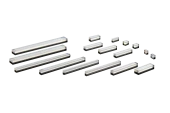
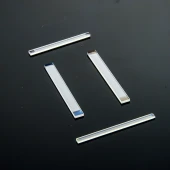
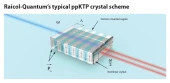
Description
Periodically poled potassium titanyl phosphate (ppKTP) has become the reference nonlinear crystal for modern quantum photonics, and is widely recognized as a workhorse material for spontaneous parametric down-conversion (SPDC) sources. By leveraging quasi phase-matching (QPM), ppKTP enables efficient frequency conversion and stable generation of nonclassical light, making it a cornerstone technology for quantum computing, quantum sensing, quantum encryption, and quantum communication systems.
Compared with conventional birefringent phase-matched crystals, ppKTP offers a unique combination of high nonlinear coefficient, broad transparency range, low walk-off, and flexible poling design. This combination supports efficient generation of entangled photon pairs, heralded single photons, and squeezed states of light at technologically important wavelengths (from the visible, through the near‑IR, and into the telecom bands). As a result, ppKTP crystals are routinely integrated into cutting-edge quantum optics experiments, fiber-compatible photon sources, and emerging industrial quantum devices that demand robust, alignment-tolerant, and reproducible performance.
A key advantage of ppKTP is the ability to tailor the poling period and crystal configuration to match specific pump lasers and desired output wavelengths. Systems can be designed for type‑0 or type‑II phase matching, supporting a wide pumping range including common laser lines such as 405 nm, 532 nm, and 775 nm, among others. This enables flexible engineering of narrowband or broadband SPDC spectra, from highly pure single-mode photon sources suitable for quantum interference experiments, to broadband sources optimized for time‑resolved measurements and advanced quantum sensing. Aperiodic poling schemes and multi-period structures further expand the design space, allowing fine control of spectral correlations, joint spectral intensity, and phase matching bandwidth for specific quantum protocols.
Raicol’s long-standing work on ppKTP has helped establish these crystals as leading SPDC sources for polarization entanglement, high-purity heralded single photons, squeezed light generation, and quantum frequency conversion. By controlling the full manufacturing chain—starting from the growth of high‑quality KTP boules through precision periodic poling—the resulting crystals exhibit excellent uniformity, high conversion efficiency, and stable operation over extended periods. This level of process control is particularly important for quantum applications, where device reproducibility, low noise, and consistent optical performance directly influence system fidelity and scalability.
In practical quantum computing platforms, ppKTP-based photon sources are used for photonic qubit generation and multi-qubit entanglement, enabling linear optical quantum computing schemes and cluster-state architectures. In quantum sensing, ppKTP crystals form the basis of squeezed-light sources that can surpass the standard quantum limit in microscopy and precision metrology, improving sensitivity in applications such as biological imaging, gravitational wave detection, and advanced interferometry. For quantum encryption and communications, ppKTP supports the generation of entangled photon pairs for free-space and fiber-based quantum key distribution (QKD), satellite links, quantum repeaters, and quantum memory interfaces operating around telecom wavelengths to minimize transmission losses.
As quantum technologies transition from laboratory research to industrial deployment, robust and customizable ppKTP solutions are essential. Crystals optimized for entangled photon sources (EPS), squeezed light sources (SLS), and heralded single-photon sources (HSPS) allow system designers to align optical performance with specific protocol requirements—whether the priority is maximum pair generation rate, spectral factorability, indistinguishability, or interface compatibility with existing photonic infrastructure. By utilizing advanced QPM design, including sophisticated poling patterns and multi-period KTP configurations, ppKTP continues to play a central role as an enabling material for the next generation of quantum information processing, secure communication networks, and ultra‑sensitive quantum measurement systems.
ppKTP Nonlinear Crystal for Quantum SPDC Entangled Photon and Squeezed Light Sources
Specifications
| Crystal Type: | ppKTP (Poled Potassium Titanyl Phosphate) |
|---|---|
| Phase Mathcing Type: | Type II |
| Mounting: | Unmounted |
| Length: | 30 mm |
| Flatness: | Not Available |
| Surface Quality (Scratch-Dig): | Not Available |
| AR Coating: | Both Sides |
| Phase Matching: | Quasi phase-matched (QPM) |
| Phase-matching Type Options: | Type-0 or Type-II |
| Pumping Wavelength Range: | Broad pumping range |
| Example Pump Wavelength: | 405 nm |
| Example Pump Wavelength: | 532 nm |
| Example Pump Wavelength: | 775 nm |
| SPDC Spectrum Options: | Narrowband or broadband |
| Poling Options: | Periodic or aperiodic poling |
| Crystal Structure Options: | Single or multi-period KTP |
Got questions about specs? Use the inquiry form to ask.
 Download Data Sheet

Features
- Leading ppKTP Crystal for Quantum Technologies – Periodically poled potassium titanyl phosphate (ppKTP) engineered specifically for state‑of‑the‑art quantum optics and photonics applications.
- Optimized SPDC Source for Entangled Photons – High‑performance spontaneous parametric down‑conversion (SPDC) crystal, ideal for:
- Polarization-entangled photon pair generation
- High‑purity heralded single‑photon sources (HSPS)
- Squeezed light sources (SLS)
- Quantum frequency conversion and wavelength translation
- Quantum-Ready Performance for Multiple Platforms – Proven building block for:
- Photonic quantum computing and multi‑qubit data transfer
- Advanced quantum sensing, microscopy and metrology
- Robust quantum encryption and satellite QKD (free‑space SPDC)
- Long‑distance quantum communications, repeaters and quantum memories
- Type‑0 and Type‑II Phase Matching Options – Custom quasi‑phase‑matching (QPM) designs:
- Type‑0 for high nonlinear efficiency and bright squeezed states
- Type‑II for high‑quality polarization entanglement and indistinguishable photons
- Wide Pump Wavelength Compatibility – Designed for commonly used pump lasers and more:
- Standard pump wavelengths: 405 nm, 532 nm and 775 nm
- Custom poling periods available for other visible and near‑IR pump lines
- Narrowband or Broadband SPDC Spectrum – Tailored spectral response:
- Narrowband designs for quantum memories and interfacing with atomic transitions
- Broadband designs for time‑bin encoding, multi‑mode sources and spectroscopy
- Aperiodic and Advanced Poling for High Spectral Purity – Custom quasi‑phase‑matching patterns:
- Aperiodic poling to engineer joint spectral amplitude and suppress frequency correlations
- High spectral purity photon pairs for high‑visibility quantum interference
- Single or Multi‑Period ppKTP Structures – Flexible device architectures:
- Single‑period crystals for standard SPDC and SHG configurations
- Multi‑period structures for multi‑wavelength operation and complex quantum schemes
- End‑to‑End In‑House Manufacturing – Complete control from crystal growth to periodic poling:
- Stable, reproducible poling with excellent domain fidelity
- Tight tolerance on poling period for precise phase‑matching
- High optical quality with low absorption and scattering
- High Nonlinear Coefficient and Conversion Efficiency – Leverages KTP’s large effective nonlinear coefficient for:
- Bright photon‑pair and squeezed‑light generation at modest pump powers
- Efficient second‑harmonic generation (SHG) and sum/difference‑frequency generation (SFG/DFG)
- Low Photorefractive Damage and High Damage Threshold – Intrinsically robust material:
- Suitable for long‑term, high‑power CW and pulsed pumping
- Maintains performance under demanding laboratory and industrial conditions
- Excellent Thermal and Mechanical Stability – Ideal for stable quantum experiments and field systems:
- Broad operational temperature range with well‑characterized phase‑matching curves
- Low thermal lensing, low walk‑off and good mechanical durability
- Application‑Specific Customization – Raicol‑Quantum co‑designs crystals with users:
- Custom crystal dimensions, apertures and poling lengths
- Coatings (AR, dual‑band AR) optimized for pump and signal/idler wavelengths
- Tailored poling schemes for EPS, SLS and HSPS sources
- Trusted by Leading Quantum Research Labs – Deployed in cutting‑edge experiments worldwide:
- Widely used standard in academic and industrial quantum optics
- Field‑tested in quantum communication links, QKD demonstrators and photonic processors
- Scalable for Laboratory and Industrial Use – From prototype to product:
- Batch‑to‑batch consistency suitable for system integrators and OEMs
- Pathway to robust, industrial entangled‑photon and single‑photon sources
- Expert Technical Support and Co‑Development – Direct access to Raicol‑Quantum’s QPM expertise:
- Design assistance for poling period, temperature tuning and target wavelengths
Applications
- Entangled Photon Pair Sources (SPDC) – Use ppKTP as a high-brightness, low-noise spontaneous parametric down-conversion (SPDC) source for generating polarization-entangled photon pairs in tabletop experiments and industrial quantum photonic platforms.
- Heralded Single-Photon Sources (HSPS) – Implement ppKTP crystals in heralded single-photon schemes to provide on-demand, high-purity single photons for quantum key distribution, quantum computing benchmarks, and photonic chip testing.
- Squeezed Light Sources (SLS) – Employ ppKTP in optical parametric oscillators and amplifiers to generate amplitude- and phase-squeezed light for applications in quantum metrology, gravitational wave detection, and ultra-precise interferometry.
- Quantum Frequency Conversion – Use ppKTP for efficient quantum frequency conversion between visible, near-IR, and telecom bands, enabling wavelength translation of single photons for hybrid quantum networks and long-distance quantum communication.
- Photonic Quantum Computing – Integrate ppKTP-based SPDC sources into photonic quantum processors for multi-photon entanglement generation, cluster-state preparation, and multi-qubit gate implementations in linear optical quantum computing.
- Boson Sampling & Multi-Photon Experiments – Use high-brightness, high-purity ppKTP photon-pair sources to drive boson sampling devices and complex multi-photon interference experiments, supporting validation of quantum advantage demonstrations.
- Quantum Repeaters & Quantum Memories – Combine ppKTP-based entangled photon generation and quantum frequency conversion to interface with atomic and solid-state memories, forming key elements of quantum repeaters for scalable quantum internet architectures.
- Satellite and Free-Space QKD – Deploy ppKTP crystals in compact, rugged entangled photon sources for satellite-to-ground and inter-satellite quantum key distribution, benefiting from stable quasi-phase matching and high efficiency in free-space links.
- Fiber-Based Quantum Key Distribution – Use ppKTP to generate telecom-band entangled photons and heralded single photons compatible with standard optical fiber networks, enabling secure long-distance quantum key distribution systems.
- Integrated Quantum Photonics – Employ bulk ppKTP or waveguide-poled KTP for chip-compatible sources, interfacing with silicon photonics, lithium niobate, and other integrated platforms for scalable, on-chip quantum information processing.
- Next-Generation Quantum Sensing & Metrology – Utilize squeezed and entangled states from ppKTP to surpass classical limits in phase, time, and displacement measurements for advanced microscopy, spectroscopy, and precision metrology.
- Quantum Microscopy & Imaging – Implement ppKTP in quantum imaging schemes such as ghost imaging, sub-shot-noise microscopy, and quantum-enhanced OCT (optical coherence tomography), improving resolution and signal-to-noise performance.
- Quantum LiDAR and Ranging – Use ppKTP-based entangled and correlated photon sources for quantum LiDAR and precise depth sensing, offering enhanced sensitivity and covert detection capabilities in challenging environments.
- Quantum-Enhanced Atomic Clocks – Integrate squeezed light generated in ppKTP with atomic reference transitions to reduce clock instability and improve timing precision beyond the standard quantum limit.
- Time-Bin and Energy-Time Entanglement – Configure ppKTP sources for narrowband or broadband operation to produce time-bin and energy-time entangled photon pairs ideal for long-distance fiber transmission and robust quantum communication protocols.
- Polarization-Entangled Photon Sources – Exploit type-II ppKTP crystals in Sagnac, Mach–Zehnder, or crossed-crystal interferometer geometries to realize highly stable, high-visibility polarization entanglement sources for laboratory and field systems.
- Cluster-State and Graph-State Generation – Use multi-period and aperiodically poled KTP designs to create multi-mode entangled states (including continuous-variable cluster states) for measurement-based quantum computing and one-way quantum computing architectures.
- Continuous-Variable Quantum Information – Deploy ppKTP-based optical parametric oscillators for multi-mode squeezing and entanglement, enabling continuous-variable quantum communication, teleportation, and error correction protocols.
Frequently Asked Questions
What is ppKTP and why is it widely used for quantum optics applications?
What quantum applications are Raicol-Quantum ppKTP crystals typically used for?
How do Raicol-Quantum ppKTP crystals enable SPDC, entangled photon pairs and squeezed light?
What customization options are available for Raicol ppKTP crystals (phase-matching type, pump wavelengths and spectra)?
How do Type-0 and Type-II ppKTP phase-matching configurations differ and when should each be used?
Can Raicol-Quantum ppKTP crystals be tailored for narrowband or high spectral purity photon sources?
How do I select and order a custom ppKTP crystal for my quantum experiment or product?
Got more questions? Use the inquiry form to ask the supplier directly.
Similar Products



Your inquiry has been received.
Create an account by adding a password
Why create an account?
- Auto-complete inquiry forms
- View and manage all your past messages
- Save products to your favorites
- Close your account anytime — no hassle