

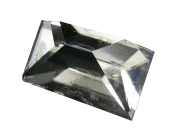
Description
The CLBO (Caesium Lithium Borate) nonlinear crystal is a high‑performance solution for deep ultraviolet (DUV) frequency conversion, engineered for demanding industrial, scientific, and research laser systems. With a broad transmission range from 180 nm to 2750 nm and excellent nonlinear properties, CLBO enables efficient generation of ultraviolet and deep‑ultraviolet wavelengths through harmonic conversion of common infrared laser sources. It is particularly well suited for applications that require stable, high‑power operation at short wavelengths where many other nonlinear crystals become strongly absorbing or suffer from low damage thresholds.
Compared with more conventional crystals such as BBO and LBO, CLBO offers a unique balance of wide transparency into the deep UV, relatively low walk‑off, and high bulk laser damage threshold in the DUV regime. Its short Type I second harmonic generation (SHG) cutoff down to around 237 nm, combined with its capability for sum frequency generation (SFG) below 200 nm, makes CLBO a preferred choice when pushing towards the shortest practical wavelengths from solid‑state laser systems. These attributes make it highly attractive for advanced frequency conversion schemes such as third, fourth, fifth, and higher‑order harmonic generation, where both conversion efficiency and long‑term stability are critical.
The crystal’s low absorption and high optical quality support high‑brightness beam propagation with minimal wavefront distortion. Typical available apertures up to 15 × 15 mm² and lengths up to 20 mm give designers flexibility in managing beam size, interaction length, and power density for both pulsed and continuous‑wave lasers. Surface quality and flatness (on the order of λ/8 at 633 nm, with scratch/dig up to 5/1) help maintain excellent spatial beam profiles after frequency conversion, which is essential in precision applications such as lithography, micro‑machining, and high‑resolution spectroscopy.
CLBO’s high laser‑induced damage threshold in both the near‑infrared and DUV spectrum enables reliable operation at elevated power levels. At fundamental wavelengths such as 1064 nm, the crystal can withstand very high peak intensities, and it also exhibits strong resilience under exposure to converted ultraviolet and deep‑ultraviolet outputs. This robustness, together with its low absorption coefficient at typical pump wavelengths, reduces the risk of thermal effects, degradation, or premature crystal failure, contributing to longer system lifetimes and lower maintenance requirements in high‑duty‑cycle environments.
In practical systems, CLBO is widely used to generate the fourth and fifth harmonics of Nd:YAG lasers, delivering UV outputs around 266 nm and 213 nm, as well as for producing the seventh and eighth harmonics of 1550 nm sources for even shorter DUV wavelengths. Its small walk‑off angle improves overlap between interacting beams, enhancing conversion efficiency and simplifying optical design relative to some alternative nonlinear media. Whether integrated into research‑grade laboratory setups or high‑volume industrial laser platforms, CLBO offers a reliable path to high‑power, short‑wavelength output where precision, stability, and throughput are paramount.
CLBO Nonlinear Crystal for Deep UV Harmonic Generation High Power DUV Lasers
Specifications
| Crystal Type: | CLBO (CsLiB6O10) |
|---|---|
| Phase Mathcing Type: | Not Applicable |
| Mounting: | Unmounted |
| Width: | Not Specified |
| Height: | Not Specified |
| Length: | Not Specified |
| Flatness: | <= Lambda/10 |
| Surface Quality (Scratch-Dig): | 10-5 |
| AR Coating: | Both Sides |
| Transmission Range: | 180–2750 nm |
| Short Type I SHG Wavelength: | 237 nm |
| Aperture: | up to 15 × 15 mm² |
| Length: | up to 20 mm |
| Surface Flatness: | λ/8 @ 633 nm |
| Perpendicularity: | < 10 arc min |
| Parallelism: | 20 arc sec |
| Scratch/Dig: | up to 5/1 |
| Wavefront Distortion: | λ/8 @ 633 nm |
| AR Coating: | Uncoated |
| Absorption Coefficient: | 150 ppm/cm @ 1064 nm |
| Laser Induced Damage Threshold @1064 Nm: | 29 GW/cm² |
| Laser Induced Damage Threshold @266 Nm: | 6.4 GW/cm² |
| Harmonic Generation Capability (1550 Nm): | 7th and 8th harmonics |
| Harmonic Generation Capability (Nd:YAG): | 4th and 5th harmonics |
Got questions about specs? Use the inquiry form to ask.
 Download Data Sheet

Features
- Wide Transparency Range (180–2750 nm) – CLBO (Cesium Lithium Borate) offers an exceptionally broad transmission window from the deep ultraviolet (DUV) to the mid‑IR, enabling versatile harmonic generation and sum‑frequency applications across a wide spectral range.
- Deep UV Frequency Conversion Below 200 nm – Optimized for high‑order harmonic generation, CLBO efficiently supports 7th and 8th harmonics of 1550 nm and 4th and 5th harmonics of Nd:YAG, enabling reliable generation of wavelengths below 200 nm.
- Short Type I SHG Cutoff Down to 237 nm – Excellent phase‑matching characteristics for Type I second harmonic generation allow efficient UV production down to 237 nm, ideal for UV lasers in lithography, inspection, metrology, and spectroscopy.
- High Bulk Laser Damage Threshold in the DUV – Demonstrated laser‑induced damage thresholds of approx. 29 GW/cm² at 1064 nm and 6.4 GW/cm² at 266 nm (literature values) make CLBO highly suitable for high‑peak‑power and high‑average‑power DUV systems.
- Low Absorption and Low Scattering Losses – Very low absorption (≈150 ppm/cm at 1064 nm) and excellent bulk homogeneity help maintain beam quality and conversion efficiency, even under high‑power operation.
- Small Walk‑Off for Improved Beam Quality – Reduced birefringent walk‑off compared with many borate crystals supports tighter focusing, higher efficiency, and better beam profile in multi‑pass or cavity‑enhanced frequency conversion stages.
- Large Aperture and Flexible Dimensions – Available with apertures up to 15 × 15 mm² and lengths up to 20 mm, making CLBO suitable for both compact solid‑state sources and large‑aperture, high‑energy DUV lasers.
- High Optical Quality for Demanding UV Systems – Tight fabrication tolerances, including flatness λ/8 @ 633 nm, perpendicularity < 10 arc min, parallelism 20 arc sec, wavefront distortion λ/8 @ 633 nm, and scratch/dig up to 5/1, ensure minimal wavefront distortion and excellent focusing performance.
- Optimized Surfaces and Coating Flexibility – Delivered uncoated as standard for maximum flexibility; users can apply application‑specific AR coatings (UV, DUV, or broadband) to optimize performance at the desired harmonic wavelengths.
- Ideal for High‑Power DUV Lasers – The combination of high damage threshold, low absorption, small walk‑off, and DUV transparency makes CLBO the crystal of choice for high‑power deep‑UV systems in semiconductor, medical, scientific, and industrial markets.
- Reliable Performance in Multi‑Stage Harmonic Generation – Well suited for multi‑stage frequency conversion chains (SHG, THG, FHG and beyond), enabling efficient generation of 4th, 5th, 7th, and 8th harmonics with stable long‑term operation.
- Excellent for Precision UV Applications – Supports applications such as laser micromachining, wafer inspection, mask writing, UV lithography, fluorescence excitation, and precision spectroscopy that demand high beam quality at deep‑UV wavelengths.
- Manufactured by a Global Leader in Nonlinear Crystals – Grown and fabricated by Raicol Crystals, a company with over 50 years of crystal growth experience and recognized as a global pioneer in advanced nonlinear materials such as RTP, HGTR KTP, and PPKTP.
- One‑Stop Production: Growth to Finished Assembly – Raicol offers an integrated workflow from crystal growth, cutting, polishing, and coating to EO cell and module assembly, ensuring consistent quality, traceability, and optimized performance for OEM and research customers.
- Suitable for Both OEM Mass Production and R&D – Available in volumes ranging from single prototypes to large‑scale production with fast delivery times, supporting both advanced research setups and high‑volume industrial laser platforms.
Applications
Applications of CLBO (Cesium Lithium Borate) Nonlinear Crystals
CLBO crystals from Raicol leverage a wide transmission range (180–2750 nm), low absorption, small walk-off, and a high laser damage threshold in the deep UV. These features make CLBO a preferred choice for demanding frequency conversion tasks, especially where high-power and deep-ultraviolet (DUV) performance are critical.
1. Harmonic Generation of Nd:YAG, Yb, and Fiber Lasers
- Fourth and fifth harmonic generation (4ω, 5ω) of Nd:YAG lasers (1064 nm → 266 nm, 213 nm) for UV and DUV sources.
- Higher harmonic generation of Yb-based lasers (e.g., 1030 nm) for UV and DUV wavelengths in industrial and scientific systems.
- 7th and 8th harmonics of 1550 nm fiber lasers for compact DUV sources in metrology and spectroscopy.
- Multipass and intracavity harmonic generation for boosting DUV power levels while maintaining beam quality.
- Frequency conversion stages in high-repetition-rate laser systems where high damage threshold and low absorption are crucial.
2. Deep-UV (DUV) Microlithography and Semiconductor Processing
- Excimer laser replacement or extension via solid-state DUV sources (e.g., 193–213 nm) for semiconductor lithography.
- Photomask inspection and repair systems requiring stable, narrow-linewidth DUV beams.
- Wafer alignment and defect inspection using short-wavelength sources to enhance resolution and sensitivity.
- Advanced patterning and nano-structuring where high photon energy and tight focusing are required.
3. Precision Micromachining and Material Processing
- Micromachining of transparent and hard materials (sapphire, glass, ceramics, polymers) using DUV pulses for minimal heat-affected zones.
- Drilling and scribing of semiconductor wafers and microelectronic components with high dimensional accuracy.
- Laser lift-off, thin-film patterning, and surface texturing enabled by short-wavelength, high-intensity beams.
- High-resolution marking and engraving on plastics and sensitive substrates with minimal discoloration.
4. Nonlinear Frequency Conversion for Scientific Research
- Sum-frequency generation (SFG) below 200 nm for accessing vacuum-UV / deep-UV regions in spectroscopy and nonlinear optics experiments.
- Second-harmonic generation (SHG) down to 237 nm (Type I) for tunable UV sources in laboratories.
- Optical parametric generation and mixing stages where CLBO acts as a final up-conversion element into the DUV.
- High-intensity beamline frequency conversion in large-scale laser facilities and free-electron laser front-ends.
- Generation of ultrashort DUV pulses for pump–probe and time-resolved spectroscopy.
5. Spectroscopy and Chemical Analysis
- Resonance Raman and UV Raman spectroscopy benefiting from shorter excitation wavelengths for enhanced sensitivity and selectivity.
- Photoionization and photoelectron spectroscopy where DUV/ VUV photons enable access to specific electronic transitions.
- Trace gas detection and environmental monitoring using DUV excitation of characteristic molecular absorption lines.
- Laser-induced fluorescence (LIF) in the UV and DUV for combustion diagnostics, plasma studies, and flow visualization.
- Surface and interface analysis via DUV-excited spectroscopic techniques.
6. Bioimaging, Microscopy, and Medical Diagnostics
- Deep-UV fluorescence microscopy for label-free imaging of proteins, nucleic acids, and cellular structures.
- Confocal and multiphoton microscopy with UV/DUV excitation to improve spatial resolution and contrast.
- UV-based flow cytometry and cell sorting where specific fluorophores or intrinsic biomolecule fluorescence are excited in the UV.
- Microspectroscopy of biological tissues for early disease detection and biochemical mapping.
7. Metrology, Calibration, and Test Equipment
- Precision wavelength standards and calibration sources in the UV/DUV for spectrometers and monochromators.
- Interferometry and high-resolution dimensional metrology using short-wavelength coherent light for improved accuracy.
Frequently Asked Questions
What is a CLBO (Caesium Lithium Borate) nonlinear crystal and what makes it unique?
What are the typical applications of CLBO crystals in laser systems?
What are the key optical and physical specifications of Raicol’s CLBO crystals?
Why choose CLBO over other nonlinear crystals like BBO or LBO for UV and DUV generation?
How is CLBO used for generating the 4th and 5th harmonics of Nd:YAG and higher harmonics of 1550 nm lasers?
Does CLBO require special handling or environmental conditions (e.g., hygroscopicity)?
What coating options are available for CLBO crystals and how do they affect performance?
Got more questions? Use the inquiry form to ask the supplier directly.
Similar Products



Your inquiry has been received.
Create an account by adding a password
Why create an account?
- Auto-complete inquiry forms
- View and manage all your past messages
- Save products to your favorites
- Close your account anytime — no hassle