


Description
Polarized Fiber Optic Source – High Extinction Ratio Laser and SLED Platform
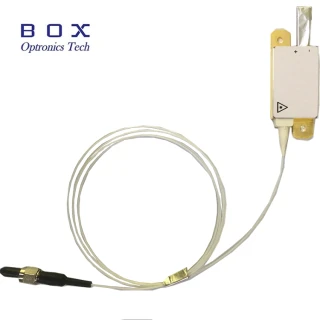
The Polarized Fiber Optic Source (PFOSS) from OZ Optics is a precision light source engineered for applications where accurate and repeatable polarization control is critical. Designed around high‑quality laser diodes or superluminescent diodes (SLEDs), this instrument provides a stable, well‑defined state of polarization directly at the fiber interface. A rotatable polarizer integrated at the output, combined with a ruggedized housing and high‑quality connectors, enables users to finely tune the polarization angle for demanding laboratory, production, and metrology tasks.
In its standard configuration, the PFOSS features a fiber receptacle and a manually rotatable polarizer that allows adjustment of the polarization axis to any arbitrary angle. This makes it especially suitable for extinction ratio and polarization dependent loss measurements, where the linear polarization state must be precisely aligned with the device under test. For users who require automated and highly repeatable control, motorized versions (MPFOSS) are available with sub‑degree rotational resolution (as fine as 0.1°), controlled through an external touchscreen interface and graphical user interface. This combination of mechanical precision and optical quality delivers a high polarization extinction ratio, typically up to 40 dB, which is on par with or better than many comparable polarized sources used in fiber optic test benches worldwide.
Beyond the receptacle‑style configuration, OZ Optics also offers models with permanently attached polarization‑maintaining (PM) fiber. In these versions, the output polarization is aligned with the slow axis of the PM fiber, providing a defined and stable polarization reference for integration into larger systems or for use as a calibration source. This design minimizes uncertainty due to connector repeatability and simplifies setup in automated or field‑deployable systems. Compared to many generic polarized laser modules on the market, the PFOSS line offers a broader choice of connector options, wavelengths, and fiber types, giving integrators more flexibility in matching the source to existing networks, instruments, and test fixtures.
Power stability and spectral integrity are central to the PFOSS design. An optional integrated blocking‑style optical attenuator allows users to adjust the output power manually without altering the laser’s spectral characteristics. Unlike electronic power control methods that can impact wavelength, linewidth, or coherence, this purely optical attenuation approach helps maintain consistent spectral properties during calibration, R&D, or quality control runs. For further improvement in measurement repeatability, OZ Optics recommends the use of angled physical contact (APC) connectors and matching angled receptacles, which significantly reduce back‑reflections that can destabilize both power and polarization in precision setups.
For applications that place extreme demands on stability—such as long‑term polarization monitoring, interferometric systems, and high‑precision PDL characterization—OZ Optics offers several upgrade paths within the same product family. Selecting a superluminescent diode in place of a traditional laser diode can mitigate coherence‑related effects and reduce sensitivity to reflections, leading to smoother polarization behavior over time. Additionally, the Highly Stable Polarized Fiber Optic Source (HIPFOSS) variants integrate Peltier temperature control and optical isolators to tightly regulate output power and wavelength. Compared with conventional benchtop polarized lasers, these thermally stabilized solutions provide superior long‑term drift performance, making them well suited for standards labs and automated production test lines.
The PFOSS platform is available over a wide range of wavelengths commonly used in fiber optics, including 1550 nm configurations such as the 1 mW FC/APC and Super/Ultra receptacle models. Its compact mechanical footprint and robust construction are designed for both laboratory optical tables and industrial rack or production environments. A wide selection of connector types, including FC/APC and high‑grade ultra‑polished interfaces, ensures compatibility with modern telecom and photonics components. Optional higher‑power variants are offered for applications requiring increased launch power into fiber while still maintaining a clean, well‑defined polarization state.
Polarized Fiber Optic Sources
Specifications
| Laser Type: | Modulated |
|---|---|
| Fiber Type: | Multi-Mode |
| Wavelength: | 1550 nm |
| Output Power: | 1 mW |
| Polarization Extinction Ratio: | up to 40 dB |
| Motorized Rotator Resolution: | 0.1 degree |
| Unit Length (front View): | 3.00 in |
| Unit Length (side View): | 2.77 in |
| Unit Height: | 2.49 in |
Got questions about specs? Use the inquiry form to ask.
 Download Data Sheet

Features
- High Polarization Extinction Ratio (up to 40 dB) – Delivers a highly pure state of polarization, ideal for precise extinction ratio and PDL measurements in fiber optic test setups and laboratory environments.
- Stable, Repeatable Optical Output – Engineered for low drift in output power and polarization state, minimizing measurement uncertainty over time and under varying operating conditions.
- Rotatable Polarizer with Fine Angular Control – Integrated rotatable polarizer enables continuous polarization angle adjustment; motorized versions (MPFOSS) provide sub‑degree (0.1°) resolution via an external touchscreen GUI for automated polarization sweeps.
- Optional Polarization Maintaining Fiber Output – Available with polarization maintaining (PM) fiber pigtails aligned to the slow axis, ensuring well‑defined and stable output polarization over the length of the delivery fiber.
- Broad Wavelength Coverage – Offered in a wide range of standard and custom wavelengths (including key telecom bands such as 1550 nm), supporting R&D, telecom, sensing, and component characterization applications.
- Choice of Laser Diodes or Superluminescent Diodes (SLEDs) – Configure as a narrowband polarized laser source or a broader‑bandwidth polarized SLED source to match application needs, from coherent telecom testing to low‑coherence interferometry.
- Optional Highly Stable HIPFOSS Versions – Advanced HIPFOSS models add Peltier cooling and optical isolators to further suppress wavelength and power drift, delivering superior long‑term stability for demanding metrology and production environments.
- Optional Blocking‑Style Optical Attenuator – Integrated manual attenuator allows smooth output power adjustment without changing drive electronics, preserving the spectral properties of the laser diode and improving measurement repeatability.
- Optimized for Low Back‑Reflection with Angled Connectors – Compatible with angled connectors and receptacles (e.g., FC/APC) to reduce Fresnel reflections, enhancing source stability and accuracy in sensitive polarization measurements.
- Rugged, Compact Benchtop/Module Design – Small footprint and robust mechanical housing withstand daily laboratory and production use while saving space in optical benches and rack systems.
- Wide Selection of Fiber Connector Receptacles – Supports a variety of industry‑standard connector types (including Super/Ultra polish and APC variants), enabling straightforward integration into existing fiber infrastructures.
- Optional High‑Power Configurations – Higher output power versions are available for applications requiring stronger launch power, higher signal‑to‑noise ratio, or additional system loss margin.
- Motorized Automation and GUI Control (MPFOSS) – Motorized models provide remote, programmable polarization control through an external touchscreen with an intuitive graphical user interface, ideal for automated test stations and production lines.
- Non‑Intrusive Power Control vs. Electrical Modulation – Optical attenuation is achieved mechanically rather than by varying drive current, decoupling power control from wavelength and spectral characteristics for more reproducible test conditions.
- Designed for Metrology, PDL, and Extinction Ratio Testing – Purpose‑built for extinction ratio measurements, polarization‑dependent loss characterization, and quality control of fiber optic components, modules, and systems.
Applications
- Extinction Ratio Measurements in Fiber Optic Components
Ideal for accurately characterizing the polarization extinction ratio (PER) of fiber jumpers, connectors, couplers, and integrated photonic devices in R&D and production environments. - Polarization Dependent Loss (PDL) Testing
Used as a stable polarized light source for PDL measurements of optical components such as wavelength division multiplexers (WDMs), filters, isolators, splitters, and multiplexers over telecom and datacom wavelength bands. - Optical Component Manufacturing and Quality Control
Deployed on production lines to verify polarization performance, repeatability, and long‑term stability of polarization maintaining fibers, connectors, and polarization‑sensitive modules. - Calibration of Polarization Measurement Instruments
Provides a reference source for calibrating and validating optical spectrum analyzers (OSAs), polarimeters, polarization controllers, and PDL meters that require well‑defined and stable polarization states. - Characterization of Polarization Maintaining (PM) Fibers
Used to align and verify slow‑axis orientation, measure cross‑talk, and determine PER in PM fibers and PM patch cords at wavelengths such as 1310 nm and 1550 nm. - Testing Polarization‑Sensitive Photonic Devices
Suitable for evaluating polarization‑dependent behavior of photonic integrated circuits (PICs), modulators, interferometers, and micro‑optical components used in coherent and analog optical systems. - Telecom and Datacom System Verification
Acts as a controlled polarized source to assess receiver sensitivity, polarization handling, and system margins in single‑mode transmission links, transceiver modules, and line cards. - Research on Polarization Effects in Optical Fibers
Supports academic and industrial research on birefringence, polarization mode dispersion (PMD), and environmental sensitivity of standard and specialty fibers. - Fiber Sensor Development and Testing
Used in the development of polarization‑based fiber sensors (e.g., interferometric, birefringent, and Sagnac loop sensors) where a well‑defined and stable polarization state is critical for sensitivity and repeatability. - Characterization of Optical Isolators and Circulators
Provides a polarized input to accurately measure isolation, insertion loss, and polarization‑dependent parameters of isolators and circulators used in laser and amplifier systems. - Superluminescent Diode (SLED) and Broadband Source Testing
When configured with super luminescent diodes, serves as a polarized broadband source for evaluating polarization performance in devices operating over wider spectral ranges. - Laser Diode Module Evaluation
Utilized to characterize output polarization, stability, and alignment of discrete laser diode modules, particularly where high PER and low drift are required. - Polarization‑Maintaining Amplifier and EDFA Testing
Acts as a reference input for testing PM erbium‑doped fiber amplifiers (EDFAs) and other polarization‑maintaining optical amplifiers, enabling gain and noise figure measurements under well‑controlled polarization states. - Alignment and Verification of Free‑Space Polarization Optics
Used with collimators or fiber‑to‑free‑space adapters to align polarizers, waveplates, polarization beam splitters (PBS), and other free‑space polarization optics in optical benches and test setups. - Automation of Polarization‑Swept Measurements
In its motorized configuration, enables automated polarization angle sweeps with sub‑degree resolution for characterizing variation of device transmission, reflection, or insertion loss versus polarization state. - Environmental Stability and Reliability Testing
Combined with temperature chambers and vibration platforms to study how devices respond to polarization changes induced by environmental stress, leveraging the source’s stable, repeatable output. - Coherent Communications and QKD Experiments
Provides controlled polarization states for laboratory experiments on coherent detection schemes, polarization multiplexing, and polarization‑encoded quantum key distribution (QKD) testbeds. - Optical Metrology and Interferometry
Used as a polarized input in interferometric metrology systems (e.g., Mach‑Zehnder, Michelson, Sagnac) to control contrast, reduce spurious reflections, and analyze polarization‑induced phase shifts.
Frequently Asked Questions
What is an OZ Optics Polarized Fiber Optic Source (PFOSS) and what makes it different from a standard fiber laser source?
What is polarization extinction ratio in the PFOSS and why is up to 40 dB significant for testing?
How does the rotatable polarizer in the PFOSS work and what is the advantage of the motorized version (MPFOSS)?
Should I choose a PFOSS with a laser diode or a superluminescent diode (SLD), and how does that affect stability?
What connector options and fiber configurations are available for OZ Optics PFOSS sources?
How is the output power controlled on the PFOSS and does attenuation affect the laser’s spectral properties?
What are typical applications of OZ Optics PFOSS, HIPFOSS, and MPFOSS sources in labs and production lines?
Got more questions? Use the inquiry form to ask the supplier directly.
Similar Products




Your inquiry has been received.
Create an account by adding a password
Why create an account?
- Auto-complete inquiry forms
- View and manage all your past messages
- Save products to your favorites
- Close your account anytime — no hassle