
Description
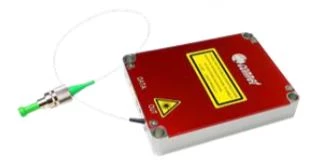
The CoLID-II-1064 short pulse fiber laser is a compact, high‑performance 1064 nm source engineered for demanding LiDAR, rangefinding, and 3D sensing applications. Built around a MOPA (Master Oscillator Power Amplifier) architecture and an all‑fiber optimized design, this pulsed laser delivers up to 10 kW peak power, 2 W average power, and pulse energies up to 50 μJ while maintaining near diffraction‑limited beam quality (M² < 1.1). This combination of high peak power and excellent spatial mode makes it particularly well suited for long‑range, high‑resolution optical systems where signal strength and beam quality are critical.
Operating in the 1059–1069 nm band with a nominal center wavelength of 1064 nm, the CoLID-II-1064 offers adjustable pulse widths from 1 ns to 50 ns and a wide repetition rate range from 30 kHz to 500 kHz. The repetition rate is controlled via an external TTL trigger, while pulse duration is easily configured through a computer interface. This flexible timing control enables precise optimization of the energy–resolution trade‑off in different environments, whether the priority is long‑distance detection, fine spatial detail in 3D scanning, or fast sampling for dynamic scenes.
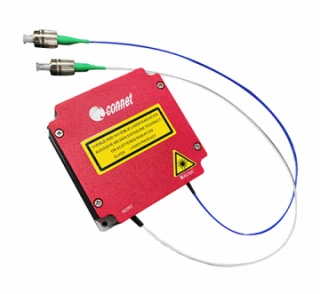
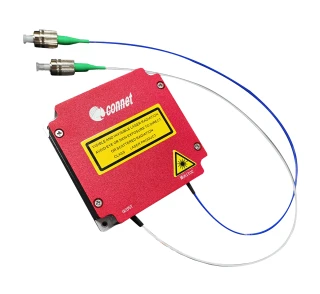
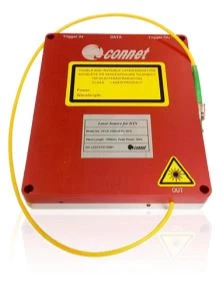
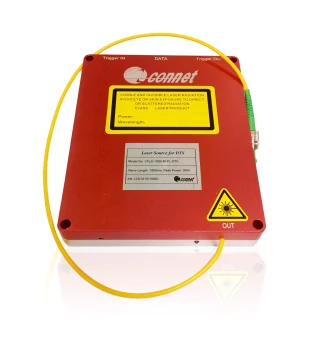
Designed for seamless integration into larger systems, the laser comes in a rugged rectangular module package measuring only 135 mm × 90 mm × 30 mm. An internal high‑quality MCU provides straightforward electronic control and monitoring, simplifying OEM integration into LiDAR engines, rangefinders, and telemetry platforms. The built‑in high‑power optical isolator safeguards the laser from back‑reflections, improving reliability when coupled to external optics or when used in environments with variable feedback conditions. Output is provided via a fiber pigtail with FC/APC connector or an optional collimator, giving system designers flexibility in beam delivery and alignment.
Long‑term operational stability is a core strength of this source. Output power stability is typically within ±2% over 8 hours at 25 °C after warm‑up, ensuring consistent measurement performance over extended runs. With electrical power consumption typically up to 24 W from a 12 V DC supply, the CoLID-II-1064 is well suited for mobile, battery‑powered, or space‑constrained platforms where efficiency matters. Its wide operating temperature range from −35 °C to +65 °C and storage range from −40 °C to +85 °C enable reliable deployment in harsh outdoor conditions common in automotive LiDAR, surveying, and defense‑oriented sensing.
Compared with many pulsed 1064 nm fiber lasers used in LiDAR and ranging, the CoLID-II-1064 stands out for its combination of high peak power, short adjustable pulse widths, and excellent beam quality in a very compact, integrator‑friendly module. The random polarization output, integrated monitoring for synchronization, and TTL trigger compatibility support straightforward interfacing with existing control electronics and detection chains. These characteristics make it an attractive choice for designers developing next‑generation LiDAR units, long‑range laser rangefinders, target detection systems, 3D scanners, and precise optical telemetry solutions where stability, reliability, and long service life translate directly into lower system cost of ownership.
CoLID-II 1064nm Short Pulse Fiber Laser for LiDAR
Specifications
| Wavelength: | 1064 nm |
|---|---|
| Average Output Power: | 2 W |
| Pulse Duration: | 1 – 50 ns |
| Beam Quality (M^2): | 1.1 |
| Max Pulse Repetition Rate: | 500 kHz |
| Part Number: | CoLID-II-1064 |
| Center Wavelength: | 1059–1069 nm (typ. 1064 nm) |
| Pulse Energy: | up to 50 μJ |
| Peak Power: | up to 10 kW |
| Average Power: | up to 2 W |
| Pulse Width: | 1–50 ns |
| Repetition Rate: | 30–500 kHz |
| Beam Quality M²: | < 1.1 |
| Polarization: | Random |
| Output Power Stability (8 Hrs): | ±2% (typ.), ±3% (max) |
| Output Isolator: | Yes |
| Operating Temperature: | -35 to +65 ℃ |
| Storage Temperature: | -40 to +85 ℃ |
| Power Consumption: | up to 24 W |
| Operating Voltage: | 12 V DC |
| Trigger Mode: | External TTL Trigger |
| Output Fiber Length: | > 0.3 m |
| Optical Connector: | FC/APC or Collimator |
| Dimension: | 135 × 90 × 30 mm |
Got questions about specs? Use the inquiry form to ask.
 Download Data Sheet

Features
- High-Peak-Power 1064 nm Pulsed Fiber Laser – Short-pulse MOPA design delivering peak power up to 10 kW and pulse energy up to 50 μJ, ideal for demanding LiDAR and rangefinding applications.
- Adjustable Repetition Rate (30–500 kHz) – Wide repetition-rate range enables optimization of detection range, resolution and scan speed for LiDAR, 3D scanning, target detection and telemetry.
- Short, Tunable Pulse Width (1–50 ns) – User-adjustable pulse width via computer control supports fine control over pulse energy, range resolution and eye-safety requirements in system design.
- Excellent Beam Quality (M2 < 1.1) – Near diffraction‑limited TEM00 output ensures tight focusing, long‑distance propagation and high coupling efficiency into optics or fiber scanners.
- Up to 2 W Average Output Power – High average power at 1064 nm increases LiDAR signal strength and measurement range while maintaining compact, fiber-based architecture.
- Integrated High‑Power Optical Isolator – Built‑in isolator protects the laser from back‑reflections from targets, lenses or fiber components, enhancing stability and lifetime in harsh optical environments.
- External TTL Trigger Input – Supports external trigger mode in TTL signal, so the repetition rate is defined by the input trigger; simplifies synchronization with scanners, timing electronics, detectors and DAQ systems.
- Onboard Output Monitor for Synchronization – Integrated output monitor signal provides precise timing reference for system control, time‑of‑flight measurements and range-gating electronics.
- Compact, Rugged Rectangle Module – Small footprint module (135 × 90 × 30 mm) designed for easy OEM integration into LiDAR heads, rangefinders and portable instruments.
- Wide Operating Temperature Range – Reliable operation from -35 °C to +65 °C with storage from -40 °C to +85 °C, suitable for outdoor, automotive and aerospace LiDAR environments.
- High Stability, Maintenance‑Free Operation – All‑fiber architecture with MCU-based control delivers output power stability of ±2% typ. over 8 hours and ensures long-life, low-maintenance performance.
- Random Polarization for Robust Integration – Randomly polarized output simplifies use with many optical systems and reduces sensitivity to polarization‑dependent components in some LiDAR designs.
- Flexible Output Interface Options – Output via FC/APC connector or optional collimator (Col), enabling direct fiber coupling or free‑space beam delivery depending on system requirements.
- Low Power Consumption, 12 V DC Supply – Typical power consumption up to 24 W from a single 12 V DC supply supports battery operation and easy integration into mobile and UAV-based LiDAR platforms.
- Digital MCU Control and Easy Configuration – Internal high‑quality MCU allows convenient setting of pulse width and operating parameters via computer, streamlining OEM customization and system tuning.
- Optimized for LiDAR and Time‑of‑Flight Systems – Short pulses, high peak power, excellent beam quality and TTL triggering are specifically tailored for LiDAR, rangefinding, 3D mapping and target detection applications.
- Configurable Model Options – Ordering flexibility (pulse width, repetition rate, peak power, connector type) via the CoLID‑II‑1064‑XX‑YY‑ZZ‑FA structure lets OEMs specify the exact laser parameters for their application.
Applications
- LiDAR (Light Detection and Ranging) Systems
- Automotive LiDAR for ADAS and autonomous driving (short- to mid‑range obstacle detection)
- Airborne and terrestrial topographic LiDAR for mapping and surveying
- Bathymetric and coastal LiDAR using 1064 nm channels for surface profiling
- Industrial LiDAR for factory automation, collision avoidance, and safety scanners
- Railway and infrastructure clearance profiling and asset inspection
- Laser Rangefinding and Distance Measurement
- Military and defense laser rangefinders and target designators
- Handheld and tripod‑mounted long‑range distance meters
- Surveying instruments for geodesy and civil engineering
- On‑board range measurement in unmanned aerial and ground vehicles (UAVs/UGVs)
- Target Detection, Tracking, and Recognition
- Active target illumination for electro‑optical/IR imaging systems
- Object detection and tracking in surveillance and security systems
- Target acquisition and fire‑control support in defense applications
- Perimeter monitoring and intrusion detection using time‑of‑flight sensing
- 3D Scanning and Dimensional Metrology
- High‑resolution 3D point‑cloud generation for industrial part inspection
- 3D scanning of buildings, tunnels, and civil infrastructure
- Robotic vision and guidance for automated assembly and logistics
- Reverse engineering and quality control of mechanical components
- Telemetry and Time‑of‑Flight Measurements
- Optical telemetry links based on pulsed time‑of‑flight techniques
- Flight‑time and trajectory measurements in aerospace testing
- Dynamic displacement, vibration, and position monitoring
- Level and fill‑height measurement in industrial process control
- Scientific Research and Laboratory Experiments
- Nonlinear optics experiments requiring high‑peak‑power 1064 nm pulses
- Pump source for frequency conversion (SHG to 532 nm, OPO/OPA pumping, supercontinuum generation)
- Time‑resolved spectroscopy and pump‑probe measurements
- Laser‑induced breakdown spectroscopy (LIBS) at 1064 nm
- Remote Sensing and Environmental Monitoring
- Aerosol and cloud profiling LiDAR for atmospheric research
- Vegetation canopy and forestry monitoring
- Snow, ice, and terrain characterization in climatology studies
- Infrastructure and power‑line corridor inspection from UAVs and aircraft
- Industrial Sensing and Process Control
- Inline thickness, flatness, and alignment measurement
- Profile and contour sensing in machining and fabrication lines
- Positioning and feedback in high‑precision motion systems
- Safety scanners and zone monitoring in automated warehouses and production cells
- Test & Measurement Equipment Integration
- Integration in optical test benches as a pulsed 1064 nm source
- Characterization of photodetectors, APDs, and SPAD arrays
- Calibration of LiDAR receivers and time‑of‑flight electronics
- Development platforms for high‑speed optoelectronic systems
- Prototype and OEM System Development
- Embedded in custom LiDAR and 3D imaging modules for OEMs
- Use in compact, rugged sensing units for field deployment
- Rapid prototyping of short‑pulse laser subsystems without complex free‑space alignment
- Educational and R&D demonstrators in universities and research institutes
Frequently Asked Questions
What is the CoLID-II-1064 1064nm short pulse fiber laser and what are its key specifications?
How is the CoLID-II-1064 pulsed fiber laser triggered and controlled?
What output options, fiber interface, and beam delivery configurations are available?
How do I select the right configuration and interpret the CoLID-II-1064 ordering code?
Is the CoLID-II-1064 suitable for LiDAR, range finding, and 3D scanning, and what are the benefits for these applications?
What are the environmental, reliability, and stability characteristics of the CoLID-II-1064?
What are the electrical power requirements and mechanical dimensions for system integration?
Got more questions? Use the inquiry form to ask the supplier directly.
Similar Products
Your inquiry has been received.
Create an account by adding a password
Why create an account?
- Auto-complete inquiry forms
- View and manage all your past messages
- Save products to your favorites
- Close your account anytime — no hassle