


Description
The MARS Series C-band high power optical fiber amplifiers are engineered for demanding applications that require high output power, low noise, and long‑term operational stability. Based on advanced double‑cladding fiber amplification technology and an all‑fiber integrated architecture, these amplifiers deliver output powers from 1 W up to 20 W in the 1540–1565 nm wavelength band. This power range makes them highly suitable for applications such as nonlinear optics research, high power optical amplification stages, fiber optic sensing, long‑haul optical fiber communication, and general research and development in photonics laboratories.
Unlike basic EDFAs that are limited to hundreds of milliwatts, the MARS Series employs high‑power, high‑performance multimode pump sources combined with optimized double‑clad fiber designs to achieve high conversion efficiency and robust beam quality. The internal optical layout is carefully designed to handle high optical densities while maintaining excellent signal integrity. This ensures that even at watt‑level output powers, the amplifier preserves low noise figures (typically < 5.5 dB at 0 dBm input) and a high degree of isolation between input and output, which is critical for sensitive experimental setups and system‑level deployments.
Operational reliability is further enhanced by a proprietary thermal treatment and management strategy. The double‑cladding gain fiber and associated components are thermally engineered to support long‑term stable operation at elevated power levels. This thermal robustness helps minimize power drift, ensuring output power stability within ±1% (over 8 hours under nominal conditions) after warm‑up. As a result, the MARS Series is well suited for continuous‑wave (CW) operation in environments where consistent output and minimal maintenance are essential, such as 24/7 test platforms, sensor interrogation units, and high‑power pre‑amplifiers or boosters in communication systems.
To protect both the amplifier and the connected optical infrastructure, the system incorporates a fast‑response protection circuit. This circuit continuously monitors the input and output optical power in real time. If the input signal drops or is suddenly disconnected, the internal controller automatically shuts down the high‑power pump diodes. This rapid protection mechanism prevents damage from back‑reflections or uncontrolled lasing, improving safety for the overall system and extending component lifetime. Such intelligent protection is particularly valuable in nonlinear optics experiments or sensing configurations, where test conditions may change abruptly.
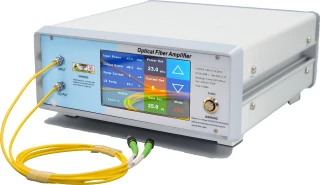
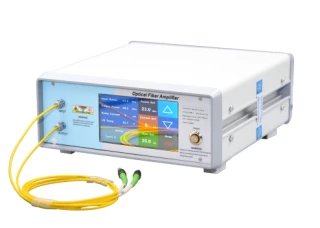
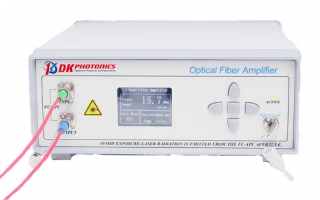
The MARS Series is designed as a turnkey solution with an embedded microprocessor for intuitive local control and monitoring. A front‑panel LCD interface clearly displays key operating parameters such as pump current, module temperatures, input/output power levels, and system status messages. Built‑in alarms and warning messages notify the user of abnormal conditions, helping operators quickly diagnose issues and maintain optimal operating points. The output power can be adjusted over a wide tuning range (typically 10–100% of rated power), enabling fine optimization of the amplification level for different experimental configurations or system requirements.
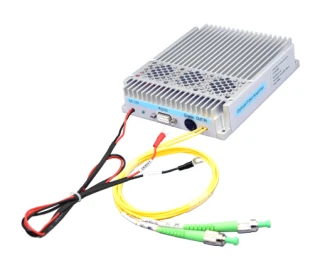
Input and output interfaces are designed for straightforward integration into existing fiber networks and laboratory setups. The amplifier typically accepts standard SMF‑28‑type single‑mode fiber (SMF 9/125 μm, NA ≈ 0.13) at the input, while the output can be provided either on standard single‑mode fiber or on large mode area (LMA) fiber depending on the desired power handling and beam characteristics. The default optical connector is FC/APC to minimize back‑reflections, with other connector options available on request. A minimum output fiber length of more than 1 m facilitates convenient routing and connection to downstream components such as nonlinear fibers, interferometers, or sensor arrays.
In terms of electrical and mechanical design, the MARS Series supports a wide AC input range (100–240 V), making it compatible with global mains standards and suitable for deployment in diverse laboratory or industrial environments. Maximum power consumption is typically on the order of 100 W, reflecting efficient pump diode and thermal management design. The amplifiers are available in standard 19″ rackmount enclosures, generally in 2U or 3U heights depending on the output power configuration. This format allows easy integration into existing test racks and system cabinets commonly used in communication and sensing infrastructures.
The family offers multiple standard output power options, including 1 W, 5 W, 10 W, and 20 W, with custom configurations available on request. Output power levels are specified at 0 dBm input over the 1540–1565 nm operati
Connet MARS Series C-Band High Power Optical Fiber Amplifier
Specifications
| Amplifier Type: | EDFA - Erbium-Doped Fiber Amplifier |
|---|---|
| Wavelength Range: | 1530 – 1575 nm |
| Min Input Power: | 4.7 dBm |
| Max Output Power: | 43 dBm |
| Nominal Gain: | 66 dB |
| Output Fiber Type: | Single Mode |
| Noise Figure @0dBm Input Power: | <5.5 dB |
| Input/output Isolation: | 30 dB |
| Output Power Stability: | ±1 % |
| Input Power Monitoring: | Yes |
| Output Power Monitoring: | Yes |
| Output Power Tunable: | Yes |
| Input Fiber Type: | SMF 9/125um NA=0.13 |
| Output Fiber Type: | SM fiber or LMA fiber |
| Output Fiber Length: | >1 m |
| Output Power Tunable Range: | 10-100 % |
| Operating Temperature: | 0 to +50 °C |
| Storage Temperature: | -40 to +85 ℃ |
| Power Supply: | 100-240 VAC |
| Power Consumption (Max): | 100-240 W |
Got questions about specs? Use the inquiry form to ask.
 Download Data Sheet

Features
- High Output Power (1–20 W) – Delivers up to 20 W continuous-wave C-band output, ideal for high‑power amplification, nonlinear optics experiments, and system test beds.
- C-Band Operating Wavelength (1540–1565 nm) – Optimized for standard C‑band optical communication windows, compatible with most telecom and test & measurement systems.
- Low Noise Figure (< 5.5 dB) – Advanced amplifier design minimizes noise, enabling improved OSNR for demanding fiber optic communication and sensing applications.
- Double-Cladding Fiber Amplification Technology – Utilizes high‑efficiency double‑clad fiber with multimode pump diodes for superior power conversion efficiency and reliable high‑power operation.
- Excellent Power Stability (±1% over 8 hours) – Proprietary thermal treatment and optimized optical structure ensure long‑term stability, supporting 24/7 operation in lab and industrial environments.
- Wide Input Power Range (‑3 to +10 dBm) – Flexible input specification allows straightforward integration with a variety of seed lasers and upstream EDFAs or fiber laser sources.
- Real-Time Input & Output Power Monitoring – Built‑in monitoring of input and output power ensures precise control, easy diagnostics, and repeatable experiment or system performance.
- Output Power Tunable from 10–100% – Adjustable output level enables smooth power scaling for system optimization, component testing, and nonlinear effect control.
- Fast Protection Circuitry for System Safety – High‑speed response protection automatically cuts off the high‑power pump if the input signal drops or is disconnected, protecting the amplifier and external components.
- All-Fiber Integrated Design – Splice‑based, all‑fiber layout minimizes free‑space optics, improving robustness, alignment stability, and resistance to vibration and shock.
- High Stability & High Reliability – Mature design for double‑clad fiber handling, conservative pump operation, and optimized thermal management ensures long service life and low maintenance.
- Turn-Key Benchtop System with Microprocessor Control – Fully integrated bench‑top unit with internal controller, ready to use out of the box for R&D labs and production lines.
- User-Friendly LCD Display Interface – Front‑panel LCD provides real‑time readout of pump current, temperature, system status, and alarm messages for intuitive operation.
- Multiple Power Configurations – Standard models available at 1 W, 5 W, 10 W, and 20 W output power; other power levels available on request to match specific application requirements.
- Flexible Fiber and Connector Options – Standard SMF 9/125 μm input fiber with FC/APC connector (other connectors available); output available on standard SM fiber or LMA fiber for higher power handling.
- Compact 19" Rackmount Form Factor – Available in 19" 2U or 3U packages, suitable for integration into optical racks, test stations, and system chassis.
- Wide Operating Temperature Range – Designed for 0–50 °C (or 0–30 °C, model dependent) operation with storage from ‑40 to +85 °C, ensuring reliability in varied lab and industrial environments.
- Universal AC Power Input (100–240 V) – Global mains compatibility with maximum power consumption of 100 W simplifies installation in diverse locations.
- Available in SM and PM Versions – Single‑mode (MFAS) and polarization‑maintaining (MFAP) configurations support both general‑purpose amplification and polarization‑sensitive applications.
- Ideal for Advanced Applications – Suited for nonlinearity research, high‑power amplification stages, fiber optic sensing, C‑band optical communications, and general research & development.
Applications
- High-Capacity DWDM Optical Fiber Communication Links – Boost C-band channels in long-haul and metro DWDM systems to extend reach and increase bandwidth in carrier-grade optical networks.
- Optical Transport Networks (OTN) and Backbone Infrastructure – Provide 1–20 W high-power amplification for backbone, regional, and inter-city fiber routes requiring low noise and high stability.
- Optical Link Budget Extension for Access Networks – Compensate for losses in passive optical networks (PON), fiber distribution networks, and extended-reach access links where higher launch power is needed.
- High-Power EDFA Booster for Transmission Systems – Serve as a booster amplifier at the transmitter side to raise C-band output levels prior to multiplexers, ROADMs, and long fiber spans.
- Pre-Amplifier and In-Line Amplifier in C-Band Systems – Operate as pre-amp or in-line amplifier stages in multi-span systems that demand low noise figure and excellent gain stability.
- Laboratory Research on Nonlinearity in Optical Fibers – Generate high optical intensities to study self-phase modulation, four-wave mixing, stimulated Brillouin scattering (SBS), and stimulated Raman scattering (SRS).
- Nonlinear Fiber Optics Experiments and Demonstrations – Drive highly nonlinear fibers, photonic crystal fibers, or specialty fibers for supercontinuum generation, soliton experiments, and advanced nonlinear effects.
- High-Power Seed Amplification for Fiber Lasers – Amplify narrow-linewidth or modulated C-band seed lasers in MOPA (master oscillator power amplifier) architectures for research and industrial systems.
- High-Power Amplification for Coherent Communication Systems – Provide stable, low-noise gain for coherent transceivers, phase-sensitive links, and advanced modulation formats in C-band.
- Optical Frequency Comb and Metrology Systems – Boost C-band comb lines or reference lasers in precision metrology, optical clocks, and frequency dissemination experiments.
- Fiber Optic Sensing – Distributed Temperature and Strain Sensing (DTS/DSS) – Supply high pump power for Raman or Brillouin based distributed sensing systems over tens of kilometers of fiber.
- Distributed Acoustic Sensing (DAS) and Vibration Monitoring – Deliver high-power C-band pulses or CW signals for DAS systems used in perimeter security, structural health monitoring, and pipeline surveillance.
- Interferometric and Coherent Fiber Sensor Systems – Improve sensitivity and signal-to-noise ratio in Mach–Zehnder, Michelson, Sagnac, and other interferometric fiber sensors.
- Optical Time-Domain Reflectometry (OTDR) Enhancement – Act as a high-power booster stage in C-band OTDR systems for long-distance fault location and fiber characterization.
- Test and Measurement in Photonics R&D Labs – Provide a stable, tunable high-power C-band source for characterizing components such as WDM filters, isolators, couplers, and optical switches.
- Component and Subsystem Burn-In and Reliability Testing – Stress-test optical components and modules under high optical power to validate long-term reliability and thermal performance.
- Prototyping of Amplified Optical Links and Systems – Rapidly build and evaluate new system architectures in universities, research institutes, and industrial R&D labs using a turnkey high-power amplifier.
- Quantum Communication and Quantum Optics Experiments – Amplify C-band carriers and auxiliary channels used in quantum key distribution (QKD) and other quantum optics platforms requiring stable, monitored power.
- Free-Space Optical Communication (FSO) Front-End – Use high-power C-band output as the launch source for atmospheric optical links where higher power improves link margin and robustness.
- Optical Signal Distribution and Routing in Large Facilities – Feed high-power signals into passive distribution networks in data centers, campuses, and large test facilities while maintaining adequate power at multiple endpoints.
- Microwave Photonics and RF-over-Fiber Links – Enhance RF-over-fiber signal strength and dynamic range by providing low-noise optical amplification for modulated C-band carriers.
- LiDAR and Ranging System Development (C-Band) – Serve as a high-power amplifier stage for C-band fiber-based LiDAR or range-finding prototypes in research environments.
- Optical Coherence Tomography (OCT) in Telecom Band Research – Supply amplified C-band light for specialized long-range or experimental OC
Frequently Asked Questions
What is the MARS series C‑band high power optical fiber amplifier and what are its typical applications?
What output power levels and wavelength range are available for this C‑band high power EDFA?
What are the input power, noise figure, and output stability specifications of the amplifier?
How is the MARS series optical fiber amplifier protected and controlled during operation?
What fiber types, connectors, and mechanical configurations are offered for this high power amplifier?
What power supply, power consumption, and environmental conditions does the amplifier require?
How do I select and order the correct MARS C‑band high power optical fiber amplifier model?
Got more questions? Use the inquiry form to ask the supplier directly.
Similar Products


Your inquiry has been received.
Create an account by adding a password
Why create an account?
- Auto-complete inquiry forms
- View and manage all your past messages
- Save products to your favorites
- Close your account anytime — no hassle