


Description
The MARS Series L-band optical fiber amplifiers are high-performance, benchtop, turnkey systems designed for applications that demand high power, low noise, and exceptional long-term stability in the L-band spectrum. Built around double-cladding erbium or erbium-ytterbium co-doped fiber technology and driven by high-power, high-reliability multimode pump diodes, these amplifiers deliver continuous-wave output power up to 5 W in the 1575–1602 nm range. By combining an optimized optical structure with precision control electronics, the MARS Series provides a robust solution for laboratory research, system prototyping, and industrial integration in advanced optical communication and sensing systems.
In contrast to conventional single-clad L-band EDFAs that are typically limited to hundreds of milliwatts, the MARS Series utilizes double-cladding fiber architectures to efficiently convert multimode pump power into high-brightness, single-mode or polarization-maintaining (PM) outputs. This approach allows the platform to maintain a low noise figure (typically < 6 dB at 0 dBm input) while achieving watt-level output. The amplifiers are available in single-mode (MFAS-ER(EY)-L) and polarization-maintaining (MFAP-ER(EY)-L) configurations, enabling use in both standard telecom-style systems and polarization-sensitive applications such as coherent detection, nonlinear optics experiments, and interferometric sensing.
A key design focus of the MARS Series is stable and repeatable operation. Each unit integrates a high-accuracy automatic current and temperature control system (ATC) for the pump diodes and automatic power/current control (APC/ACC) for the output, ensuring excellent output stability over time. After a typical 30-minute warm-up at 25 °C, power stability is maintained within approximately ±1–2% over 8 hours, which is critical for long-term experiments, fiber sensing networks, and field-deployed subsystems. Precision monitoring of both input and output power is provided, and the output can be tuned over a defined range to match system-level power budgets or to explore power-dependent nonlinear effects.
Protection and reliability are central to the MARS Series platform. A high-speed protection circuit continuously monitors the input and output power in real time. If the input signal unexpectedly drops or is disconnected, the system rapidly reduces or shuts down the high-power pump sources to prevent damage to the active fiber, downstream components, or connected devices. This kind of automatic pump protection is commonly found in leading high-power EDFA designs and is essential when operating with watt-level optical power, making these amplifiers suitable for both sensitive laboratory environments and demanding industrial settings.
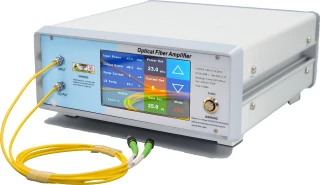
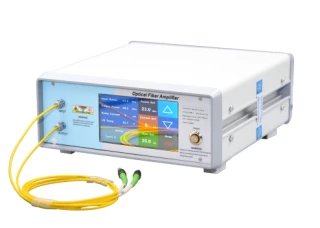
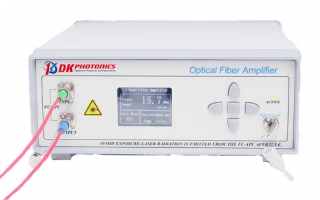
From an integration perspective, the MARS Series is offered in a 19-inch 2U benchtop form factor with universal 100–240 VAC power input, making it straightforward to deploy in standard racks or on optical test benches. The front-panel LCD interface provides clear readouts of operating parameters such as output power, pump status, and alarms, while allowing users to configure control modes and tuning ranges without external controllers. The output is typically provided on standard FC/APC connectors with either SMF-28-compatible single-mode fiber (SMF 9/125 µm, NA ≈ 0.13) or PM1550 polarization-maintaining fiber, with output fiber lengths greater than 1 m to facilitate easy splicing or patch-cord use in complex optical setups.
These L-band amplifiers are engineered to support a wide range of applications. In optical fiber communications, they serve as booster, in-line, or pre-amplifiers in L-band dense wavelength division multiplexing (DWDM) systems, extending transmission reach and increasing channel capacity beyond the conventional C-band. For fiber sensing, the high power and low noise characteristics enhance the performance of distributed temperature and strain sensing systems, interferometric sensor arrays, and long-range OTDR or reflectometry setups. In nonlinear optics and photonics research, the watt-level power enables experiments in supercontinuum generation, parametric processes, and other intensity-dependent phenomena requiring stable L-band pump sources.
By combining high output power, low noise figure, precise electronic control, and robust optical design, the MARS Series L-band optical fiber amplifiers provide a versatile platform for demanding photonics applications. Whether used in telecom laboratories, university research facilities, or industrial sensing and test systems, these amplifiers offer the performance and reliability needed to support advanced R&D, system qualification, and long-term deployment in the 1575–1602 nm L-band window.
Connet MARS L Band High Power Benchtop Optical Fiber Amplifier 5W
Specifications
| Amplifier Type: | EDFA - Erbium-Doped Fiber Amplifier |
|---|---|
| Wavelength Range: | 1575 – 1602 nm |
| Min Input Power: | -3 dBm |
| Max Output Power: | 5 dBm |
| Nominal Gain: | 30 dB |
| Output Fiber Type: | PM1550-XP |
| Typical Operating Wavelength: | 1590 nm |
| Input Power Range: | -3 to +10 dBm |
| Output Power (maximum): | 5 W |
| Output Power @ 0 DBm Input: | up to 5 W (model dependent) |
| Noise Figure @ 0 DBm Input (typical): | < 6 dB |
| Input/Output Isolation: | 30 dB |
| Output Power Stability (8 H, Typical): | ±1% |
| Output Power Stability (8 H, Max): | ±2% |
| Input Power Monitoring: | Yes |
| Output Power Monitoring: | Yes |
| Output Power Tunable: | Yes |
| Output Power Tunable Range: | Not specified |
| Output Fiber Type (SM): | SMF 9/125 µm, NA = 0.13 |
| Output Fiber Type (PM): | PM1550 |
| Output Fiber Length: | >1 m |
| Optical Connector: | FC/APC (other options available) |
| Operating Temperature: | 0 to +50 °C |
| Storage Temperature: | -40 to +85 °C |
| Power Supply (benchtop): | 100–240 VAC |
| Power Consumption: | 100 W |
| Form Factor: | 19 |
| Maximum Output Power Option (ordering Example): | 30 dBm (1 W) |
| Lower Output Power Option (ordering Example): | 20 dBm (100 mW) |
Got questions about specs? Use the inquiry form to ask.
 Download Data Sheet

Features
- High-Power L-Band Output up to 5 W – Double-clad fiber amplification and integrated high-power multimode pumps deliver up to 5 W optical output in the L-band (1575–1602 nm), ideal for demanding amplification and research applications.
- Low Noise Figure for Clean Signal Amplification – Optimized EDFA/ EYDFA design and carefully engineered optical path provide a low noise figure (typically < 6 dB @ 0 dBm input), preserving signal quality in fiber communication and sensing systems.
- High Stability & Long-Term Reliability – Built-in high-accuracy ATC & ACC (APC) control electronics maintain stable gain and output power with typical power stability of ±1–2% over 8 hours at 25 °C after warm-up.
- Turn-Key Benchtop Platform – 19" 2U benchtop chassis integrates driver electronics, control module, cooling, and user interface for true plug-and-play operation in laboratories and production environments.
- Integrated Laser Current Driver & Protection – Internal high-stability laser current driver and high-speed protection circuitry continuously monitor input and output power, shutting down the high-power pump within microseconds if the input signal drops or is disconnected.
- LCD Display with Intuitive Front-Panel Control – On-board LCD display interface provides real-time readout of operating status, pump current, input/output power, alarms, and setpoints for easy monitoring and control.
- Input & Output Power Monitoring – Built-in photodetectors measure and display both input and output optical power, simplifying gain characterization, system diagnostics, and remote supervision.
- Output Power Tunability – Adjustable output power over a defined dynamic range (e.g., from tens of mW up to multi‑W level depending on model and wavelength) supports flexible use in R&D, system optimization, and power-scaling experiments.
- SM or PM Fiber Output Options – Available in:
- MFAS‑ER(EY)‑L‑B‑<PW> (SM) – Standard single-mode output with SMF 9/125 μm, NA = 0.13.
- MFAP‑ER(EY)‑L‑B‑<PW> (PM) – Polarization-maintaining PM1550 fiber output for polarization-sensitive experiments and coherent systems.
- Wide Wavelength Coverage in the L-Band – Designed for operation from approximately 1575 to 1602 nm and optimized around 1590 nm, supporting a broad set of L-band optical communication channels and sensing lines.
- Excellent Input/Output Isolation – Integrated optical isolators provide high input and output isolation (typically ~30 dB), suppressing back-reflections and protecting the internal laser diodes and amplifier chain.
- Configurable Output Power Classes – Output power is selectable at order time via the <PW> code, covering ranges such as 20–100 mW, 30–1000 mW, and up to multi‑watt class to match diverse link budgets and experimental setups.
- High-Efficiency Double-Clad Fiber Technology – Proprietary handling and optimization of double-clad active fiber maximize pump absorption and conversion efficiency, resulting in high optical output power with reduced thermal load.
- Robust Protection & Alarm Functions – Continuous monitoring of temperature, pump current, and optical power combines with automatic shutdown and alarm indication to protect both the amplifier and connected components.
- Flexible Optical Connector Options – Standard FC/APC connector for low-reflection coupling; other connector types (e.g., FC/PC, SC, LC) available on request to match existing fiber infrastructure.
- Laboratory-Ready & OEM-Friendly – Turn-key benchtop design is ideal for immediate lab use, while the underlying platform and ordering flexibility support integration into larger testbeds and system prototypes.
- Designed for Demanding Applications – Optimized for:
- Nonlinearity research (supercontinuum generation, nonlinear fiber optics, parametric processes).
- High-power amplification in L‑band optical links and test systems.
- Fiber sensing (distributed and point sensors, interferometric and Brillouin/ Raman systems).
- Optical fiber communication in extended L‑band transmission and DWDM networks.
- Research & development in photonics, telecom, and fiber laser experiments.
- Wide Operating & Storage Temperature Ranges – Engineered for stable performance in typical lab and industrial environments, with operating temperature from 0 to +50 °C and storage from −40 to +85 °C. <
Applications
- L‑Band Optical Fiber Communication Systems – Boosts signal power in long‑haul and metro fiber networks, compensating for span loss in DWDM/CWDM links operating in the L‑band window. Ideal for carriers upgrading legacy systems to higher data rates or extended reach.
- High‑Capacity DWDM Transmission – Provides high output power (up to 5 W) to amplify dense wavelength‑division multiplexing channels in the 1575–1602 nm range, enabling higher channel counts, longer repeater spacing, and improved OSNR in backbone networks.
- Nonlinearity and Fiber Propagation Research – Serves as a powerful L‑band source for studying nonlinear effects in fibers (SPM, XPM, FWM, Raman scattering) and advanced propagation phenomena in university and laboratory environments.
- Optical Signal Regeneration and Repeater Stations – Used in inline amplifier nodes and repeater stations to restore signal levels over very long distances, including undersea links, terrestrial long‑haul routes, and regional fiber loops.
- Optical Fiber Sensing Systems – Provides high‑power pumping for distributed fiber‑optic sensors (DTS, DAS, DSS) and interferometric sensing schemes where long sensing ranges and high SNR are required in the L‑band.
- Structural Health and Security Monitoring – Integrates into fiber‑based monitoring of bridges, tunnels, pipelines, perimeters, and critical infrastructure, where high optical power extends sensing distance and improves detection sensitivity.
- Research & Development Test Platforms – Acts as a stable, low‑noise L‑band amplifier for R&D labs developing new components (modulators, filters, WDM devices) and systems that need precise gain control and high stability.
- Optical Component Characterization – Used to provide sufficient power for testing passive and active components (attenuators, couplers, isolators, WDMs) at L‑band wavelengths, especially when measuring insertion loss, return loss, and spectral response.
- Optical Fiber Laser Pumping (L‑Band Seed Amplification) – Employed as a pre‑amplifier or power amplifier for narrow‑linewidth L‑band seed lasers in fiber laser architectures, improving seed power before further amplification stages.
- Coherent Communication System Development – Supports coherent detection experiments and coherent transceiver testing by providing high‑power, low‑noise amplification of modulated L‑band signals in advanced modulation formats (QPSK, QAM, etc.).
- Optical Network Prototyping and System Integration – Integrated in prototyping stages of new L‑band network equipment (ROADMs, OADMs, OXCs) for system‑level validation, OSNR margin studies, and interoperability testing.
- Laboratory Benchtop Optical Source – The turn‑key benchtop package with LCD interface and integrated ATC/ACC (APC) control makes it suitable as a general‑purpose high‑power L‑band source in optics and photonics laboratories.
- Education and Training in Photonics – Used in university and technical institute labs for hands‑on training in EDFAs, gain dynamics, noise figure measurements, and L‑band system design, thanks to its robust and user‑friendly benchtop format.
- Amplification of L‑Band ASE and Broadband Sources – Amplifies L‑band amplified spontaneous emission (ASE) sources or superluminescent diodes to create broadband, high‑power illumination for spectroscopy, component testing, and system calibration.
- Optical Time‑Domain and Frequency‑Domain Reflectometry – In OTDR/OFDR setups that operate or probe in the L‑band, the amplifier boosts probe pulses or continuous‑wave signals to extend measurement range and enhance backscatter signal levels.
- Quantum and Low‑Noise Photonics Experiments – Supports experiments requiring stable, low‑noise L‑band amplification (e.g., quantum optics at telecom wavelengths, photon‑pair generation, entanglement distribution) where gain and stability are critical.
- Remote Light Delivery and Illumination – Used for long‑distance optical power delivery over fiber in specialized industrial or scientific setups where high L‑band power is transported to a remote site for sensing or illumination.
- Polarization‑Sensitive Applications (PM Version) – With the PM output option (MFAP‑ER(EY)‑L), supports polarization‑maintaining applications such as polarization‑multiplexed signals, coherent detection, and interferometric sensing requiring stable SOP.
- Single‑Mode System Integration (SM Version) – With the SM output option (MFAS‑ER(EY)‑L), integrates seamlessly into standard single‑mode networks and testbeds based on SMF‑28‑type fib
Frequently Asked Questions
What is the Connet MARS Series L‑band optical fiber amplifier and what are its main features?
What output power and wavelength range does the MARS L‑band amplifier support?
What applications are MARS Series L‑band fiber amplifiers commonly used for?
What is the difference between the MFAS‑ER(EY)‑L (SM) and MFAP‑ER(EY)‑L (PM) models?
How stable and quiet is the output of the MARS L‑band amplifier (noise figure and power stability)?
What built‑in protection and monitoring functions does the MARS Series provide?
What mechanical, electrical, and connectivity options are available for the MARS L‑band amplifier?
Got more questions? Use the inquiry form to ask the supplier directly.
Similar Products


Your inquiry has been received.
Create an account by adding a password
Why create an account?
- Auto-complete inquiry forms
- View and manage all your past messages
- Save products to your favorites
- Close your account anytime — no hassle