


Description
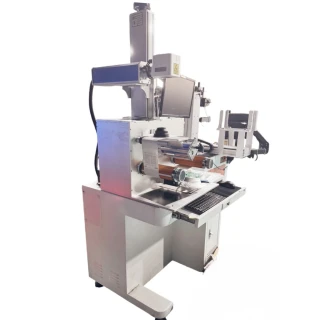
The PCB Laser Marking Machine UV Fiber Fixed Head is a 20W fiber laser PCB marking machine with fixed laser head design, engineered for high-speed, high-precision marking in electronics manufacturing and industrial production environments. Operating at a 1064 nm fiber laser wavelength, the system delivers permanent, high-contrast markings on PCBs, metal components, and a wide range of industrial materials with exceptional stability and repeatability.
Designed specifically for inline PCB production and intelligent traceability systems, this machine enables seamless integration into modern SMT and automated production lines. Its fixed laser head architecture ensures consistent focal stability, reducing mechanical variation and improving marking uniformity during continuous operation.
The PCB Laser Marking Machine UV Fiber Fixed Head is widely used for QR code marking, barcode engraving, serial number coding, and product traceability applications in the electronics industry. It supports direct integration with MES (Manufacturing Execution Systems), allowing real-time data exchange for smart factory environments and Industry 4.0 workflows.
With its ability to achieve extremely fine marking resolution and high-speed processing, this system is ideal for manufacturers requiring high-throughput PCB identification, anti-counterfeiting marking, and full production traceability. The combination of fiber laser technology, stable fixed-head structure, and industrial automation compatibility makes it a reliable solution for continuous, high-volume production lines.Built for durability, efficiency, and precision, the VIPIN-PD20FB delivers low-maintenance operation, long laser lifetime, and consistent marking quality, making it a core tool for modern electronics manufacturing and PCB processing industries.
PCB Laser Marking Machine UV Fiber Fixed Head
Specifications
| Work Area X: | 300 mm |
|---|---|
| Work Area Y: | 400 mm |
| Beam Delivery: | Galvo |
| Laser Source: | Fiber |
| Laser Output Power: | 20 W |
| Laser Wavelength: | 1064 nm (IR) |
| Marking Speed: | 3000 mm/sec |
| Voltage Requirement: | 220V - 50Hz |
| Materials: | Stainless Steel, Steel/Iron, Steel Alloy, Aluminum, Anodized Aluminum, Brass, Copper, Gold, Silver, Nickel, Titanium, Platinum, Glass, Plastic, Wood, Paper, Textile, Granite, Marble, Nylon, Acrylic, Plexiglass |
| Air Assist: | Included |
| Fume Extraction Unit: | Included |
| Safety Enclosure: | Included |
| Laser Type: | Fiber |
| Laser Power: | 5W/20W |
| Output Fluctuation Rate: | <3% |
| Laser Wavelength: | 355nm/1064nm |
| Laser Cooling Method: | WaterCooling/Air Cooling |
| Minimum Point Diameter: | 0.13mm |
| Engraving Angle: | 0-360° |
| Repeat Accuracy: | ±0.03mm |
| Transition Speed: | 0-3000mm/s |
| QR Code Size (minimum): | 3mm×3mm |
Got questions about specs? Use the inquiry form to ask.
 Download Data Sheet

Features
- High‑Precision PCB Laser Marking for Traceability – Designed specifically for PCB QR codes, barcodes, characters, and logos on a wide range of solder mask colors (white, green, black, blue, red), as well as reinforcement steel sheets and shielding covers, ensuring reliable product identification and traceability.
- Fixed Laser Head for Maximum Stability – Fixed laser head architecture (VIPin‑260B) delivers superior marking consistency and repeatability compared with moving-head systems, reducing mechanical wear and ensuring long-term accuracy in automated production environments.
- Online and Offline Models for Flexible Integration –
- Inline Model: Supports PCB sizes up to 200 × 200 mm, installed at the front of the production line for continuous marking, real-time MES connection, and intelligent traceability.
- Offline Model: Supports PCB sizes up to 260 × 260 mm, ideal for bare boards or boards with components when MES connectivity and inline reading are not required.
- UV or Fiber Laser Options for Different Materials –
- UV Laser (5 W, 355 nm): Ideal for high-contrast marking on PCB solder masks, plastics, and sensitive materials with minimal thermal impact. Laser lifespan ≥ 15,000 hours.
- Fiber Laser (20/30 W, 1064 nm): Suited for metal parts such as reinforcement sheets and shielding covers. Laser lifespan ≥ 50,000 hours.
- Premium Laser Sources for Reliability – Equipped with renowned laser sources such as American Inno / Shenzhen RFH (UV) and German IPG / MAX (fiber), providing stable output (< 3% fluctuation), high beam quality, and reliable long-term operation under industrial duty cycles.
- Ultra‑Fine Marking Capability –
- Laser spot size (UV): Down to approx. 0.04 mm, enabling crisp micro-text and microcodes.
- Minimum point diameter: 0.13 mm for precise and clear line work.
- Minimum QR code size: As small as 0.8 × 0.8 mm (typical applications), with system spec of 3 × 3 mm for high readability and scanning reliability.
- High Speed Marking for Mass Production –
- Average marking time per PCB: about 6 seconds, translating to ~360 components per hour per machine.
- Annual output per system: approx. 2.376 million marks under standard operating conditions.
- Transition speed up to 0–3000 mm/s, suitable for high-throughput SMT lines.
- 360° Flexible Engraving – Engraving angle from 0–360° allows codes and characters to be marked at any orientation on the PCB, simplifying layout design and fixture positioning in complex panel configurations.
- High Repeat Accuracy – Positioning repeatability of ±0.03 mm ensures stable code placement on pads, fiducials, or designated label areas, supporting downstream automated optical inspection (AOI) and pick-and-place alignment.
- Extensive Code Format Support – Capable of marking and encoding a wide range of industrial standards:
- 2D Codes: QR Code, Micro QR Code, IQR Code, Data Matrix, GS1 DataMatrix, PDF417
- 1D Barcodes: CODE39, CODE128, ITF, NW-7, JAN (EAN), UPC
- Text: English uppercase, English lowercase, numbers, Katakana, Chinese characters
- Integrated Code Reading and Verification (Inline) – Inline model supports stable code reading within 200 × 200 mm PCB size, enabling in-situ verification of marked QR codes/barcodes and closed-loop feedback to MES for improved traceability and process yield.
- MES Connectivity for Smart Factories – Online automatic PCB laser marking system can be directly connected to Manufacturing Execution Systems (MES), providing:
- Automatic assignment and recording of serial numbers and lot data.
- Bi-directional data exchange for traceability and quality control.
- Real-time monitoring of marking status and production metrics.
- Water or Air Cooling for Stable Operation –
- UV laser: typically configured with water cooling for superior thermal stability at high duty cycles.
- Fiber laser: air-cooled configurations simplify installation and maintenance.
- Permanent, Non-Contact Marking – Laser marks are permanent and resistant to abrasion, chemicals, and high reflow temperatures, unlike conventional high-temperature labels that can drop off, fade, or fail in harsh environments.
Applications
The PCB Laser Marking Machine UV Fiber Fixed Head with fixed laser head is designed for high‑precision, high‑reliability identification and traceability on printed circuit boards and related electronic components. It supports both UV and fiber laser sources, enabling high‑contrast permanent marks on a wide range of PCB substrates and coatings.
1. PCB Identification and Traceability- Permanent marking of QR codes, Micro QR codes, Data Matrix codes, and barcodes (CODE39, CODE128, ITF, GS1 DataMatrix, PDF417, JAN/EAN, UPC) on:
- Single‑sided and double‑sided PCBs
- Multilayer PCBs for high‑density electronic assemblies
- Rigid, flex, and rigid‑flex PCBs
- Marking of serial numbers, lot numbers, and production batch IDs to enable full product traceability throughout the manufacturing and service lifecycle.
- Integration with MES (Manufacturing Execution Systems) in inline configurations for automatic code generation, reading, verification, and data upload.
- Replacement of traditional high‑temperature paper labels with direct laser marks, eliminating label cost, adhesive failures, and risk of label drop‑off.
- High‑contrast marking on PCBs with different solder mask (oil) colors:
- Green oil (standard PCB solder mask)
- White oil (LED PCBs, lighting and display boards)
- Black oil (high‑end consumer electronics and communication boards)
- Blue and red oil (special application or branding‑specific PCBs)
- Clear and stable codes on:
- Matte and glossy solder mask surfaces
- Surface‑finished pads (ENIG, HASL, OSP, etc., where marking on nearby solder mask is required)
- PCBs with reinforcing steel sheets, shielding covers, and metal stiffeners
- Fine marking capability with:
- Laser spot size down to approx. 0.04 mm (UV)
- Minimum point diameter 0.13 mm
- Minimum QR code size approx. 3 mm × 3 mm (typical 0.8 × 0.8 mm to 2 × 2 mm marking windows on pads or dedicated code areas)
- Suitable for:
- High‑density interconnect (HDI) boards
- Compact consumer electronics PCBs (smartphones, tablets, wearables)
- Medical device electronics and aerospace electronics where very small, high‑reliability codes are required
- Integrated code reading and verification (inline model) for micro‑codes on confined PCB areas.
- Online (inline) configuration for installation at the front end of:
- SMT production lines (pre‑solder paste printing)
- Automated assembly lines for consumer and industrial electronics
- High‑volume PCB manufacturing and testing lines
- Automatic conveyor‑based PCB handling for:
- PCB max size approx. 200 × 200 mm (for stable fixed‑head code reading and marking)
- Single panel or panelized boards
- MES data connectivity for:
- Automatic code assignment
- Real‑time traceability and yield tracking
- Integration with AOI, ICT, and functional test data
- High throughput marking:
- Average marking time ~6 s per code
- Approx. 360 cycles per hour (cph) depending on code content and layout
- Offline model suitable for:
- Bare PCBs before entering the main production line
- PCBs with components that cannot be marked inline due to process flow or handling constraints
- Support for larger PCB formats:
- Max PCB size approx. 260 × 260 mm without MES integration and without code auto‑reading
- Flexible loading/unloading:
- Manual tray loading for small and medium batches
- Offline kitting of PCBs requiring re‑marking or additional tracking codes
- Direct laser marking as a cost‑effective alternative to:
- High‑temperature resistant labels
- Barcode stickers and nameplates
Frequently Asked Questions
What is PCB Laser Marking Machine UV Fiber Fixed Head laser marking machine and what applications is it designed for?
What are the key technical specifications of the VIPin‑260B PCB laser marker?
What PCB sizes and production line configurations does the PCB Laser Marking Machine UV Fiber Fixed Head support?
How does the VIPin‑260B compare to traditional high‑temperature PCB labels in terms of cost and reliability?
What marking performance and throughput can the VIPin‑260B achieve for PCB QR codes and barcodes?
Should I choose the UV or fiber laser option for the VIPin‑260B for my PCB marking application?
How is code quality verified and integrated with MES or traceability systems using the PCB Laser Marking Machine UV Fiber Fixed Head?
Got more questions? Use the inquiry form to ask the supplier directly.
Similar Products


Your inquiry has been received.
Create an account by adding a password
Why create an account?
- Auto-complete inquiry forms
- View and manage all your past messages
- Save products to your favorites
- Close your account anytime — no hassle