


Description
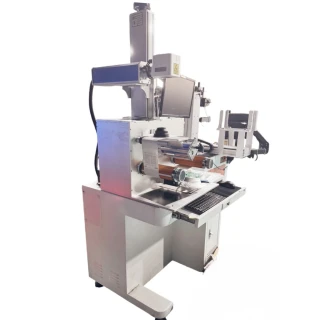
The PCB Laser Marking Machine UV Fiber Fixed Head VIPIN-260B-01 is a fixed laser head PCB marking machine designed for high-speed, high-precision inline electronics manufacturing. Operating at 1064 nm fiber laser wavelength, it delivers permanent, high-contrast markings on printed circuit boards (PCBs), metal surfaces, and industrial components used in automated production environments.
Built for continuous production line integration, the system features a rigid fixed-laser-head architecture that ensures stable optical alignment and consistent marking quality over long-duration operation. This design eliminates mechanical variability, making it highly suitable for high-throughput PCB marking, serialization, and traceability applications.
The VIPIN-260B-01 is widely used in SMT production lines, electronics assembly, and industrial automation systems, where it performs rapid marking of QR codes, barcodes, serial numbers, and product identifiers directly on PCBs. Its compatibility with MES systems enables real-time data exchange for smart factory and Industry 4.0 workflows.
Unlike vision-based or XY-stage systems, this model is optimized for streamlined, fixed-position inline marking, prioritizing speed, stability, and production efficiency. It is particularly well suited for manufacturers requiring continuous marking of uniform PCB formats with minimal setup changes.
With long laser lifespan, low maintenance requirements, and stable output performance, the VIPIN-260B-01 provides a cost-effective and reliable solution for high-volume PCB traceability and industrial laser marking applications.
PCB Laser Marking Machine UV Laser
Specifications
| Work Area X: | 260 mm |
|---|---|
| Work Area Y: | 260 mm |
| Beam Delivery: | Galvo |
| Laser Source: | Fiber |
| Laser Output Power: | 5 W |
| Laser Wavelength: | 355 nm (UV) |
| Marking Speed: | 300 mm/sec |
| Voltage Requirement: | 220V - 50Hz |
| Materials: | Stainless Steel, Steel/Iron, Steel Alloy, Aluminum, Anodized Aluminum, Brass, Copper, Gold, Silver, Nickel, Titanium, Platinum, Glass, Plastic, Wood, Paper, Textile, Granite, Marble, Nylon, Acrylic, Plexiglass |
| Air Assist: | Included |
| Fume Extraction Unit: | Included |
| Safety Enclosure: | Included |
| Laser Type: | UV/Fiber |
| Laser Power: | 5W/20W |
| Output Fluctuation Rate: | <3% |
| Laser Wavelength: | 355nm/1064nm |
| Laser Cooling Method: | WaterCooling/Air Cooling |
| Minimum Point Diameter: | 0.13mm |
| Engraving Angle: | 0-360° |
| Repeat Accuracy: | ±0.03mm |
| Transition Speed: | 0-3000mm/s |
| QR Code Size (minimum): | 3mm×3mm |
Got questions about specs? Use the inquiry form to ask.
 Download Data Sheet

Features
- High-Contrast, Permanent PCB Marking – Optimized for clear QR codes, barcodes, and text on PCBs with white, green, black, blue, and red solder mask. Laser marks will not drop off, fade, or peel like high‑temperature paper labels.
- Laser Head Fixed Design for Stable Code Reading – The fixed laser head ensures consistent focal distance and highly stable code quality, improving readability and reducing mis-reads in AOI and code verification systems.
- Supports Both UV and Fiber Lasers – Dual laser options in one platform:
- UV Laser 5W (355 nm) – Ideal for fine, high‑contrast marking on sensitive PCB materials with minimal heat impact.
- Fiber Laser 20W/30W (1064 nm) – Suitable for metal parts, reinforcement steel sheets, and shielding covers, offering fast and deep marking.
- Long Laser Lifespan & Stable Output – UV source life ≥15,000 hours and fiber source life ≥50,000 hours with output fluctuation <3% for consistent, production‑grade performance over many years of operation.
- Fine Marking Resolution for Small Codes – Minimum QR code size down to approximately 0.8 × 0.8 mm with laser spot sizes as small as 0.04 mm, suitable for dense PCB layouts and limited marking areas.
- High-Speed Throughput for Mass Production – Typical cycle time of about 6 seconds per mark, enabling around 360 components per hour. Annual capacity can reach approximately 2.376 million boards per machine, supporting 10M‑board volumes with multiple units.
- Significant Cost Savings vs. High-Temperature Labels – Eliminates the recurring cost of label stock and manual labeling:
- No consumables such as 10 × 10 mm or 15 × 40 mm high‑temperature labels.
- Removes multi‑year label expenses (up to millions of RMB over 5 years in typical scenarios).
- Reduces labor costs tied to manual labeling (operators, rework, and verification).
- Eliminates Label-Related Failures – Unlike stickers that can drop off or crack under reflow and handling, laser markings are directly on the PCB or metal surface and remain readable throughout the product lifecycle.
- Flexible Inline and Offline Models – Available configurations to fit different production flows:
- Inline Model – For boards up to 200 × 200 mm, placed at the front of the production line for automatic, continuous marking and seamless integration.
- Offline Model (bare or assembled boards) – For boards up to 260 × 260 mm, ideal for PCBs with components or for stand‑alone batch processing.
- MES Connectivity & Intelligent Traceability (Inline) – The online model supports connection to MES/ERP and traceability systems, enabling automatic code assignment, marking data logging, and full life‑cycle tracking of each PCB.
- Comprehensive Code Type Support – Capable of marking a wide range of industry‑standard codes and characters:
- 2D codes: QR Code, Micro QR, IQR, Data Matrix, GS1 DataMatrix, PDF417
- 1D codes: CODE39, CODE128, ITF, NW‑7, JAN (EAN), UPC
- Alphanumeric and symbols: English uppercase, English lowercase, digits
- Multilingual: Katakana, Chinese characters (for localized marking)
- High Precision & Repeatability – Mechanical and optical design delivers:
- Repeat accuracy: ±0.03 mm
- Minimum point diameter: ~0.13 mm (system spec) with fine laser spot for detailed patterns.
- Engraving angle: 0–360° for flexible code orientation to fit tight PCB layouts.
- Fast Motion & Marking Speed – Transition / scanning speeds up to 0–3000 mm/s ensure quick movement between marking positions and high total line throughput.
- Optimized for Multilayer and Coated PCBs – Tuned for stable, legible codes across various solder mask and coating colors (white, green, black, blue, red) and for use on reinforcement steel plates and shielding covers typically found in electronic assemblies.
- Configurable for Different Board Types – Supports:
- Bare PCB marking before SMT.
- PCBs with components (offline configuration) to add codes after assembly or for repair/inspection loops.
- Single or panelized boards, with marking on panel frames or individual PCB areas.
- Industrial-Grade Laser Sources – Incorporates branded
Applications
- PCB Identification and Traceability – High-speed marking of PCB IDs, serial numbers, and multi-level product codes for single- and double-sided boards in SMT and DIP lines.
- QR Code and Data Matrix Marking – Permanent 2D codes (Micro QR, QR, Data Matrix, IQR, GS1 DataMatrix, PDF417) for automated traceability in electronics manufacturing (MES/ERP integration).
- Barcode Marking – 1D barcodes such as CODE39, CODE128, ITF, NW-7, JAN(EAN), UPC for component tracking, WIP control, and warehouse logistics.
- Component-Level Marking on PCBs – Marking of sub-boards, panelized PCBs, coupons, and functional blocks with unique IDs for assembly and testing feedback.
- Marking on Solder Mask (Green/White/Black/Blue/Red Oil) – High-contrast marking on various PCB solder mask colors without damaging copper tracks or affecting electrical performance.
- High-Temperature and Harsh Environment Identification – Direct laser marking replaces high-temperature paper or polyimide labels on PCBs subjected to reflow, wave soldering, conformal coating, and cleaning processes.
- Replacement of Printed/Adhesive Labels – Elimination of consumable labels for PCB identification, reducing annual label and labor costs in high-volume production (up to tens of millions of boards per year).
- Inline PCB Laser Marking in SMT Lines – Installed at the front of SMT lines for automatic board ID assignment, continuous marking, and direct MES connectivity.
- Offline Marking for Bare PCBs – Batch marking of bare boards (panels or single PCBs) before they enter the production line, suitable for job-shop PCB manufacturers and OEMs.
- Offline Marking for Assembled PCBs – Marking of PCBs already populated with components, for retrofit traceability or post-assembly identification.
- Marking of Small Codes and Fine Graphics – Marking of minimum character heights and micro codes (e.g., 0.8 mm × 0.8 mm codes, small logos, polarity marks, pin-1 indicators) for dense layouts.
- Batch Number, Date Code, and Lot Marking – Automated marking of production dates, lot numbers, line codes, and shift information for quality control and recall management.
- Process and Test Result Marking – Encoding test results (ICT/FCT), calibration data, and configuration versions in 1D/2D codes directly on each PCB.
- Marking on Reinforcement Steel Sheets – Permanent ID, code, or logo markings on reinforcement steel plates used in PCB assemblies or mechanical carriers.
- Marking on Shielding Covers and Metal Housings – Fiber laser marking on EMI/RF shielding covers, metal lids, and small housings used on PCBs.
- Traceability for Automotive Electronics PCBs – High-reliability marking for engine control units, airbag modules, infotainment units, ADAS boards, and other automotive electronics.
- Industrial Control and Power Electronics – Marking of PCBs used in inverters, drives, PLCs, power supplies, chargers, UPS, and industrial control modules.
- Consumer Electronics and Smart Devices – Identification marking on PCBs for smartphones, tablets, wearables, game consoles, set-top boxes, and smart home devices.
- Telecom and Network Equipment – Marking on PCBs used in routers, switches, base stations, optical network units, and RF front-end modules for full traceability.
- Medical Device PCBs – Permanent, non-contact marking for boards used in diagnostic equipment, patient monitors, imaging systems, and life-support electronics.
- Aerospace and Defense Electronics – Long-life, tamper-resistant codes on mission-critical boards for avionics, radar, guidance systems, and secure communication hardware.
- High-Density and HDI PCB Applications – Micro code marking for high-density interconnect, fine-pitch BGA, and advanced packaging substrates where label space is limited.
- Panelized PCB Marking – Centralized marking of panels (multi-up PCBs) before depaneling, using code schemes that support traceability down to each individual PCB.
- Smart Factory and Industry 4.0 Integration – Real-time data exchange with MES and traceability systems through reading and verification of codes immediately after marking.
- Anti-Counterfeiting and Brand Protection – Unique, hard-to-remove laser marks and encrypted codes on PCBs and metal parts to prevent counterfeiting and unauthorized repairs.
- Logo and Text Marking – Company logos, certifications (CE, UL, FCC), polarity indicators, revision n
Frequently Asked Questions
What is the PCB Laser Marking Machine UV Fiber Fixed Head VIPIN-260B-01 and what does it do?
How does the VIPin‑260B laser marking machine compare to traditional PCB label printing and high‑temperature labels?
What are the key technical specifications and marking capabilities of the VIPin‑260B?
What PCB sizes and production modes (inline/offline) does the PCB Laser Marking Machine UV Fiber Fixed Head VIPIN-260B-01 support?
Which materials and PCB surface colors can be marked, and how is code readability ensured?
What is the throughput and productivity of the VIPin‑260B for PCB laser marking?
How does the VIPin‑260B integrate with MES and existing SMT/PCB production lines?
Got more questions? Use the inquiry form to ask the supplier directly.
Similar Products


Your inquiry has been received.
Create an account by adding a password
Why create an account?
- Auto-complete inquiry forms
- View and manage all your past messages
- Save products to your favorites
- Close your account anytime — no hassle