


Description
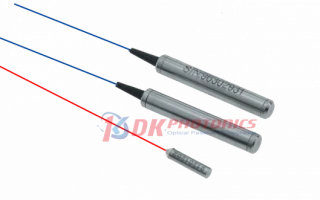
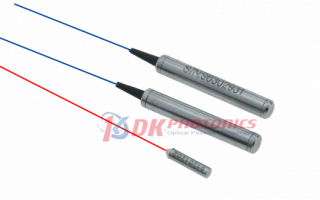
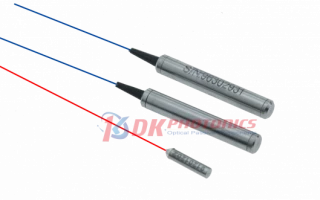
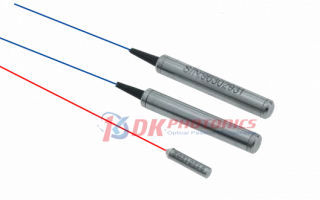
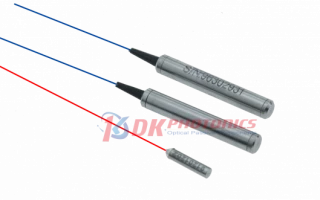
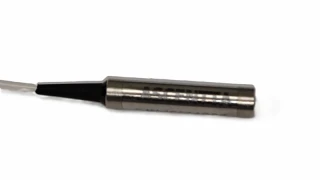
Faraday Rotators and Mirrors in pigtail style are essential optical components designed to manipulate the polarization state of light within fiber optic systems. These devices are engineered to provide precise polarization rotation, typically by 45 degrees, making them invaluable in applications where polarization control and stability are critical. The pigtail configuration ensures easy integration with singlemode, multimode, or polarization-maintaining fibers, catering to a wide range of photonic setups.
The core function of a Faraday rotator is to rotate the polarization of incoming light by a fixed angle, independent of the direction of light propagation. When paired with a mirror, the system acts as a Faraday mirror, effectively rotating the polarization by 90 degrees upon reflection and reversing its handedness. This unique property is particularly beneficial in interferometric systems, such as fiber optic sensors and optical coherence tomography (OCT), where it compensates for polarization changes induced by fiber birefringence, thus enhancing measurement accuracy and system stability.
These miniature Faraday rotator and mirror packages are available for a broad spectrum of center wavelengths, including 633–850 nm, 980–1064 nm, and 1300–1550 nm, making them suitable for diverse applications such as fiber lasers, amplifiers, circulators, and advanced sensing systems. The compact housing design allows for seamless integration into space-constrained environments, while the low insertion loss and high return loss ensure minimal signal degradation and optimal performance. The devices maintain a high polarization extinction ratio, especially when used with polarization-maintaining fibers, supporting demanding applications that require precise polarization control.
With robust construction and reliable performance across various wavelengths, these pigtail-style Faraday rotators and mirrors are a trusted choice for researchers and engineers seeking to enhance the functionality and reliability of their fiber optic systems. Their versatility and precision make them a staple in both laboratory and industrial photonics environments.
Faraday Rotators and Mirrors - Pigtail Style
Specifications
| Center Wavelength: | 1550 nm |
|---|---|
| Operating Bandwidth: | 1064 nm |
| Insertion Loss (max): | 0.75 dB |
| Faraday Rotation Angle (single Pass): | 45 deg deg |
| Center Wavelength: | 633-850 nm, 980-1064 nm, 1310-1550 nm & 1064 nm |
| Insertion Loss (Typical): | 0.8 dB (633-850 nm, 980-1064 nm), 0.6 dB (1310-1550 nm & 1064 nm), 0.5 dB (Faraday Mirror 1310-1550 nm & 1064 nm) |
| Insertion Loss (Maximum): | 1.0 dB (633-850 nm, 980-1064 nm), 0.8 dB (1310-1550 nm & 1064 nm), 0.75 dB (Faraday Mirror 1310-1550 nm & 1064 nm) |
| Low Loss: | 0.6 dB (1310-1550 nm & 1064 nm), 0.5 dB (Faraday Mirror 1310-1550 nm & 1064 nm) |
| Return Loss: | 40 dB (633-850 nm, 980-1064 nm), 40/60 dB (1310-1550 nm & 1064 nm, Faraday Mirror 1310-1550 nm & 1064 nm) |
| Polarization Extinction Ratio: | 20 dB (633-850 nm, 980-1064 nm), 20/25/30 dB (1310-1550 nm & 1064 nm), 20 dB (Faraday Mirror 1310-1550 nm & 1064 nm) |
| Rotation Angle: | 45 degrees |
| Rotation Tolerance: | ±3 degrees (all), ±1 degree (Faraday Mirror 1310-1550 nm & 1064 nm) |
| Package Diameter: | 5.5 mm (0.216 in) |
| Package Length: | 40 mm (1.575 in) |
| Housing Type: | Compact, pigtail style |
Got questions about specs? Use the inquiry form to ask.
 Download Data Sheet

Features
- Wide Wavelength Range: Available for center wavelengths of 633–850 nm, 980–1064 nm, and 1300–1550 nm, supporting a broad spectrum of photonics applications.
- Multiple Fiber Types: Offered in singlemode, multimode, and polarization maintaining fiber versions for maximum compatibility.
- Low Insertion Loss: Typical insertion loss as low as 0.5 dB (maximum 1.0 dB), ensuring minimal signal attenuation.
- High Return Loss: Return loss up to 60 dB for superior suppression of back reflections, critical for high-performance optical systems.
- High Polarization Extinction Ratio: Extinction ratios up to 30 dB (with PM fiber), providing excellent polarization control.
- Precise Rotation Angle: Delivers a 45° polarization rotation (±3° tolerance, ±1° for select models) at the center wavelength for accurate polarization management.
- Compact Miniature Design: Space-saving, robust housing ideal for integration into dense optical setups and OEM applications.
- High Power Handling: Special high-power versions available for demanding laser and amplifier systems.
- Pigtail Style Packaging: Convenient fiber pigtail configuration for easy splicing and integration into existing fiber networks.
- Low Back Reflection: Engineered to minimize unwanted reflections, enhancing system stability and performance.
- Faraday Mirror Option: Integrated Faraday mirror packages provide 90° polarization rotation and orthogonal polarization return, ideal for interferometric and sensing applications.
- Versatile Applications: Perfect for use in fiber lasers, interferometers, optical amplifiers, circulators, and OCT systems.
- Customizable Solutions: Custom center wavelengths, fiber types, and connector options available upon request.
- Reliable Performance: Designed and manufactured by OZ Optics, a trusted leader in fiber optic components.
Applications
- Fiber Lasers
Faraday rotators and mirrors are essential in fiber laser systems to manage polarization, suppress feedback, and enhance laser stability and performance. - Optical Coherence Tomography (OCT) Systems
Used in OCT imaging to maintain polarization integrity, improve signal-to-noise ratio, and enable high-resolution biomedical imaging. - Interferometric Sensors
Critical for fiber optic interferometers, these devices compensate for polarization changes, ensuring accurate phase measurements in sensing applications. - Optical Amplifiers
Employed in fiber amplifiers (such as EDFA and YDFA) to control polarization effects, reduce noise, and optimize amplification efficiency. - Optical Circulators
Integrated into circulator designs to direct light paths and manage polarization, enabling efficient signal routing in optical networks. - Quantum Communication Systems
Used to preserve polarization states and minimize errors in quantum key distribution and other quantum optics experiments. - Telecommunications Networks
Enhance signal integrity and reduce polarization mode dispersion in high-speed fiber optic communication links. - Polarization Control and Management
Essential for systems requiring precise polarization control, such as polarization-maintaining fiber networks and polarization-sensitive measurements. - Optical Isolators
Serve as key components in isolators to prevent back reflections and protect sensitive laser sources. - Laser Measurement and Metrology
Used in precision measurement setups to ensure stable polarization states and accurate optical measurements. - Fiber Optic Gyroscopes
Improve the accuracy and reliability of fiber optic gyroscopes by compensating for polarization fluctuations. - Research and Development
Widely used in photonics research labs for experiments involving polarization rotation, reflection, and compensation.
Frequently Asked Questions
What is a Faraday rotator and how does it work?
What are the main applications of pigtail style Faraday rotators and mirrors?
What wavelength ranges are supported by these Faraday rotators and mirrors?
What are the typical insertion loss and return loss values for these devices?
Are singlemode, multimode, and polarization maintaining versions available?
How does a Faraday mirror differ from a standard Faraday rotator?
What is the polarization extinction ratio for these Faraday rotators and mirrors?
Got more questions? Use the inquiry form to ask the supplier directly.
Similar Products
Your inquiry has been received.
Create an account by adding a password
Why create an account?
- Auto-complete inquiry forms
- View and manage all your past messages
- Save products to your favorites
- Close your account anytime — no hassle