


Description
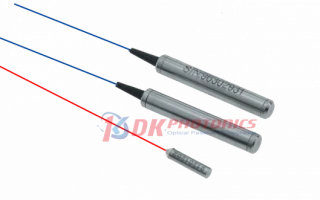
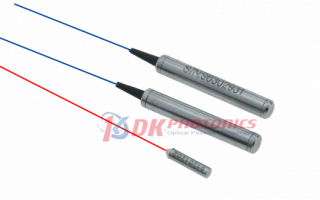
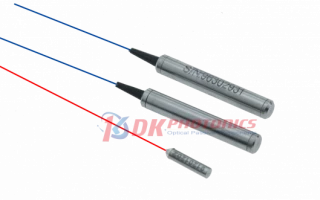
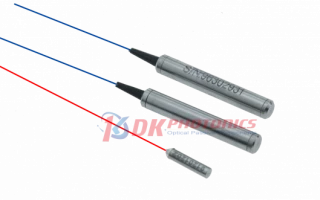
The 1480nm Faraday Mirror from DK Photonics is a precision passive component engineered to provide highly stable polarization rotation and reflection in single‑mode fiber systems. Designed around a high‑isolation Faraday rotator and a low‑loss reflective interface, this device delivers either 45‑degree or 90‑degree rotation of the state of polarization (SOP) upon reflection. By converting arbitrary input polarization states into well‑defined, rotated and reflected outputs, the mirror effectively cancels polarization fluctuations accumulated along the fiber path, making it ideal for advanced interferometric and amplification architectures.
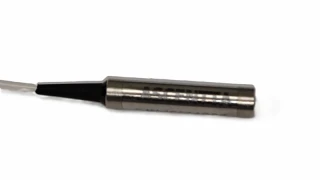
Operating at a 1480 nm center wavelength with a broad operating bandwidth of ±30 nm, this Faraday Mirror is tailored for use in C‑ and L‑band pumping schemes, EDFAs and Raman amplifiers, and other 1.4–1.5 µm photonic platforms. Its compact Ø5.5 × 35 mm package is optimized for integration into space‑constrained modules, optical benches, and rack‑mounted subsystems. The epoxy‑free optical path minimizes absorption, outgassing, and long‑term drift, providing excellent thermal and environmental stability compared with conventional glued assemblies often seen in lower‑end solutions.
Robust Polarization Control for Interferometers, Amplifiers, and LasersIn many fiber optic systems, uncontrolled polarization leads to power fluctuations, fading, and measurement uncertainty. The DK Photonics 1480nm Faraday Mirror is specifically designed to mitigate these effects by providing a built‑in mechanism for polarization compensation. When placed at the end of a fiber path, the double pass through the Faraday rotator and fiber reverses polarization distortions, making the overall system largely insensitive to birefringence changes caused by temperature, mechanical stress, or vibration. This makes the device particularly effective in fiber interferometers, coherent detection setups, and distributed sensing systems, where long‑term phase and amplitude stability are critical.
In fiber amplifiers and laser cavities, especially those operating around 1480 nm pump wavelengths, the mirror helps stabilize gain and output power by reducing polarization‑dependent gain and feedback variations. It is commonly used in Brillouin amplifier systems, fiber laser resonators, and high‑power pump delivery modules, where maintaining a consistent polarization environment translates directly into improved efficiency and spectral purity. Compared to standard reflective terminations, the Faraday Mirror significantly enhances system robustness without requiring active polarization controllers or complex feedback electronics.
Low Loss, High Return Loss, and Flexible Fiber ConfigurationThe 1480nm Faraday Mirror is designed for low insertion loss and high return loss, ensuring that the majority of input power is efficiently reflected while minimizing excess attenuation within the device. The epoxy‑free optical path not only reduces intrinsic loss but also improves resistance to high optical powers and wide temperature excursions, which is essential for telecom and industrial environments. High isolation performance further suppresses undesired back‑reflections and crosstalk, contributing to cleaner signal integrity in dense photonic networks.
DK Photonics offers the mirror with a variety of fiber pigtail configurations to match different installation scenarios. Standard options include 250 µm bare fiber for direct fusion splicing and 900 µm loose‑tube pigtails for more ruggedized routing and handling, with typical fiber lengths of 0.5 m, 1.0 m, or 1.5 m. The device can be supplied without connectors for lowest loss and maximum flexibility, or with popular connector types such as FC/PC, FC/APC, SC/APC, and LC/APC upon request. This flexibility allows seamless integration into existing fiber runs, test platforms, or OEM modules without major redesign of the optical layout.
Optimized for Telecommunications, Test Systems, and Fiber NetworksThe combination of high isolation, low insertion loss, compact footprint, and broad wavelength compatibility makes the 1480nm Faraday Mirror well suited for modern telecommunications infrastructure. It can be deployed in fiber‑to‑the‑home (FTTH) networks, metro and long‑haul links, and optical distribution frames to stabilize return paths and reduce polarization‑induced penalties in high‑bit‑rate transmission. Its high return loss performance helps to protect upstream components and transmitters from detrimental back‑reflections, contributing to improved system reliability and longer component lifetimes.
In fiber optic test and measurement environments, the Faraday Mirror serves as a stable termination for polarization‑sensitive experiments and instruments. It is
1480nm Faraday Mirror
Specifications
| Center Wavelength: | 1480 nm |
|---|---|
| Operating Bandwidth: | 30 nm |
| Insertion Loss (max): | 0.6 dB |
| Faraday Rotation Angle (single Pass): | 45 deg deg |
| Operating Bandwidth: | ±30 nm |
| Faraday Rotation Angle: | 45° or 90° |
| Dimensions: | Ø5.5mm x L35mm |
| Pigtails Diameter: | 250μm or 900μm |
| Fiber Length: | 0.5m, 1.0m, or 1.5m |
| Connector: | None, FC/PC, FC/APC, SC/APC, LC/APC |
Got questions about specs? Use the inquiry form to ask.
 Download Data Sheet

Features
- Optimized for 1480 nm Operation
Precisely designed for a 1480 nm center wavelength with ±30 nm operating bandwidth, ideal for fiber amplifiers and telecom windows around the 1.48 μm band. - High Faraday Rotation Accuracy (45° or 90°)
Available with 45° or 90° Faraday rotation options, ensuring accurate and repeatable polarization rotation for interferometric and sensing applications. - High Isolation & Polarization Insensitivity
Provides strong isolation and efficient polarization rotation to eliminate polarization-induced fluctuations in fiber interferometers, Brillouin amplifiers, fiber lasers, and coherent detection systems. - Low Insertion Loss
Engineered optical design and high-quality materials ensure very low insertion loss, helping to maintain system power budgets in long-haul, amplifier, and test setups. - High Return Loss / Low Back Reflection
High-quality optical finishing and internal structure provide high return loss, minimizing back reflections and improving signal integrity in sensitive optical links. - Epoxy-Free Optical Path
The optical path is completely epoxy free, guaranteeing excellent reliability, low outgassing, and high temperature stability for demanding environments and long-term field deployment. - Compact Package
Standard compact housing of Ø5.5 mm × 35 mm enables easy integration into space-constrained modules, laboratory setups, and OEM systems. - Flexible Fiber Pigtail Options
Available with 250 μm bare fiber or 0.9 mm loose tube pigtails and customizable pigtail length (e.g., 0.5 m, 1.0 m, 1.5 m or others), supporting easy integration into existing fiber networks. - Connector Configurability
Offered with multiple connector types such as FC/PC, FC/APC, SC/APC, LC/APC, or no connector, allowing optimization for return loss and compatibility with different systems. - Passive, Maintenance-Free Device
As a fully passive component, the Faraday Mirror requires no electrical power or control, providing high reliability and zero electronic noise contribution. - Improved System Stability in Reflective Architectures
Ideal for use at the end of fiber links in Michelson interferometers, fiber sensors, and coherent detection schemes, turning arbitrary input polarization into a stable, well-behaved return path. - Enhanced Performance in Fiber Optic Amplifiers
Specially suited for 1480 nm pumped fiber amplifier systems, helping manage polarization effects and improve gain stability and noise performance. - Ideal for Fiber Optic Testing & Measurement
Well suited for fiber optic test benches, component characterization, and polarization-sensitive measurements, simplifying setups where return-path polarization control is critical. - Telecommunications & Fiber LAN Applications
Designed for integration in telecom networks, fiber optic LAN systems, and long-haul links, where low loss, high stability, and polarization control are essential for high data-rate transmission. - Rugged and Stable Over Temperature
Epoxy-free optical design and robust packaging deliver excellent stability over a wide temperature range, suitable for both laboratory and field environments. - Customizable Designs Available
DK Photonics supports custom wavelengths, rotation angles, package dimensions, pigtail configurations, and connector options, enabling tailored solutions for OEMs and specialized research setups. - Easy Integration with Existing Fiber Systems
Standard fiber types and connector options ensure plug-and-play compatibility with common fiber components, making upgrades or new system designs straightforward.
Applications
Applications of 1480nm Faraday Mirror (Faraday Mirror Series, DK-XS-DT-006-A/2)
- Erbium-Doped Fiber Amplifiers (EDFAs)
- Used in EDFA gain-flattening and monitoring loops at 1480 nm pump wavelength.
- Improves amplifier stability by eliminating polarization-dependent gain variations.
- Enhances performance of pre-amplifiers and booster amplifiers in long-haul links.
- Raman and Brillouin Fiber Amplifier Systems
- Stabilizes polarization in distributed Raman amplifiers around 1480 nm.
- Reduces polarization-induced fluctuations in Brillouin fiber amplifiers.
- Supports high-power pump handling with low insertion loss and high isolation.
- Fiber Laser Systems
- Integrated as a cavity end mirror in 1480 nm and 1.5 µm band fiber lasers.
- Improves polarization control and reduces polarization mode instability (PMI).
- Used in ring and linear cavity designs for narrow-linewidth and stable output.
- Polarization-Insensitive Interferometers
- Ideal for Michelson and Mach–Zehnder fiber interferometers.
- Eliminates polarization-induced fading in coherent detection setups.
- Enhances repeatability and accuracy of interferometric phase measurement systems.
- Fiber Optic Sensing and Distributed Sensing Systems
- Used in fiber Bragg grating (FBG) sensor interrogators to suppress polarization effects.
- Improves stability of distributed temperature and strain sensing (DTS/DSS) based on OTDR or BOTDA/BOTDR.
- Enhances signal quality in long-range sensing with 1480 nm pumping schemes.
- Fiber Optic Antenna Remoting and RF-over-Fiber Links
- Compensates polarization fluctuations in analog RF-over-fiber links.
- Improves carrier-to-noise ratio (CNR) and link linearity in remote antenna units.
- Suitable for radar remoting, DAS (Distributed Antenna Systems), and 5G fronthaul.
- Telecommunications and Optical Transmission Systems
- Applied in metro, long-haul and submarine systems using 1480 nm pumps for C-band amplification.
- Used in bidirectional and loop-back configurations for signal monitoring and testing.
- Reduces polarization-dependent loss (PDL) effects in high-capacity DWDM networks.
- Fiber Optic LAN, Access and CATV Networks
- Supports stable operation of optical amplifiers and nodes in FTTH, FTTx and HFC networks.
- Improves performance of CATV transmitters and EDFA-based distribution amplifiers.
- Used in loop-back and monitoring ports for network qualification and service turn-up.
- Laboratory Fiber Optic System Testing
- Used as a stable polarization-rotating reflector in test setups and characterization benches.
- Helps evaluate polarization-dependent loss, polarization mode dispersion and component stability.
- Common in research labs for coherent detection, phase-sensitive applications and nonlinear optics experiments.
- Polarization Control and PMD/PDL Compensation
- Employed in polarization diversity receivers and polarization scrambling schemes.
- Compensates random polarization transformations in installed fiber links.
- Improves measurement repeatability in polarization-sensitive test systems.
- Optical Coherent Communication and Phase-Modulated Systems
- Stabilizes polarization state in coherent QPSK/QAM transceiver testbeds.
- Supports homodyne and heterodyne detection experiments at 1.5 µm band.
- Reduces signal fading caused by polarization mismatch at coherent receivers.
- Optical Time-Domain Reflectometry (OTDR) and Network Diagnostics
- Serves as a reflective termination in test lines for OTDR and backscatter analysis.
- Enhances accuracy of loss and reflectance measurements by ensuring stable polarization.
- Useful in 1480 nm OTDR characterization for amplifiers and specialty fibers.
- Quantum Communications and Photon-Based Experiments (1480/1550 nm)
- Used in fiber-based quantum key distribution (QKD) test setups as a polarization-rotation mirror.
- Improves interference visibility in entanglement and single-photon experiments near telecom band.
- Provides stable, low-loss reflection with minimal environmental sensitivity.
Frequently Asked Questions
What is a 1480 nm Faraday mirror and how does it work?
What are the key performance specifications of the DK Photonics 1480 nm Faraday mirror?
What are typical applications of a 1480 nm Faraday mirror in fiber‑optic systems?
How does the ordering code for the DK Photonics 1480 nm Faraday mirror work?
What fiber pigtail and connector options are recommended for the 1480 nm Faraday mirror?
How does a Faraday mirror improve polarization stability compared to a standard fiber mirror?
Can the 1480 nm Faraday mirror be customized for other wavelengths or mechanical packages?
Got more questions? Use the inquiry form to ask the supplier directly.
Similar Products
Your inquiry has been received.
Create an account by adding a password
Why create an account?
- Auto-complete inquiry forms
- View and manage all your past messages
- Save products to your favorites
- Close your account anytime — no hassle