


Description
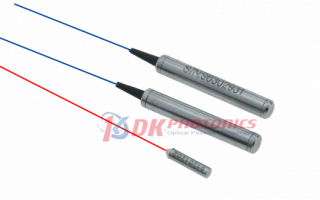
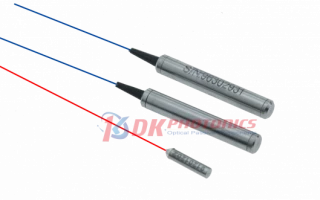
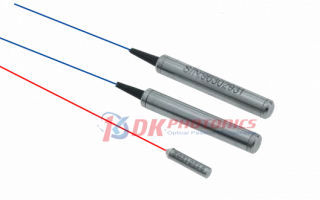
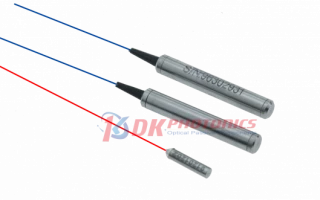
The 2050nm Faraday Mirror from DK Photonics is a precision passive component engineered for high‑performance fiber optic systems operating in the 2.0–2.1µm wavelength region. Specifically optimized around a 2050 nm center wavelength with a broad ±30 nm operating bandwidth, this device delivers a controlled 45° single‑pass polarization rotation and mirror reflection in a compact cylindrical package. By combining low insertion loss (typically 0.6 dB, max 0.9 dB), high return loss, and excellent polarization characteristics, the Faraday Mirror is ideal for demanding interferometric, sensing, and laser‑based applications where polarization stability is critical.
At its core, the 2050nm Faraday Mirror uses the non‑reciprocal Faraday effect to convert any incoming polarization state into a rotated, reflected state that effectively compensates for birefringence and polarization fluctuations in the fiber path. When used at the end of a fiber link or in a reflective arm of an interferometer, it automatically reverses and corrects polarization distortions that accumulate along the fiber. This inherently reduces polarization sensitivity in the system, stabilizes signal performance, and improves measurement repeatability without the need for active polarization controllers. Compared with standard mirrors or simple fiber terminations, a Faraday Mirror dramatically enhances polarization‑independent operation, especially in long‑reach or environmentally varying links.
The device design emphasizes reliability and environmental robustness. An epoxy‑free optical path minimizes absorption and aging effects at 2 µm, enabling stable operation over an extended temperature range from −5 °C to +70 °C with a storage range down to −40 °C and up to +85 °C. The Faraday rotation angle is tightly controlled, with a tolerance of ±2° over both wavelength and temperature, ensuring consistent performance across real‑world operating conditions. Low polarization dependent loss (PDL ≤ 0.10 dB) further preserves signal quality in polarization‑sensitive architectures, making the component suitable for precision metrology and coherent detection schemes where small polarization imbalances can degrade signal‑to‑noise ratio.
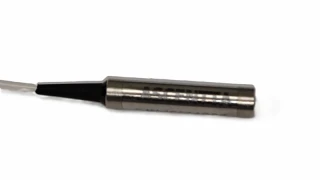
With a compact Ø5.5 × 35 mm package, the 2050nm Faraday Mirror integrates easily into space‑constrained modules, benchtop instruments, or field‑deployable systems. It supports up to 500 mW of optical power, making it compatible with a wide range of 2.0 µm laser sources, including thulium‑ and holmium‑doped fiber lasers, supercontinuum sources, and high‑power test systems commonly used in sensing, LIDAR, and medical research. The standard fiber option is SMF‑28e or SM1950, delivered with 0.9 mm loose‑tube pigtails at a typical length of 1.0 m, providing straightforward splicing or integration into existing fiber networks. Connectors can be added as required, with the understanding that this will slightly increase insertion loss and reduce return loss compared to the bare‑fiber configuration.
Typical applications for the DK Photonics 2050nm Faraday Mirror include fiber optic amplifiers and lasers in the 2 µm window, polarization‑insensitive fiber interferometers, Brillouin and distributed sensing systems, coherent detection setups, and fiber‑based antenna remoting. In these scenarios, the Faraday Mirror acts as a key building block to suppress polarization‑induced fading and intensity fluctuations, enhance measurement stability, and simplify system design. It is also well suited for laboratory test and measurement platforms and fiber optic LAN or telecommunication links that are migrating towards longer‑wavelength operation for specialized use cases such as eye‑safer free‑space links and advanced gas sensing.
The product is fully customizable within the defined platform. Users can specify the fiber type (such as SMF‑28e or SM1950), pigtail length, Faraday rotation configuration (45° single pass for 90° round‑trip behavior), and connector options to match their system layout. By leveraging the compact, epoxy‑free construction and proven polarization control performance, the 2050nm Faraday Mirror from DK Photonics provides a robust, long‑term solution for next‑generation 2 µm photonic systems where stable, polarization‑independent operation and low insertion loss are essential design requirements.
2050nm Faraday Mirror High Isolation Low Loss
Specifications
| Center Wavelength: | 2050 nm |
|---|---|
| Operating Bandwidth: | 30 nm |
| Insertion Loss (max): | 0.9 dB |
| Faraday Rotation Angle (single Pass): | 45 deg deg |
| Center Wavelength: | 2050 nm |
| Operating Bandwidth: | ±30 nm |
| Max. Insertion Loss: | 0.9 dB (Typ. 0.6) |
| Faraday Rotation Angle (Single Pass): | 45 degree |
| Rotation Angle Tolerance Over Wavelength And Temperature: | +/-2.0 degree |
| Max. PDL: | 0.10 dB |
| Max. Optical Power: | 500 mW |
| Fiber Type: | SMF-28e (default) or SM1950 |
| Operation Temperature: | -5 ~ +70 °C |
| Storage Temperature: | -40 ~ +85 °C |
| Dimensions: | Ø5.5xL35 mm |
Got questions about specs? Use the inquiry form to ask.
 Download Data Sheet

Features
- Optimized for 2050 nm Wavelength – Precisely designed for fiber systems operating around 2050 nm with ±30 nm operating bandwidth, ideal for thulium/holmium-doped fiber lasers, mid‑IR sensing, and specialty telecom links.
- High Isolation & Polarization Control – Faraday rotation angle of 45° (single pass) with ±2° tolerance over wavelength and temperature effectively suppresses polarization‑induced fluctuations and improves system stability in interferometers and amplifiers.
- Low Insertion Loss – Maximum insertion loss ≤ 0.9 dB (typically 0.6 dB) minimizes system attenuation, enabling longer reach and higher OSNR in fiber laser, amplifier, and sensing applications.
- High Return Loss – High return loss design reduces back reflections, protecting upstream laser sources and improving performance in high‑precision measurement and coherent systems.
- Epoxy‑Free Optical Path – Fully epoxy‑free optical path provides excellent long‑term reliability, low outgassing, and superior high‑temperature stability compared with conventional glued assemblies.
- Compact, Robust Package – Small form factor (Ø5.5 × 35 mm) allows easy integration into space‑constrained modules, OEM instruments, and fiber laser cavities while maintaining mechanical robustness.
- Low Polarization Dependent Loss (PDL) – Maximum PDL ≤ 0.10 dB ensures accurate measurements and stable output power in polarization‑sensitive systems such as interferometric sensors and coherent communication links.
- High Power Handling – Supports up to 500 mW optical power, making it suitable for many fiber laser configurations, EDFA/TDFL amplifier setups, and high‑power test environments.
- Wide Operating & Storage Temperature Range – Operating temperature from -5 to +70 °C and storage from -40 to +85 °C ensure dependable performance in lab, industrial, and field‑deployed systems.
- Standard and Specialty Fiber Options – Delivered with SMF‑28e as standard or SM1950 fiber on request, providing compatibility with common 2.0 µm‑band components and existing fiber infrastructures.
- Customizable Pigtails and Connectors – Available with 0.9 mm loose‑tube pigtails, standard 1 m length (other lengths on request) and optional connectors (e.g., FC/PC, FC/APC, SC, LC), allowing easy adaptation to different system layouts.
- Ideal for Polarization‑Insensitive System Design – Faraday mirror configuration helps compensate for random polarization changes in the fiber, enabling polarization‑insensitive operation in fiber sensors, OTDR setups, and remote interferometric systems.
- Designed for Advanced Fiber Laser & Amplifier Architectures – Well‑suited for double‑pass amplifiers, Brillouin and Raman fiber amplifiers, and cavity designs that require precise polarization rotation at 2050 nm.
- Reliable Performance for Fiber Optic Testing – Used as a reference termination or reflective element in fiber optic test benches, component characterization, and system evaluation platforms operating around 2 µm.
- Telecommunications & LAN Compatibility – Supports specialty telecom and fiber optic LAN systems in the 2 µm band where polarization stability, low loss, and compact size are critical.
- OEM‑Ready & Volume Scalable – Manufactured to support OEM integration with consistent performance, making it suitable for volume deployment in instruments, sensor networks, and communication systems.
Applications
- 2050 nm Fiber Lasers and Amplifiers
- Stabilizing polarization in high‑power 2.0–2.1 µm fiber laser cavities (thulium/holmium-doped)
- Improving performance of 2050 nm fiber amplifiers and pre‑amplifiers by eliminating polarization‑induced gain fluctuations
- Use in ring and linear cavity designs requiring robust polarization rotation and reflection
- Enhanced stability for ultra‑short pulse and CW mid‑IR fiber laser systems around 2.05 µm
- Fiber Interferometers and Coherent Detection
- Polarization‑insensitive Michelson, Mach‑Zehnder, and Sagnac interferometers using Faraday mirror terminations
- Phase‑stable 2050 nm coherent detection schemes (heterodyne and homodyne)
- Long‑arm fiber interferometric sensors where polarization scrambling must be minimized
- Low‑drift interferometric metrology and precision optical path length measurements at 2.05 µm
- Brillouin and Raman Systems at 2.0–2.1 µm
- Brillouin fiber amplifiers and distributed Brillouin sensing systems operating near 2050 nm
- Mitigation of polarization‑dependent Brillouin gain in long‑reach fiber links
- Polarization‑insensitive Raman amplifier configurations in the 2 µm band
- Fiber Optic Sensing and Distributed Measurement
- Polarization‑insensitive fiber Bragg grating (FBG) interrogation at 2050 nm
- Distributed temperature and strain sensing (DTS/DSS) in specialty fibers at 2 µm
- Interferometric and reflectometric (OFDR/OTDR) sensing where return path must be polarization‑scrambled
- Hydrophone arrays and vibration/acoustic sensing using interferometric configurations with Faraday mirrors
- Telecommunications and Fiber Networks (2 µm Band)
- Emerging 2 µm band telecommunications testbeds and research networks
- Polarization‑insensitive reflection points for bidirectional 2050 nm links
- Compensation of polarization effects in wavelength‑division multiplexed (WDM) systems around 2.0–2.1 µm
- Fiber optic LAN and access systems employing 2 µm sources and amplifiers
- Fiber Optic System Testing and Characterization
- Return loss and insertion loss measurements for components at 2050 nm using Faraday mirror terminations
- Back‑reflection calibration of 2 µm connectors, circulators, isolators, and couplers
- Polarization‑insensitive reflection standards in R&D and production test setups
- Automatic test equipment (ATE) for mid‑IR fiber components requiring stable, epoxy‑free optical paths
- Fiber Optic Antenna Remoting and Microwave Photonics
- Remote antenna remoting systems using 2050 nm optical carriers to transport RF and microwave signals
- Polarization diversity in analog fiber links and phased‑array antenna feed networks
- Low‑noise interferometric microwave photonic links with Faraday mirror terminations
- Polarization Control and Polarization Diversity Schemes
- Elimination of polarization‑induced fading in fiber sensors and coherent links at 2 µm
- Implementation of polarization diversity receivers using Faraday mirror‑based reflection paths
- Improved stability of polarization‑sensitive measurement instruments at 2050 nm
- Compensation of random fiber birefringence in long‑length SMF‑28e and SM1950 fibers
- Optical Coherence Tomography (OCT) and Imaging at 2.05 µm
- 2 µm OCT systems requiring polarization‑insensitive reference arms
- Biomedical and industrial imaging setups where sample and reference arms benefit from Faraday mirror reflection
- Mid‑IR diagnostic and inspection systems using 2050 nm swept‑source or broadband sources
- Environmental and Gas Sensing around 2050 nm
- Fiber‑based gas sensing and spectroscopy of CO2 and other molecules with absorption features near 2.0–2.1 µm
- Multipass and interferometric gas cells using fiber‑coupled 2050 nm sources and Faraday mirror terminations
- Remote monitoring of atmospheric parameters using 2 µm coherent and direct‑detection schemes
- Military, Aerospace, and LIDAR Platforms (2 µm Region)
- 2 µm eyesafer LIDAR systems for range finding, wind profiling, and remote sensing
- Polarization‑insensitive return paths in coherent and direct‑detection 2050 nm LIDAR
- Ruggedized fiber laser subsystems for defense and aerospace using epoxy‑free Faraday mirrors
Frequently Asked Questions
What is a 2050nm Faraday Mirror and how does it work?
What are the key specifications of the DK Photonics 2050nm Faraday Mirror?
What are typical applications of a 2050nm Faraday Mirror in fiber optic systems?
How does using a Faraday Mirror improve polarization stability and measurement accuracy?
What fiber and connector options are available for the DK Photonics 2050nm Faraday Mirror?
What are the operating and storage temperature ranges, and is the device suitable for harsh environments?
How do I select and order the correct 2050nm Faraday Mirror for my application?
Got more questions? Use the inquiry form to ask the supplier directly.
Similar Products
Your inquiry has been received.
Create an account by adding a password
Why create an account?
- Auto-complete inquiry forms
- View and manage all your past messages
- Save products to your favorites
- Close your account anytime — no hassle