
Description
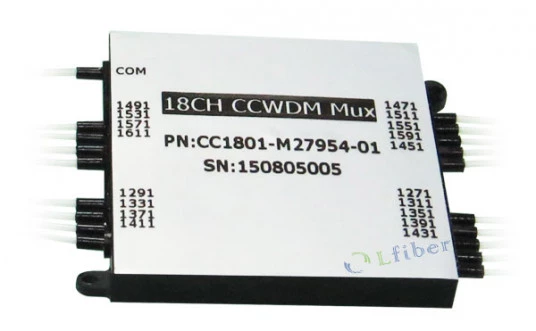
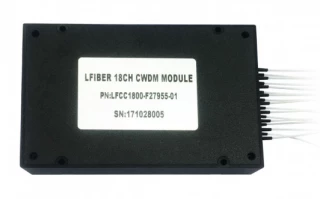
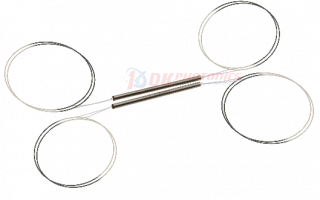
The Free-space Compact CWDM 1x18 is a high‑density coarse wavelength division multiplexer/demultiplexer engineered for modern metro and access networks that demand compact size, low insertion loss, and long‑term reliability. Designed on the ITU‑T CWDM grid from 1271 to 1611 nm (or 1270 to 1610 nm), this device supports up to 18 channels in a single module, enabling significant fiber capacity expansion without the cost and complexity of adding new physical fiber. Its compact free‑space optical design minimizes footprint while maintaining excellent optical performance, making it ideal for space‑constrained central offices, street cabinets, and data center environments.
Built on a SMF‑28e compatible fiber platform with 900 μm loose tube fiber, this 1x18 CWDM module provides a typical insertion loss as low as 1.0 dB and a maximum of 2.5 dB across all channels. The wide 13–15 nm passband bandwidth on each channel ensures robust performance even in the presence of wavelength drift from lasers or environmental variations. High adjacent channel isolation (typically 35 dB) and non‑adjacent channel isolation (typically 45 dB) effectively suppress crosstalk and enable clean multiplexing and demultiplexing of traffic, which is essential for error‑free transmission in high‑capacity telecom and metro networks.
The free‑space compact CWDM 1x18 supports both unidirectional and bidirectional WDM configurations, allowing network engineers to optimize fiber usage by sending multiple wavelengths in one or both directions over a single fiber pair. The module is suitable for use in optical add/drop multiplexing schemes, where select wavelengths are inserted or removed at intermediate nodes without disturbing other channels. This capability is especially valuable in ring and mesh topologies, enterprise campus networks, and next‑generation access networks where flexible traffic engineering and scalable bandwidth are required.
With a return loss of 45 dB, directivity of 55 dB, and very low polarization dependent loss (PDL) of 0.2 dB, the device maintains signal integrity across a broad range of deployment scenarios. The polarization mode dispersion (PMD) is controlled to a low 0.2 ps, supporting higher‑speed transmission formats and longer distances without introducing significant dispersion penalties. The module is rated for a maximum optical power handling of 300 mW, allowing it to be used with higher‑power transmitters and in amplified systems where optical power levels can be elevated.
Designed for field deployment, this compact CWDM 1x18 is available in commercial (‑5 to +70 °C) and industrial (‑40 to +85 °C) operating temperature ranges, ensuring stable performance from controlled indoor environments to harsh outdoor cabinets. The standard package size of 50 x 50 x 7 mm (excluding boots) can be customized to adapt to different enclosure and system layouts. Factory‑terminated fiber lengths and connector types, such as LC/UPC, LC/APC, SC/UPC, and SC/APC, can be selected to match existing infrastructure and simplify installation. All optical parameters are specified without connectors; when connectors are used, the additional insertion loss remains low, with a typical value of less than 0.3 dB per connector pair.
This free‑space compact CWDM 1x18 module is a practical, cost‑effective solution for expanding capacity in legacy and new fiber plants alike. It enables service providers and network operators to increase bandwidth, aggregate multiple services, and support converged data, voice, and video transport over a single optical infrastructure. Its combination of compact form factor, ITU‑compliant channel spacing, high isolation, and extended temperature operation aligns it with best‑in‑class CWDM solutions used worldwide in telecom, metro, and access network applications.
Low-Loss CWDM Module 1x18 (+1)
Specifications
| Operating Wavelength: | 1271 nm |
|---|---|
| Operating Bandwidth: | 13 nm |
| Isolation (min): | 40 dB |
| Max Power Handling: | 300 W |
| Polarization Maintaining: | No |
| Connector: | None, LC/UPC, LC/APC, SC/UPC, SC/APC, Custom … |
| Channel Number (CH): | 18 |
| Fiber Type: | SMF-28e Compatible; 900 μm Loose Tube |
| Central Wavelength (nm): | ITU CWDM Grid: 1271 to 1611; (OR) 1270 to 1610 |
| Operating Temperature: | -5 to +70 (Commercia); -40 to +85 (Industrial) |
| Package (exclude Boots): | 50 X 50 X 7; (OR) Custom |
Got questions about specs? Use the inquiry form to ask.
 Download Data Sheet

Features
- High-Density 1×18 CWDM Mux/Demux – Supports up to 18 CWDM channels on the ITU CWDM grid from 1271 to 1611 nm (or 1270 to 1610 nm), enabling efficient wavelength utilization for growing bandwidth demands.
- Ultra-Compact Free-Space Package – Space-saving 50 × 50 × 7 mm footprint (excluding boots), with fully customizable package sizes to fit tight system layouts in metro and access networks, data centers, and OEM modules.
- Unidirectional & Bidirectional Operation – Supports both uni- and bi-directional wavelength multiplexing for maximum deployment flexibility in point-to-point links, ring topologies, and optical add/drop architectures.
- Low Insertion Loss for Extended Reach – Typical insertion loss of 1.0 dB (max 2.5 dB) per channel helps preserve optical power budgets, extend transmission distance, and reduce the need for amplification.
- Excellent Channel Isolation – Adjacent channel isolation of 30–35 dB and non-adjacent isolation of 40–45 dB minimize crosstalk and interference, ensuring high signal integrity in dense wavelength environments.
- Wide 13–15 nm Passband – Generous passband bandwidth supports wavelength drift and tolerances of DFB lasers and CWDM transceivers while maintaining stable transmission performance.
- Ultra-Low PDL & PMD – Polarization dependent loss (PDL) ≤ 0.2 dB and polarization mode dispersion (PMD) ≤ 0.2 ps deliver consistent performance for high-speed and sensitive modulation formats.
- High Return Loss & Directivity – Return loss ≥ 45 dB and directivity ≥ 55 dB reduce back-reflections and unwanted signal leakage, improving link stability and system reliability.
- Robust Power Handling – Maximum input optical power up to 300 mW, suitable for use with higher-power transmitters, EDFAs, and advanced optical amplification schemes in telecom-grade systems.
- Rugged SMF-28e Compatible Fiber – Built on SMF-28e compatible fiber with 900 μm loose tube protection for easy handling, splicing, and integration into existing fiber infrastructures.
- Commercial & Industrial Temperature Options – Available for -5 to +70 °C (commercial) and -40 to +85 °C (industrial) operation, providing stable performance in central office, outdoor cabinet, and harsh environments.
- High Reliability & Long-Term Stability – Free-space CWDM design with proven assembly processes ensures ultra-stable performance, low drift over time, and high reliability for carrier-grade deployments.
- Flexible Fiber Lengths & Connectors – Standard fiber lengths of 0.5 m and 1.0 m with options for LC/UPC, LC/APC, SC/UPC, SC/APC, or connector-free pigtails, simplifying OEM integration and field installation.
- Ideal for Add/Drop & Aggregation – Optimized for optical add/drop multiplexing in CWDM rings and linear chains, supporting efficient wavelength routing in metro, access, and enterprise networks.
- Optimized for Metro & Access Telecom Networks – Designed for CWDM-based telecom and metro networks, FTTx/FTTH, mobile fronthaul/backhaul, and enterprise campus links where cost-effective wavelength multiplexing is critical.
- Connector Loss Transparency – All optical parameters are specified without connectors; typical insertion loss of one connector pair is < 0.3 dB, making total link budgeting straightforward for system designers.
- Custom Wavelength & Configuration Support – Supports custom wavelength sets, special channel counts, and tailored packaging to match specific CWDM system architectures and OEM requirements.
Applications
- High-Density CWDM for Telecom Backbone Networks
Deployed in long-haul and backbone telecom infrastructures to multiplex up to 18 CWDM channels (1271–1611 nm) over a single fiber, reducing fiber plant usage while maintaining low insertion loss and high channel isolation. - Metro and Regional Network Aggregation
Used in metro/access rings to aggregate multiple 1G/10G/25G/40G/100G services from different nodes, enabling cost-effective bandwidth scaling without laying additional fibers. - Optical Add/Drop Multiplexing (OADM)
Integrated as a compact free-space CWDM module in OADM nodes to add and drop selected wavelengths in ring, linear, or mesh topologies, supporting flexible and scalable network architectures. - Unidirectional and Bidirectional CWDM Links
Supports unidirectional and bidirectional transmission over single or dual fibers, allowing cost-optimized point-to-point and point-to-multipoint links in carrier and enterprise networks. - 5G Front‑haul, Mid‑haul, and Back‑haul
Multiplexes multiple CPRI/eCPRI, Ethernet, and sync channels for 4G/5G fronthaul and midhaul connections between baseband units and remote radio heads, improving fiber utilization in mobile networks. - Data Center Interconnect (DCI)
Deployed between data centers or between data center buildings to combine multiple Ethernet, Fibre Channel, or storage traffic streams onto a single fiber pair, simplifying cabling and reducing footprint. - Enterprise Campus and Building Interconnects
Used to consolidate multiple LAN, SAN, VoIP, and video services between buildings or campuses over limited fiber resources, ideal for universities, hospitals, industrial parks, and corporate campuses. - FTTx / FTTB / FTTH Capacity Expansion
Enables operators and ISPs to overlay multiple CWDM wavelengths on existing feeder fibers, increasing capacity for broadband, IPTV, and voice services without major outside plant upgrades. - Broadcast and Media Networks
Used in professional video transport, contribution, and distribution networks to carry multiple HD/4K/8K video, audio, and control signals over long distances with low latency and minimal signal degradation. - Security, Surveillance, and Traffic Monitoring
Aggregates multiple IP cameras, PTZ controls, and sensor feeds onto one fiber for city surveillance, highway monitoring, airport, seaport, and critical infrastructure security systems. - Utility, Smart Grid, and Substation Communications
Deployed in power utilities, substations, and smart grid infrastructures to multiplex SCADA, protection, synchrophasor, and voice/data channels over a single optical path, leveraging wide operating temperature options. - Industrial and Transportation Networks
Suitable for harsh-environment industrial Ethernet, railways, metros, tunnels, and pipeline monitoring networks, taking advantage of the industrial temperature range and robust free-space design. - Military, Defense, and Government Optical Links
Applied in secure optical communication links, command and control systems, radar backhaul, and tactical networks that require high reliability, low loss, and high isolation across multiple wavelengths. - Research, Testbeds, and Lab Fiber Networks
Used in university and R&D laboratories, testbeds, and pilot networks for multi-wavelength experiments, prototyping new transmission formats, and validating WDM equipment and protocols. - Optical Test and Measurement Systems
Integrated into optical test benches and characterization setups as a stable CWDM multiplexer/demultiplexer for component testing, channel routing, and spectrum management in the 1270–1610 nm window. - Redundancy and Protection Schemes
Employed in 1+1, 1:1, and ring protection architectures by mapping working and protection paths onto different CWDM wavelengths, ensuring service continuity with minimal fiber requirements. - Multi-Service Transport Platforms
Works with CWDM transceivers and MSPP/OTN platforms to transport mixed TDM, packet, and storage services (Ethernet, SDH/SONET, OTN, Fibre Channel) on separate wavelengths in a single optical fiber. - Campus Radio over Fiber (RoF) and DAS
Supports distributed antenna systems and radio-over-fiber architectures in stadiums, large venues, campuses, and buildings by carrying multiple RF or IF signals on different CWDM channels. - Disaster Recovery and Business Continuity Links
Used to build high-bandwidth, multi-service links between primary and backup sites, enabling synchronous data replication, backup
Frequently Asked Questions
What is the Free-space Compact CWDM 1x18 module and what is it used for?
What are the key optical performance specifications of this 1x18 CWDM multiplexer?
Which wavelength channels and fiber types are supported by this CWDM 1x18 device?
What package size, connectors, and customization options are available?
What operating temperature ranges and reliability characteristics does this CWDM module offer?
How does insertion loss, isolation, and connector choice affect system performance?
How do I specify and order the correct Free-space Compact CWDM 1x18 configuration?
Got more questions? Use the inquiry form to ask the supplier directly.
Similar Products
Your inquiry has been received.
Create an account by adding a password
Why create an account?
- Auto-complete inquiry forms
- View and manage all your past messages
- Save products to your favorites
- Close your account anytime — no hassle