
Description
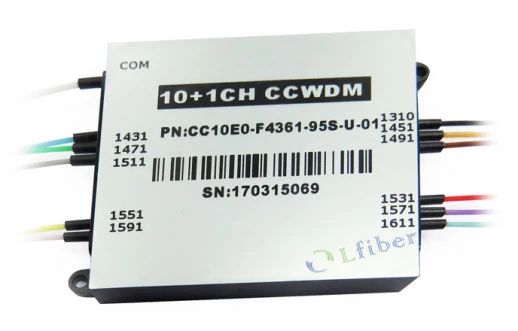
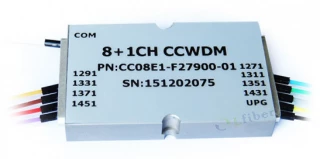
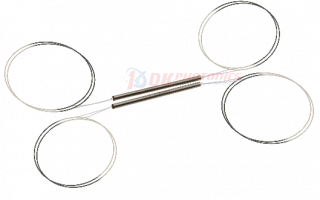
The Free-space Compact CWDM 1x10 (+1) module is a high‑density coarse wavelength division multiplexer designed for cost‑effective expansion of fiber capacity in modern optical networks. Using advanced free-space optics and thin‑film filter technology, this compact CWDM platform combines or separates up to 10 wavelength channels plus an additional upgrade or monitor port, all within a highly stable package optimized for long‑term reliability.
Engineered around the standard ITU‑T CWDM frequency grid, this module supports channel plans from 1271 nm to 1611 nm (or 1270 nm to 1610 nm), making it fully compatible with widely adopted CWDM transceivers and network equipment. The free‑space optical design enables low insertion loss, excellent isolation between adjacent and non‑adjacent channels, and inherently robust performance against environmental variations. With ultra‑low polarization dependent loss (PDL) and polarization mode dispersion (PMD), it maintains signal integrity for both legacy and high‑bit‑rate applications.
The compact form factor (typical package size of 50 × 50 × 7 mm, excluding boots) allows easy integration into space‑constrained systems such as compact DWDM/CWDM platforms, access nodes, and customer premises equipment. Custom mechanical footprints and fiber management options are available to meet specific integration requirements. The module is supplied with SMF‑28e compatible fibers in 900 μm loose tube construction, supporting simple handling, routing, and protection during installation and operation.
Designed for demanding telecom, metro, and access network environments, the 1x10 (+1) CWDM module offers excellent channel isolation—typically 35 dB for adjacent channels and 45 dB for non‑adjacent channels—to minimize crosstalk and maintain a high optical signal‑to‑noise ratio. A dedicated upgrade or common port provides additional flexibility for future expansion, monitoring, or network reconfiguration without disrupting existing traffic. With maximum optical power handling up to 300 mW, it supports a broad range of transmit power levels and link budgets, including amplified links.
The module is available in both commercial (‑5 to +70 °C) and industrial (‑40 to +85 °C) temperature grades, addressing everything from controlled indoor environments to outdoor cabinets and harsh field deployments. High return loss and directivity contribute to low reflection operation, which is critical for stable transmitter performance and long‑reach links. Each unit is fully tested without connectors to ensure that intrinsic insertion loss remains exceptionally low; connectorized configurations can be provided upon request while maintaining stringent performance targets.
This Free-space Compact CWDM 1x10 (+1) solution is ideally suited for optical add/drop multiplexing, multiservice aggregation, and capacity upgrades in metro, access, and backbone networks. Typical uses include cell site backhaul, enterprise and campus networks, CATV transport, and any application seeking to maximize fiber utilization by transporting multiple services—such as Ethernet, SDH/SONET, and SAN traffic—over a single pair of fibers. Its combination of compact size, ITU‑aligned wavelength plan, and ultra‑stable free‑space construction makes it a robust building block for scalable, high‑availability fiber optic infrastructures.
Free Space Compact CWDM 1x10 Plus1 Optical Multiplexer Demultiplexer Module
Specifications
| Operating Wavelength: | 1271 nm |
|---|---|
| Operating Bandwidth: | 13 nm |
| Isolation (min): | 40 dB |
| Max Power Handling: | 300 W |
| Polarization Maintaining: | No |
| Connector: | None, LC/UPC, LC/APC, SC/UPC, SC/APC, Custom … |
| Channel Number (CH): | 10 |
| Insertion Loss (dB): | 1.0 (Typical); 2.0 (Max) |
| Fiber Type: | SMF-28e Compatible; 900 μm Loose Tube |
| Operating Temperature: | -5 to +70 (Commercial); -40 to +85 (Industrial) |
Got questions about specs? Use the inquiry form to ask.
 Download Data Sheet

Features
- Compact Free‑Space CWDM Design – Miniaturized free‑space optical architecture in a 50 × 50 × 7 mm package (or custom) for easy integration into dense optical modules and line cards.
- 10(+1) Channel CWDM Multiplexer/Demultiplexer – Supports 10 data channels plus 1 common/upgrade port for flexible system expansion, monitoring, and future capacity upgrades.
- ITU-T CWDM Grid Compliance – Operates on standard CWDM wavelengths from 1271 to 1611 nm (or 1270–1610 nm), enabling full interoperability with CWDM transceivers and telecom equipment.
- Unidirectional & Bidirectional Operation – Supports both single‑direction and bi‑directional WDM configurations over a single fiber pair, reducing fiber plant usage and deployment costs.
- Ultra‑Low Insertion Loss – Typical insertion loss of only 2.0 dB (max 2.0 dB, 1.0 dB min) per channel for longer reach, higher system margin, and improved network performance.
- High Channel Isolation – Adjacent channel isolation of ≥ 30 dB (typ. 35 dB) and non‑adjacent isolation of ≥ 40 dB (typ. 45 dB) to minimize crosstalk and support high‑capacity CWDM links.
- Dedicated COM / Upgrade Port – Integrated common/upgrade port isolation ≥ 13 dB (typ. 15 dB) simplifies optical add/drop multiplexing and network expansion without service disruption.
- Optical Add/Drop Ready – Optimized for OADM applications in metro and access networks, enabling selective channel add/drop with minimal signal degradation.
- Ultra‑Stable & Highly Reliable – Free‑space design with robust mechanical packaging delivers excellent long‑term stability under temperature, vibration, and aging conditions.
- Low PDL & PMD for High‑Speed Systems – Polarization dependent loss ≤ 0.2 dB and PMD ≤ 0.2 ps support 1G/10G/25G (and higher) CWDM transmission with minimal signal distortion.
- Excellent Return Loss & Directivity – Return loss of ≥ 45 dB and directivity of ≥ 55 dB reduce back‑reflections and interference, improving overall link quality and OSNR.
- High Optical Power Handling – Handles up to 300 mW of optical power, suitable for high‑power transmitters and amplified links in metro and long‑reach applications.
- Wide Operating Temperature Options – Available in commercial (‑5 to +70 °C) and industrial (‑40 to +85 °C) temperature grades for central office, data center, and harsh outdoor environments.
- Standard SMF‑28e Compatible Fiber – Uses SMF‑28e compatible, 900 µm loose‑tube fiber, ensuring easy splicing, routing, and compatibility with existing single‑mode fiber infrastructure.
- Flexible Fiber Lengths & Connectors – Configurable fiber pigtails (e.g., 0.5 m or 1.0 m) and connector options including LC/UPC, LC/APC, SC/UPC, SC/APC, or bare fiber to match system requirements.
- Connector‑Independent Performance – All specifications are measured without connectors; a typical connector pair adds < 0.3 dB insertion loss, simplifying link budgeting.
- Customizable Package & Channel Configuration – Custom mechanical sizes, fiber lengths, connector types, and wavelength plans available to fit OEM modules and specialized network designs.
- Ideal for Metro & Access Networks – Designed for telecom and metro CWDM networks, FTTx, enterprise backbones, and mobile fronthaul/backhaul where compact, low‑loss WDM is essential.
- Cost‑Effective CWDM Aggregation – Enables multiple services (data, voice, video) over a single fiber with minimal footprint, reducing CAPEX and OPEX compared to laying new fiber.
Applications
- Optical Add/Drop Multiplexing (OADM) – Ideal for adding and dropping multiple CWDM wavelengths in backbone and access networks, enabling flexible channel management without full system overhauls.
- Telecom Long-Haul and Access Networks – Used to multiplex up to 10 (+1 upgrade) CWDM channels over a single fiber pair in carrier and service provider infrastructures, reducing fiber usage and deployment cost.
- Metro and Regional Networks – Optimized for metro rings and regional aggregation networks that require compact, low-loss CWDM mux/demux modules for high‑density deployment in constrained rack space.
- Enterprise & Campus Fiber Backbones – Supports multi‑service transport (data, voice, video, storage) over existing single‑mode fiber between buildings, data centers, and campus sites.
- 5G / LTE Mobile Fronthaul & Backhaul – Enables cost‑effective wavelength multiplexing for CPRI/eCPRI and packet‑based transport between baseband units (BBUs), remote radio heads (RRHs), and centralized RAN hubs.
- FTTx / FTTH / FTTB WDM Upgrades – Adds CWDM channels on existing PON or point‑to‑point fiber to carry business services, mobile backhaul, or high‑capacity enterprise links alongside residential access traffic.
- Data Center Interconnect (DCI) – Used in short- to medium‑reach inter‑data‑center links to aggregate multiple 1G/10G/25G/40G/100G Ethernet services onto limited fiber infrastructure.
- High‑Capacity Enterprise WAN Links – Provides scalable bandwidth between headquarters, branches, and disaster recovery sites without leasing additional dark fiber.
- Broadcast and Media Transport – Carries multiple uncompressed/compressed HD/4K video, audio, and control signals over a single fiber pair for studio‑to‑studio, stadium, and OB‑truck connectivity.
- CCTV and Security Surveillance Networks – Aggregates many IP or analog camera feeds, access control, and monitoring signals over one fiber infrastructure in campuses, transportation hubs, and industrial plants.
- Industrial & Utility Communications – Robust operation over extended temperature makes it suitable for smart grid, substation automation, oil & gas pipelines, mining, and transport corridor communications.
- Railway, Highway, and Tunnel Communications – Supports signaling, SCADA, emergency communication, CCTV, and operational data along linear assets where fiber count is limited.
- Government & Defense Networks – Compact CWDM multiplexing for secure, segregated wavelengths carrying voice, data, and video over shared optical infrastructure in command and control networks.
- Campus-Wide Research & Education Networks – Used in university and laboratory environments to multiplex experimental links, storage networks, and high‑performance computing traffic across shared fiber.
- Storage Area Networks (SAN) Extension – Extends Fibre Channel and other SAN protocols over metro distances by transporting multiple storage wavelengths through one CWDM trunk.
- Disaster Recovery and Business Continuity Links – Provides resilient, multi‑channel connectivity between primary and backup sites, supporting synchronous data replication and real‑time failover.
- IP, SDH/SONET, and Legacy TDM Transport – Combines Ethernet, IP/MPLS, SDH/SONET, and TDM services on distinct wavelengths, enabling gradual migration from legacy to packet networks.
- Test, Measurement, and R&D Laboratories – Serves as a flexible wavelength management module in optical testbeds, component characterization setups, and system prototyping environments.
- Unidirectional and Bidirectional WDM Links – Supports both single‑direction and duplex CWDM configurations, including point‑to‑point, linear chain, and ring topologies.
- Free‑Space Optical (FSO) and Specialty Links – The free‑space compact design can be integrated into FSO terminals or custom optical assemblies that require stable multiplexing without bulky fiber pigtail modules.
- Dense Rack and Chassis Integration – Ultra‑compact 50 × 50 × 7 mm package (customizable) simplifies integration into high‑density transponder shelves, access platforms, and OEM system designs.
- Temperature‑Critical Outdoor Deployments – Industrial‑grade option (‑40 to +85 °C) is suited for street cabinets, tower sites, outside plant enclosures, and uncontrolled environments.
Frequently Asked Questions
What is the Free-space Compact CWDM 1x10 (+1) module and what does 1x10(+1) mean?
Which CWDM wavelengths are supported and what ITU grid does this device follow?
What are the key optical performance specifications (insertion loss, isolation, return loss, PDL, PMD)?
What fiber type, connectors, and cable lengths are available for this CWDM module?
What operating temperature ranges and applications is this CWDM 1x10(+1) suitable for?
How compact is the Free-space CWDM 1x10(+1) module and can the package size be customized?
Is this CWDM 1x10(+1) module unidirectional or bidirectional, and how is it typically deployed in a network?
Got more questions? Use the inquiry form to ask the supplier directly.
Similar Products
Your inquiry has been received.
Create an account by adding a password
Why create an account?
- Auto-complete inquiry forms
- View and manage all your past messages
- Save products to your favorites
- Close your account anytime — no hassle