
Description
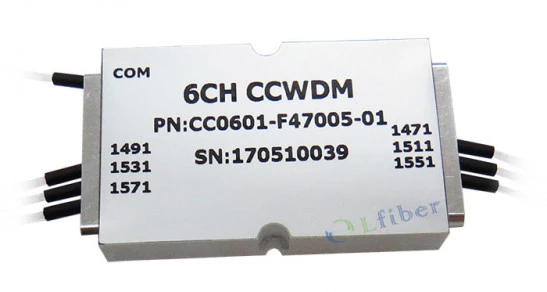
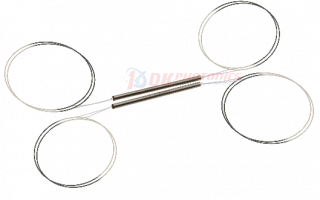
Free-Space Compact CWDM 1x6 (+1) Multiplexer/Demultiplexer
The Free-space Compact CWDM 1x6 (+1) is a high-performance coarse wavelength division multiplexer designed for next‑generation fiber optic communication systems. Using a compact free‑space optical architecture rather than bulkier in-line filter assemblies, it combines or separates up to six CWDM channels plus one upgraded or common port in a single, space‑efficient module. This design enables system integrators and network engineers to dramatically increase fiber capacity and optimize network topology without the need for additional dark fiber.
Engineered around the ITU-T standardized CWDM frequency grid from 1271 nm to 1611 nm (or 1270 nm to 1610 nm, depending on configuration), this device delivers low insertion loss, excellent channel isolation, and superior long‑term stability. Typical insertion loss is as low as 1.3 dB, helping to preserve optical power budgets even in extended link distances or cascaded architectures. The 13–15 nm passband bandwidth around each channel wavelength ensures reliable operation with a wide range of CWDM transceivers and modulation formats, supporting current and future system upgrades.
The module is built with SMF‑28e compatible fiber in 900 μm loose tube, making it easy to integrate into existing single‑mode infrastructures. High return loss (≥ 45 dB) and directivity (≥ 55 dB) help to minimize back reflections and crosstalk, which is crucial for maintaining signal integrity in dense wavelength environments and bidirectional links. With polarization dependent loss (PDL) as low as 0.2 dB and polarization mode dispersion (PMD) typically 0.2 ps, the CWDM unit supports high‑speed data rates and is well suited for applications that demand stable, polarization‑insensitive performance.
A key distinction of this compact free-space CWDM versus many conventional filter‑based designs is its combination of small footprint and rugged optical alignment. The package size of 44 × 28 × 6 mm (excluding boots), with custom form factors available, allows for easy deployment in space‑constrained platforms such as transponder modules, compact data center equipment, edge routers, and mobile backhaul nodes. The robust free-space optics and mechanical design provide ultra‑stable operation over a wide range of environmental conditions, making the device suitable for both controlled indoor environments and more demanding field installations.
The 1x6 (+1) topology supports both unidirectional and bidirectional WDM configurations, which is particularly advantageous in networks where upstream and downstream traffic must share the same fiber pair. The additional “+1” port can be used as a common port, upgrade port, or express channel for future wavelength expansion or network reconfiguration. This flexibility simplifies network planning and offers a cost‑effective migration path as bandwidth requirements grow, without major re‑cabling or re‑engineering of the physical layer.
With adjacent channel isolation typically 35 dB and non‑adjacent isolation up to 45 dB, the module effectively suppresses interchannel interference, enabling higher spectral efficiency and cleaner signal separation at receivers. Com‑upgrade port isolation of up to 15 dB further assists in maintaining clear boundaries between existing and additional wavelengths, which is important when overlaying new services on top of legacy traffic. The device supports maximum optical input power up to 300 mW, leaving ample margin for high‑power transmitters, optical amplifiers, or extended reach configurations.
Designed for both commercial and industrial environments, the Free-space Compact CWDM 1x6 (+1) is available with operating temperature ranges from -5 to +70 °C for standard telecom and data center deployments, and from -40 to +85 °C for harsh outdoor or uncontrolled locations such as access networks, metropolitan rings, and remote terminals. Storage temperatures span -40 to +85 °C, safeguarding product integrity during shipping, warehousing, and system integration. These extended temperature capabilities, combined with the inherently stable free-space optical path, support long‑term reliability and reduced maintenance in demanding field conditions.
The module is ideally suited for optical add/drop multiplexing in CWDM backbone and metro rings, front‑haul and back‑haul in wireless networks, enterprise campus and data center interconnects, as well as other telecom and metro network architectures. It can be deployed in point‑to‑point links, ring topologies, or star and mesh configurations, allowing operators to consolidate multiple services—such as Ethernet, Fibre Channel, SONET/SDH, CPRI/eCPRI, and video—onto a single pair of fibers. By leveraging standardized CWDM wavelengths, it supports interoperability across a wide ecosystem of transceivers, amplifiers, and monitoring equipment.
Compact CWDM Module 1x6 (+1)
Specifications
| Operating Wavelength: | 1271 nm |
|---|---|
| Operating Bandwidth: | 13 nm |
| Isolation (min): | 40 dB |
| Max Power Handling: | 300 W |
| Polarization Maintaining: | No |
| Connector: | None, LC/UPC, LC/APC, SC/UPC, SC/APC, Custom … |
| Channel Number(CH): | 6 |
| Fiber Type: | SMF-28e Compatible; 900 μm Loose Tube |
| Central Wavelength(nm): | 1271 to 1611; 1270 to 1610 |
| Operating Temperature(°C): | -5 to +70(Commercial); -40 to +80 (Industrial) |
| Package (exclude Boots) (mm): | 44 ×28 ×6; Custom |
Got questions about specs? Use the inquiry form to ask.
 Download Data Sheet

Features
- Free-Space Compact CWDM 1x6 (+1) Architecture – Compact free-space design integrating 6 CWDM channels plus 1 upgrade/expansion port for flexible network growth and simplified system integration.
- Unidirectional & Bidirectional Operation – Supports both unidirectional and bidirectional wavelength multiplexing/demultiplexing, ideal for point-to-point links, ring, and bidirectional transmission systems.
- ITU-T G.694.2 Compliant CWDM Grid – Channels aligned to standard CWDM ITU frequency grid from 1271 to 1611 nm (or 1270 to 1610 nm), ensuring interoperability with mainstream CWDM transceivers and system equipment.
- 6 (+1) Channel Design with Upgrade Port – Integrated upgrade (COM-Upgrade) port allows adding extra channels or bandwidth in the field without redesigning the main link, supporting scalable network deployment.
- Low Insertion Loss – Typical insertion loss of 1.3 dB (max) per channel helps extend link distance, improve system margin, and reduce the need for additional amplification.
- Excellent Channel Isolation – High adjacent channel isolation of up to 35 dB and non-adjacent isolation up to 45 dB minimizes crosstalk and signal interference for dense CWDM deployments.
- Upgrade Port Isolation – COM-upgrade port isolation up to 15 dB delivers clean separation between active channels and future expansion channels, ensuring stable performance when scaling networks.
- Ultra-Low PDL and PMD – Polarization dependent loss (PDL) < 0.2 dB and polarization mode dispersion (PMD) < 0.2 ps provide stable performance for high-speed and sensitive optical modulation formats.
- High Return Loss & Directivity – Return loss > 45 dB and directivity > 55 dB reduce back-reflections and interference, supporting error-sensitive and long-reach applications.
- High Optical Power Handling – Supports up to 300 mW of optical input power, compatible with high-power transmitters and amplified systems commonly used in metro and access networks.
- Compact Footprint with Custom Package Options – Standard package size of approximately 44 × 28 × 6 mm (excluding boots) with custom mechanical options available for space-constrained or OEM integration.
- Rugged Fiber Interface – Uses SMF-28e compatible single-mode fiber in 900 μm loose tube, making it easy to handle, route, and protect in dense routing environments or patch panel installations.
- Flexible Operating Temperature Grades – Available in Commercial (-5 to +70 °C) and Industrial (-40 to +85 °C) versions, suitable for controlled data centers as well as harsh outdoor or cabinet environments.
- Wide Storage Temperature Range – Storage temperature from -40 to +85 °C supports reliable logistics, field spares, and long-term warehousing.
- Optimized Passband Bandwidth – Typical passband of 15 nm provides sufficient tolerance for wavelength drift and transceiver variation while maintaining good isolation and low loss.
- Application-Ready for CWDM Networks – Designed for optical add/drop multiplexing (OADM), telecom and metro networks, access aggregation, and enterprise CWDM backbone links.
- Connector and Fiber-Length Customization – Configurable with multiple connector types (LC/UPC, LC/APC, SC/UPC, SC/APC, or none) and standard or custom fiber lengths (e.g., 0.50 m, 1.00 m), simplifying installation and reducing on-site termination work.
- Highly Reliable, Ultra-Stable Design – Engineered for long-term stability with robust free-space optics and precise alignment, comparable to leading CWDM modules used in carrier-class infrastructure.
- Seamless Integration with CWDM Transceivers and Systems – Fully compatible with standard CWDM SFP/SFP+/XFP optics and typical DWDM/CWDM hybrid architectures for upgrade paths in existing optical networks.
Applications
The Free-space Compact CWDM 1x6 (+1) module is a high‑density coarse wavelength division multiplexer designed for cost‑effective, space‑saving deployment in modern optical networks. With ITU‑grid wavelengths from 1270/1271 nm to 1610/1611 nm, low insertion loss, and excellent isolation, it is suitable for a wide range of short‑, metro‑, and long‑reach applications.
1. Optical Add/Drop Multiplexing (OADM)- Node‑based wavelength add/drop: Use the 1x6 (+1) CWDM as an add/drop element in ring, bus, or mesh topologies to insert and extract specific wavelengths at intermediate sites without affecting other channels.
- Scalable multi‑service aggregation: Combine multiple services (e.g., Ethernet, Fibre Channel, CPRI/OBSAI) over different CWDM wavelengths on a single fiber, enabling easy capacity upgrades by lighting additional channels as needed.
- Backhaul and front‑haul OADM: Ideal for mobile fronthaul and backhaul networks where specific wavelengths are added/dropped at baseband units (BBU) or remote radio heads (RRH) using compact OADM nodes.
- Upgrade and bypass paths: Utilize the (+1) upgrade/common port to introduce new services or reroute traffic without reengineering the entire DWDM or CWDM layer, aligning with practices seen in compact CWDM/OADM units from major vendors.
- Metro aggregation rings: Deploy in metropolitan rings and distribution networks to aggregate traffic from multiple access nodes (e.g., cell sites, enterprise POPs, remote OLTs) onto a single or redundant fiber pair.
- FTTx / FTTB / FTTH overlay: Use the CWDM channels to overlay business, mobile, and residential services on the same fiber as GPON/XGS‑PON or active Ethernet, leveraging low insertion loss and high isolation to limit crosstalk.
- Access network extension: Extend the reach of existing access networks (copper or fiber) by transporting multiple access segments over one fiber, reducing the need for new ducting or fiber builds.
- Campus and metropolitan inter‑building links: Implement multi‑wavelength links between campuses, data centers, or municipal facilities for converged voice, data, and video transport.
- Cost‑effective wavelength provisioning: Combine up to six ITU‑grid CWDM wavelengths (plus upgrade/common) onto a single fiber in regional or long‑haul routes where fiber is scarce or expensive.
- Hybrid CWDM/DWDM layers: Use the CWDM module as a coarse “super‑channel” layer to carry DWDM blocks (e.g., in the 1550 nm region), following architectures found in carrier‑grade transport systems.
- Redundant path and protection schemes: Implement 1+1 or ring protection by assigning dedicated protection wavelengths, taking advantage of low PDL/PMD and high isolation to maintain signal integrity.
- 4G/5G fronthaul over CWDM: Transport CPRI/eCPRI signals from multiple remote radio units to centralized BBUs on separate wavelengths, a common use case for compact CWDM units in RAN deployments.
- Microwave and small‑cell backhaul: Consolidate several microwave or small‑cell links onto one fiber pair, reducing tower or rooftop fiber requirements and simplifying backhaul upgrades.
- Cloud RAN (C‑RAN) architectures: Use the 1x6 (+1) multiplexer to build cost‑efficient, high‑density C‑RAN hubs where multiple fronthaul links are aggregated onto shared fiber infrastructure.
- Data center campus links: Aggregate multiple 1G/10G/25G/40G/100G Ethernet channels between data centers or between data halls onto a single single‑mode fiber pair using colored CWDM transceivers.
- Storage and disaster recovery replication: Carry Fibre Channel, FICON, or iSCSI traffic over dedicated CWDM wavelengths to support synchronous and asynchronous replication between primary and backup sites.
- High‑availability enterprise backbones: Build resilient backbone links between headquarters and branch offices, combining corporate LAN, voice, and video conferencing traffic using wavelength separation.
Frequently Asked Questions
What is the Free-space Compact CWDM 1x6 (+1) module and what applications is it used for?
What CWDM wavelengths and ITU channels does this 1x6 (+1) CWDM support?
What are the key optical performance specifications (insertion loss, isolation, PDL, PMD) for this CWDM module?
What fiber type, connectors, and fiber length options are available for the 1x6 (+1) CWDM?
What are the operating temperature ranges and reliability options for this CWDM module?
How compact is the Free-space 1x6 (+1) CWDM and can the package size be customized?
How do I specify and order the correct 1x6 (+1) CWDM configuration for my network?
Got more questions? Use the inquiry form to ask the supplier directly.
Similar Products
Your inquiry has been received.
Create an account by adding a password
Why create an account?
- Auto-complete inquiry forms
- View and manage all your past messages
- Save products to your favorites
- Close your account anytime — no hassle