
Description
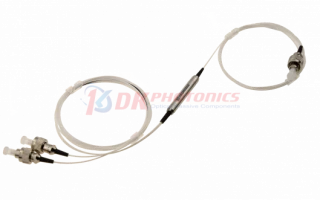
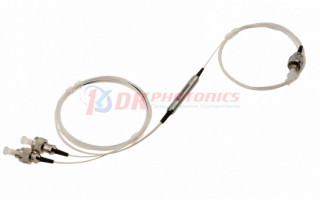
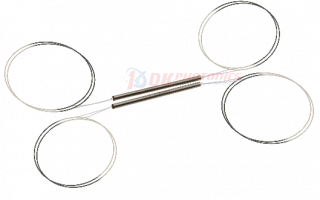
The 1x2 Mechanical Optical Switch is a compact, high‑performance fiber optic switching component designed for precise routing of optical signals between one input fiber and two output fibers. Engineered for low insertion loss and high isolation, it is ideal for use in demanding test and measurement environments, optical network protection paths, and fiber sensing systems. Its wide operating wavelength range spans 1260–1620 nm for single‑mode fibers and 850 nm for multimode fibers, making it compatible with most telecom, datacom, and instrumentation platforms.
At the core of this 1x2 mechanical fiber optic switch is a robust electromechanical actuator that physically redirects the optical path with excellent repeatability and long‑term stability. The epoxy‑free optical path design minimizes contamination and aging effects, ensuring reliable performance over extended lifetimes and across a broad temperature range. With insertion loss typically below 0.6 dB and polarization‑dependent loss under 0.05 dB, the switch maintains signal integrity for both high‑speed digital transmission and analog applications where optical power stability is critical.
The device supports both latching and non‑latching configurations, giving designers flexibility in power consumption and control scheme. Latching variants maintain the selected state without continuous drive current, which is useful in power‑sensitive or battery‑powered systems. Non‑latching versions are well suited for dynamic test setups and automated routing where frequent state changes are required. Operation with 3 V or 5 V control signals enables straightforward integration with common driver circuits, microcontrollers, and system control boards.
Designed for harsh and variable environments, the switch offers stable performance from −20 °C to +70 °C in operation and −40 °C to +85 C in storage. Temperature‑dependent loss is tightly controlled (≤0.20 dB), ensuring that signal budgets remain predictable over the full thermal range. High return loss (≥50 dB for single‑mode) and high crosstalk isolation (≥55 dB for single‑mode) help suppress back‑reflections and channel interference, which is especially important in high‑density optical networks and precision measurement systems.
With a compact package of approximately 27.0 mm × 12.0 mm × 8.2 mm, this 1x2 fiber optic switch fits easily into modular instruments, rack‑mounted platforms, and space‑constrained optical modules. It supports a variety of fiber types, including standard single‑mode (9/125 µm) and multimode (50/125 µm and 62.5/125 µm), and is available with different fiber jackets such as 250 µm bare fiber and 900 µm tight‑buffered fiber. A wide selection of connector options—such as FC/PC, FC/APC, SC/PC, SC/APC, LC/PC, and LC/APC—allows straightforward integration into existing fiber infrastructures without additional termination steps.
The switch’s fast response time (≤8 ms) and superior repeatability (≤±0.02 dB) make it well suited for automated optical testing, end‑to‑end loss measurements, and dynamic reconfiguration in optical monitoring systems. It is frequently deployed in optical network monitoring, optical path redundancy, and protection switching applications where rapid, precise path selection is required. In instrumentation and fiber‑based sensing, the device enables flexible routing of probe signals and reference channels, supporting complex test topologies and multiplexed sensor networks.
With a durability rating of at least 107 switching operations and a maximum optical power handling of 500 mW, this 1x2 mechanical optical switch delivers long‑term reliability in both laboratory and field environments. Its combination of low loss, high isolation, and robust mechanical design provides a dependable solution for system integrators and designers building advanced optical communication, sensing, and measurement platforms that demand repeatable and stable optical switching performance.
1x2 Mechanical Fiber Optic Switch Low Loss High Isolation 1260 to 1620 nm
Specifications
| Operating Wavelength: | 1271 nm |
|---|---|
| Operating Bandwidth: | 13 nm |
| Isolation (min): | 40 dB |
| Max Power Handling: | 300 W |
| Polarization Maintaining: | No |
| Connector: | None, LC/UPC, LC/APC, SC/UPC, SC/APC, Custom … |
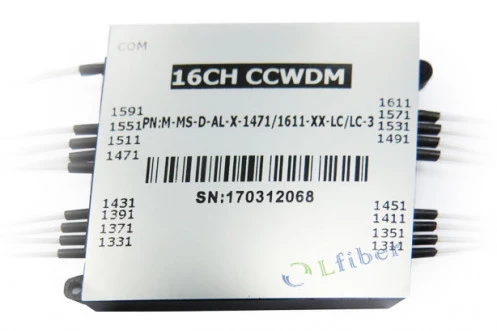
| Channel Number (CH): | 16 |
| Fiber Type: | SMF-28e Compatible; 900 μm Loose Tube |
| Central Wavelength (nm): | ITU CWDM Grid: 1271 to 1611; (OR) 1270 to 1610 |
| Operating Temperature: | -5 to +70 (Commercial) ; -40 to +85(Industrial) |
| Package (exclude Boots) (mm): | 50 x 50 x 7; (OR) Custom |
Got questions about specs? Use the inquiry form to ask.
 Download Data Sheet

Features
- Wide Operating Wavelength Range – Supports 1260–1620 nm single-mode and 850 nm multimode operation, making it suitable for telecom, datacom, test & measurement, and sensing applications.
- Low Insertion Loss (≤0.6 dB) – Optimized optical design minimizes signal attenuation, ensuring high optical power throughput and improved system performance over longer fiber runs.
- High Isolation & Low Crosstalk – ≥55 dB (SM) / ≥35 dB (MM) isolation effectively separates optical channels, reducing interference and enhancing measurement accuracy and network reliability.
- Excellent Return Loss – ≥50 dB (SM) and ≥30 dB (MM) return loss for low back reflection, ideal for high‑precision instrumentation, coherent systems, and stable optical link performance.
- Ultra‑Stable Performance – Very low wavelength, polarization, and temperature dependent losses (WDL ≤0.25 dB, PDL ≤0.05 dB, TDL ≤0.20 dB) ensure consistent insertion loss over broad wavelengths, polarizations, and environmental conditions.
- Fast Switching Time – ≤8 ms switching enables rapid optical path reconfiguration, suitable for dynamic optical network monitoring, protection switching, and automated test setups.
- High Repeatability & Long‑Term Durability – Repeatability ≤±0.02 dB and mechanical life ≥107 cycles support stable, long‑term operation in demanding fiber optic systems and automated measurement platforms.
- Epoxy‑Free Optical Path – Optical path is free of epoxy for low out‑gassing, minimal contamination risk, and superior long‑term reliability in precision measurement and sensing applications.
- Latching and Non‑Latching Options – Available in latching and non‑latching configurations to match system requirements for power consumption, switching behavior, and state retention.
- Flexible Electrical Drive – Operates from 3 V or 5 V control voltages, simplifying integration with a wide range of control electronics, PCBs, and existing instrument platforms.
- Compact Footprint – Small package size (27.0 × 12.0 × 8.2 mm) saves space in dense optical modules, rack systems, portable instruments, and OEM assemblies.
- Multiple Fiber and Connector Options – Supports SM 9/125, MM 50/125, MM 62.5/125, and custom fibers with configurable pigtail length and common connectors (FC/PC, FC/APC, SC/PC, SC/APC, LC/PC, LC/APC, or others) for easy drop‑in integration.
- Robust Environmental Performance – Wide operating temperature range from –20 °C to +70 °C and storage from –40 °C to +85 °C, ensuring stable operation in lab, field, and industrial environments.
- High Optical Power Handling – Supports input optical power up to 500 mW, suitable for high‑power test setups, high‑performance laser sources, and long‑reach systems.
- Designed for Diverse Applications – Optimized for instrumentation, fiber‑optic sensor systems, optical network monitoring, and end‑to‑end loss measurement in R&D, production test, and field deployment.
Applications
- Optical Network Monitoring and Protection
Used in metro, access, and long-haul DWDM/CWDM networks for path selection, protection switching, and in-service monitoring without disrupting live traffic. Ideal for optical line protection (OLP), optical supervisory channel routing, and network fault localization. - Optical Test and Measurement Systems
Integrated into optical test sets, benchtop and rack-mounted instruments, and automated test equipment as a programmable routing element for signal selection, calibration paths, and reference channels. - End-to-End Fiber Loss and Link Characterization
Employed in insertion loss, return loss, and continuity measurement setups to switch between reference and test fibers, enabling repeatable, automated end-to-end link testing in manufacturing and field environments. - Fiber-Based Sensing Systems
Used in fiber Bragg grating (FBG) and interferometric sensor networks to multiplex and demultiplex multiple sensor arrays, enabling channel selection for temperature, strain, vibration, and structural health monitoring. - Instrumentation and Laboratory Research
Provides flexible optical routing in R&D labs, physics and photonics experiments, and prototype systems, allowing rapid reconfiguration of signal paths in setups requiring high stability and low insertion loss. - Optical Signal Routing and Distribution
Serves as a compact optical cross-point for directing signals between redundant transmitters/receivers, switching between primary/backup links, and sharing one source among multiple destinations in fiber systems. - Telecommunications and Data Center Infrastructure
Applied in central offices, PoPs, and data centers for remote fiber patching, traffic grooming, and backup link switching in high-density optical distribution frames and fiber management systems. - PON, FTTx, and Access Network Systems
Used in passive optical network (PON) OLT/ONT testing, ONT selection, fiber route switching, and field diagnostics for FTTx deployments to isolate faults and reroute traffic during maintenance. - Optical Module and Device Production Testing
Incorporated in automated test stations for transceivers, amplifiers, WDM components, splitters, and filters to select different DUTs, reference channels, or calibration paths with high repeatability. - Multimode and Single-Mode System Qualification
Suitable for both SM (1260–1620 nm) and MM (e.g., 850 nm) applications, allowing flexible switching in systems that combine single-mode and multimode channels, such as short-reach links and backbone interconnects. - Redundancy and Backup Path Management
Enables 1x2 protection architectures where a single source or receiver is toggled between primary and backup fibers to enhance system reliability in mission-critical industrial and telecom environments. - Optical Signal Injection and Tapping
Used to selectively inject test signals, OTDR pulses, or monitoring tones into live networks, or to divert traffic to analysis equipment such as optical spectrum analyzers and BER testers. - Remote Fiber Monitoring and OTDR Systems
Integrated into centralized OTDR-based monitoring platforms to switch the OTDR output among multiple field fibers, enabling remote, multi-channel network surveillance and fault detection. - Military, Aerospace, and Harsh-Environment Links
With high isolation, low loss, and epoxy-free optical path, suitable for robust switching in defense communication links, avionics fiber systems, and ruggedized sensing networks where reliability is critical. - Industrial Automation and Process Control
Deployed in industrial fiber networks and distributed sensing systems for machinery monitoring, pipeline surveillance, and plant automation, enabling remote optical path selection under varying environmental conditions. - Medical and Biomedical Optical Systems
Applied in diagnostic and imaging instruments (e.g., OCT and spectroscopy systems) to route optical signals between different probes, patient channels, or reference arms with high stability. - Educational and Training Laboratories
Useful in university and vocational training labs for demonstrating fiber routing, loss measurement, network protection, and sensor multiplexing concepts in photonics and optical communications courses.
Frequently Asked Questions
What is a 1x2 mechanical optical switch and how does it work?
What is the difference between latching and non‑latching types in this 1x2 mechanical fiber optic switch?
What fiber types and operating wavelengths does this 1x2 mechanical optical switch support?
What are the key optical performance parameters of this 1x2 mechanical fiber optic switch?
What are the electrical drive requirements and switching speed for the 1x2 mechanical optical switch?
What are the package size, environmental conditions, and reliability of this 1x2 mechanical optical switch?
How can I customize fiber length and connectors when ordering this 1x2 mechanical optical switch?
Got more questions? Use the inquiry form to ask the supplier directly.
Similar Products
Your inquiry has been received.
Create an account by adding a password
Why create an account?
- Auto-complete inquiry forms
- View and manage all your past messages
- Save products to your favorites
- Close your account anytime — no hassle